
Table of Contents
Topic Summary
Understand What Activity Code 4781.99 Covers
This license lets you sell traditional, ethnic, heritage, and culturally distinctive food products from a market stall or marketplace position. It covers Emirati foods, regional ethnic products, spices, artisan items, and festive foods sold directly to customers.
Tap Into a Booming Global Ethnic Food Market
The global ethnic food market was valued at USD 86.90 billion in 2024 and is projected to reach USD 153.21 billion by 2032 at a 7.43% CAGR. The artisanal foods market adds further opportunity, expected to grow from USD 148.3 billion to USD 277.2 billion by 2033.
Know Your Three Core Customer Groups
Your buyers include UAE residents seeking authentic heritage foods, expatriate communities wanting familiar products from home, and tourists eager to explore new flavours. Dubai's 3.5 million Indian expatriates and 18.72 million annual tourists represent a ready-made, culturally diverse customer base.
Choose Between Mainland and Free Zone Setup
Mainland registration through DET is the direct route for souk and licensed market traders, while Meydan Free Zone offers 100% foreign ownership, zero corporate tax on qualifying income, and a fully digital licensing process. Neither option requires third-party pre-approval for this activity.
Leverage Dubai's Cultural Events for Scale
Global Village's 2024/25 season attracted 10.5 million visitors across more than 250 food outlets representing over 90 nationalities. Positioning your stall within Dubai's packed cultural calendar can dramatically expand your reach and revenue.
Follow the Four-Step Licensing Process
Start by reserving a trade name and confirming activity code 4781.99, then gather passport copies, a product range description, and a business plan summary. Meydan Free Zone's digital platform processes approvals quickly once your documents are complete.
Know What Falls Outside This License
Activity code 4781.99 does not cover selling food in non-specialised multi-product retail stores, wholesale trading to other businesses, or manufacturing and baking on premises. Each of those activities sits under a separate licence code and requires its own registration.
How to Start a Folk Goods Seller Business in Dubai with Meydan Free Zone
Every culture carries food that tells a story: spices ground the way a grandmother made them, sweets sold only during a festival, bread baked to a recipe passed down for generations. A folk goods seller brings these traditional, ethnic, and heritage food products to market, whether trading from a stall in a souk, a spot inside Global Village, or a marketplace position at a cultural festival.
This guide covers what activity code 4781.99 lets you do, who your clients will be, and how you set the business up in Dubai.
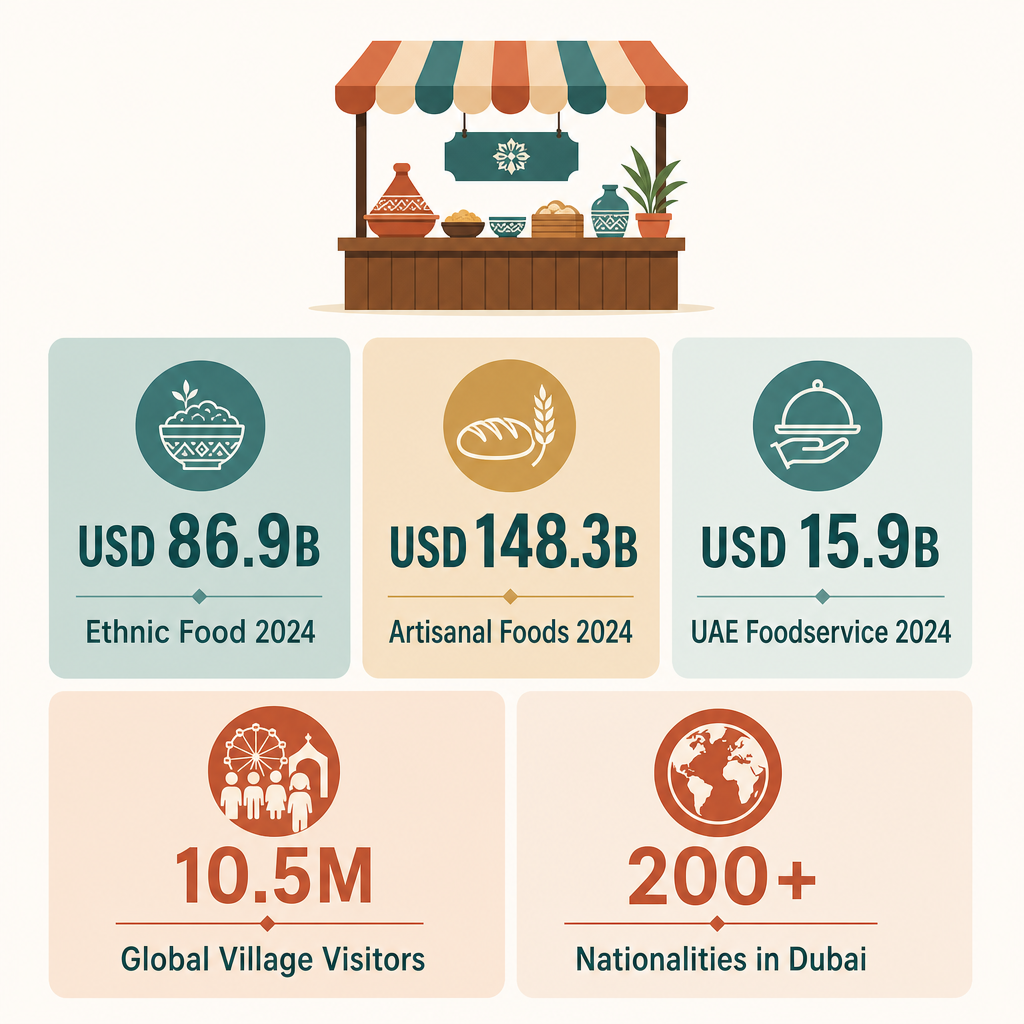
Key Stats at a Glance
What This License Covers
Activity code 4781.99 licenses you to sell traditional, ethnic, heritage, and culturally distinctive food products from a market stall or marketplace position, covering traditional Emirati foods, regional ethnic products, artisan items, spices, and festive foods.
The scope excludes retail sale of food in non-specialised stores where multiple product lines are sold under one roof, wholesale trading of food products to other businesses, and manufacturing or baking of food products on premises, each of which sits under a separate code.
If you sell traditional, ethnic, or heritage food products directly to customers from a stall or marketplace position, this is the code you need.
Who Your Clients Will Be
Your customer base spans three groups. Traditional and Emirati food traders sell heritage dishes and festive specialities to UAE residents seeking an authentic taste of home.
Ethnic and regional food sellers serve the UAE's large expatriate communities with familiar products from their home countries. Cultural food importers and curators source spices, sweets, and artisan goods for tourists and residents keen to try something new.
The UAE's Indian expatriate community alone runs to 3.5 million people, per the Ministry of External Affairs, and Dubai welcomes 18.72 million tourists a year, both groups drawn to the kind of authentic, culturally specific food a folk goods stall sells.
Global Village's 2024/25 season drew 10.5 million visitors across more than 250 food outlets representing over 90 nationalities, a clear sign of the scale a market-stall food business can reach when it taps into Dubai's cultural calendar and its packed events schedule.
Mainland or Free Zone
Mainland registration through DET suits a trader working directly through souks and licensed markets under standard commercial rules. Meydan Free Zone offers 100% foreign ownership, zero corporate tax on qualifying income, and a fully digital licensing process, giving a folk goods seller a fast route to setup, with no third-party pre-approval needed for this activity.
[blockCTACostCalculator]
Step-by-Step Setup Guide
- Step 1, book your trade name: Check availability through DET or your chosen free zone authority, confirming activity code 4781.99 is listed for your application.
- Step 2, prepare your setup documents: Passport copies of shareholders and directors, your intended product range, traditional Emirati, regional ethnic, or artisan goods, and a business plan summary.
- Step 3, get your initial approval and license: Meydan Free Zone's fully digital process moves quickly once your documents are complete.
- Step 4, secure your stall or marketplace position: A souk pitch, a Global Village outlet, or a spot at a seasonal market or festival is central to this activity, so line this up alongside your license application.
- Step 5, source your product range: Build relationships with producers and importers of the traditional, ethnic, or artisan goods you plan to sell.
- Step 6, register with MOHRE if you employ staff: This sets your visa quota and puts your team under Wage Protection System compliance from the outset.
Compliance and What You Need in Place
Third-party approval
No third-party approval is needed for this activity, which keeps your setup timeline focused on securing a stall position and building your product range rather than extra regulatory sign-off.
Anti-money laundering compliance
This activity is exempt from anti-money laundering compliance duties, keeping your ongoing regulatory load lighter than higher-risk trading categories.
Food safety and sourcing standards
Every food product you sell needs to meet UAE food safety rules, so check sourcing, labelling, and storage practices with each supplier before you commit to stock, particularly for perishable or festival-specific items with a short shelf life.
Ongoing renewals
Renew your license every year, keep your marketplace or stall agreements current, and keep your MOHRE registrations up to date if you employ staff. Building a good relationship with the venue or market operator who grants your stall position also matters here, since a strong track record often makes renewal and repositioning at popular events a lot simpler.
Market Opportunity
The global ethnic food market reached USD 86.90 billion in 2024 and is projected to grow to USD 153.21 billion by 2032 at a 7.43% CAGR, per Fortune Business Insights, while the global artisanal foods market, valued at USD 148.3 billion in 2024, is set to nearly double to USD 277.2 billion by 2033 at a 7.1% CAGR, per Growth Market Reports. Both trends point to steady, real demand for the kind of heritage and artisan products a folk goods seller trades in.
The UAE foodservice market, worth USD 15.90 billion in 2024 and projected to reach USD 41.80 billion by 2033 at an 11.45% CAGR, per Renub Research, gives a folk goods seller a fast-growing backdrop to sell into. Global Village alone draws 10.5 million visitors a season across more than 250 food outlets representing over 90 nationalities, and the UAE's 3.5 million-strong Indian expatriate community, alongside Dubai's 18.72 million annual tourists, gives a folk goods seller a large and culturally diverse customer base that does not depend on any single nationality or product category staying in fashion.
Conclusion
A Folk Goods Seller license under activity code 4781.99 is a workable business anchored in real, growing demand for traditional, ethnic, and artisan food products. Meydan Free Zone's foreign ownership, tax position, and digital setup process give a trader a practical route to sell heritage products to Dubai's diverse residents and its millions of annual visitors. A trader who builds a reputation for authentic, well-sourced products at a good stall position stands to see steady repeat custom across the busy events calendar year after year.
[blockCTAContact]