

Table of Contents
Topic Summary
Understand What Activity Code 4721.72 Covers
This license allows you to trade frozen fish and seafood to UAE retail channels, foodservice operators, and specialty buyers. It does not cover manufacturing, general food retail, or wholesale trading to other businesses, which each require separate codes.
Know the Market Size Before You Start
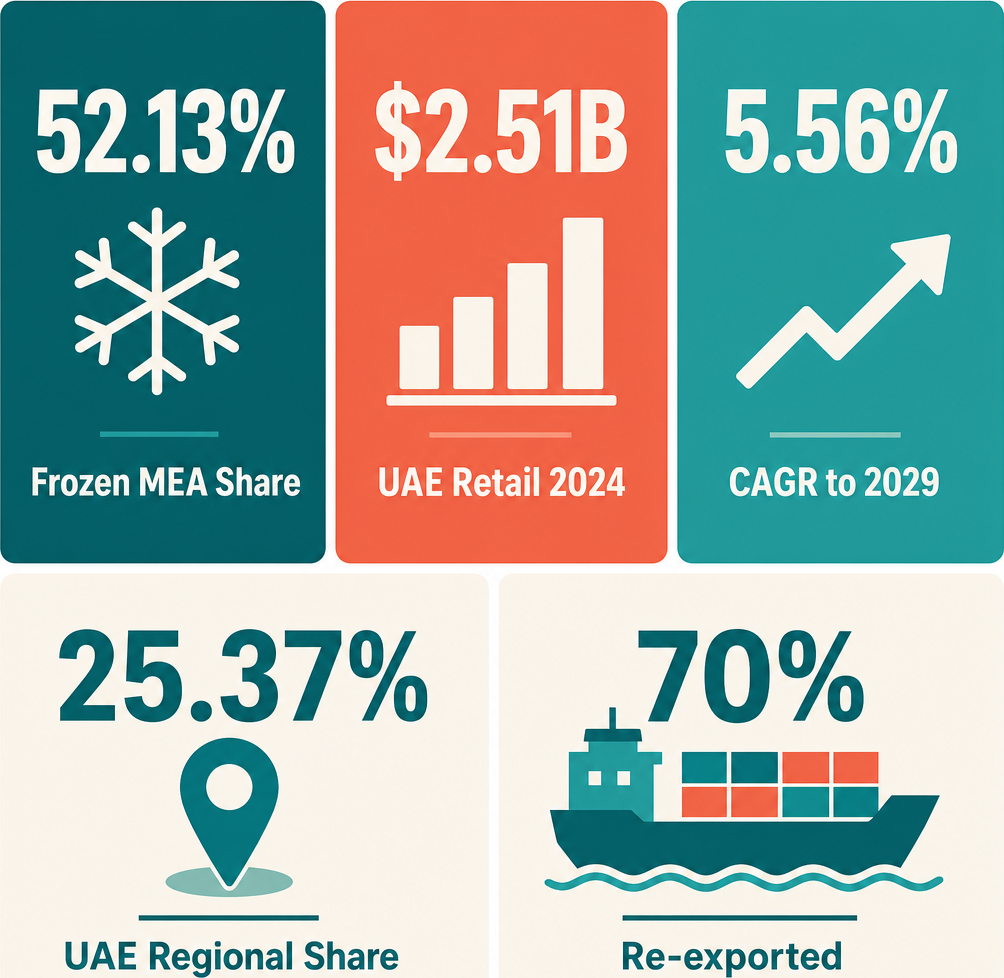
The Middle East seafood market is estimated at USD 22.54 billion in 2026, with frozen seafood holding a 52.13% share in 2025. The UAE alone accounts for 25.37% of Middle East seafood revenue, making it the largest single-country market in the region.
Identify Your Three Core Customer Groups
Frozen seafood traders typically serve supermarkets and specialty retailers, restaurants and hotel catering operations, or premium buyers seeking portioned and value-added products. Around 70% of UAE imported seafood is re-exported regionally, so your customer base can extend well beyond the domestic market.
Secure Ministry Approval Before Anything Else
Pre-establishment approval from the Ministry of Climate Change and Environment is required before your trading license can be issued, regardless of whether you register on the mainland or in a free zone. Treat this as your first step, not a parallel task, to avoid delays in your setup timeline.
Compare Mainland and Free Zone Registration Carefully
Mainland registration through DET gives you direct access to UAE retail and foodservice contracts under standard commercial rules. Meydan Free Zone offers 100% foreign ownership, zero corporate tax on qualifying income, and a fully digital licensing process, though MOCCAE approval is still required either way.
Prioritise Cold-Chain Infrastructure From Day One
Cold storage and logistics capability directly determines whether you can serve both domestic and regional export customers from a single operation. Building this infrastructure early gives you the flexibility to compete on reliability and cold-chain integrity rather than price alone.
Follow the Correct Step-by-Step Licensing Sequence
Begin by checking trade name availability and confirming activity code 4721.72 is listed for your application, then apply for MOCCAE approval before preparing shareholder and director documents. Following the correct sequence prevents your application from stalling at the approval stage.
How to Start a Frozen Fish and Seafood Trading Business in Dubai with Meydan Free Zone
Frozen fish and seafood solve a problem fresh product cannot: they let a UAE buyer stock a consistent, year-round supply whatever the season, catch volumes, or import disruption. A frozen fish and seafood trader sources product at scale and distributes it to retail channels, foodservice operators, and specialty buyers, competing on reliability, cold-chain integrity, and price rather than on same-day freshness.
This guide covers what activity code 4721.72 lets you do, who your clients will be, and how you set the business up in Dubai.
Key Stats at a Glance
| Activity code | 4721.72 |
|---|---|
| Middle East seafood market | Estimated at USD 22.54 billion in 2026, with frozen seafood at 52.13% share in 2025, per Mordor Intelligence |
| UAE market share | 25.37% of Middle East seafood revenue, the largest single-country share, per Mordor Intelligence |
| UAE fish and seafood retail | USD 2.51 billion in 2024, growing at 5.56% CAGR through 2029, per Statista |
| Third-party approval | Pre-establishment approval needed from the Ministry of Climate Change and Environment before your license is issued |
What This License Covers
Activity code 4721.72 licenses you to trade frozen fish and seafood to UAE retail channels, supply frozen fish and shrimp to foodservice operators, or trade specialty and value-added frozen seafood to premium customers.
The scope excludes manufacturing of bakery products, retail sale of food in non-specialised stores where multiple product lines are sold under one roof, and wholesale trading to other businesses, each of which sits under a separate code. If you trade frozen fish or seafood to UAE retail, foodservice, or specialty buyers, this is the code you need.
Who Your Clients Will Be
Your customer base splits into three groups. Retail-channel frozen seafood distributors supply supermarkets and specialty retailers with a consistent, year-round frozen fish and seafood range.
Foodservice frozen seafood suppliers provide frozen fish and shrimp to restaurants, hotels, and catering operators needing reliable stock whatever the season. Specialty and value-added frozen seafood traders supply premium, prepared, or portioned frozen seafood products to customers wanting convenience alongside quality.
Around 70% of UAE imported seafood is re-exported to neighbouring markets, per Mordor Intelligence, showing that a UAE-based frozen seafood trader can serve both the domestic market and a wider regional customer base from the same operation. Building strong cold storage and logistics capability from the outset gives a trader the flexibility to serve both channels without having to choose one over the other.
Mainland or Free Zone
| Factor | Mainland (DET) | Free Zone (Meydan Free Zone) |
|---|---|---|
| Direct retail and foodservice contracts | Direct, standard route | Workable via approved distribution structuring |
| Foreign ownership | 100% | 100% |
| Corporate tax | Standard rate applies | 0% on qualifying income |
| Setup process | Standard commercial registration plus MOCCAE approval | Fully digital licensing plus MOCCAE approval |
Mainland registration through DET suits a trader working directly with UAE retailers and foodservice operators under standard commercial rules. Meydan Free Zone offers 100% foreign ownership, zero corporate tax on qualifying income, and a fully digital licensing process, though Ministry of Climate Change and Environment approval is needed before your license can be issued whatever jurisdiction you choose, since frozen seafood trading is a regulated food safety category.
[blockCTACostCalculator]
Step-by-Step Setup Guide
- Step 1, book your trade name: Check availability through DET or your chosen free zone authority, confirming activity code 4721.72 is listed for your application.
- Step 2, apply for Ministry of Climate Change and Environment approval: This needs to happen before your license can be issued, so start this step first rather than treating it as a parallel task alongside other paperwork.
- Step 3, prepare your setup documents: Passport copies of shareholders and directors, your intended trading segment, retail, foodservice, or specialty and value-added, and a business plan summary.
- Step 4, get your license issued: Once Ministry of Climate Change and Environment approval is confirmed, your license moves through Meydan Free Zone's fully digital process or DET's standard registration.
- Step 5, secure your cold storage and logistics infrastructure: Frozen seafood trading depends on an unbroken cold chain from import or sourcing through to delivery, so plan your warehouse and transport around this from the outset.
- Step 6, register with MOHRE if you employ staff: This sets your visa quota and puts your team under Wage Protection System compliance from the outset.
Compliance and What You Need in Place
Third-party approval
Pre-establishment approval from the Ministry of Climate Change and Environment is needed before your license can be issued. This is the one step in this activity that runs before license issuance rather than after it.
Anti-money laundering compliance
This activity is exempt from anti-money laundering compliance duties, keeping your ongoing regulatory load lighter than higher-risk trading categories.
Cold storage and product standards
Frozen fish and seafood need to stay within strict temperature standards from import or sourcing through to delivery, so build tested cold storage and handling protocols into your operation rather than discovering a gap after a shipment fails a quality check. Keeping a clear record of temperature logs for every batch also makes it a lot simpler to satisfy retail and foodservice buyers who audit their suppliers before signing a contract.
Ongoing renewals
Renew your license every year, keep your Ministry of Climate Change and Environment approval current, and keep your MOHRE registrations up to date if you employ staff.
Market Opportunity
The Middle East seafood market is estimated at USD 22.54 billion in 2026, with frozen seafood holding a 52.13% share in 2025, per Mordor Intelligence, and the UAE capturing 25.37% of Middle East seafood revenue, the largest single-country share in the region. UAE fish and seafood retail was worth USD 2.51 billion in 2024 and is growing at a 5.56% CAGR through 2029, per Statista, giving a frozen seafood trader a large and expanding domestic retail base to sell into.
The UAE's role as a re-export hub adds a second layer of opportunity on top of domestic retail and foodservice demand: around 70% of UAE imported seafood is re-exported to neighbouring markets, per Mordor Intelligence, meaning a well-set-up frozen seafood trader can build a business that serves both UAE buyers and a wider regional customer base from a single Dubai operation.
Conclusion
A Frozen Fish and Seafood Trading license under activity code 4721.72 is a workable business anchored in the region's largest single-country seafood market. Meydan Free Zone's foreign ownership, tax position, and digital setup process give a trader a practical route to serve UAE retail, foodservice, and re-export demand, once Ministry of Climate Change and Environment approval is secured before your license is issued.
A trader with reliable cold storage and consistent product standards in place stands to build the kind of repeat retail and foodservice contracts that keep this activity workable well beyond a first year of trading.
[blockCTAContact]
Compliance
THIRD-PARTY APPROVAL
This activity requires pre-approval from the Ministry of Climate Change and Environment (MoCCAE) / Dubai Municipality (DM) / The Dubai Maritime Authority (DMA) before a business license can be issued by Meydan Free Zone.
ANTI-MONEY LAUNDERING COMPLIANCE
This business activity is exempt from AML compliance requirements.