Table of Contents
Topic Summary
Understand What Activity Code 4730.95 Covers
This license permits licensed mobile fuel delivery and vehicle refuelling for consumer, fleet, and industrial clients across the UAE. It covers on-demand consumer delivery, scheduled corporate fleet refuelling, and construction or industrial site refuelling, including marina applications.
Secure RTA Approval Before Your Trade License
Pre-establishment approval from the Roads and Transport Authority must be obtained before your trade license is issued, making it the first step in your timeline. Skipping or delaying this approval will hold up the entire licensing process.
Know Which Services Fall Outside This License
Wholesale of fuels, retail fuel sales where food and beverages dominate, and retail sale of LPG for cooking or heating are all excluded from code 4730.95. Operating in those areas requires separate activity codes and licenses.
Target Three Distinct Client Segments Strategically
Consumers pay for convenience and time savings, corporate fleets pay for measurable operational efficiency, and industrial clients pay for on-site availability that keeps equipment running. Each segment requires a different pricing model and sales approach.
Meet ESMA and Dubai Municipality Equipment Standards
Delivery trucks must comply with ESMA and MOIAT safety and metering standards, with meters verified by Dubai Municipality. Fuel products must also be tested regularly by certified laboratories against Emirates Authority for Standardisation and Metrology standards.
Choose Between Mainland and Free Zone Carefully
A mainland DET license allows you to serve UAE consumers, fleets, and industrial clients directly, which suits the physical nature of fuel truck operations on public roads. A Meydan Free Zone license offers 100% foreign ownership and zero corporate tax on qualifying income, making it better suited to a platform, holding, or coordination structure.
Enter a Market With Strong and Growing Demand
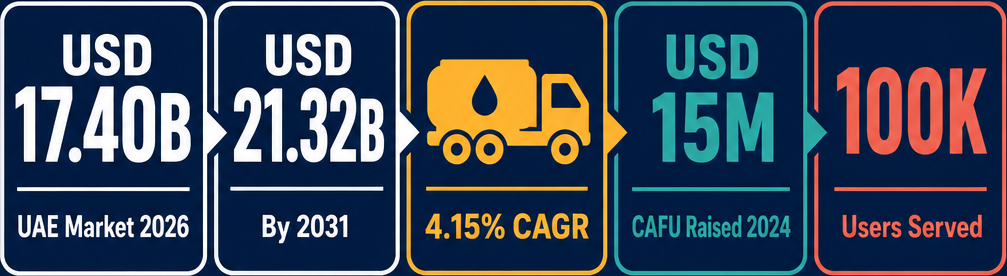
The UAE fuel station market is valued at USD 17.40 billion in 2026 and is projected to reach USD 21.32 billion by 2031 at a 4.15% CAGR. Sector player CAFU raised USD 15 million in 2024 and had served 100,000 users by late 2025, validating real consumer appetite for mobile refuelling.
How to Start a Fuel Delivery and Vehicle Refueling Services Business in Dubai with Meydan Free Zone
Since 2018, a share of UAE drivers have stopped going to the petrol station. A truck comes to the residential car park, the office basement or the fleet yard instead. Activity code 4730.95 is the license for running that service.
This guide covers what the license allows, who books you, the approvals you need, and the steps to get set up. RTA pre-establishment approval comes before your trade license, so plan the timeline around that.
Key Stats at a Glance
What This License Covers
Code 4730.95 covers licensed fuel delivery and vehicle refuelling services to UAE consumers, fleets and industrial clients.
Three service segments sit inside it. On-demand consumer delivery brings petrol or diesel to cars in residential car parks, office building basements and highway breakdowns, usually booked through a mobile app. Corporate fleet refuelling fills vehicles on a schedule at company premises, logistics yards and transport depots.
Construction and industrial refuelling serves heavy equipment, generators and specialised applications on site, with marina refuelling for recreational craft at selected locations.
Three things sit outside the code. Wholesale of fuels falls under wholesale of solid, liquid and gaseous fuels. Retail sale of fuel combined with food and beverages where the food side dominates falls under retail in non-specialised stores. And retail sale of liquefied petroleum gas for cooking or heating sits under hardware, paints and glass retail.
Who Your Clients Will Be
Consumers, corporate fleets and industrial operators, and they buy for quite different reasons.
Consumers buy time. Somebody who never has to detour to a station is paying for the hour they get back, which makes the service a convenience purchase rather than a fuel purchase. That shapes how you price it and how you market it.
Corporate fleets buy efficiency. A logistics operator whose vehicles refuel at their own yard overnight is removing dead mileage, driver hours and queueing from the operation, and that saving is measurable on a spreadsheet. These clients contract on service-level agreements and want consumption reporting, which makes them the steadiest revenue in the business. Construction and industrial clients buy availability, because equipment that runs dry on site stops the job.
Mainland or Free Zone
This is a physical operation with fuel trucks on public roads and in private car parks, so the operating entity generally sits on the mainland. A license from the Department of Economy and Tourism lets you serve consumers, fleets and industrial clients directly.
Meydan Free Zone gives you full foreign ownership, zero corporate tax on qualifying income and a digital process, which suits the technology platform or a holding structure sitting above the delivery operation. That split matters more here than in most activities, because a large part of the value in on-demand refuelling is the app rather than the truck.
Neither route changes the approval question. RTA pre-establishment approval applies before the trade license is issued, and no jurisdiction avoids it.
[blockCTACostCalculator]
Step by Step Setup Guide
- Step 1, start the RTA pre-approval: This comes before the trade license, so treat it as the item everything else waits on.
- Step 2, define your service segments: Consumer on-demand, corporate fleet, or construction and industrial. Each has a different fleet profile, pricing model and client.
- Step 3, choose your jurisdiction: Mainland through DET for the operating entity, or Meydan Free Zone for a platform or holding structure.
- Step 4, book your trade name: Check availability through the DET portal or the Meydan Free Zone portal, following UAE naming conventions.
- Step 5, specify and source your trucks: Purpose-built delivery vehicles must meet ESMA and MOIAT safety and metering standards. Get the specification right before you order.
- Step 6, arrange meter verification and fuel supply: Meters are checked and verified by Dubai Municipality, and you need a fuel supply relationship before you can serve anybody.
- Step 7, recruit and train your pilots, then collect your license: Delivery staff need specialised training and safety certifications. Register for VAT with the Federal Tax Authority once taxable turnover passes AED 375,000.
Compliance and What You Need in Place
RTA pre-establishment approval
The gating item for this activity. Approval from the Roads and Transport Authority applies before the trade license is issued, and there is no structure that gets round it.
Equipment and metering
Delivery trucks must meet ESMA and MOIAT safety and metering standards, and meters are checked and verified by Dubai Municipality. Metering matters commercially as much as legally, because a customer disputing how much fuel they received is an argument you can only win with verified equipment.
Fuel testing
Products must be tested regularly by certified laboratories against Emirates Authority for Standardisation and Metrology standards. A fuel quality failure in somebody's engine is a reputational event, not just a compliance one.
Pilot training
Staff delivering fuel need specialised training and safety certifications. They are handling a flammable product in enclosed residential car parks and office basements, which is a materially different risk environment from a forecourt.
Digital platform
App-based booking and tracking is the operating system of consumer on-demand refuelling rather than a nice extra. Corporate clients increasingly want consumption reporting through the same channel.
Fuel supply relationships
You need a supply agreement before you have a business. That relationship also determines your margin, since you are reselling a commodity with a published pump price.
Market Opportunity
The category is validated rather than speculative. CAFU raised USD 15 million in 2024 and had serviced 100,000 users by late 2025, operating across Dubai, Sharjah, Ajman and Umm Al Quwain. That is proof the consumer proposition works here.
The wider market gives it room. The UAE fuel station market is projected at USD 17.40 billion in 2026 growing to USD 21.32 billion by 2031 at 4.15% CAGR, with mobile refuelling recognised as a growing complement to traditional stations rather than a replacement for them.
The B2B side is where a new entrant can compete most readily. Consumer on-demand is capital-intensive and already has scale players, but corporate fleet refuelling, construction site supply and industrial on-site service are contract businesses won on reliability and reporting rather than on brand recognition. Established operators run trucks with petrol flow around 24 litres a minute and diesel up to 70, which gives a sense of the throughput you need to match.
Conclusion
Fuel delivery and vehicle refuelling under code 4730.95 sits in a segment the UAE market has already proven, with policy and regulation set up to support licensed operators.
The barrier is regulatory and real. RTA pre-establishment approval, ESMA and MOIAT equipment standards, Dubai Municipality meter verification, certified fuel testing and trained pilots all have to be in place before you serve a first customer.
That barrier is also the protection, because it keeps the licensed field narrow. Decide early whether you are building a consumer app business or a B2B contract operation, since they need different capital, different fleets and different people. Speak to the Meydan Free Zone team to confirm the right structure and work through the approval sequence.
[blockCTAContact]