

Table of Contents
Topic Summary
Understand What Activity Code 4661.99 Covers
This license lets you distribute refined petroleum fuels — including diesel, gasoline, and heavy fuel oil — from terminals or refineries directly to end users. It excludes crude oil, coal-based products, and standalone LPG wholesale, which fall under separate classifications.
Know Your Most Profitable Customer Segments
Construction contractors, logistics fleets, marine vessels, and data centre operators are your core clients, with transport and logistics fleets growing at 7.1% CAGR through 2031. Critical infrastructure buyers like data centres prioritize guaranteed availability, making them ideal long-term contract customers.
Decide Between Mainland and Free Zone Setup
A mainland DET license is the practical choice if you plan to deliver directly to sites across the UAE, while Meydan Free Zone offers 100% foreign ownership and zero corporate tax on qualifying income. Many operators use a free zone entity for ownership and coordination while routing onshore deliveries through a mainland structure.
Factor In the UAE's Fixed Pricing Framework
Fuel prices are set monthly by the UAE Fuel Price Committee under the Ministry of Energy and Infrastructure, meaning you cannot compete on price alone. Your competitive edge comes from reliability, logistics efficiency, and the strength of your customer relationships.
Recognize the Market's Scale and Concentration
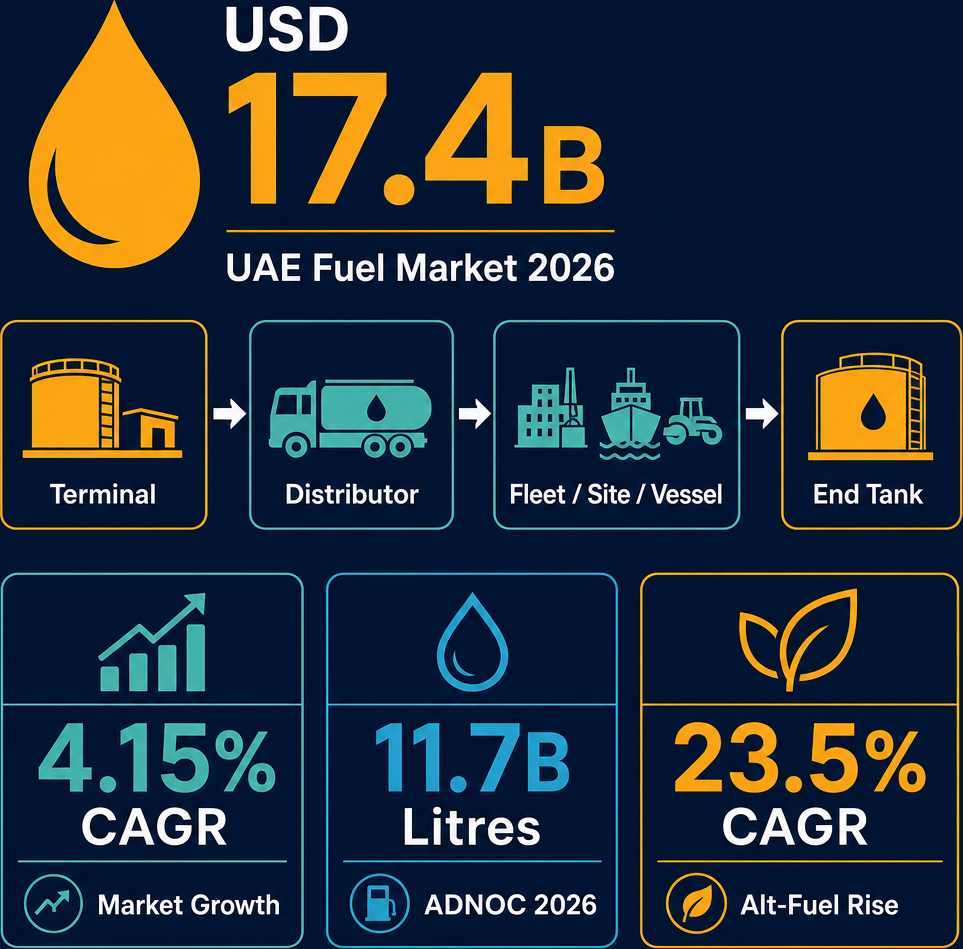
The UAE fuel station market is valued at USD 17.40 billion in 2026 and is projected to reach USD 21.32 billion by 2031, but the top three operators already control around 85% of retail volumes. Targeting underserved industrial and marine niches gives new entrants a more realistic path to market share.
Plan for Emerging Energy Categories Early
Multi-energy hubs, hydrogen stations, and EV charging infrastructure are growing at 23.5% CAGR and fall within the specialty distribution segment covered by this license. Building relationships in these categories now positions your business ahead of the transition away from conventional fuels.
Leverage Meydan Free Zone's Digital Setup Process
Meydan Free Zone offers a fully digital licensing process with 100% foreign ownership and no corporate tax on qualifying income, making it one of the more accessible entry points for international investors. Pairing this with the right mainland distribution arrangement gives you both ownership control and operational reach across the UAE.
How to Start a Fuel Distribution Business in Dubai with Meydan Free Zone
Every morning, tanker trucks leave UAE terminals for construction sites, logistics yards, marine anchorages and data centres. None of those customers drives to a forecourt. The fuel goes to them. Activity code 4661.99 is the license for moving it.
This guide covers what the license allows, who buys from you, how mainland and free zone compare, and the steps to get set up. No third-party approval applies to the license itself, though one feature of this market shapes everything about how you compete.
Key Stats at a Glance
What This License Covers
Code 4661.99 lets you distribute refined petroleum fuels across the UAE. Your role is to source refined product from refiners, terminals or upstream suppliers and move it to the end user, managing transport, storage where needed, delivery logistics and the commercial relationship.
Three segments sit inside it. Commercial and industrial distribution moves diesel, gasoline and heavy fuel oil to construction sites, logistics fleets, industrial plants and back-up power. Marine bunkering and aviation supply covers bunker fuel to vessels and jet fuel to aviation operators. Specialty distribution covers lubricants, LPG and emerging categories including hydrogen and EV charging.
Three things sit outside. Wholesale of crude petroleum and crude oil is excluded. So is wholesale of charcoal, coal, coke, fuel wood and naphtha. And wholesale of liquefied petroleum gases, butane and propane sits under its own sub-class of the fuels wholesale group.
Who Your Clients Will Be
Construction contractors, logistics fleets, industrial plants, marine vessels, aviation operators and critical infrastructure sites.
Construction and logistics are the volume base and the fastest-growing part of the market. A concrete pour needs diesel at the generators and a logistics fleet needs bulk diesel staged before the dawn shift, and neither can wait. These fleets are growing at 7.1% CAGR through 2031, faster than any other end-user segment.
Marine bunkering at Fujairah and Jebel Ali is a distinct business with its own logistics and port authority relationships, and aviation fuel supply works the same way through airside handlers. Critical infrastructure, including data centre back-up power, buys on standing contracts and values guaranteed availability above almost anything else.
Mainland or Free Zone
A mainland license from the Department of Economy and Tourism is the practical route for the delivery operation, since you are moving product to sites and depots across the emirates.
Meydan Free Zone gives you full foreign ownership, zero corporate tax on qualifying income and a digital process. It suits a trading, import or coordination structure, particularly one whose supply relationships matter more than onshore delivery at the outset.
One warning worth taking seriously. Although code 4661.99 needs no third-party approval, closely related fuel activities do. Diesel fuel transport carries SCOE and RTA pre-approval, and vehicle refuelling services carry RTA pre-approval. If your model involves tankers on public roads, confirm in writing which conditions apply before you buy a vehicle.
[blockCTACostCalculator]
Step by Step Setup Guide
- Step 1, define your segment precisely: Commercial and industrial, marine and aviation, or specialty and alternative energy. Each has different logistics, different clients and a different regulatory footprint.
- Step 2, confirm the transport approvals question: The license needs no third-party approval, but running tankers may bring SCOE or RTA conditions. Get this confirmed in writing before committing to fleet.
- Step 3, choose your jurisdiction: Mainland through DET for the delivery operation, or Meydan Free Zone for a trading or coordination structure.
- Step 4, book your trade name: Check availability through the DET portal or the Meydan Free Zone portal, following UAE naming conventions.
- Step 5, secure terminal access and supply: Without a supply relationship and somewhere to load, you have no business. This is the hardest commercial step, not the license.
- Step 6, build fleet and storage: Tanker capacity and any storage you hold carry safety conditions and real capital cost.
- Step 7, collect your license, open a bank account and register for VAT: Bulk fuel attracts extra bank scrutiny. Register with the Federal Tax Authority once taxable turnover passes AED 375,000.
Compliance and What You Need in Place
No third-party approval on the license
Code 4661.99 needs no third-party approval and is exempt from AML duties. That applies to the license, not to everything a fuel business might do, so read it narrowly rather than broadly.
Adjacent activity approvals
Related fuel codes carry pre-establishment approvals from the Supreme Council of Energy and the Roads and Transport Authority. If your operation includes tanker transport or vehicle refuelling, those conditions may reach you even though your primary code does not name them. Confirm your position rather than inferring it.
Terminal access and supply
The trade runs on relationships with refiners, terminals and upstream suppliers. Without one you cannot load, and without loading you cannot deliver.
Credit terms
Fuel distribution is a working capital business. You buy a commodity and sell it on terms, and commercial clients expect credit. Arrange financing before your first large contract.
Storage and handling
Any storage you hold carries safety conditions and capital cost. Model both before committing to a segment that needs it.
VAT
Register with the Federal Tax Authority once taxable turnover passes AED 375,000. Fuel volumes cross that line immediately.
Market Opportunity
The single most important feature of this market is that you cannot compete on price. UAE fuel prices are set monthly by the Fuel Price Committee under the Ministry of Energy and Infrastructure, standardised across the emirates. Distributors compete on service, delivery reliability, credit terms and customer relationships instead.
That changes where a new entrant can win. The top three operators control around 85% of retail volumes, so head-on retail competition is not viable. Commercial, industrial, marine and specialty segments are the realistic entry points, and they are also where the growth sits.
The wider market gives room for both. The UAE fuel station market reached USD 17.40 billion in 2026 and is forecast at USD 21.32 billion by 2031 at 4.15% CAGR, and that excludes the larger commercial layer feeding fleets, industrial sites, bunkering and back-up power. Alongside it, multi-energy hubs, hydrogen and EV charging are growing at 23.5% CAGR, giving a conventional distributor a second category to move into rather than a threat to defend against.
Conclusion
Fuel distribution under code 4661.99 sits behind demand that construction, logistics, shipping and industry generate continuously, in a market where the commercial layer is larger than the retail one.
The licensing is simple on its face. No third-party approval on this code, no AML duties, and a digital process through Meydan Free Zone with full foreign ownership. What deserves checking is whether your model pulls in the transport approvals attached to neighbouring fuel codes.
The commercial reality is what decides the business. Regulated pricing means you win on service, reliability, credit and relationships, and the realistic openings are in commercial, industrial, marine and specialty supply rather than retail. Speak to the Meydan Free Zone team to confirm the right structure and clarify which approvals reach your model.
[blockCTAContact]