

Table of Contents
Topic Summary
Understand What Activity Code 4711.00 Covers
This license lets you operate non-specialised retail stores where food, beverages, or tobacco are the predominant product lines, from hypermarkets to corner convenience stores. It excludes fuel-dominant retail operations, which fall under a separate automotive fuel category.
Know the UAE Grocery Market Opportunity
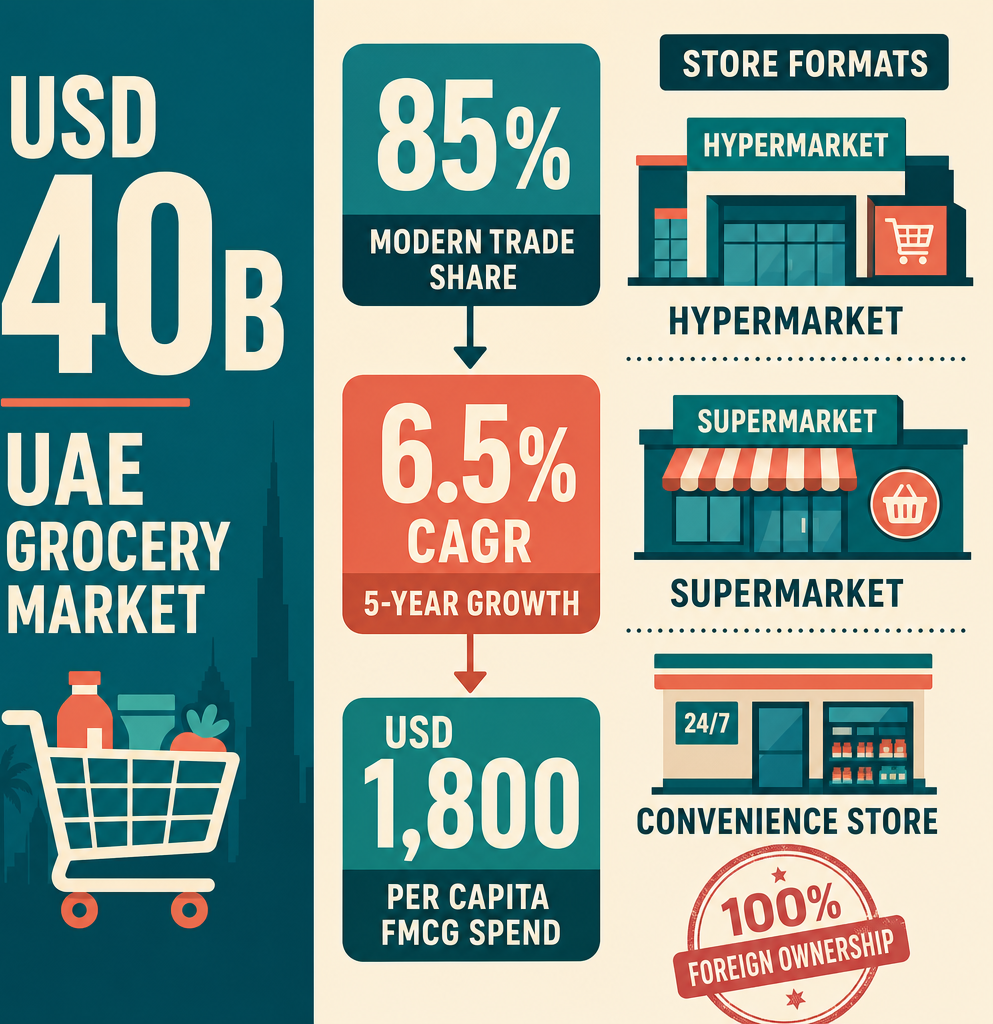
The UAE grocery retail market is worth around USD 40 billion and is projected to grow at a 6.5% CAGR over the next five years. UAE shoppers spend USD 1,600 to USD 1,800 per capita on FMCG goods annually, well above the regional average, giving well-run stores strong revenue potential per customer.
Identify Your Target Customer Segments
Your potential clients include hypermarket operators, supermarket chain operators across residential districts, and convenience store owners serving neighbourhood daily shopping needs. Hypermarkets and supermarkets alone account for 85% of total UAE grocery sector spending.
Choose Between Mainland and Free Zone Setup
Mainland registration through DET is the standard route for direct store operations, while Meydan Free Zone offers 100% foreign ownership, zero corporate tax on qualifying income, and a fully digital licensing process. No third-party pre-approval is required for activity code 4711.00, keeping your timeline straightforward.
Follow the Four Core Setup Steps
Start by reserving your trade name and confirming activity code 4711.00 is listed, then prepare passport copies, a business plan, and your intended store format details. After receiving initial approval through Meydan Free Zone's digital process, secure retail premises suited to your chosen store format.
Leverage Meydan Free Zone's Digital Advantage
Meydan Free Zone's fully digital licensing process speeds up setup once your documents are complete, removing the delays common in traditional registration routes. Combined with zero corporate tax on qualifying income and 100% foreign ownership, it is a competitive option for international retail operators entering Dubai.
How to Start a Retail Sale in Non-Specialized Stores With Food and Beverages Business in Dubai with Meydan Free Zone
A hypermarket anchoring a Dubai mall, a supermarket chain serving residential communities, and a corner convenience store stocking a neighbourhood's daily essentials all sell the same broad thing: food and beverages as the main product line, alongside household and general merchandise under one roof. This activity licenses that non-specialised, food-predominant retail format at any scale.
This guide covers what activity code 4711.00 lets you do, who your clients will be, and how you set the business up in Dubai.
Key Stats at a Glance
What This License Covers
Activity code 4711.00 licenses you to operate retail sale in non-specialised stores where food products, beverages, or tobacco are the predominant lines, whether that means running a hypermarket serving a UAE mall catchment, operating a supermarket chain across residential communities, or managing a convenience store serving a UAE neighbourhood.
The scope excludes retail sale of fuel combined with food and beverages where fuel sales dominate, which sits under retail sale of automotive fuel. If you run a food-predominant retail store selling a broad general merchandise range alongside it, this is the code you need.
Who Your Clients Will Be
Your customer base spans three groups. Hypermarket and large-format food retailers operate UAE hypermarkets combining grocery, fresh food, household, and general merchandise under one large-format roof.
Supermarket chain operators run stores across UAE residential districts with a food-predominant product mix. Convenience and community grocery operators manage smaller formats and neighbourhood-focused stores where food and beverages predominate, often serving as the closest, most convenient option for a resident's daily top-up shopping.
Hypermarkets and supermarkets already account for 85% of total UAE grocery sector spending, per Majid Al Futtaim, and the UAE's per capita FMCG spend of USD 1,600 to USD 1,800 in 2026 sits well above Saudi Arabia's USD 900 to USD 1,100, per Bagason, showing UAE shoppers spend more per person on everyday goods than most of their regional neighbours, a gap that gives a well-run store real room to grow revenue per customer rather than relying purely on footfall growth.
Mainland or Free Zone
Mainland registration through DET suits an operator running a store directly under standard commercial rules. Meydan Free Zone offers 100% foreign ownership, zero corporate tax on qualifying income, and a fully digital licensing process, and no third-party pre-approval is needed for this activity, which keeps your setup timeline simple.
[blockCTACostCalculator]
Step-by-Step Setup Guide
- Step 1, book your trade name: Check availability through DET or your chosen free zone authority, confirming activity code 4711.00 is listed for your application.
- Step 2, prepare your setup documents: Passport copies of shareholders and directors, your intended store format, hypermarket, supermarket, or convenience store, and a business plan summary.
- Step 3, get your initial approval and license: Meydan Free Zone's fully digital process moves quickly once your documents are complete.
- Step 4, secure your retail premises: A location suited to your chosen format, from a large hypermarket footprint to a small neighbourhood convenience store, is central to this activity, with footfall and catchment population shaping which format works best where.
- Step 5, build your supplier and distribution relationships: Line up agreements with food, beverage, and general merchandise suppliers to build a full retail range, and confirm delivery schedules that match your expected footfall.
- Step 6, register with MOHRE if you employ staff: This sets your visa quota and puts your team under Wage Protection System compliance from the outset.
Compliance and What You Need in Place
Third-party approval
No third-party approval is needed for this activity, which keeps your setup timeline focused on premises and supplier readiness rather than extra regulatory sign-off.
Anti-money laundering compliance
This activity is exempt from anti-money laundering compliance duties, keeping your ongoing regulatory load lighter than higher-risk trading categories.
Food safety and retail standards
Every food and beverage product you sell needs to meet UAE food safety rules, so build checks on sourcing, storage, and shelf life into your daily operations rather than treating food safety as a one-off setup task.
Regular stock rotation checks also matter here, since a food-predominant store carries a much wider range of perishable items than a general merchandise retailer.
Ongoing renewals
Renew your license every year, keep your supplier agreements current, and keep your MOHRE registrations up to date if you employ staff. Review your product range and pricing against local competition regularly too, since this is a high-turnover, high-visibility retail category.
Market Opportunity
The UAE grocery retail market is worth around USD 40 billion and is expected to grow at a 6.5% CAGR over the next five years, per Oliver Wyman via Khaleej Times, a large and steadily expanding base for any non-specialised, food-predominant retailer.
Hypermarkets and supermarkets already capture 85% of total UAE grocery sector spending, per Majid Al Futtaim, showing where the bulk of consumer spending concentrates within this format.
The UAE's per capita FMCG spend of USD 1,600 to USD 1,800 in 2026, well above Saudi Arabia's USD 900 to USD 1,100, per Bagason, points to a UAE shopper base with real spending power behind everyday grocery purchases.
A retailer who builds a strong, well-located store, whether a large hypermarket or a neighbourhood convenience format, is well placed to capture a share of that steady, high-spending demand, particularly where a catchment area is underserved by existing large-format stores.
Conclusion
A Retail Sale in Non-Specialised Stores license under activity code 4711.00 is a workable business anchored in a large, high-spending UAE grocery retail market. Meydan Free Zone's foreign ownership, tax position, and digital setup process give a retailer a practical route to serve UAE residents across hypermarket, supermarket, and convenience formats.
A retailer who builds strong supplier relationships and a reliable food safety record from day one stands to build the kind of repeat, everyday custom that keeps this activity workable for years.
[blockCTAContact]