
Table of Contents
Topic Summary
Understand What Activity Code 4722.98 Covers
This license permits trading in juice and juice-based products, including long-life ambient cartons, fresh-pressed, cold-pressed, functional, and organic lines. Knowing the exact scope prevents costly mismatches between your invoices and your license.
Watch the Exclusions Before You Trade
Retail in non-specialised stores, on-premises beverage service, and wholesale supply to other businesses all fall outside this code. If your model involves supplying supermarkets or hotels in bulk, confirm the correct wholesale license category in writing before committing.
Tap Into a Fast-Growing UAE Market
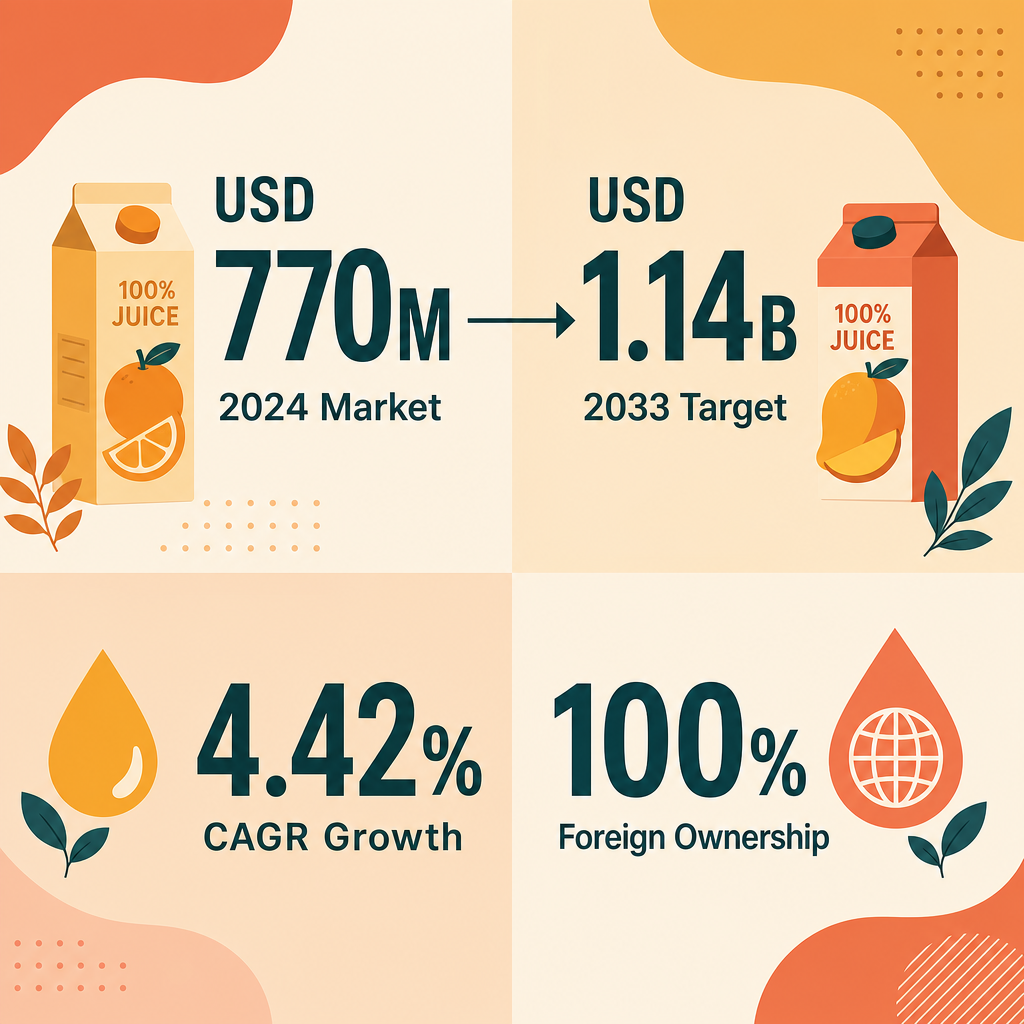
The UAE fruit juice market was valued at USD 770.1 million in 2024 and is projected to reach USD 1,136.2 million by 2033 at a 4.42% CAGR. Health consciousness, organic demand, and functional beverage adoption are the primary growth drivers.
Know Your Key Customer Segments
Supermarkets and hypermarkets buy long-life ambient cartons on repeat orders, while hotels and institutional caterers prioritise fresh and premium lines with reliable cold-chain delivery. Health-focused retailers and fitness clients represent the fastest-moving segment, driven by cold-pressed and functional products.
Choose Between Mainland and Free Zone Setup
A Meydan Free Zone license offers 100% foreign ownership, zero corporate tax on qualifying income, and a strong position for import and re-export operations. Selling directly into UAE retail or foodservice, however, typically requires working through a mainland distributor or agent.
Confirm Food Handling Approvals Separately
Registering with Meydan Free Zone does not replace the food handling approvals required for storing and handling juice products. Obtain these approvals independently to stay compliant whether you operate on the mainland or within the free zone.
Verify AML Status and Third-Party Requirements
Juice trading under this activity code is exempt from AML compliance obligations, which simplifies setup. No third-party approvals are listed on the source documentation, but confirming this position in writing with the licensing authority before you begin trading is strongly advised.
How to Start a Juice Trading Business in Dubai with Meydan Free Zone
Juice sits in almost every part of the UAE food chain. Fresh orange and apple on hotel breakfast buffets, mango and tropical blends in multicultural households, pomegranate on premium shelves, cold-pressed packs for fitness buyers, and long-life cartons in every weekly shop. Activity code 4722.98 is the license for trading it.
This guide covers what the license allows, who buys from you, the approval position and the steps to get set up. Read the boundary section closely. Juice is a food product, and the scope of this code is narrower than the trade it is often used to describe.
Key Stats at a Glance
What This License Covers
Code 4722.98 covers trading in juice and juice-based products. In practice that spans long-life ambient cartons, fresh-pressed and cold-pressed lines, and the functional and organic tier fortified with vitamins, probiotics or superfood ingredients.
The exclusions are where this code needs care. Three things sit outside it. Retail of beverages in non-specialised stores, where many product lines are sold under one roof, is a different class. So is retail of beverages for drinking on the premises, which falls under food and beverage service. And so is wholesale trading to other businesses.
That third exclusion is the one to check against your own plan. If your model is buying in volume and supplying supermarkets, hotels and catering companies, that is business-to-business supply, and the exclusion points to a wholesale class rather than this one.
Take your intended customer list to the licensing authority and confirm the right code in writing before you commit. Getting this wrong is not a technicality: it shows up when a customer, a bank or an inspector compares your invoices against your license.
Who Your Clients Will Be
Retail buyers
Supermarkets, hypermarkets and convenience networks take long-life ambient cartons on repeating orders. Shelf life is generous, logistics are simple, and the competition is on price and brand availability rather than service.
Hospitality and foodservice
Hotels, restaurants and institutional catering, including schools, buy fresh and premium lines for breakfast service and beverage menus. Cold chain matters here, shelf life is short and reliability is worth more to the buyer than a small discount.
Health and wellness buyers
Premium retailers, health-focused stores and fitness clients take cold-pressed, functional and organic lines. This is the fastest-moving segment and the one where product claims carry the most weight, so labelling accuracy becomes a commercial issue as well as a compliance one.
Mainland or Free Zone
A mainland license from the Department of Economy and Tourism is the route for selling into the UAE market directly, and it is the structure most juice traders end up with because the customers are here.
Meydan Free Zone gives you 100% foreign ownership and a lower cost base, and it suits an import, hold and re-export operation or an entity holding brand agreements while a local partner handles delivery into stores.
Storage is the practical divider, not the jurisdiction. Ambient cartons need clean dry warehousing. Fresh and cold-pressed lines need temperature-controlled storage and a delivery chain that keeps them cold from the door to the shelf. Decide the product mix first, because it sets the cost base.
[blockCTACostCalculator]
Step-by-Step Guide
- Step 1, confirm your model against the code: Specialised juice retail sits here. Supply to other businesses at wholesale points elsewhere. Settle this with the licensing authority first.
- Step 2, check the food approval position in writing: Do not rely on a summary. Ask the licensing authority and the municipality what is needed for your products and premises.
- Step 3, choose your jurisdiction: Mainland through DET for direct local trade, or Meydan Free Zone for import, holding and re-export.
- Step 4, book your trade name: Check availability through the DET or Meydan Free Zone portal, following UAE naming conventions.
- Step 5, sort storage and cold chain: Ambient warehousing for long-life stock, temperature-controlled space and vehicles for fresh and cold-pressed lines.
- Step 6, agree your brand portfolio: Distribution agreements with the juice brands you plan to carry. This decides your shelf position more than anything else you do.
- Step 7, get your labelling right: Arabic labelling, ingredient and nutrition declarations, shelf life and any health or organic claims must match the product.
- Step 8, collect your license, open a bank account and register for VAT: Register with the Federal Tax Authority once turnover passes AED 375,000.
Compliance and What You Need in Place
Food approvals: confirm, do not assume
The source page states that no third-party approval is needed for this activity. Treat that with caution. Juice is a food product, and food storage, handling, labelling and import in Dubai are regulated whatever a summary page says. Confirm the position in writing with the licensing authority and Dubai Municipality before you trade, and keep the confirmation on file. Silence or a blanket "none needed" is not permission.
Cold chain and shelf life
Fresh and cold-pressed juice has a short life and fails visibly when the chain breaks. Temperature-controlled storage, monitored transport and stock rotation are the working conditions of the business, not refinements.
Labelling and product claims
Functional and organic lines carry claims about vitamins, probiotics and sourcing. Those claims have to be accurate and properly declared, and they are checked. This is the most common source of trouble in the premium tier.
AML and VAT
This activity is exempt from AML duties. Register with the Federal Tax Authority once turnover passes AED 375,000.
Market Opportunity
The market is mid-sized and growing steadily rather than dramatically. UAE fruit juice reached USD 770.1 million in 2024 and is expected to reach USD 1,136.2 million by 2033 at 4.42% CAGR. That is a dependable rise built on population and habit rather than a boom.
What moves inside the total is more interesting than the total. Growth is coming from health consciousness, demand for natural and organic products, functional adoption with probiotics and fortification, and new flavour blends across fruit, vegetable and superfood combinations. Rising disposable incomes sit behind all of it.
The UAE's mix of residents is the structural advantage. Different communities buy different fruit, hotels and restaurants carry a large premium segment, and schools and institutional catering add steady volume. A trader who covers two or three channels smooths out the seasonality that hits any single one.
Conclusion
Juice trading under code 4722.98 sits in a market heading from USD 770.1 million to USD 1,136.2 million by 2033, with the fastest growth in the functional, organic and cold-pressed tiers.
Two things need settling before anything else. Check that your customer base fits this code rather than a wholesale class, and get the food approval position confirmed in writing rather than assumed. Both are cheap to resolve now and expensive to fix later.
After that the business runs on brand agreements, cold chain and shelf discipline. Speak to the Meydan Free Zone team to confirm the right structure and the right activity for the trade you plan to do.
[blockCTAContact]