
Table of Contents
Topic Summary
Understand Exactly What License Code Covers
Activity code 4669.94 covers wholesale trading of analytical reagents, research chemicals, pharmaceutical standards, and specialty laboratory chemicals. The defining factor is grade and certification, not the chemical itself — the same substance sold as certified analytical grade qualifies, while bulk industrial supply does not.
Secure Dubai Police Approval Before Anything Else
Dubai Police pre-approval is a mandatory third-party clearance required before your trade license can be issued. Flagging this early in your setup process prevents costly delays down the line.
Know the Four Activities Outside Your License
Manufacturing or blending chemicals, bulk commodity chemical trading, laboratory instruments sales, and medicines for human or animal use all fall outside code 4669.94. If your product scope drifts toward any of these, clarify your license boundaries with the authority before applying.
Target the Right Buyer Segments Strategically
Your main clients will be universities, pharmaceutical manufacturers, hospital pathology labs, food testing centres, and industrial R&D facilities. Each segment has distinct buying cycles and documentation requirements, with pharmaceutical clients being the most audit-intensive.
Treat Documentation as a Core Part of Your Product
Certificates of analysis, batch traceability records, and storage condition documentation are not optional extras — pharmaceutical and clinical clients actively audit them. Strong paperwork practices are as commercially important as your chemical inventory itself.
Tap Into a Fast-Growing Regional Market
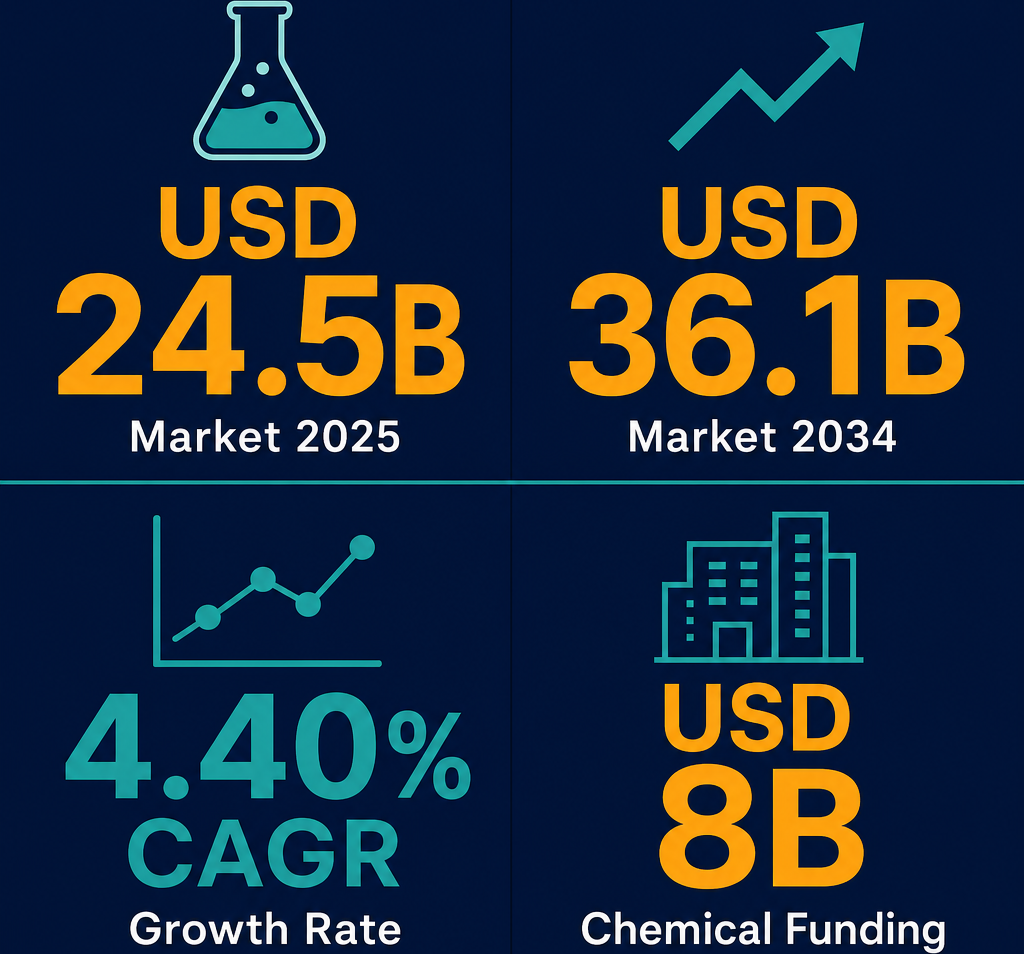
The Middle East specialty chemicals market is valued at USD 24.5 billion in 2025 and is projected to reach USD 36.1 billion by 2034. UAE government initiatives like Operation 300bn and USD 8 billion in Emirates Development Bank funding for chemical firms signal strong long-term demand.
Choose Meydan Free Zone for Ownership and Tax Benefits
Setting up in Meydan Free Zone gives you 100% foreign ownership and zero corporate tax on qualifying income. This structure is particularly attractive for international traders looking to serve the UAE market without a local partner requirement.
How to Start a Laboratories Chemicals Trading Business in Dubai with Meydan Free Zone
Every university research lab, hospital pathology department, pharmaceutical quality control facility, food testing centre and industrial R&D unit in the UAE runs on a steady supply of laboratory chemicals. Analytical reagents, reference standards, stains, solvents and specialty chemicals graded for scientific work. Activity code 4669.94 is the license for supplying them.
This guide covers what the license allows, who buys from you, the approval you need and the steps to get set up. Note the approval point early: Dubai Police clear this activity before your trade license is issued.
Key Stats at a Glance
What This License Covers
Code 4669.94 covers wholesale trading in laboratory chemicals. That means analytical reagents, research chemicals, pharmaceutical and reference standards including USP and BP grades, QC analytical chemicals and specialty laboratory lines, sold to research institutions, pharmaceutical companies, testing labs and industrial R&D clients.
Grade is what defines this code rather than the chemical itself. The same substance sold as a bulk industrial input belongs to a commodity chemical trading class. Sold as a certified analytical grade with a certificate of analysis and traceable purity, it is a laboratory chemical. Your paperwork is the product as much as the bottle is.
Four things sit outside the code. Making or blending chemicals yourself is manufacturing, with its own license and approvals. Bulk industrial and commodity chemical wholesale sits in a separate trading class. Laboratory instruments and equipment are a different activity from the chemicals that go into them. And medicines for human or animal use are regulated products handled under health authority licensing, not this code. If your list is drifting toward any of these, settle the scope with the licensing authority before you apply.
Who Your Clients Will Be
Academic and research institutions
Universities, research institutes and academic laboratories buy analytical reagents, research chemicals and laboratory standards. Purchasing runs on tenders and framework agreements tied to academic and grant cycles, so the buying is predictable once you are on the list and slow to win before that.
Pharmaceutical and clinical laboratories
Pharmaceutical manufacturers, hospital pathology departments and pharmaceutical testing operations buy pharmaceutical-grade chemicals, USP and BP reference standards and QC analytical lines. This is the most documentation-heavy segment. Certificates of analysis, batch traceability and storage conditions are audited, not assumed.
Industrial R&D and testing labs
Manufacturing research facilities, food and product testing labs and specialty analytical operations buy industrial R&D chemicals, food testing reagents and specialty lines. Volumes are smaller and the range is wider, which puts the demand on your catalogue depth and your ability to source uncommon items quickly.
Mainland or Free Zone
Most of your buyers are institutions, and institutions buy through tenders. A mainland license from the Department of Economy and Tourism is the usual route for supplying universities, hospitals and government testing labs directly.
Meydan Free Zone gives you 100% foreign ownership and a lower cost base, and it works well for import, holding and regional distribution, or as the entity holding your supplier agreements with global producers while a local partner handles institutional delivery.
Storage decides more than the jurisdiction does. Laboratory chemicals need temperature-controlled space, segregation by hazard class and grade-specific stock handling. A flexi-desk covers the admin side, and the storage sits separately whichever license you hold.
[blockCTACostCalculator]
Step-by-Step Setup Guide
- Step 1, fix your catalogue and grades: Decide which chemicals and which grades you will carry. This drives the Dubai Police conversation and your storage plan together.
- Step 2, start the Dubai Police pre-approval: This clearance comes before the license. Expect questions on your product list, storage and customer base.
- Step 3, choose your jurisdiction: Mainland through DET for direct institutional supply, or Meydan Free Zone for import, holding and regional distribution.
- Step 4, book your trade name: Check availability through the DET or Meydan Free Zone portal, following UAE naming conventions.
- Step 5, set up compliant storage: Temperature control, hazard segregation, ventilation and secure areas for controlled lines.
- Step 6, build supplier relationships: Agreements with global laboratory chemical producers. Authorised supply and traceable sourcing are what institutional buyers check first.
- Step 7, collect your license and open a bank account: Banks want the license, shareholder papers and a clear account of the trading model, including the controlled-product side.
- Step 8, register for VAT: Register with the Federal Tax Authority once turnover passes AED 375,000.
Compliance and What You Need in Place
Dubai Police pre-approval
This activity calls for Dubai Police clearance before the trade license is issued. Laboratory catalogues contain controlled and precursor substances, which is what brings the police into the approval chain. Treat it as the gating item in your plan.
Storage, segregation and records
Temperature-controlled storage, segregation by hazard class and secure handling for controlled lines are the working conditions of this license. Keep clean records of what you import, hold and sell, because traceability is what any review looks at first.
Documentation is the product
Certificates of analysis, batch numbers, safety data sheets and storage history are what a pharmaceutical or clinical buyer audits. A correct chemical with missing paperwork is a rejected delivery, so build the document chain before you chase the first order.
AML and VAT
This activity is exempt from AML duties. Register with the Federal Tax Authority once turnover passes AED 375,000.
Market Opportunity
The regional backdrop is a specialty chemicals market valued at USD 24.5 billion in 2025 and forecast to reach USD 36.1 billion by 2034 at 4.40% CAGR, with laboratory and electronic chemicals among the priority segments inside it.
National policy sits behind the UAE share of that. Operation 300bn targets manufacturing at USD 81.7 billion by 2031, up from USD 36.2 billion, with the Emirates Development Bank allocating USD 8 billion to chemical industry firms. More local pharmaceutical and industrial production means more quality control labs, and every one of them is a repeat buyer.
The demand is also unusually diversified. Academic research, pharmaceutical manufacturing, hospital pathology, food and product testing and industrial R&D all draw on overlapping catalogues but move on different cycles. A trader covering three or four of them is insulated from a slow year in any single one.
Conclusion
Laboratory chemicals trading under code 4669.94 serves buyers who cannot pause. Testing, quality control and research consume reagents continuously, and the UAE is adding labs across pharmaceutical, food safety and industrial research at the same time.
The licensing needs planning. Dubai Police clear you before the license is issued, and compliant storage is a working condition rather than a paperwork step. Start both before you commit to premises.
What separates the businesses that last is documentation discipline. Institutional and pharmaceutical buyers award on traceability and grade certainty as much as price. Speak to the Meydan Free Zone team to confirm the right structure for the catalogue you plan to carry.
[blockCTAContact]