
Table of Contents
Topic Summary
Choose the Right Licence Code for Sweets
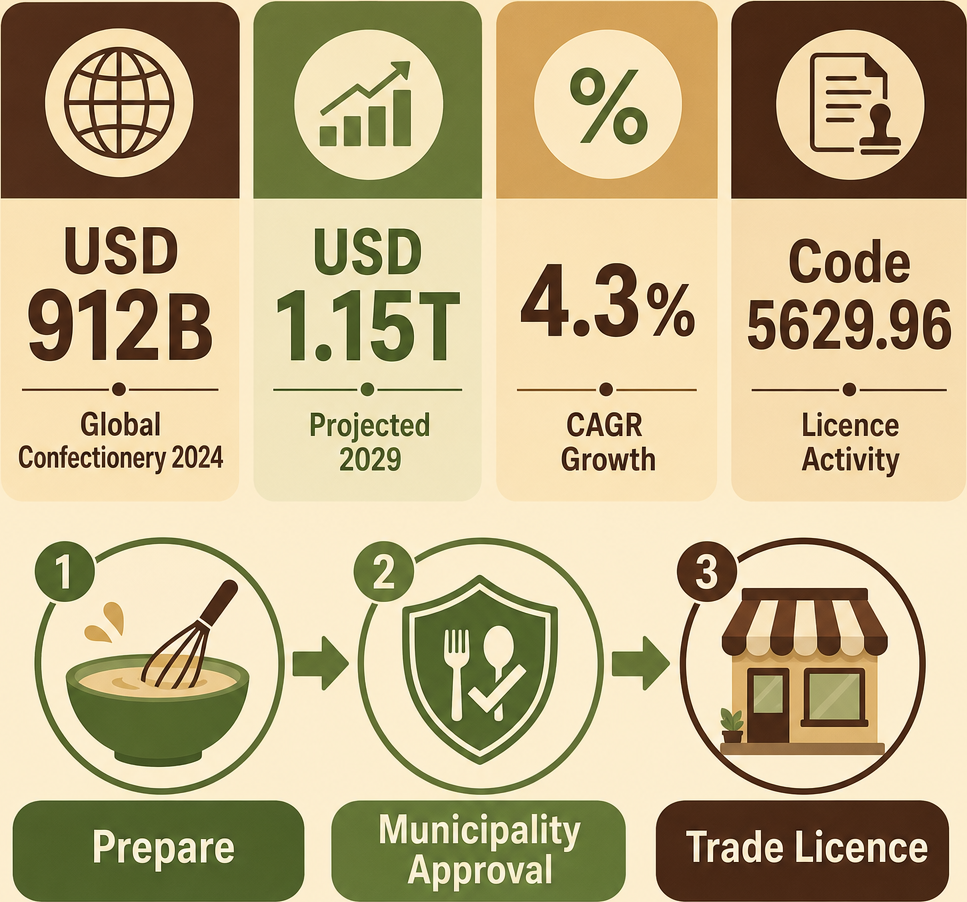
Code 5629.96 specifically covers the preparation and service of local and traditional sweets for immediate consumption, takeaway, and gifting. Using the correct activity code ensures your business is properly classified and avoids compliance issues down the line.
Know Which Sweets Fall Under This Licence
Luqaimat, kunafa, baklava, maamoul, basbousa, and halawet el jibn are all covered under Code 5629.96 as a licensed food service activity. Seasonal specialities like qatayef for Ramadan and kahk for Eid also fall within scope.
Plan Around Ramadan and Eid Peak Demand
Arabic sweets are central to Ramadan and Eid entertaining across the UAE, creating predictable seasonal surges in demand. Building your production capacity and staffing around these peaks can significantly boost annual revenue.
Tap Into the Dubai Chocolate Fusion Trend
The viral 2024 Dubai Chocolate trend, combining kataifi shredded wheat and pistachio cream, showed how traditional Arab confectionery ingredients can achieve global commercial momentum in a new format. Modern and fusion concepts using saffron, rosewater, date syrup, and cardamom represent a fast-growing sub-segment.
Secure Dubai Municipality Food Safety Approval
Code 5629.96 requires a post-licence food safety approval from Dubai Municipality before you can begin operations. Factoring this step into your launch timeline prevents costly delays after your trade licence is issued.
Understand What This Licence Does Not Cover
Code 5629.96 applies to preparation and service from a specialist outlet, not to industrial manufacture or wholesale of packaged confectionery for retail resale. If your model involves supplying pre-packaged products to supermarkets, a different activity classification applies.
Study Established Operators Before You Launch
Named Dubai operators such as Logma at Dubai Mall, Just Kunafa in Downtown Dubai, and Al Fanar at Festival City Mall offer useful benchmarks for format, location strategy, and menu positioning. Analysing their approaches can help you identify gaps and differentiate your own concept.
How to Start a Local Sweets Preparing Business in Dubai with Meydan Free Zone
Luqaimat, small fried dough balls drizzled with date syrup, is widely regarded as the national sweet of the UAE. Kunafa, baklava, basbousa, maamoul, and halawet el jibn are among the most consumed Arabic and Emirati sweets across the seven emirates, prepared and served from specialist sweet shops, traditional cafes, market stalls, and heritage restaurants. Code 5629.96 covers the preparation of local and traditional sweets as a licensed food service activity. The global confectionery market reached USD 912.34 billion in 2024 and is projected to reach USD 1.15 trillion by 2029 at a CAGR of 4.3%, according to The Business Research Company¹, with artisanal and culturally distinctive sweet formats among the fastest-growing sub-segments globally.
Arabic sweets are the centrepiece of Ramadan and Eid entertaining in the UAE: qatayef (stuffed pancakes) during Ramadan, maamoul (date and nut cookies) at Eid, luqaimat at heritage festivals, and kunafa as a year-round staple. The 2024 Dubai Chocolate viral trend, pistachio and kataifi, now globally replicated, demonstrated how traditional Arab confectionery ingredients (kataifi shredded wheat, pistachio cream) can generate international commercial momentum when presented in a new format. Named Dubai sweet shop operators include Logma (luqaimat specialist, Dubai Mall), Just Kunafa (Downtown Dubai), Al Fanar Restaurant and Cafe (traditional Emirati sweets, Festival City Mall), and Firas Sweets. Code 5629.96 carries a Dubai Municipality post-licence food safety approval requirement.
Who is this for?
5629.96 - Local Sweets Preparing
Code 5629.96 covers the preparation and service of local and traditional sweets for immediate consumption, takeaway, and gifting from a specialist local sweets outlet. It does not cover the industrial manufacture and wholesale of packaged confectionery products for retail resale (ISIC division 10); the retail sale of pre-packaged sweets through supermarkets (ISIC 47); patisserie and Western pastry shop operations (5629.94); or ice cream shop operations (5610.98). It expressly excludes the manufacture and retail sale of perishable food items. DM FoodWatch registration and food safety approval must be obtained before commencing service.
In short: if you prepare and serve local Emirati and Arabic sweets for immediate consumption or gifting from a specialist outlet, DM post-approval applies and you are in. If you manufacture packaged confectionery for wholesale or retail sale, you are not under this code.
Third-Party Approval
This activity requires Dubai Municipality Food Safety Department approval after the Meydan Free Zone licence is issued but before operations commence; operators must register on the DM FoodWatch platform, submit a food safety plan, pass inspection, and obtain a food safety certificate before serving customers.
Anti-Money Laundering Compliance
This activity is not classified as a Designated Non-Financial Business or Profession (DNFBP) under UAE anti-money laundering legislation, and operators are not subject to AML registration or reporting obligations specific to this licence category.
References
- ¹ The Business Research Company, Bakery and Confectionery Global Market Report 2025
- ² Dubai’s Best, The Best Arabic Sweets in Dubai 2025
- ³ HiDubai / Focus, The Ultimate Guide to the Yummiest Arabic Sweets in Dubai
- ⁴ Grand Bake, Top 10 Traditional Arabic Sweets in Dubai: Order Online
- ⁵ MyBayut, Popular Arabic Sweets and Desserts: Kunafa, Baklawa and More