Table of Contents
Topic Summary
Understand Exactly What Activity Code Covers
Activity code 4669.74 permits trading, sorting, baling, and wholesaling waste paper to recyclers and pulp mills. It does not cover waste collection services, waste treatment, or materials recovery through physical transformation, so knowing these boundaries prevents costly licensing errors.
Resolve the Collection Ambiguity Before Applying
The source documentation describes collection as part of the activity but also lists it as an exclusion, creating a direct contradiction. Confirm in writing with the licensing authority whether your business model requires a separate collection permit or whether offtake agreements with licensed collectors are sufficient.
Target the Right Buyers for Your Grades
Domestic and regional pulp mills in the GCC, South Asia, and Southeast Asia are your primary export customers, buying to strict grade specifications and volume commitments. Recyclers and material processors offer steadier but lower-priced offtake and serve as a useful volume floor.
Lock In Reliable Supply from Waste Generators
E-commerce fulfilment centres, retail chains, offices, and hospitality operators are your suppliers, not your customers, and securing consistent feedstock from them is often the harder side of the business. Strong supply agreements with these generators are as important as your buyer relationships.
Leverage Meydan Free Zone's Ownership and Tax Benefits
Meydan Free Zone allows 100% foreign ownership with zero corporate tax on qualifying income, making it attractive for internationally oriented trading operations. Free zone status also streamlines export logistics to regional pulp mills across the GCC and beyond.
Ride Significant Market Growth Tailwinds
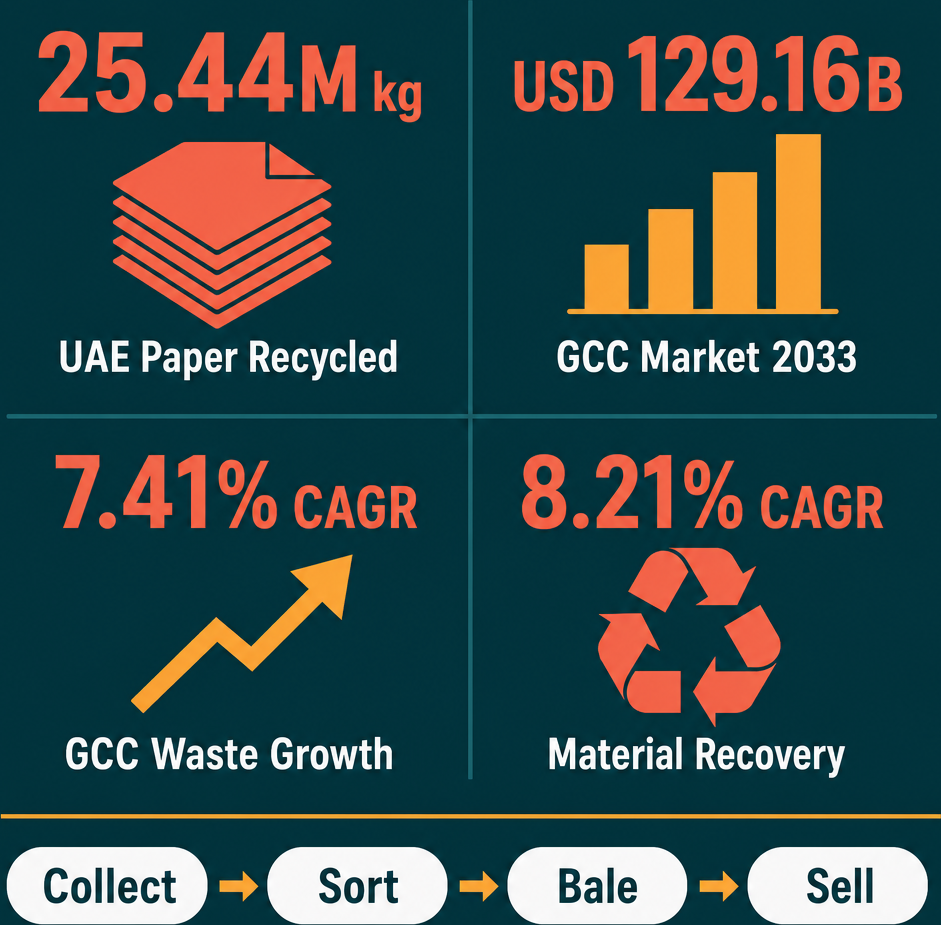
The GCC waste management market is projected to grow at a 7.41% CAGR to USD 129.16 billion by 2033, while UAE industrial waste management is expanding at 6.68% CAGR with recycling and material recovery at 8.21% CAGR through 2030. Policy drivers including Dubai's Waste Management Strategy 2041 and the UAE Net Zero 2050 target reinforce long-term demand.
Know Which Paper Grades Drive Your Revenue
The main tradeable grades are old corrugated cardboard, mixed office paper, newsprint, and high-grade white paper, each commanding different benchmark prices from mill buyers. Grading and baling to specification is central to the value you add between generator and mill.
How to Start a Waste Paper Trading Business in Dubai with Meydan Free Zone
Every used carton from an e-commerce fulfilment centre, every office print run and every stack of old newsprint is feedstock for a global recycling industry that supplies pulp mills. Activity code 4669.74 covers buying, sorting, baling and selling that material.
This guide covers what the license allows, who buys from you, the approval position and the steps to get set up. One point needs settling before you apply, and it is set out in the boundary section: the source page is not consistent about whether collection sits inside this activity.
Key Stats at a Glance
What This License Covers
Code 4669.74 covers trading in waste paper: taking sorted or unsorted paper, grading it, baling it and selling it on to recyclers and paper mills. You sit between the point where paper stops being packaging and the point where it becomes pulp again.
The exclusions matter here and they are substantive rather than boilerplate. Collecting household and industrial waste is a waste collection service in its own class. Treating waste for disposal rather than onward industrial use is waste treatment.
Processing waste and scrap into secondary raw material through a real transformation process is materials recovery, which is a manufacturing-type activity rather than trading. Dismantling vehicles, computers and equipment for recovery, shredding cars, ship-breaking and retail of second-hand goods all sit elsewhere.
There is a wrinkle to resolve before you apply. The source page describes the activity as including collection, then lists collection of household and industrial waste among the exclusions.
Those two statements cannot both be operative. In practice the safe reading is that trading, sorting and baling sit inside this code while operating a waste collection service is a separate licensed activity, but do not rely on that: confirm in writing with the licensing authority whether your model needs a collection permission alongside this license, or offtake agreements with licensed collectors instead.
Who Your Clients Will Be
Domestic and regional pulp mills
Paper mills across the GCC, South Asia and Southeast Asia buying UAE-sorted waste paper as pulp feedstock. They buy to grade specification and volume commitments, pricing against global recovered paper benchmarks rather than negotiating case by case.
Recyclers and material processors
Operators taking graded material for further processing. Steadier offtake than export mills, usually at lower prices, and useful as a floor under your volumes.
On the supply side: waste generators
E-commerce fulfilment centres, retail chains, offices and hospitality operators. These are suppliers rather than customers, and securing a reliable stream from them is the harder half of this business.
Mainland or Free Zone
This business needs space. Waste paper arrives loose and only becomes economic to move once baled, so a yard with a baler is the core asset and it sits on the mainland.
Meydan Free Zone gives you 100% foreign ownership and a low fixed cost base, and it suits a trading and export operation buying baled material from licensed collectors and selling to regional mills, without running collection yourself.
Which model you choose determines the license question above. A pure trading and export desk has a much simpler regulatory position than an operation collecting from sites, and that decision should come before the application rather than after.
[blockCTACostCalculator]
Step-by-Step Setup Guide
- Step 1, decide whether you collect or buy: Running collection is a different regulatory position from buying baled material. Settle this first, because it changes everything downstream.
- Step 2, confirm the approval position in writing: Ask the licensing authority and the relevant municipality what permissions your model needs beyond the trade license.
- Step 3, choose your jurisdiction: Mainland through DET if you plan direct collection and a yard, or Meydan Free Zone for a trading and export operation.
- Step 4, book your trade name: Check availability through the DET or Meydan Free Zone portal, following UAE naming conventions.
- Step 5, secure your supply: Offtake agreements with fulfilment centres, retail chains, offices or licensed collectors. Supply is the constraint in this trade, not demand.
- Step 6, set up sorting and baling: Grade separation into corrugated, mixed office, newsprint and high-grade white is what turns waste into a saleable commodity.
- Step 7, build mill relationships: Domestic and regional buyers, with grade specifications agreed in advance to avoid rejected loads.
- Step 8, collect your license, open a bank account and register for VAT: Register with the Federal Tax Authority once turnover passes AED 375,000.
Compliance and What You Need in Place
Settle the collection question
The source page states no third-party approval, but it also describes collection as part of the activity while excluding waste collection in the same section.
Waste handling is regulated in Dubai, and an operation that picks up material from sites is doing something materially different from one that buys baled stock. Get written confirmation of what your specific model needs before you begin.
Grade discipline is the commercial control
Mills buy to specification and reject loads that fail it. Contamination, moisture and mixed grades cause most rejections, and a rejected export load is expensive to recover from. Sorting discipline is the product, not a detail.
Price risk
Recovered paper trades against global benchmarks that move independently of your costs. Buying at a fixed rate while selling at a floating benchmark is the classic way to lose money here.
AML and VAT
This activity is exempt from AML duties. Register with the Federal Tax Authority once turnover passes AED 375,000.
Market Opportunity
The feedstock side is expanding steadily. The Emirates Environmental Group reports 25.44 million kg of paper recycled cumulatively through its Paper Collection Campaign alone, and the total national stream is far larger, driven by e-commerce fulfilment, retail, office and hospitality waste.
Regulation is pulling in the same direction. UAE industrial waste management is growing at 6.68% CAGR with recycling and material recovery at 8.21% CAGR through 2030, anchored by the Dubai Waste Management Strategy 2041 and Abu Dhabi's target of 80% landfill diversion by 2030.
Diversion targets create material that has to go somewhere, and traders are how it gets there.
The buyer side is established rather than speculative. GCC waste management is projected to reach USD 129.16 billion by 2033 at 7.41% CAGR, and pulp mills across the GCC, South Asia and Southeast Asia already buy UAE-sorted waste paper. This is an existing trade with known routes, not a market that needs creating.
Conclusion
Code 4669.74 sits at the front of the circular paper economy, with policy targets pushing material toward recovery and established mills buying at the other end.
The regulatory question to resolve is collection. Trading and baling is one activity; picking material up from sites is another, and the source page is not clear about where the line falls.
Commercially, secure supply before you invest in a yard. Demand for graded waste paper is reliable; consistent access to feedstock is what separates traders who last from those who bale one good month. Speak to the Meydan Free Zone team to confirm the right structure for the model you plan to run.
[blockCTAContact]