Table of Contents
Frequently Asked Questions
What does this activity cover?
It covers buying grain and seed in bulk and selling it on to businesses. Wheat, rice, corn, barley and pulses are all included.
Does it include pulses and lentils?
Yes. Dry legumes such as lentils and chickpeas sit inside this activity.
Can I mill grain into flour?
No. Milling is manufacturing and sits under a separate code.
Can I trade other farm goods under the same class?
The class also covers hides, leather, plants and live animals. Several of those carry Dubai Municipality approvals, so check each code before adding it.
Do I need third-party approval?
No. This activity does not require third-party approval to obtain a business license from Meydan Free Zone.
Topic Summary
Dubai Sits at a Global Grain Crossroads
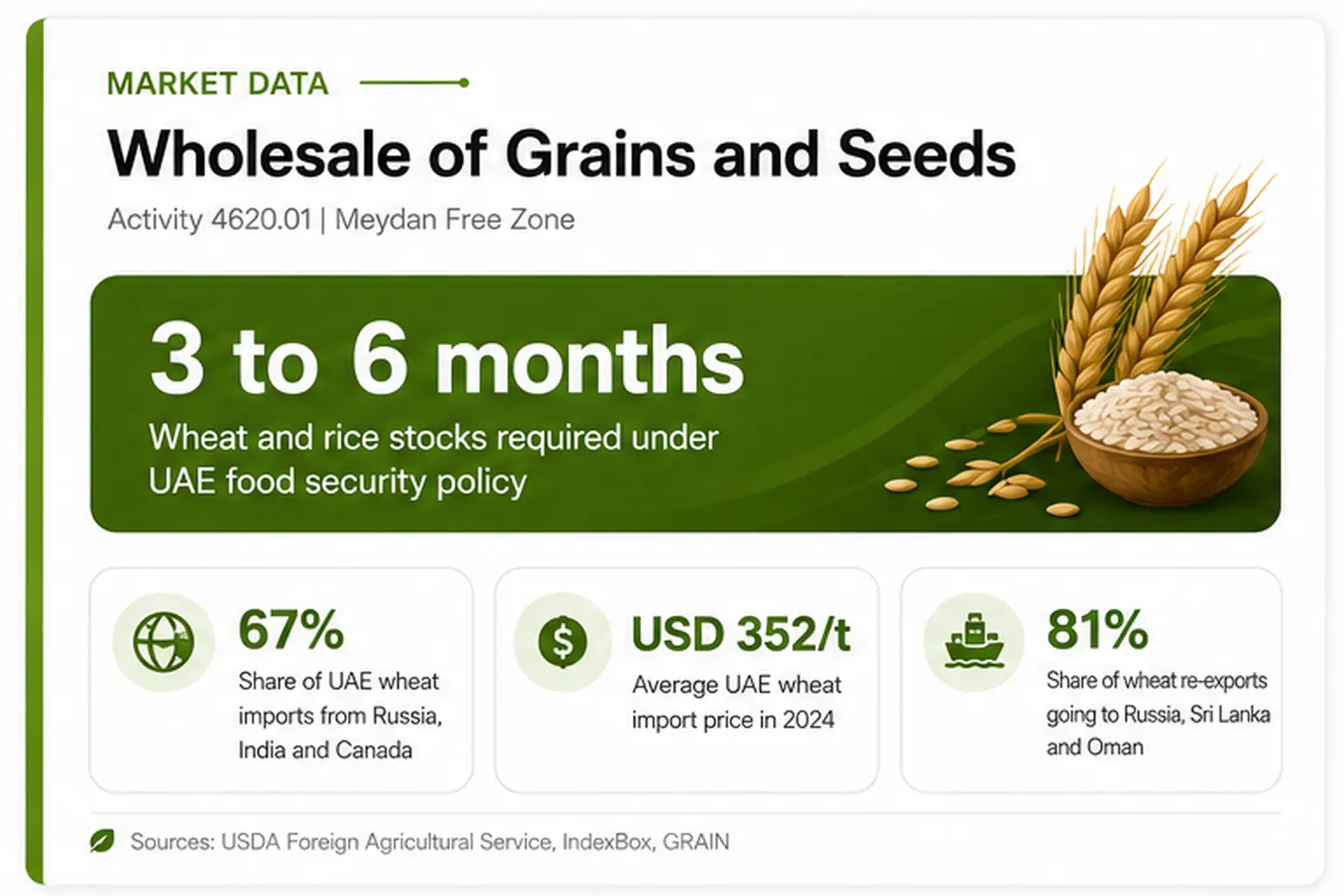
The UAE re-exports 81% of its wheat to markets like Russia, Sri Lanka, and Oman, making Dubai a major transit hub. Free trade agreements and deep port capacity keep turnaround times fast and costs competitive.
UAE Food Policy Drives Steady Grain Demand
Government food security rules require wheat and rice stockpiles covering three to six months of supply. That mandate alone ensures a continuous, predictable flow of grain through the country.
The UAE Imports Nearly All Its Grain
The UAE produces almost no grain domestically, so imports fill virtually all demand. Russia, India, and Canada together supply 67% of UAE wheat imports by value.
Know Exactly What This License Covers
A wholesale grains and seeds license permits bulk buying, storage, grading, and re-export of cereals, pulses, and planting seeds. It does not cover milling grain into flour or selling directly to consumers.
Two Clear Business Models Fit This Activity
You can operate as a grain importer bringing containerized or vessel-load shipments into the UAE, or as a trade supplier delivering consistent bulk orders to mills, feed producers, and food manufacturers. Both models depend on reliable grades and competitive freight costs.
No Third-Party Approvals or AML Requirements
Meydan Free Zone does not require third-party approval to issue a business license for this activity. The activity is also not subject to anti-money laundering compliance obligations, simplifying the setup process.
How to Open a Wholesale of Grains and Seeds in Dubai with Meydan Free Zone
Wholesale of grains and seeds covers the bulk trade in wheat, rice, corn, barley and pulses. Traders buy by the container or vessel and sell on to businesses. Their buyers include mills, food makers, feed producers and retail chains. The trade sits at the front of the food chain, well before anything reaches a shelf.
The UAE grows almost no grain of its own. Imports meet the demand instead, and forecasts point to those imports rising further.1 Food security policy requires wheat and rice stocks covering three to six months.1 That rule alone keeps a steady flow of grain moving through the country.
Dubai is also a route to other markets. Russia, India and Canada supply 67% of UAE wheat imports by value.2 Much of what arrives leaves again, with 81% of wheat re-exports heading to Russia, Sri Lanka and Oman.2 Free trade agreements and deep port capacity make that turnaround quick and cheap.3
Why the UAE imports nearly all its grain
Whether you supply mills, feed producers, food makers or retail chains, this activity covers bulk trade in grain and seed. The figures below show how the trade flows.
Who is this activity for?
| Category | Business Type | Description |
|---|---|---|
| Importer | Grain Importers And Traders | You Buy Grain At Volume From Producers Abroad And Bring It Into The UAE. Timing And Freight Cost Decide Your Margin. |
| Trade Supplier | Mill And Feed Suppliers | You Supply Mills, Food Makers And Feed Producers With Steady Bulk Orders. Consistent Grade And Reliable Delivery Keep The Contract. |
What this activity covers
This code covers wholesale trade in grains and seeds, sold in bulk to other businesses. The class guidelines set a wider scope across farm raw materials.
- Bulk buying of wheat, rice, corn, barley and other cereals
- Trade in pulses, lentils and other dry legumes
- Trade in seed sold for planting rather than eating
- Storage, grading and breaking bulk before resale
- Import and re-export of grain through UAE ports
[blockCTAmCore]
Product scope
[blockFaqsCategory]
What falls outside this activity
This activity does not cover milling or processing grain. Turning wheat into flour is manufacturing and sits under a separate code. Selling direct to the public is retail trade and needs a retail activity instead. The class guidelines also place textile fibres outside this class.
In short, you can import, store and sell grain in bulk, but you cannot mill it or sell it to shoppers.
[blockCTANameCheck]
Compliance
Third-party Approval
This activity does not require third-party approval to obtain a business license from Meydan Free Zone.
Anti-money Laundering Compliance
This business activity is not subject to AML compliance requirements.
Footnotes
1. USDA Foreign Agricultural Service, United Arab Emirates Grain and Feed Annual, April 2026.
2. IndexBox, United Arab Emirates Wheat Market Report 2026, March 2026.
3. GRAIN, From Land to Logistics: UAE's Growing Power in the Global Food System, 2025.