
Table of Contents
Topic Summary
Understand Exactly What License 4791.99 Covers
Activity code 4791.99 licenses printed and digital catalogue retail, subscription box services, direct-to-consumer online retail, and internet auctions. The key legal test is simple: if a customer selects and orders at a distance from a curated presentation and you fulfil the order, you are inside the code.
Know What Falls Outside This License
Selling from a fixed physical store, supplying goods wholesale to other businesses, and running a marketplace platform that only connects buyers to third-party sellers are all excluded from this activity code. Getting this distinction wrong at the outset can create compliance problems, so confirm your exact model with the licensing authority before trading.
Target the Right Customer Segments Early
The three core customer types are subscription buyers on recurring schedules, catalogue and direct mail buyers ordering from curated brochures, and direct-to-consumer shoppers purchasing from a brand's own site or app. Subscription buyers offer the strongest unit economics because acquisition cost is paid once and revenue repeats, which explains the sector's 14.2% CAGR.
Tap Into Explosive Market Growth Figures
The global subscription box market is projected to grow from USD 34.6 billion in 2024 to USD 114.3 billion by 2033, while the direct-to-consumer market is forecast to reach USD 2.75 trillion over the same period. The UAE e-commerce market alone is expected to surpass AED 48.8 billion by 2028, giving locally licensed operators a fast-growing domestic base.
Choose Meydan Free Zone for Full Ownership
Meydan Free Zone allows 100% foreign ownership with zero corporate tax on qualifying income, compared to the 9% corporate tax rate applied to mainland entities above the threshold. This structure is widely used for e-commerce businesses that fulfil orders through third-party logistics providers rather than maintaining their own warehoused premises.
Plan Your Fulfilment Infrastructure from Day One
Dubai hosts more than 100 fulfilment centres, and the government offers warehousing subsidies and tax reliefs for high-efficiency fulfilment models. With 98% smartphone penetration in the UAE, the logistics and customer-reach infrastructure is already in place, but you need to decide early whether to hold stock yourself or outsource to a third-party provider.
Confirm Approval and Compliance Status in Writing
The source documentation for this activity code leaves both third-party approval requirements and AML compliance obligations unstated. Treat these as open questions rather than settled ones, and obtain written confirmation from the licensing authority before you begin trading to avoid regulatory exposure.
How to Start a Purchasing Through Catalogue Services Business in Dubai with Meydan Free Zone
Catalogue retail is one of the oldest forms of distance selling and one of the fastest changing. The printed mail-order book became the subscription box, the brand website and the curated digital lookbook, but the logic never moved: the customer decides from a presentation rather than a shop visit, and the product arrives at their door. Activity code 4791.99 licenses that model.
This guide covers what the license allows, who buys from you, the approval position and the steps to get set up. One caution up front: the source page leaves its approval and compliance sections blank, so treat those points as unanswered rather than settled.
Key Stats at a Glance
What This License Covers
Code 4791.99 sits inside ISIC class 4791, which covers retail conducted through mail order, catalogues, telephone, television, radio or internet, where the buyer decides on the basis of how the product is presented rather than by visiting a shop.
Under this sub-code that spans printed and digital catalogue retail, subscription box delivery, direct-to-consumer online retail and internet retail auctions. If a customer selects and orders at a distance from a curated presentation and you fulfil the order, you are inside the code.
Three things sit outside it. Selling from a fixed physical store is ordinary retail under a different class, even if you also take orders online. Wholesale supply to other businesses is a wholesale activity, not this one.
And running a platform that only introduces buyers to third-party sellers, without selling the goods yourself, is an intermediary or portal activity rather than retail.
Who Your Clients Will Be
Subscription buyers
Consumers taking a curated selection on a recurring schedule. This is the highest-value customer in the model because acquisition cost is paid once and revenue repeats, which is why the global subscription market grows at 14.2% CAGR while general retail does not.
Catalogue and direct mail buyers
Customers ordering from printed catalogues, email catalogues and brochures by phone, post or web. Older as a format, still effective for considered purchases and for audiences who prefer browsing a curated selection over searching.
Direct-to-consumer shoppers
People buying from a brand's own site or app rather than through a retailer. The brand keeps the margin and the customer relationship, and takes on the fulfilment and service load that a retailer would otherwise carry.
Mainland or Free Zone
This is one of the few retail models with no shop, which makes it a natural fit for a free zone structure. Meydan Free Zone gives you 100% foreign ownership and a low fixed cost base, and the business can run from a flexi-desk with stock held at a fulfilment provider.
A mainland license from the Department of Economy and Tourism suits an operation selling heavily into the UAE domestic market, particularly one holding its own warehouse and running local delivery.
Fulfilment is the real decision, not the jurisdiction. Whether you hold stock yourself or use a third-party provider sets your cost base, your delivery promise and how quickly you can scale, and Dubai's 100-plus fulfilment centres make the outsourced route simple to arrange.
[blockCTACostCalculator]
Step-by-Step Setup Guide
- Step 1, confirm the approval and AML position in writing: The source page leaves both blank. Ask the licensing authority directly before you build anything around this code.
- Step 2, define your format: Subscription, catalogue, direct-to-consumer or auction. Each has a different cash cycle and a different customer acquisition model.
- Step 3, choose your jurisdiction: Meydan Free Zone for 100% foreign ownership and a lean base, or mainland through DET if you plan a domestic warehouse and delivery operation.
- Step 4, book your trade name: Check availability through the DET or Meydan Free Zone portal, following UAE naming conventions.
- Step 5, settle fulfilment early: Own warehouse or third-party provider. This decides your delivery promise, which is what customers actually judge you on.
- Step 6, build the payment and returns process: Distance selling lives on trust. Clear pricing, secure payment and a workable returns policy do more for conversion than advertising.
- Step 7, handle customer data properly: Subscription and catalogue models run on customer records, so set up consent, storage and marketing permissions correctly from the start.
- Step 8, collect your license, open a bank account and register for VAT: Register with the Federal Tax Authority once turnover passes AED 375,000.
Compliance and What You Need in Place
The source page leaves the key sections blank
Third-party approval, AML and references are all empty on the published activity page, and no approval position is stated anywhere in its text. That silence is not a clearance. Get written confirmation from the licensing authority on both the approval and AML positions before you trade, and keep it on file.
Product category drives any approval you need
This code describes a selling channel rather than a product. What you ship decides what else applies, and selling food, cosmetics, supplements, medical items or media through a catalogue brings those product rules with it. Check the position for your specific range rather than for the channel.
Distance selling duties
Customers buying at a distance cannot inspect before purchase, so accurate description, clear total pricing and a stated returns process are the baseline. These are also the things consumer complaints turn on.
VAT
Register with the Federal Tax Authority once turnover passes AED 375,000. E-commerce volumes cross that line quickly.
Market Opportunity
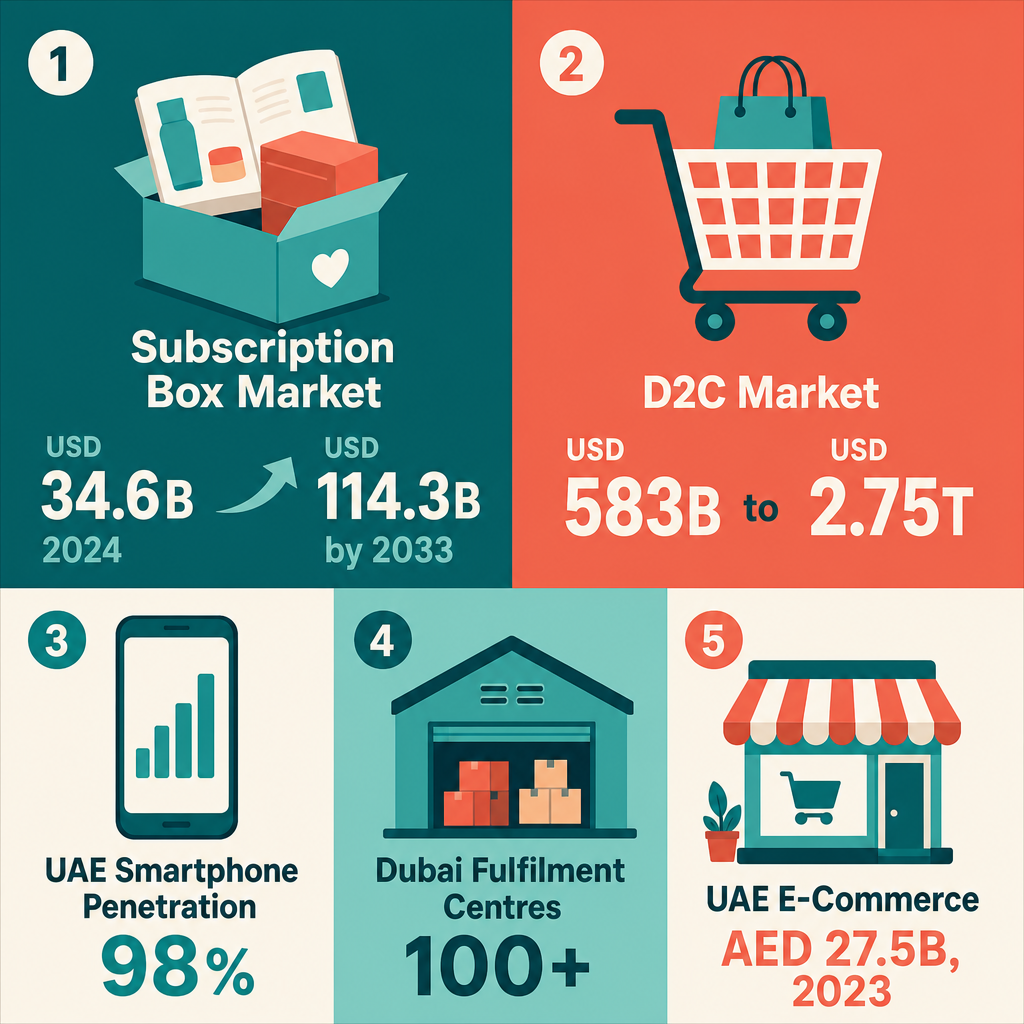
The modern form of catalogue retail is growing quickly. The global subscription box market reached USD 34.6 billion in 2024 and is projected at USD 114.3 billion by 2033 at 14.2% CAGR.
The wider direct-to-consumer market was valued at USD 583.48 billion in 2024 and is forecast to reach USD 2.75 trillion by 2033 at 17.3% CAGR. Both are driven by the same thing: customers wanting curated discovery and convenience rather than search and collection.
The UAE is well set up for it. E-commerce was valued at AED 27.5 billion in 2023 with projections to pass AED 48.8 billion by 2028, and smartphone penetration at 98% means the storefront is already in everyone's hand.
The infrastructure closes the gap between the order and the doorstep. Dubai has more than 100 fulfilment centres, and government support for direct-to-consumer logistics through warehousing subsidies and tax reliefs favours operators adopting efficient fulfilment.
Beauty and personal care is the fastest-growing subscription category, with books and media, food and beverage, fashion and health and wellness behind it.
Conclusion
Code 4791.99 covers a retail model with no shop, no footfall problem and, in subscription form, revenue that repeats without being re-sold each month.
The commercial work is fulfilment and retention. Getting the parcel there when promised, and giving customers a reason to stay past month three, are what separate the businesses that last from the ones that acquire expensively and churn.
Before any of that, close the gap the source page leaves open. Get the approval and AML positions confirmed in writing, then speak to the Meydan Free Zone team about the right structure for your format.
[blockCTAContact]