Table of Contents
Topic Summary
Understand What Activity Code 4669.99 Covers
This license allows wholesale trading of raw materials across multiple categories simultaneously, including industrial minerals, specialty fibres, agricultural raw materials, and specialty industrial feedstock. It is designed for traders who supply diverse inputs to manufacturers from a single operation rather than specializing in one narrow class.
Know the Boundaries of This Catch-All License
If a material has its own defined sub-class — such as metal ores, textile fibres, or specific chemical trading codes — you must hold that specific license instead. Manufacturing or processing materials yourself, and trading in waste or scrap for recycling, also fall under separate license categories.
Identify Your Most Valuable Customer Types
Your strongest clients will be multi-sector manufacturers seeking procurement simplification, specialty formulators buying smaller but higher-margin volumes, and downstream processors who purchase steadily and plan ahead. Downstream processors in particular make reliable anchor customers because of their predictable buying patterns.
Compare Mainland vs. Meydan Free Zone Setup
A mainland DET license allows direct sales to UAE manufacturers but comes with 9% corporate tax above AED 375,000 taxable income and foreign ownership restrictions. Meydan Free Zone offers 100% foreign ownership, zero corporate tax on qualifying income, and is well suited to regional import and re-export distribution flows.
Tap Into Significant Regional Market Growth
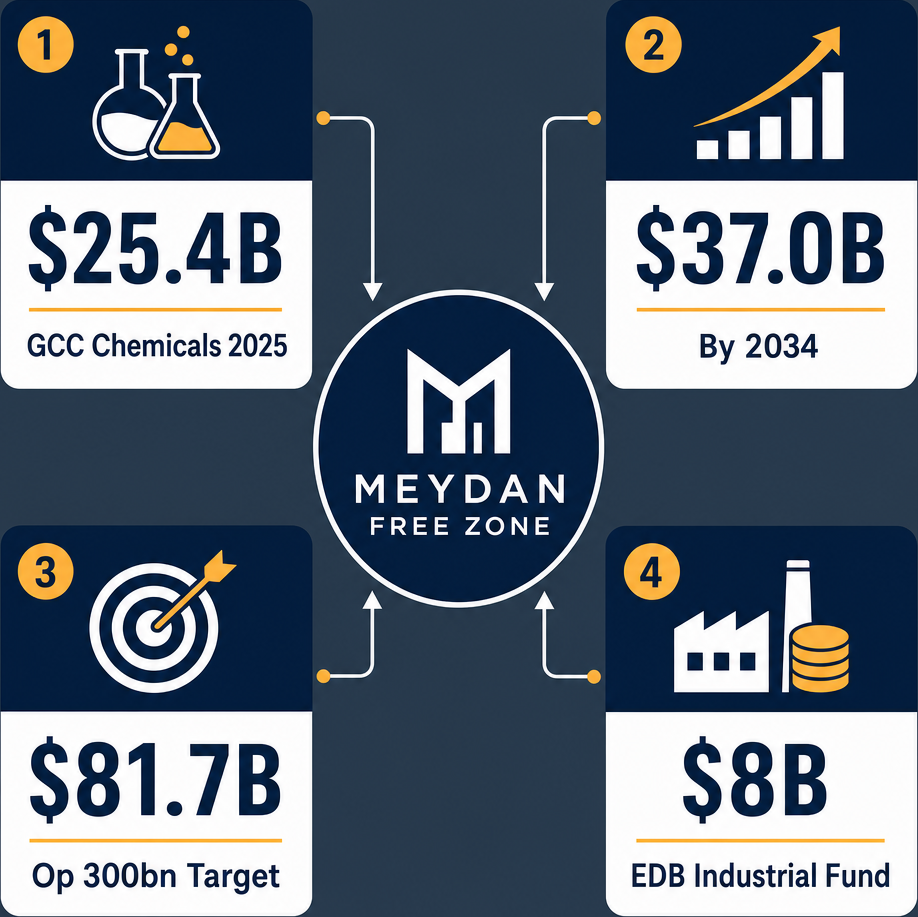
The GCC specialty chemicals market is valued at USD 25.4 billion in 2025 and is projected to reach USD 37.0 billion by 2034 at a 4.11% CAGR. The UAE's Operation 300bn manufacturing target of USD 81.7 billion by 2031 and USD 8 billion in Emirates Development Bank funding for industrial firms signal strong demand for raw material suppliers.
Audit Your Portfolio Before Applying for the License
The most common problem with a catch-all code is a trading portfolio that has gradually expanded into two or three defined license classes without the license being updated to match. Mapping your actual and planned product range against existing sub-class definitions before applying prevents compliance issues later.
How to Start a Raw Materials Trading Business in Dubai with Meydan Free Zone
Not every commodity trade fits one category. Plenty of UAE traders run mixed portfolios: a shipment of industrial minerals, a container of specialty fibres, a cargo of agricultural inputs and a lot of industrial feedstock moving through the same warehouse network. Activity code 4669.99 is the license for that kind of business.
This guide covers what the license allows, who buys from you, the approval position and the steps to get set up. Because this is a catch-all class, the boundary needs more attention than usual.
Key Stats at a Glance
What This License Covers
Code 4669.99 covers wholesale trading in raw materials across several categories at once. You import, stock and distribute industrial inputs to UAE manufacturers, specialty industrial clients and downstream processors, spanning categories that do not sit neatly in a narrower sub-class.
In practice that means industrial minerals, specialty fibres outside the textile fibre classes, agricultural raw materials that fall outside their own sub-categories, and specialty industrial feedstock. The unifying feature is breadth: a customer who wants to order across categories from one supplier rather than coordinate four specialists.
The boundary follows from that. If a material has its own defined sub-class, you belong in that class rather than here. Metal ores, textile fibres and the specific chemical trading codes each have their own activity, and holding this code does not extend to them.
Making or processing material yourself is manufacturing, with its own license, and wholesale of waste and scrap for recycling is a separate class again, because recovered material and raw material are treated differently.
Get the mapping right at license stage, because on a catch-all code the most common problem is a portfolio that has quietly drifted into two or three defined classes without the license following it.
Who Your Clients Will Be
Multi-sector manufacturers
Producers buying several input categories who would rather deal with one supplier than four. The value you offer is procurement simplification, and that is what justifies your margin over a specialist.
Specialty formulators and processors
Specialty chemical formulators and niche manufacturers buying smaller volumes of specific inputs. Lower tonnage, better margins, and buyers who care about consistency of specification between deliveries.
Downstream processors
Operations converting raw inputs into intermediate goods. They buy steadily and plan ahead, which makes them the most predictable customers in the mix and the best anchor for a warehouse.
Mainland or Free Zone
A mainland license from the Department of Economy and Tourism suits a trader selling mostly into UAE factories and processors, holding local stock and delivering directly.
Meydan Free Zone gives you 100% foreign ownership and a lower cost base, and it fits an import, hold and re-export operation or an entity holding international supplier relationships while a local partner handles delivery into UAE plants.
Warehousing decides the shape of the business either way. A multi-category portfolio means many stock lines with different handling needs, so storage capacity and stock control matter more here than in a single-product trade.
[blockCTACostCalculator]
Step-by-Step Setup Guide
- Step 1, map your portfolio against the sub-classes: List every material you plan to carry and check which have their own codes. Do this before you apply, not after.
- Step 2, choose your jurisdiction: Mainland through DET for direct supply to UAE manufacturers, or Meydan Free Zone for import, holding and re-export.
- Step 3, book your trade name: Check availability through the DET or Meydan Free Zone portal, following UAE naming conventions.
- Step 4, build supplier relationships: Producers across Asia, Europe and the region. On a broad portfolio, reliable multi-category sourcing is the hard part.
- Step 5, size your warehousing: Multi-category stock needs more space and better systems than a single line. Storage handling needs differ by material.
- Step 6, set up stock control: Managing many stock lines across categories is the operational core of this model, and the place where margin leaks fastest.
- Step 7, collect your license and open a bank account: Banks want the license, shareholder papers and a clear account of the trading model and product range.
- Step 8, register for VAT: Register with the Federal Tax Authority once turnover passes AED 375,000.
Compliance and What You Need in Place
Approval position
The source position is that no third-party approval is needed for this activity. Confirm that in writing against your actual material list, because a catch-all portfolio can include items that carry approvals on their own. Controlled chemicals, for instance, bring clearances that a general raw materials license does not cover.
Staying inside a catch-all code
This is the compliance point that matters most here. Portfolios expand, and each new material should be checked against the defined sub-classes before you start trading it. A license amendment is far cheaper than explaining a mismatch to a bank or an inspector.
Storage by material type
Different raw materials need different handling, and a mixed warehouse carries mixed risks. Segregation, labelling and material safety documentation should follow the most demanding item you hold, not the average.
AML and VAT
This activity is exempt from AML duties. Register with the Federal Tax Authority once turnover passes AED 375,000.
Market Opportunity
The regional demand base is growing steadily. The GCC specialty chemicals market is valued at USD 25.4 billion in 2025 and forecast to reach USD 37.0 billion by 2034 at 4.11% CAGR, driven by manufacturing expansion, consumer goods production and economic diversification pulling several input categories at once.
National policy sits behind the UAE portion. Operation 300bn targets manufacturing at USD 81.7 billion by 2031, up from USD 36.2 billion, with the Emirates Development Bank allocating USD 8 billion to chemical and industrial firms. More factories mean more input buyers on the ground.
The commercial argument for a broad portfolio is procurement simplification. A manufacturer ordering four input categories from one supplier saves coordination, consolidates deliveries and holds one relationship instead of four. That is the margin a mixed trader earns, and it is unavailable to specialists by definition.
Conclusion
Code 4669.99 exists for traders whose business is range rather than depth. In a market where manufacturing is expanding across several sectors at once, being able to supply across categories is a real commercial position.
The licensing is light, with no third-party approval stated and no AML load. That puts the work on getting the class mapping right and keeping it right as your portfolio grows.
The operational challenge is stock. Many lines, different handling needs and a warehouse that has to serve all of them is what this business actually consists of. Speak to the Meydan Free Zone team to confirm the right structure and check your material list against the sub-classes before you apply.
[blockCTAContact]