
Table of Contents
Topic Summary
Tap Into Dubai's Booming Real Estate Demand
Dubai recorded 180,987 real estate transactions worth AED 522.5 billion in 2024, a 36.5% rise in volume year on year. Every new home represents direct demand for carpets and rugs, making the city's residential pipeline a structural advantage for stall-based traders.
Register Under the Right Activity Code
Retail carpet and rug stall trading falls under ISIC activity code 4789.01, specifically designated for Retail Sale Via Stalls of Carpets and Rugs. This covers hand-knotted, machine-made, Oriental, kilim, and natural fibre floor coverings sold new, vintage, or second-hand.
Leverage Dubai's Deep Carpet Trading Heritage
Dubai's traditional carpet souks in Satwa and Deira have operated for decades, with bargaining and direct seller expertise central to the buying experience. This cultural familiarity gives stall-based traders a natural and trusted commercial format.
Access a Global Supply Chain From One City
Dubai sits at the crossroads of carpet production from Iran, Turkey, Afghanistan, India, and Pakistan, connecting suppliers directly with Gulf, European, and international buyers. This established supply network gives traders in the city a significant sourcing advantage.
Serve a Diverse, Multi-National Consumer Base
With residents spanning over 200 nationalities, Dubai offers stall traders exposure to buyers with widely varying tastes, budgets, and cultural preferences in floor coverings. This diversity supports demand across every product category, from luxury hand-knotted rugs to affordable machine-made options.
Enter a High-Growth Global Market
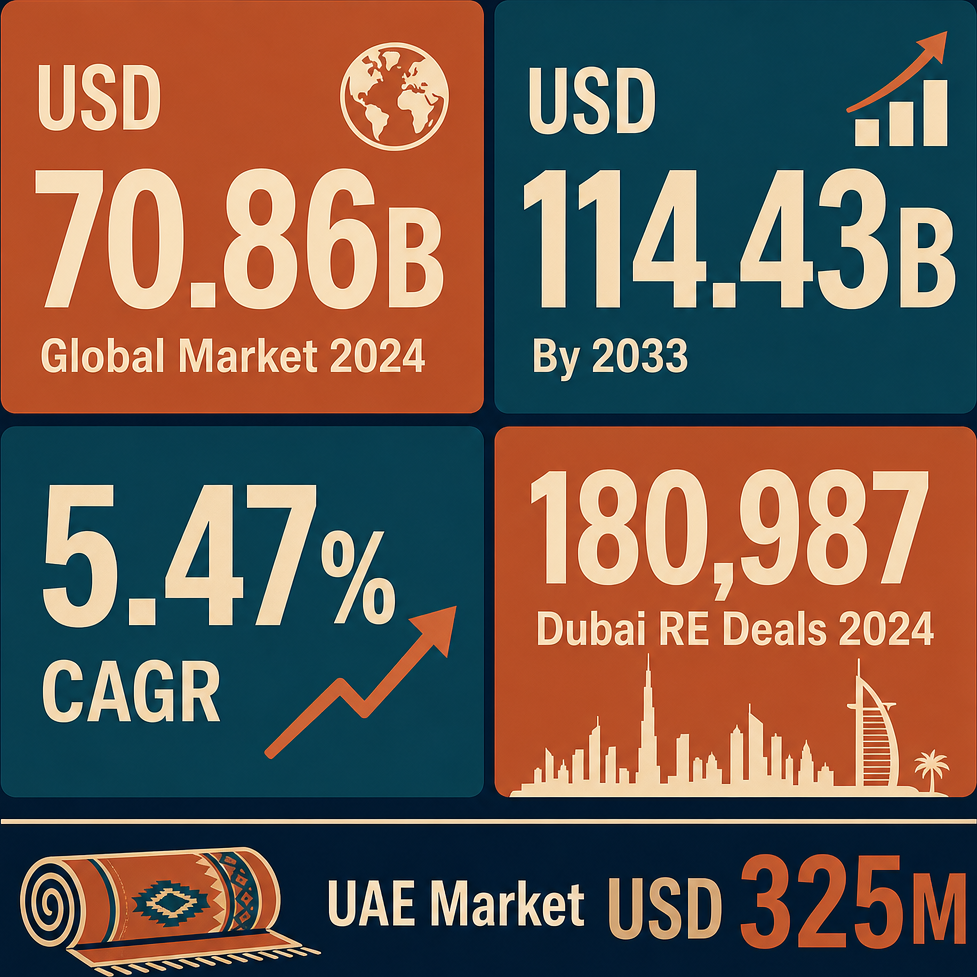
The global carpet and rug market was valued at USD 70.86 billion in 2024 and is projected to reach USD 114.43 billion by 2033 at a CAGR of 5.47%. Rising interest in interior design, premium products, and sustainable materials is driving sustained demand worldwide.
Use Meydan Free Zone for Streamlined Setup
Meydan Free Zone offers a straightforward licensing pathway for retail stall businesses, including carpet and rug trading under activity code 4789.01. Registering through a free zone can simplify compliance and provide a credible business structure for traders entering the Dubai market.
How to Start a Retail Sale Via Stalls of Other Goods Business in Dubai with Meydan Free Zone
Introduction
Carpet and rug trading is one of the most established commercial traditions in Dubai and the wider Gulf, deeply rooted in the city’s history as a trading hub where Persian, Turkish, Afghan, and Central Asian textiles have passed through markets for centuries. Today, this heritage intersects with one of the world’s most dynamic property markets, creating structural and sustained demand for floor coverings across every price point and product category.
The global carpet and rug market was valued at USD 70.86 billion in 2024 and is projected to reach USD 114.43 billion by 2033 at a CAGR of 5.47%, according to Renub Research¹. This growth is driven by rising demand from residential and commercial construction, increasing consumer interest in interior design and home decor, and a growing preference for premium, sustainable, and artisan floor coverings.
The UAE domestic carpet market reached USD 325.05 million in 2024 and is projected to reach USD 393.91 million by 2033, according to IMARC Group². Expanding construction and luxury hospitality sectors, rising interior decor demand, and a growing consumer shift towards customised and premium carpet designs are the principal drivers.
Dubai is widely recognised as one of the world’s leading carpet and rug trading hubs, with a deep supply chain connecting producers in Iran, Turkey, Afghanistan, India, and Pakistan with buyers across the Gulf, Europe, and beyond.
The single most powerful demand driver for carpet and rug traders in Dubai is the city’s real estate market. In 2024, Dubai recorded 180,987 real estate transactions worth AED 522.5 billion, a 36.5% increase in volume and 27.2% increase in value compared to 2023, according to Property Finder³.
Developers launched over 50,000 new residential units, with luxury villa transactions up 33% year on year, according to Savills⁴. Every new home represents potential demand for carpets and rugs, and the scale of Dubai’s residential pipeline creates a structurally favourable environment for stall-based carpet traders serving buyers who need floor coverings for newly purchased properties.
The stall format is historically and culturally natural for carpet trading. Dubai’s traditional carpet souks, particularly those in the Satwa and Deira neighbourhoods, have operated on this model for decades, where bargaining, expert comparison, and direct seller knowledge are central to the purchasing experience.
For stall-based carpet traders, this cultural familiarity combined with a booming property market and a consumer base that spans over 200 nationalities creates a diverse and well-established commercial opportunity.
Market at a glance
4789 Retail sale via stalls and markets of other goods
Activity code 4789.01 falls within ISIC class 4789, which covers the retail sale of other goods via stalls or markets. Within this class, sub-code 4789.01 is specifically designated for Retail Sale Via Stalls of Carpets and Rugs, covering the retail sale of all categories of carpets and rugs from a market stall or marketplace position.
This encompasses hand-knotted and machine-made carpets, Oriental and Persian rugs, flatweave and kilim rugs, prayer rugs, broadloom carpet lengths, area rugs, and natural fibre floor coverings sold new, vintage, or second-hand directly to consumers through a stall-based channel.
What this activity does not cover
Licensing and compliance
Who is this for?
| Audience Segment | Profile |
|---|---|
| Global carpet and rug market (2024) | $70.86B CAGR 5.47% to 2033 (Renub Research) |
| UAE carpet market (2024) | $325.05M CAGR 1.94% to 2033 (IMARC Group) |
| Dubai real estate transactions (2024) | AED 522.5B 180,987 transactions, +36.5% YoY |
Activity Details
Oriental and hand-knotted rug traders Importers and traders of authentic hand-knotted Persian, Turkish, Afghan, and Indian Oriental rugs, selling directly to collectors, interior designers, and UAE residents through market stalls and specialist fair formats across Dubai’s vibrant home decor retail circuit.
Home decor and floor covering sellersBusinesses selling machine-made, tufted, and flatweave carpets and rugs at market stalls for the residential market, serving the large number of Dubai residents furnishing new homes in a property market that recorded over 180,000 transactions in 2024.
Specialist and vintage rug tradersDealers in antique, vintage, prayer, and collectible rugs who use market stalls and specialist fair formats to reach buyers in Dubai’s affluent and culturally diverse consumer market, where appreciation of premium craftsmanship and cultural heritage textiles is deeply embedded.
| Category | Scope |
|---|---|
| Global carpet and rug market projection | $114.43B projected global carpet market by 2033 UAE carpet market projection (2033) $393.91M Dubai luxury villa transactions (2024) +33% YoY Dubai off-plan units launched (2024) 50,000+ |
| Key product categories | Hand-knotted and Oriental rugs — Premium and collectible Machine-made and tufted carpets — Largest volume segment Prayer rugs and Islamic textiles — Cultural staple Flatweave and kilim rugs — Growing market Sustainable and natural fibre rugs — Fastest growing |