Table of Contents
Topic Summary
Understand Exactly What Activity Code 4711.96 Covers
This code permits sourcing green coffee beans, roasting them on-site, and selling whole bean and ground coffee to customers. The roasting process is the defining element that separates a roastery license from a café or a standard grocery retail license.
Know the Licensing Boundaries Before You Apply
Serving prepared drinks, supplying cafés in bulk, and industrial roasting for third-party brands each fall under different activity codes. Map your actual business model carefully, because roasting, pouring, and wholesaling are treated as three separate activities even if they happen in the same room.
Target Three Distinct Customer Segments
Home buyers on subscription, cafés and hotels needing volume supply, and traditional Arabic coffee buyers represent three separate revenue streams with different margins and purchase rhythms. Identifying which segments you serve shapes your product range, pricing, and sales channels from day one.
Factor in the Dubai Municipality Approval Timing
Dubai Municipality clears roastery operations after the trading license is issued, not before, so build this step into your launch timeline. Missing this sequence can delay the moment you are legally permitted to operate on the ground.
Choose Between Mainland and Free Zone Based on Your Model
A mainland DET license suits walk-in retail storefronts, while Meydan Free Zone is better suited to online, subscription, import, and wholesale operations. Free zone registration offers 100% foreign ownership and zero corporate tax on qualifying income, but does not replace Dubai Municipality approval.
Tap Into a Market With Strong Structural Growth
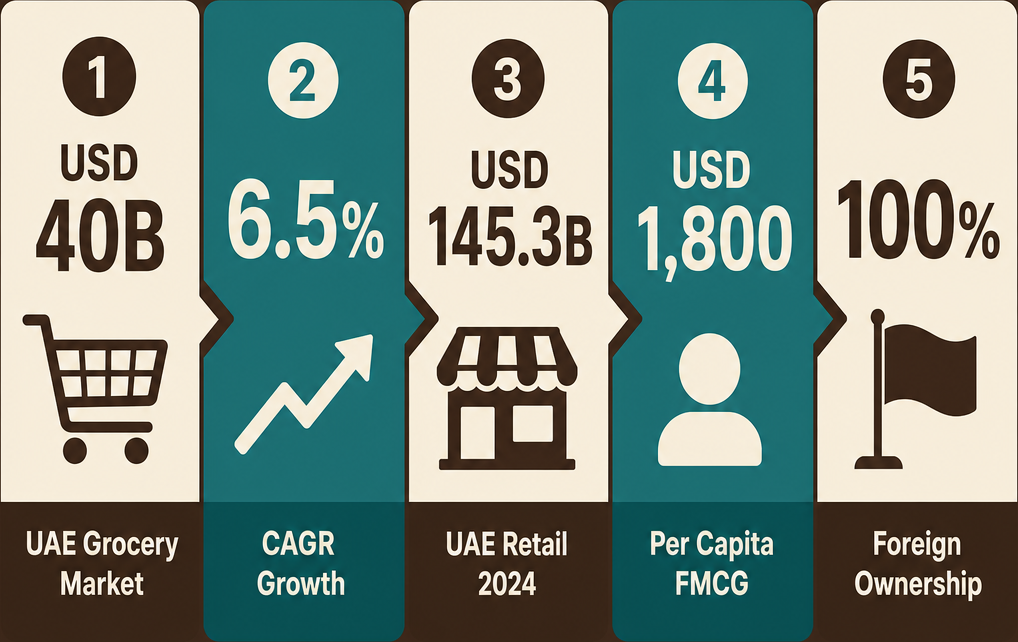
The UAE retail market was valued at USD 145.3 billion in 2024 and is projected to reach USD 227.1 billion by 2033, with grocery retail alone growing at a 6.5% CAGR. Per-head FMCG spend is forecast at USD 1,600 to USD 1,800 in 2026, signalling sustained consumer purchasing power for premium products like specialty coffee.
Source From Established Coffee Origins for Market Credibility
Ethiopia, Yemen, Colombia, Brazil, and Indonesia are the main origins that resonate with UAE buyers across both specialty and traditional segments. Highlighting provenance and roast profiles is a proven way to justify premium pricing and build repeat purchase behaviour.
How to Start a Roastery Business in Dubai with Meydan Free Zone
A roastery is where green beans arrive and finished coffee leaves. Between those two points sits the roast itself, which is the whole product. Activity code 4711.96 covers running that operation: sourcing beans, roasting on site, and selling whole and ground coffee.
This guide covers what the license allows, who buys from you, the approval you need and the steps to get set up. Note the approval timing early: Dubai Municipality clears this activity after the trading license is issued.
Key Stats at a Glance
What This License Covers
Code 4711.96 covers roastery operations: sourcing green coffee, roasting it on the premises, and selling whole bean and ground coffee to customers. The roasting is what distinguishes this from a coffee shop or a grocery selling packaged beans.
The stated exclusion belongs to the wider retail class this code sits in: retail of fuel combined with food and beverages, where fuel dominates, sits under automotive fuel retail. That is unlikely to affect a roastery, so the boundaries worth actually checking are elsewhere.
Three of them matter. Serving prepared drinks to customers on the premises is food and beverage service, a different activity, so a roastery with a café counter may need both.
Supplying cafés and retailers in volume is business-to-business wholesale, which sits outside a retail code. And industrial-scale roasting for third-party brands moves toward food manufacturing rather than retail. Most roasteries end up doing at least two of these. Map your actual model against the codes before you apply, because roast, pour and wholesale are three different activities in licensing terms even though they happen in one room.
Who Your Clients Will Be
Home coffee buyers
Households buying whole bean or ground for home brewing, increasingly on subscription. They buy on origin, roast profile and freshness, and they return often, which makes them the most valuable customer per dirham spent on acquisition.
Cafés and hospitality
Independent cafés, restaurants and hotels buying roasted coffee in volume, often with a house blend developed for them. Lower margin, larger volume, and revenue that is contracted rather than hoped for.
Traditional and hospitality buyers
Arabic coffee remains a distinct market with its own profiles, cardamom and spice blends, and its own occasions. Households, majlis hospitality and event suppliers buy on a rhythm shaped by tradition rather than by trend.
Mainland or Free Zone
Roasting needs a real space. Machines, extraction, cooling, green bean storage and packing all take room and infrastructure, and that unit sits on the mainland, which points to a mainland license from the Department of Economy and Tourism for the operating business.
Meydan Free Zone gives you 100% foreign ownership and a low cost base, and it fits an online and subscription coffee business, an import arm bringing in green beans, or a holding entity above several outlets.
Ventilation and neighbours are the practical constraint people underestimate. Roasting produces smoke and a powerful smell, so extraction and unit selection matter as much as the roaster you buy, particularly in a mixed retail or residential building.
[blockCTACostCalculator]
Step-by-Step Setup Guide
- Step 1, decide what happens in the room: Roast only, roast and serve, or roast and wholesale. This determines how many activities your license needs.
- Step 2, secure premises with extraction in mind: Roasting needs ventilation, power and green storage. Confirm the landlord and building permit what you plan to install.
- Step 3, choose your jurisdiction: Mainland through DET for the roastery itself, or Meydan Free Zone for online, subscription and import operations.
- Step 4, book your trade name: Check availability through the DET or Meydan Free Zone portal, following UAE naming conventions.
- Step 5, get the license, then the municipality approval: Dubai Municipality clearance follows the license and precedes trading. Do not commit to opening dates before it is in hand.
- Step 6, build origin sourcing: Importers or direct relationships with producers. Consistency of supply matters more than a single exceptional lot.
- Step 7, develop your roast profiles: This is the product. Profiles for filter, espresso and traditional Arabic preparation are different jobs, and each takes time to dial in.
- Step 8, open a bank account and register for VAT: Register with the Federal Tax Authority once turnover passes AED 375,000.
Compliance and What You Need in Place
Dubai Municipality approval comes after the license
This activity carries Dubai Municipality approval sequenced after the trading license. You can be licensed and still not cleared to trade, so build that gap into the launch plan and hold off on opening commitments until clearance is through.
Food handling applies to green and roasted coffee
Coffee is a food product. Green bean storage, pest control, humidity management, roasting hygiene and packing all fall under food safety, and imported green coffee comes with import clearance and documentation of its own.
Labelling and origin claims
Roast date, origin, variety and processing method are what specialty customers buy on, and single-origin or certification claims need to be supportable. Arabic labelling applies to packaged retail product.
AML and VAT
This activity is exempt from AML duties. Register with the Federal Tax Authority once turnover passes AED 375,000.
Market Opportunity
Coffee sits inside a large and growing grocery market. UAE grocery retail is worth around USD 40 billion and growing at 6.5% CAGR, within a total retail market moving from USD 145.3 billion in 2024 toward USD 227.1 billion by 2033. FMCG spending per head at USD 1,600 to USD 1,800 in 2026 supports premium rather than price-led positioning.
What makes the UAE unusual is that two coffee cultures run side by side. Arabic coffee carries centuries of hospitality tradition and its own preparation and profiles. Specialty coffee brings single-origin sourcing, light roasting and an audience that reads a roast date. A roastery can serve one properly or bridge both, and few markets offer that choice.
The channel mix is the commercial advantage. A roastery can sell across a counter, supply cafés wholesale, and ship subscriptions nationally from the same batch. That spread smooths the seasonality that hits any single channel, provided the licensing covers each one.
Conclusion
Code 4711.96 covers a business with a real product advantage: freshly roasted coffee is measurably different from packaged, and customers can taste it. That is a defensible position against supermarket competition.
The licensing sequence needs respecting. Dubai Municipality clears you after the license and before you trade, and premises with proper extraction are harder to find than the code suggests.
Settle the scope question first. Roasting, serving and wholesaling are three activities, and most roasteries want at least two. Speak to the Meydan Free Zone team to confirm the right structure for the model you plan to run.
[blockCTAContact]