Table of Contents
Topic Summary
Understand Exactly What License 4773.d9 Covers
Activity code 4773.d9 authorizes the sale of satellite components, subsystems, and spare parts used in building, operating, and maintaining satellites. It does not cover manufacturing those parts yourself, operating satellites, or providing satellite communications services.
Confirm Approvals Before You Start Trading
The source licensing page leaves the third-party approval section blank, which should not be treated as automatic clearance. You must confirm the approval position in writing with both the licensing authority and the UAE Space Agency, as satellite parts are export-sensitive goods.
Know the Massive Market You Are Entering
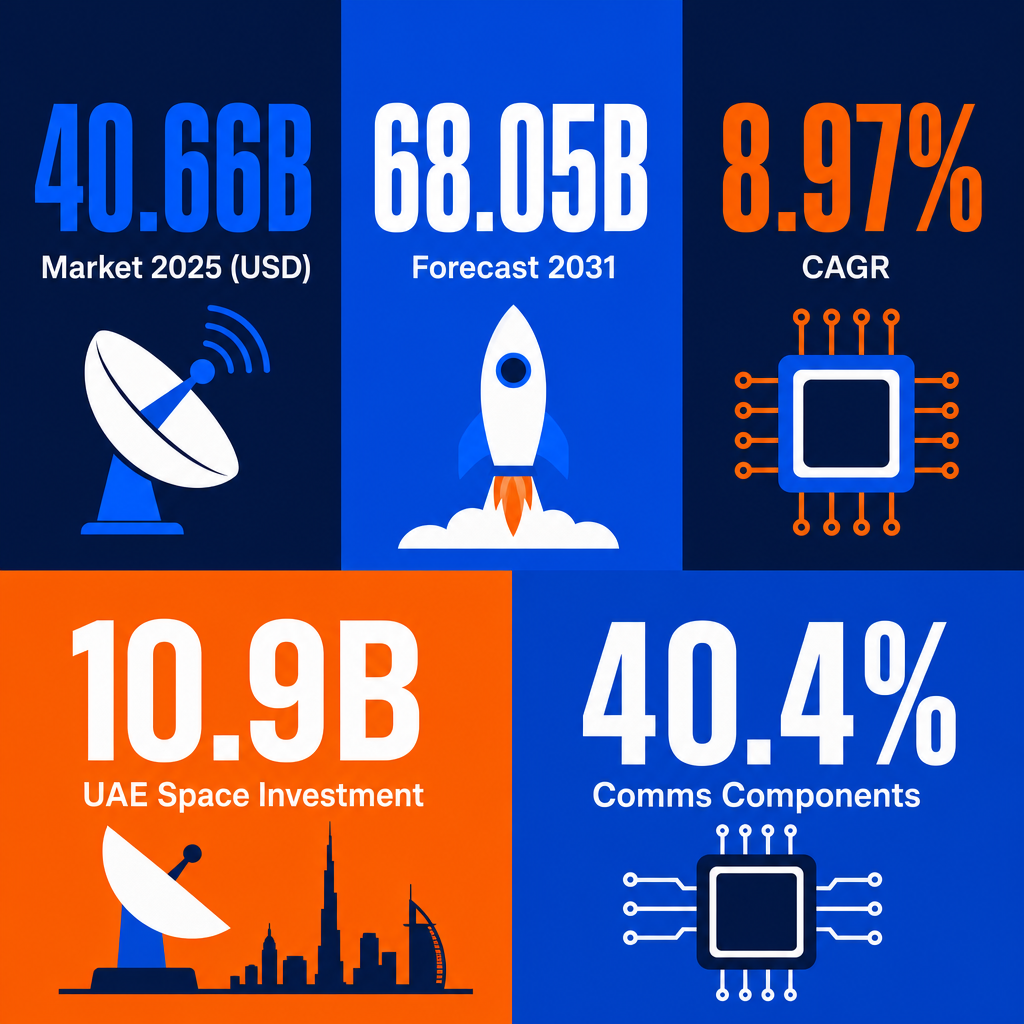
The global satellite parts and components market is valued at USD 40.66 billion in 2025 and is projected to reach USD 68.05 billion by 2031 at an 8.97% CAGR. Communication systems and propulsion hardware dominate demand, while software is the fastest-growing segment.
Identify Your Most Likely Buyers Early
Your customers will primarily be satellite operators, system integrators, research institutions, and defence-linked programmes rather than individual consumers. These are highly technical, documentation-heavy buyers who will scrutinize tolerances, qualification standards, and part traceability.
Clarify Whether a Retail Code Fits Your B2B Model
Code 4773.d9 sits within a retail classification, yet almost every real buyer in this sector is an institution purchasing in volume. Confirm with the licensing authority before applying that this specialized retail sub-code legally covers the business-to-business model you plan to operate.
Leverage Meydan Free Zone's Ownership and Tax Benefits
Meydan Free Zone allows 100% foreign ownership and zero corporate tax on qualifying income, making it an attractive base for international satellite parts trading. However, supplying UAE mainland institutions directly may require routing through a separate mainland entity.
Position for the UAE's Growing Space Investment
The UAE has committed approximately AED 40 billion (around USD 10.9 billion) to space investment, creating strong local demand for satellite components. Space observation is the fastest-growing end-use segment globally, expanding at an 11.47% CAGR through 2031.
How to Start a Satellites’ Components and Spare Parts Trading Business in Dubai with Meydan Free Zone
Satellites are assembled from thousands of specified parts: communication subsystems, propulsion hardware, power systems, structural elements and the software that runs them. Somebody has to source and supply those parts. Activity code 4773.d9 is the license for doing it.
This guide covers what the license allows, who buys from you, the approval position and the steps to get set up. Read the compliance section carefully. The source page leaves its approval section blank, and on this particular category that silence should not be read as clearance.
Key Stats at a Glance
| Activity code | 4773.d9, within ISIC class 4773, retail sale of other new goods in specialised stores |
|---|---|
| Activity name | Satellites' Components and Spare Parts Trading |
| What it covers | Sale of components, subsystems and spare parts used in the manufacture, assembly, operation and maintenance of satellites |
| Third-party approval | Not stated on the source page. These are export-sensitive goods, so confirm the position in writing with the licensing authority and the UAE Space Agency before trading |
| AML compliance | Not stated on the source page. Confirm in writing |
| Satellite parts and components market | USD 40.66 billion in 2025, reaching USD 68.05 billion by 2031 at 8.97% CAGR – Mordor Intelligence |
| Satellite manufacturing market | USD 22.5 billion in 2024, projected at USD 57.2 billion by 2030 at 16.1% CAGR – Grand View Research |
| Component demand by subsystem | Communication systems at 40.4% and propulsion hardware at 33.8%, with software the fastest-growing segment at 10.47% CAGR |
| Fastest-growing end use | Space observation, at 11.47% CAGR through 2031 – Mordor Intelligence |
| UAE space investment | AED 40 billion, around USD 10.9 billion – Economy Middle East |
| Foreign ownership | 100% in Meydan Free Zone, with zero corporate tax on qualifying income |
What This License Covers
Code 4773.d9 sits inside ISIC class 4773, which covers retail of new goods across specialised product categories. This sub-code is designated for satellite components and spare parts: the subsystems, electronic components and replacement parts used to build, operate and maintain satellites, sold through a specialised commercial channel.
The exclusions are the rest of class 4773, which covers unrelated categories from jewellery to cleaning materials to stamps and coins. Nothing there overlaps with space hardware, so the boundaries worth checking sit elsewhere.
Three of them matter. Manufacturing components yourself is a production activity rather than a trading one. Operating satellites or providing satellite communications services is a different sector entirely, regulated separately.
And supplying manufacturers and government bodies in volume is business-to-business wholesale, which sits outside a retail class despite being exactly how this trade works in practice. That last point deserves attention before you apply. Almost every buyer in this category is an institution, not a consumer, so confirm with the licensing authority that a specialised retail sub-code covers the model you intend to run.
Who Your Clients Will Be
Satellite operators and space agencies
Organisations running satellites need replacement parts and subsystems across the operational life of each spacecraft. Procurement is formal, specifications are exact, and traceability of every part is part of the purchase.
System integrators and manufacturers
Firms building satellites or subsystems, buying components for integration. Technical depth matters here: the buyer is an engineer who will ask about tolerances, qualification standards and heritage.
Research institutions and defence buyers
Universities, research bodies and defence-linked programmes. The most documentation-heavy customers, and the ones most likely to bring export control and end-use questions into the transaction.
Mainland or Free Zone
| Factor | Mainland (DET) | Free Zone (Meydan Free Zone) |
|---|---|---|
| Supplying UAE institutions | Direct across the local market | Through a mainland entity for some public procurement |
| Import and re-export | Standard customs route | Well suited to import, hold and re-export |
| Foreign ownership | Set by DET rules for the activity | 100% yours |
| Corporate tax | 9% above AED 375,000 taxable income | Zero on qualifying income, subject to the conditions |
| Premises | Office and controlled storage registered on Ejari | Flexi-desk for the admin side, with controlled storage held separately |
This is a low-volume, high-value trade with no showroom, which makes a lean structure workable. Meydan Free Zone gives you 100% foreign ownership and a low fixed cost base, and it suits an import and re-export model serving regional programmes.
A mainland license from the Department of Economy and Tourism suits a supplier focused on UAE institutional and government procurement, where local presence and contract arrangements often matter.
Storage is specialised rather than large. Satellite components need controlled conditions, static protection and secure handling, and the documentation chain travels with each part. Space matters less than control.
[blockCTACostCalculator]
Step by Step Setup Guide
- Step 1, confirm the approval position in writing: The source page states nothing. Ask the licensing authority and the UAE Space Agency what applies to your product list before committing anything else.
- Step 2, understand export controls on your range: Satellite components are commonly controlled goods in their country of origin. Establish what permits your suppliers need to ship to you, and what you need to ship onward.
- Step 3, define your product scope: Communication subsystems, propulsion, power, structural or software. Each has different suppliers and different control regimes.
- Step 4, choose your jurisdiction: Meydan Free Zone for import and regional re-export, or mainland through DET for UAE institutional procurement.
- Step 5, book your trade name: Check availability through the DET or Meydan Free Zone portal, following UAE naming conventions.
- Step 6, build supplier authorisations: Component makers appoint distributors carefully in this sector, and end-user documentation is part of every agreement.
- Step 7, set up traceability: Certificates of conformity, batch and lot records and full provenance. In space hardware, a part without documentation is unusable.
- Step 8, collect your license, open a bank account and register for VAT: Register with the Federal Tax Authority once turnover passes AED 375,000.
Compliance and What You Need in Place
The blank approval section is the main risk here
The published activity page leaves third-party approval, AML and references empty, and states no approval position anywhere in its text. On most categories that is an editorial gap.
On satellite components it is a serious one, because space hardware sits close to defence and dual-use classifications in most jurisdictions. Get written confirmation from the licensing authority and the UAE Space Agency covering your specific product list, and keep it on file before you trade.
Export controls follow the goods, not the license
A UAE trade license does not override the export rules of the country a component came from. End-user certificates, re-export conditions and destination restrictions attach to the part itself, and breaching them is a matter for the exporting country's authorities as well as your own.
Traceability is the product
Buyers purchase documented provenance as much as hardware. Certificates of conformity, test records and unbroken chain of custody are what make a component usable on a spacecraft.
VAT
Register with the Federal Tax Authority once turnover passes AED 375,000.
Market Opportunity
The market is expanding quickly. Satellite parts and components stood at USD 40.66 billion in 2025 and are forecast at USD 68.05 billion by 2031 at 8.97% CAGR, while satellite manufacturing itself grows faster, from USD 22.5 billion in 2024 toward USD 57.2 billion by 2030 at 16.1% CAGR. Low Earth orbit constellations, defence programmes and commercial satellite services are all driving that.
The demand splits usefully by subsystem. Communication systems take 40.4% of component demand and propulsion hardware 33.8%, while software is the fastest-growing component segment at 10.47% CAGR and space observation the fastest-growing end use at 11.47% CAGR through 2031.
The UAE has built a real position rather than an aspirational one. Space sector investment has reached AED 40 billion, around USD 10.9 billion, and the Mohammed Bin Rashid Space Centre has developed and launched DubaiSat-1, DubaiSat-2, KhalifaSat and the MBZ-SAT earth observation satellite.
The UAE Space Agency's National Space Strategy 2030 sets the framework for growing the sector and attracting private participation, which is what turns sovereign programmes into a supply chain a trader can serve.
Conclusion
Code 4773.d9 covers a small, technical, high-value trade in a sector the UAE is deliberately building. Domestic programmes with a launch record create real local demand rather than speculative opportunity.
The barrier is not capital. It is supplier authorisation, documentation discipline and understanding the control regime attached to every part you handle.
Settle the regulatory position before anything else. The source page says nothing about approvals on a category where that silence is least safe to assume. Speak to the Meydan Free Zone team once you have written confirmation of what applies to your range.
[blockCTAContact]