
Table of Contents
Frequently Asked Questions
What is activity code 7420.03 and what does it cover
Activity code 7420.03 is the official UAE classification for Photojournalists, sitting under the ISIC category of other professional, scientific and technical activities. It specifically covers photography produced for news, editorial, and documentary purposes.
It is distinct from related but separate classifications such as commercial photography, event photography, and studio portraiture — each of which carries its own activity code. If your work spans multiple categories, you may need to list more than one activity on your licence.
Is a media permit required to operate a photojournalism business in Dubai
Yes. A UAE Media Council permit is mandatory for any entity that produces or distributes media content commercially in the UAE. This applies to photojournalism businesses regardless of whether they are registered on the mainland or in a free zone.
Applications are submitted directly through uaemc.gov.ae. Operating without this permit exposes your business to financial penalties, and the permit should be obtained before you begin commercial activity — not retrospectively.
How long does it take to set up a photojournalism business in Dubai
The typical setup timeline is 7–15 working days for a free zone structure, provided all documents are complete and submitted correctly. Delays most commonly occur when the media permit step is skipped or reordered in the process.
Mainland registration via the Dubai Department of Economy and Tourism may involve additional steps, particularly if government contracts or cross-emirate operations are intended. Having a clear business plan summary and a well-prepared document pack will help minimise processing time at every stage.
What is the difference between mainland and free zone registration for a photojournalist
Mainland registration through the Dubai Department of Economy and Tourism allows unrestricted work across all seven emirates and enables direct government contracts — an important consideration if your client base includes UAE public sector entities.
A free zone structure — such as through Meydan — offers 100% foreign ownership, no currency restrictions, and a streamlined professional licence suited to independent practitioners and small agencies. Free zones are generally better suited to photojournalists whose primary clients are international media organisations rather than local government bodies.
What documents are typically needed to incorporate a photojournalism business in Dubai
Standard incorporation documents for activity 7420.03 typically include passport copies, a visa page, a No Objection Certificate (NOC) if you are currently on an existing UAE visa, and a business plan summary.
When opening a corporate bank account, media businesses should also prepare a clear description of their revenue model and client base, as UAE banks commonly apply additional due diligence to entities in the media sector.
When does a photojournalism business in Dubai need to register for VAT
VAT registration with the Federal Tax Authority becomes mandatory when annual turnover exceeds AED 375,000. Businesses approaching this threshold should monitor their revenue carefully and register before the threshold is breached rather than after.
Revenue streams that count toward this threshold include assignment fees, image archive licensing, retainer contracts with media houses, and syndication arrangements — all common income sources for photojournalists operating in the Dubai market.
What types of clients and revenue streams are typical for a photojournalism business in Dubai
Typical clients include regional and international news agencies, print and digital magazines, NGOs, government communications offices, and media platforms. Dubai's high event density creates consistent year-round demand, with major events such as GITEX Technology Week, the Dubai Airshow, and an extensive international sports calendar all requiring editorial coverage.
Revenue is commonly generated through assignment fees, image archive licensing, retainer contracts with media houses, and syndication arrangements. The Dubai Culture and Arts Authority and Visit Dubai both document the scale of the city's cultural programming, providing useful commercial context for new entrants to the market.
Are press credentials and location permits needed to operate as a photojournalist in Dubai
Yes. If you are operating in news contexts, you should coordinate with the Dubai Film and TV Commission to obtain shoot permits for specific locations. This is a separate requirement from your trade licence and media permit, and applies to assignments at regulated or restricted sites.
Press credentials are also relevant for access to major events and venues. Establishing these credentials early — and maintaining them as part of your compliance framework — reduces friction when taking on time-sensitive editorial assignments across the emirate.
How to Start a Photojournalism Business in Dubai
Dubai is one of the most photographed cities in the world, and the commercial demand for photojournalism work here is real and growing. Major international events, a busy news cycle, and a media market that spans print, broadcast, and digital all create steady work for photographers who operate professionally.
This guide covers what license you need, where to set up, and what compliance looks like before you start shooting professionally. If you are a freelance photojournalist, a wire agency, or a documentary photographer looking to base yourself in the UAE, this is where to start.
| Activity | Photojournalism |
|---|---|
| Jurisdiction options | Mainland (DET) or Meydan Free Zone |
| Foreign ownership | 100% permitted in Meydan Free Zone |
| UAE Media Council registration | Required for press and editorial content distributed in the UAE – UAE Media Council |
| Filming permits | Required for specific locations – Dubai Film and TV Commission |
| VAT threshold | AED 375,000 annual turnover triggers mandatory registration – Federal Tax Authority |
What a Photojournalism License Covers
A photojournalism license covers editorial photography: news imagery, documentary work, and press assignments. You are licensed to capture and supply images for publication in newspapers, magazines, online news outlets, and broadcast media.
It does not cover commercial advertising photography. If you want to shoot product campaigns or brand content, that sits under a separate activity code. Many photographers hold both, but they are distinct activities and need to be listed correctly on your license from the start.
The UAE Media Council oversees press and media activity in the country. If you are distributing editorial content to UAE-based publications or platforms, you need to register with the council. This applies whether you are based on the mainland or in a free zone.
Press card requirements also apply. Working journalists and photographers covering news in Dubai need a valid press card. The UAE Media Council issues these, and you will need your trade license in place before you can apply. Check the UAE Media Council website for the current application process and document list.
If you plan to cover a wide range of business activities beyond photojournalism, confirm each code is approved in your chosen jurisdiction before you apply. Adding activities later is possible but adds time and cost.
Mainland vs Meydan Free Zone
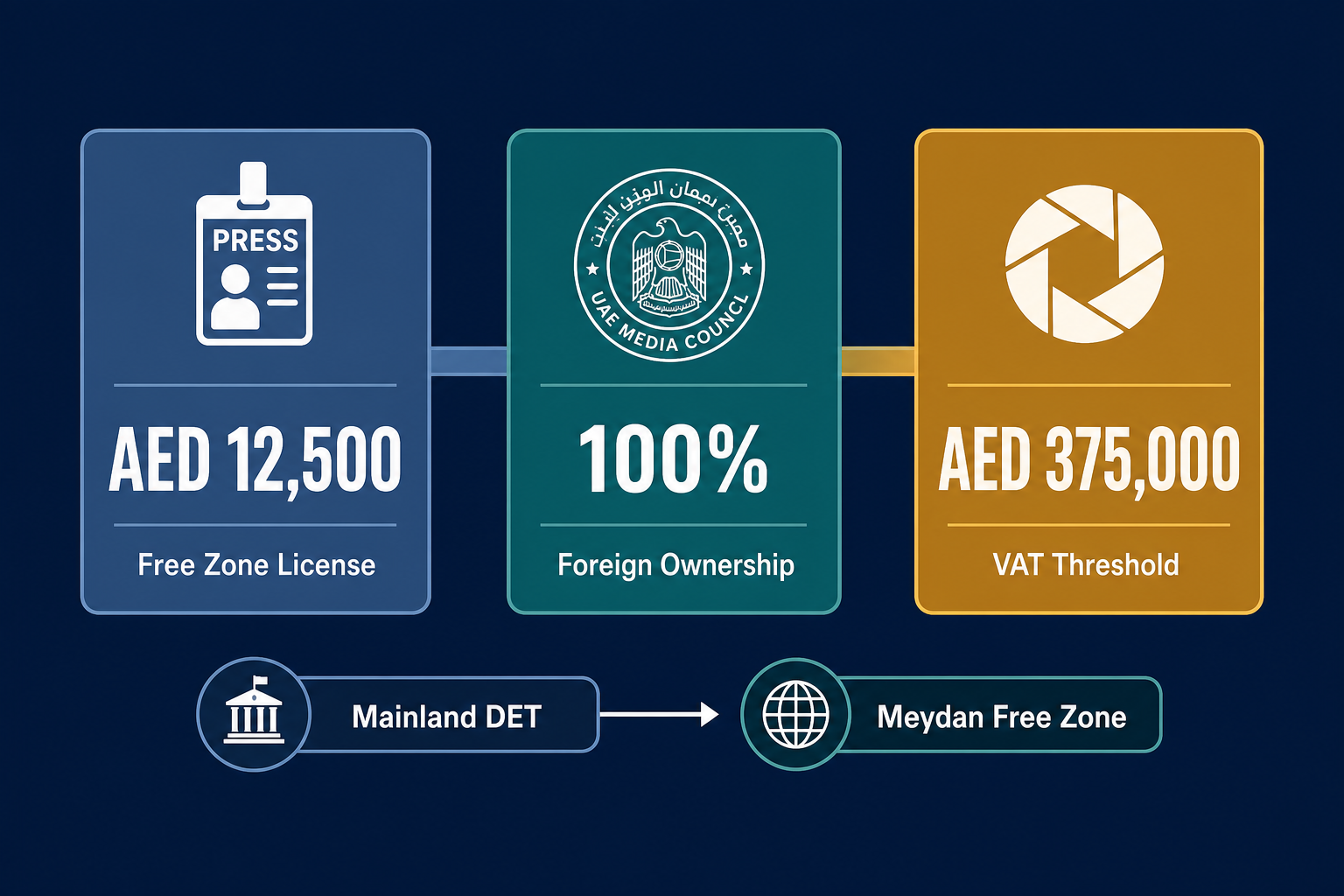
This is the biggest choice you will make when setting up. Let your clients decide it, not the price.
| Factor | Mainland (DET) | Meydan Free Zone |
|---|---|---|
| Client access | Direct work with UAE government bodies, local newspapers, and broadcast outlets | Mainly international clients and wire agencies |
| Foreign ownership | 100% permitted in most activities since 2021 | 100% permitted |
| Office requirement | Physical office required | Flexi-desk options available |
| Setup cost | Generally higher | Lower entry point – Trade License from AED 12,500 |
| Visa eligibility | Based on office space and headcount | Included in most packages |
A mainland license from the Department of Economy and Tourism (DET) lets you work directly with UAE government bodies, local newspapers, and broadcast outlets. If your target clients are UAE-based media organisations or public sector communications teams, mainland is the right call.
Meydan Free Zone suits freelancers, international wire agencies, and photographers whose clients are mostly outside the UAE. You get 100% foreign ownership, lower setup costs, and flexi-desk options instead of a fixed office. If you are planning to start a business remotely before relocating, a free zone setup makes that process simpler.
Work without the right license and you risk fines, cancelled contracts, and damage to your name. Get the jurisdiction right from the start.
Free Business Setup Cost Calculator
Calculate NowStep-by-Step Setup Guide
- Step 1, book your trade name: Use the DET e-Services portal for a mainland company, or the Meydan Free Zone portal for a free zone one. Check your company name availability before you submit. Names must not conflict with existing registrations and must not include restricted words.
- Step 2, pick your activity code: Confirm the photojournalism code is approved in your chosen jurisdiction before you go further. If you want to add commercial photography as a second activity, confirm that too.
- Step 3, choose your jurisdiction: Mainland or Meydan Free Zone. Use the client logic above, not the price. Once you are set up, switching jurisdiction is possible but disruptive.
- Step 4, submit your documents: You will need your Memorandum of Association (MOA), passport copies for all shareholders, and a No Objection Certificate if you are currently employed in the UAE. Meydan Free Zone handles the submission process directly.
- Step 5, get initial approval and pay your fees: Once the authority reviews your application, you get initial approval. Pay your license fees to receive the trade license.
- Step 6, get your visa and Emirates ID: Your trade license lets you apply for a UAE residence visa. After the medical fitness test and biometrics, you get your Emirates ID. Meydan Free Zone's mResidency service covers this process. If you need to sponsor family members, the dependent visa process runs alongside your own application.
- Step 7, open a UAE business bank account: You need your trade license, Emirates ID, and company documents. Free zone companies can open accounts at most UAE banks. If you want support with this, business banking support through mCore can help you navigate the process.
- Step 8, register with the UAE Media Council: If you are distributing press or editorial content locally, register with the UAE Media Council and apply for your press card. Do this before you start taking assignments.
Compliance, Permits, and What You Need in Place
Most photojournalism businesses in Dubai get the license right and then get caught out on compliance. Here is what you need to have in place before you start working.
UAE Media Council registration
The UAE Media Council oversees press and editorial content distributed in the UAE. If you are supplying images to UAE-based publications or platforms, you need to register. This is not optional, and it applies to free zone companies as well as mainland ones. Check the UAE Media Council for current registration requirements.
Filming permits
Specific locations in Dubai need prior approval before you can shoot. This includes government buildings, airports, metro stations, and many public spaces. The Dubai Film and TV Commission handles permit applications. Some permits are issued quickly; others need lead time. Build this into your assignment planning. Check the Dubai Film and TV Commission for the current permit list and application process.
VAT registration
Once your annual turnover crosses AED 375,000, you must register for VAT with the Federal Tax Authority. Voluntary registration is possible below that threshold. If you are supplying images to international clients, those sales may be zero-rated, but you still need to account for them correctly. Get your bookkeeping in order from the start. Meydan Free Zone's mAccounting service covers VAT registration support and ongoing compliance.
Contracts and IP ownership
Work-for-hire norms in the UAE differ from Western markets. By default, the photographer often retains copyright unless a contract explicitly transfers it. Many local media organisations will ask you to sign contracts that assign all rights. Read every contract before you sign. If you are supplying to international wire agencies, their standard agreements will govern usage rights. Get legal advice if you are unsure.
Corporate tax
The UAE introduced a 9% corporate tax on business profits above AED 375,000 from June 2023. Most small photojournalism businesses will sit below this threshold in their early years, but you need to register regardless. Meydan Free Zone's mAccounting service includes corporate tax services in Dubai to keep you compliant.
Market Opportunity in Dubai
Dubai's events calendar drives consistent editorial demand. The Expo legacy infrastructure, Dubai Airshow, Dubai World Cup, and GITEX Technology Week all bring international press to the city and generate assignment work for locally based photojournalists. Being on the ground here matters. Wire agencies and international publications want photographers who can respond quickly.
International wire agencies, regional broadcasters, and luxury brands all commission photojournalism work in Dubai. The city's visual identity, from its skyline to its cultural events, makes it a regular subject for global media. If you build relationships with international desks early, the work comes steadily.
The Dubai Culture and Arts Authority supports documentary and cultural photography projects. If your work has a cultural or heritage angle, it is worth checking their funding and partnership programmes. Visit the Dubai Culture and Arts Authority for current initiatives.
Digital-first regional media is also growing fast. New online news outlets, lifestyle platforms, and Arabic-language digital publications are commissioning original photography at a rate that did not exist five years ago. These clients often move quickly and pay on shorter cycles than traditional print media.
The Dubai Department of Economy and Tourism also publishes data on visitor numbers and major events that can help you plan your editorial calendar and pitch to international clients with confidence.
Conclusion
A photojournalism business in Dubai is workable from a free zone if your clients are international, or from the mainland if you are targeting local media and government bodies. The license is simple to get. The compliance around filming permits and media registration is where most founders get caught out. Sort those before you start taking assignments, not after.
Meydan Free Zone offers a straightforward path for international photographers and freelancers. Business setup in Dubai through Meydan gives you 100% foreign ownership, flexi-desk options, and support services that cover everything from visa processing to accounting. Talk to Meydan Free Zone to confirm your activity code and get a cost estimate before you commit to a jurisdiction.
Ready to Launch Your Business in Dubai?
Let's Connect