
Table of Contents
Frequently Asked Questions
What is activity code 6020 and what does it allow a television broadcasting business to do in Dubai
Activity code 6020 covers Television Programming and Broadcasting Activities in Dubai. Under this classification, a licensed entity is permitted to operate a television channel, produce original programming, run an OTT platform, conduct live broadcasts, and license or syndicate content to third parties.
Permitted business models include subscription-based services, advertising-funded broadcast, B2B content licensing to distributors or streaming platforms, and co-production arrangements with government or commercial partners. The activity accommodates both traditional linear broadcast and digital-first distribution formats.
Which regulatory bodies oversee television broadcasting in Dubai and the UAE
Regulation sits with two primary bodies. The UAE Media Council governs broadcast licensing and content compliance at the national level. The Dubai Film and TV Commission facilitates production and distribution activity specifically at the emirate level.
Where a broadcast operation involves spectrum use or satellite transmission, the Telecommunications and Digital Government Regulatory Authority (TDRA) issues the relevant spectrum and transmission approvals. OTT-only operations have a simpler technical approval path, though content licensing obligations remain identical across all formats.
Is a broadcast licence mandatory before going live with a television or streaming service in Dubai
Yes. A broadcast licence issued by the UAE Media Council is a mandatory prerequisite before any broadcast or streaming output goes live. Operating without one carries material legal risk.
The Media Council application requires a defined content scope, ownership structure, editorial policy, and a technical broadcast plan. There is no legal pathway to begin transmitting content — whether over-the-air or via OTT — without this licence in place first.
What content is prohibited under UAE media law for television broadcasters
UAE media law prohibits material that conflicts with public order, national values, or religious sensitivities. This applies equally to linear broadcast channels and OTT platforms operating under a UAE licence.
Operators are required to establish an editorial compliance process prior to broadcast. The UAE Media Council publishes the applicable content classification framework, and adherence to it is a condition of licence retention. Non-compliance can result in licence suspension or revocation.
What are the VAT and corporate tax obligations for a television broadcasting business in Dubai
Media businesses generating revenue above the VAT registration threshold of AED 375,000 must register with the Federal Tax Authority and charge VAT accordingly.
Corporate tax at 9% applies to taxable income above AED 375,000 under the UAE's current framework. However, free zone entities on qualifying income may benefit from a 0% corporate tax rate, subject to meeting substance requirements as defined by the relevant regulations.
Why is Dubai considered a stronger base for television broadcasting than other MENA cities like Riyadh or Cairo
Dubai's advantage over other MENA hubs lies in its infrastructure depth. This includes extensive fibre connectivity, satellite uplink facilities, a mature free zone ecosystem, and a resident talent pool with multilingual production capability.
The UAE media and entertainment market is projected to exceed USD 4 billion by 2027, and internet penetration stands above 99%, supporting rapid OTT and streaming growth. The emirate also hosts hundreds of licensed media entities across broadcast, digital, and production verticals, creating a well-developed commercial ecosystem for new entrants.
Who are the typical target customers for a television broadcasting business operating out of Dubai
Target customers span several distinct segments. These include regional advertisers seeking broadcast inventory, content distributors requiring localised programming, and international streaming platforms sourcing Arabic-language content.
Government entities commissioning public information or cultural programming also represent a significant customer category. The MENA region's population of more than 400 million people provides the underlying audience base that makes these commercial relationships viable for broadcasters operating from Dubai.
What is the scale of the UAE media and entertainment market and what is driving its growth
The UAE media and entertainment market is projected to exceed USD 4 billion by 2027, according to Mordor Intelligence. Internet penetration in the UAE stands above 99%, which is directly supporting rapid growth in OTT and streaming services, as reported by the TDRA.
Dubai serves as the operational base for a significant share of the region's broadcast infrastructure, with the emirate's free zone ecosystem and the active facilitation role of the Dubai Film and TV Commission attracting both international and regional production and distribution operations.
How to Start a Television Broadcasting Business in Dubai
Dubai is one of the most active media markets in the Arab world, and television broadcasting here is a licensed, regulated activity with real commercial weight behind it. The sector draws international broadcasters, regional content producers, and niche channel operators, all working within a structured approval framework.
This guide covers the license you need, where to set up, how the approval process works, and what compliance looks like once you are on air.
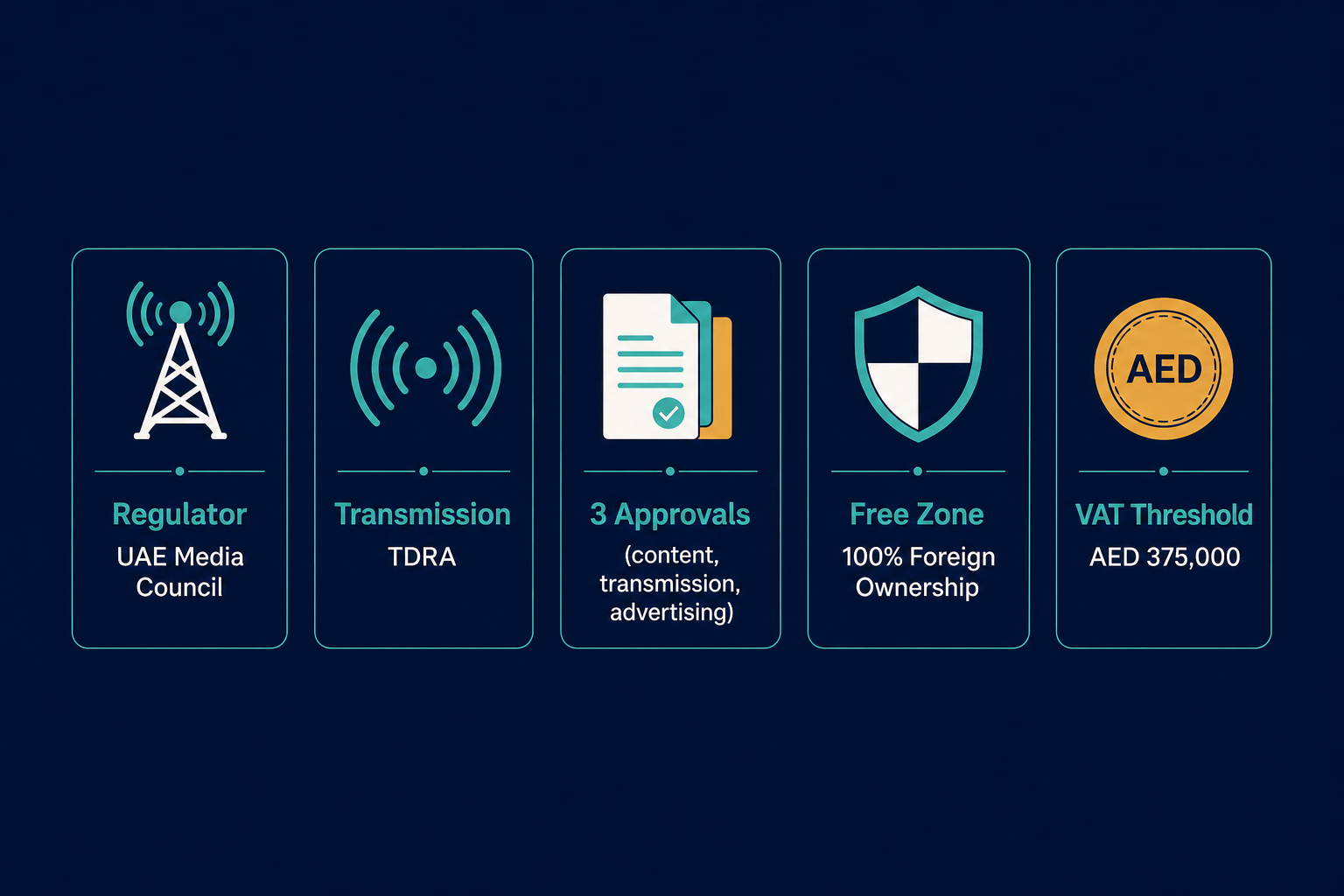
| Regulator | UAE Media Council – uaemc.gov.ae |
|---|---|
| Transmission oversight | Telecommunications and Digital Government Regulatory Authority (TDRA) – tdra.gov.ae |
| Production-linked broadcast | Dubai Film and TV Commission – filmdubai.gov.ae |
| Free zone setup | Meydan Free Zone – 100% foreign ownership available |
| VAT threshold | AED 375,000 annual revenue |
What the License Covers and Who Regulates It
The UAE Media Council sets the rules for broadcast content and channel licensing in the UAE. If you want to operate a television channel, whether free-to-air, satellite, or digital, you need their approval before you go live. There is no route around this.
The activity covers a broad range of broadcast formats. Free-to-air terrestrial channels, satellite distribution, and digital TV broadcasting all fall under this umbrella. Each has its own technical and editorial requirements, but the Media Council is the common point of approval for all of them.
It is worth knowing that the license is not a single document. You need separate approvals for content, transmission, and commercial advertising. These run in parallel but they are not the same application. Content approval covers what you broadcast. Transmission licensing, handled by the TDRA, covers how the signal gets out. Advertising approval covers commercial spots and sponsored content shown on your channel.
If your operation combines broadcasting with production, the Dubai Film and TV Commission becomes relevant. They handle permits and support for production-linked broadcast operations, including location shoots and studio-based productions that feed into a broadcast schedule. If you are building a channel that produces its own content rather than just distributing licensed material, get them involved early.
The key point is this: the trade license from your chosen jurisdiction, whether mainland or free zone, is not enough on its own. The UAE Media Council broadcast license is a separate regulatory requirement, and you cannot legally transmit without it.
Mainland vs Meydan Free Zone: Where to Set Up
This is the biggest choice you will make when setting up. Let your clients and your revenue model decide it, not the cost alone.
A mainland license from the Dubai Department of Economy and Tourism (DET) lets you work directly with UAE government bodies and local advertising clients. If your channel targets the UAE domestic market and you want to sign contracts with UAE-based brands, government entities, or local media buyers, a mainland setup gives you the clearest path to those relationships. The trade-off is higher overhead, a physical office requirement, and more administrative steps.
Meydan Free Zone offers 100% foreign ownership, faster setup, and lower running costs. For international founders building a channel aimed at regional or diaspora audiences, or for operators who distribute primarily outside the UAE, a free zone setup is often the more workable option. You can get a trade license, open a corporate bank account, and bring in staff without the overhead of a mainland entity.
One thing to be clear about: a free zone company broadcasting into the UAE market still needs UAE Media Council content approval. The free zone gives you the legal entity. The Media Council gives you permission to broadcast. These are separate, and neither replaces the other.
| Factor | Mainland (DET) | Free Zone (Meydan Free Zone) |
|---|---|---|
| Foreign ownership | 100% in most activities | 100% |
| UAE government contracts | Yes, direct access | Requires a local agent or branch |
| Office requirement | Physical office required | Flexi-desk options available |
| Setup speed | Longer process | Faster, more streamlined |
| Media Council approval | Required | Required |
| Best for | Local UAE advertising clients, government contracts | International distribution, diaspora channels, lower overhead |
If your revenue comes mainly from international distribution deals or advertising sold outside the UAE, Meydan Free Zone is the more practical base. If you are selling airtime to UAE brands and working with local media agencies, a mainland license gives you more commercial reach. You can also explore remote business setup options if you are not yet based in the UAE.
Free Business Setup Cost Calculator
Calculate NowStep-by-Step Setup Guide
The process has more layers than a standard trade license application. Plan for the Media Council approval to run alongside your company setup, not after it.
- Step 1, book your trade name: Use the DET e-Services portal for a mainland company, or the Meydan Free Zone portal for a free zone one. Use the Company Name Check tool to confirm availability before you go further. Avoid names that reference news, government, or religious content without prior approval.
- Step 2, select the correct activity code: Television broadcasting has a specific activity code. Confirm this with your chosen jurisdiction before submitting. Using the wrong code creates delays and may require a fresh application. Check the Business Activities List to find the right code for your operation.
- Step 3, submit your initial company application: For Meydan Free Zone, this covers your trade license application, shareholder details, and activity selection. You will get your initial approval and can then move to the regulatory steps.
- Step 4, apply to the UAE Media Council for your broadcast license: This is a separate application to the Media Council. You will need to show your proposed content format, editorial policy, target audience, and transmission plan. Budget time for this. It does not move at the same pace as a trade license.
- Step 5, get TDRA transmission approval: If you are broadcasting over a frequency or satellite, the TDRA needs to approve your transmission setup. This covers spectrum allocation and technical standards. Digital-only or OTT channels have a different path, but you still need to confirm your requirements with TDRA.
- Step 6, secure your office or studio space: Your premises need to meet the regulatory requirements set by the Media Council. A flexi-desk alone is unlikely to satisfy broadcast operation requirements. Plan for a proper production or broadcast facility.
- Step 7, register with MOHRE and handle staff visas: Once your trade license is issued, register with the Ministry of Human Resources and Emiratisation (MOHRE) to bring in staff. On-air talent, production crew, and technical staff all need valid UAE residence visas and work permits. Emiratisation duties apply once you reach the relevant headcount threshold.
- Step 8, open a UAE corporate bank account: Your trade license and company documents are what the bank needs. For free zone companies, mCore from Meydan Free Zone includes business banking support to help you through the process.
Compliance: What You Need in Place Before You Broadcast
Broadcasting in the UAE is not a self-regulated activity. There are multiple bodies watching different parts of your operation, and breaking the rules in any one area can get your channel suspended.
Content standards
The UAE Media Council sets and enforces content standards for all broadcast material. This covers news, entertainment, drama, religious content, and advertising. Content that conflicts with UAE law, public morality standards, or national security is not permitted. You need to understand these rules before you build your schedule, not after you go live.
Advertising rules
Commercial advertising broadcast in the UAE is subject to separate Media Council rules. Certain product categories face restrictions or require additional approvals. Alcohol advertising, for example, is not permitted on UAE television. Political advertising has its own framework. Get the full list from the Media Council before you sign any advertising contracts.
Transmission and spectrum
The TDRA oversees spectrum allocation and transmission licensing. If you are using a broadcast frequency, you need their approval. Operating without it is a regulatory offence. For satellite or digital distribution, confirm your specific obligations with TDRA early in the process.
VAT registration
Once your annual revenue crosses AED 375,000, you must register with the Federal Tax Authority (FTA) for VAT. Advertising revenue, subscription income, and distribution fees all count toward the threshold. If you expect to reach this quickly, register early. You can also get VAT registration support through Meydan Free Zone's mAccounting service.
Employment and staff clearances
Employment contracts must comply with UAE Labour Law. On-air talent and production staff need valid work permits before they start. Any staff accessing broadcast facilities may also need security clearances depending on the nature of your operation. Get this sorted before you hire, not after.
Corporate tax
The UAE introduced a 9% corporate tax on profits above AED 375,000. Free zone entities can access a 0% rate on qualifying income, but this depends on meeting the substance requirements set by the FTA. If you are setting up in Meydan Free Zone, confirm your qualifying status with an accountant before you assume the exemption applies. Meydan Free Zone's mAccounting service covers corporate tax services in Dubai if you need support.
Market Opportunity in Dubai Television Broadcasting
Dubai sits at the centre of a media market that serves the Arab world, South Asia, and a large international diaspora. That gives a broadcast operation here a much wider potential audience than the UAE population alone suggests.
Demand for niche channels is growing. Diaspora communities across the GCC want content in their own languages, covering their own cultures. OTT-linked broadcast channels, which distribute via streaming platforms as well as traditional broadcast, are opening up new revenue models that did not exist five years ago. A channel that combines a UAE broadcast license with an OTT distribution deal can reach audiences across multiple markets from a single Dubai base.
Advertising spend in UAE broadcast media remains significant. According to data from Statista and IMARC Group, the UAE media and entertainment sector continues to attract strong advertising investment, driven by high consumer spending, a large expatriate population, and growing digital media consumption. Television remains a major channel for brand advertising in the region, particularly for FMCG, automotive, and financial services categories.
The UAE government's investment in the creative economy also supports long-term sector growth. Initiatives backed by the Dubai Culture and Arts Authority and broader national creative economy strategies create a favourable environment for media businesses that produce original content alongside their broadcast operations.
The opportunity is real. But it is a regulated market with genuine barriers to entry. That last part works in your favour once you are licensed and on air.
Conclusion
Television broadcasting in Dubai is workable for international founders, but it requires layered approvals from the UAE Media Council, TDRA, and your chosen licensing authority before you transmit a single frame. The trade license is the starting point, not the finish line.
Set up the legal entity first. Run the Media Council application in parallel. Get TDRA transmission approval in place before you go live. And make sure your content, advertising, and employment compliance is sorted before you hire anyone or sign any broadcast contracts.
Meydan Free Zone gives you a fast, cost-effective base for the legal entity side of this. The regulatory approvals are yours to manage, but having the right jurisdiction and activity code from day one makes everything that follows easier. Speak to Meydan Free Zone to confirm the right activity code and get your setup moving without delay.
Ready to Launch Your Business in Dubai?
Let's Connect