
Table of Contents
Frequently Asked Questions
What is activity code 4774.95 and what does it allow you to trade
Activity code 4774.95 covers Used Electrical & Electronic Appliances Trading and permits both retail and wholesale of second-hand electrical and electronic goods under a single licence.
Tradeable products include white goods such as washing machines, refrigerators, and dryers, as well as consumer electronics like televisions, audio equipment, and laptops, air conditioning units, kitchen appliances, and small domestic devices.
Because both retail and wholesale transactions fall within the same activity code, a trader can serve individual consumers and bulk-buying resellers or exporters without needing separate licences for each channel.
Why is Dubai a strong location for a used electrical appliances trading business
Dubai combines a large, fast-rotating expatriate population — exceeding 90% of residents — with world-class trade infrastructure, creating consistent demand for affordable used appliances and straightforward routes to export markets.
The city handles over 14 million tonnes of cargo annually through its ports and logistics network, supporting robust re-export activity into Africa, South Asia, and the broader MENA region, where appetite for quality second-hand electronics at competitive prices is strong.
Free zones, bonded warehousing, and established freight corridors give Dubai-based traders a structural advantage that mainland-only operators in other markets cannot easily replicate.
How does VAT work for used electrical appliances traders in the UAE
The Federal Tax Authority applies a margin scheme to second-hand goods, which means VAT is calculated on the profit margin rather than the full sale price. This is a material financial advantage for traders who buy and resell used stock.
VAT registration becomes mandatory once a business's taxable supplies exceed the AED 375,000 threshold. Traders should monitor turnover carefully and register before that threshold is reached to avoid penalties.
Because the margin scheme reduces the effective VAT burden compared with standard goods trading, it makes the used appliances category structurally more attractive from a tax perspective than many other retail or wholesale activities.
What product safety and standards compliance is required for used electrical goods in the UAE
Electrical goods traded in the UAE must comply with Emirates Authority for Standardisation and Metrology (ESMA) safety standards. Critically, used goods are not exempt from these requirements — the same conformity obligations apply whether goods are new or second-hand.
Traders should verify that any imported or locally sourced stock meets applicable conformity requirements before offering it for resale. Selling non-compliant goods can expose a business to regulatory action and reputational damage.
Building a pre-sale inspection and verification process into your sourcing workflow is therefore not just good practice — it is a compliance necessity in this category.
What customs and import documentation is needed to trade used electrical goods in Dubai
Importing and re-exporting used electrical goods requires correct commodity classification, accurate customs declarations, and, where applicable, certificates of conformity. The Ports, Customs and Free Zone Corporation oversees these requirements.
Misclassification of goods or incomplete documentation can delay shipments and trigger additional scrutiny, so working with an experienced customs broker familiar with second-hand electronics is advisable, particularly for high-volume or cross-border operations.
Traders operating through a free zone such as Meydan Free Zone benefit from streamlined customs procedures and access to bonded warehousing, which can simplify the documentation process for re-export activity.
Who are the main customer segments for a used electrical appliances business in Dubai
The market divides into two clear segments. On the B2C side, primary customers include budget households, newly arrived expats furnishing accommodation quickly, students, and low-to-mid income residents who need functional appliances without new-goods pricing.
On the B2B side, customers include resellers, refurbishers, exporters, and regional distributors sourcing stock in volume. These buyers often prioritise consistent supply and competitive per-unit pricing over individual item condition.
A well-structured business can serve both segments simultaneously under the same licence, using retail channels for B2C sales and wholesale or export channels for B2B customers, which helps diversify revenue and manage inventory turnover efficiently.
What are the main sourcing channels for used electrical appliances stock in Dubai
Key sourcing channels include corporate asset disposals, hotel and hospitality sector clearances, auction houses, direct imports, and local procurement from private individuals. Each channel offers different price points, volumes, and product conditions.
Hotel and hospitality clearances in particular can yield large batches of relatively uniform, well-maintained appliances — a useful source for traders targeting the B2B export market where consistency of stock matters.
Margin dynamics depend heavily on sourcing discipline. The spread between acquisition cost and resale price can be substantial, especially on high-demand items such as air conditioning units and refrigerators, making supplier relationships and procurement processes a core competitive advantage.
What role does the UAE's re-export infrastructure play in this type of business
The UAE's re-export infrastructure is a defining advantage for used electrical appliances traders. Established freight corridors connect Dubai to Africa, South Asia, and the broader MENA region — markets with strong demand for quality second-hand electronics at competitive prices.
Dubai's free zones and bonded warehousing facilities allow goods to be stored, inspected, repackaged, and re-exported without incurring import duties, which significantly improves the economics of cross-border trading compared with operating through a standard mainland structure.
For traders with an export focus, this infrastructure effectively turns a Dubai licence into a gateway business, enabling sourcing from one market and distribution across multiple international destinations from a single, well-connected base.
How to Start a Used Electrical Appliances Trading Business in Dubai
Dubai's re-export economy and large expat population create steady, real demand for affordable used electrical appliances. Fridges, washing machines, air conditioners, and consumer electronics move in volume here. Residents furnishing short-term rentals, traders shipping stock to Africa and South Asia, and repair shops sourcing parts all need the same thing: reliable supply at the right price.
This guide covers the license you need, where to set up, who your buyers are, and how to get trading without wasted steps.
What This License Covers and What the Numbers Look Like
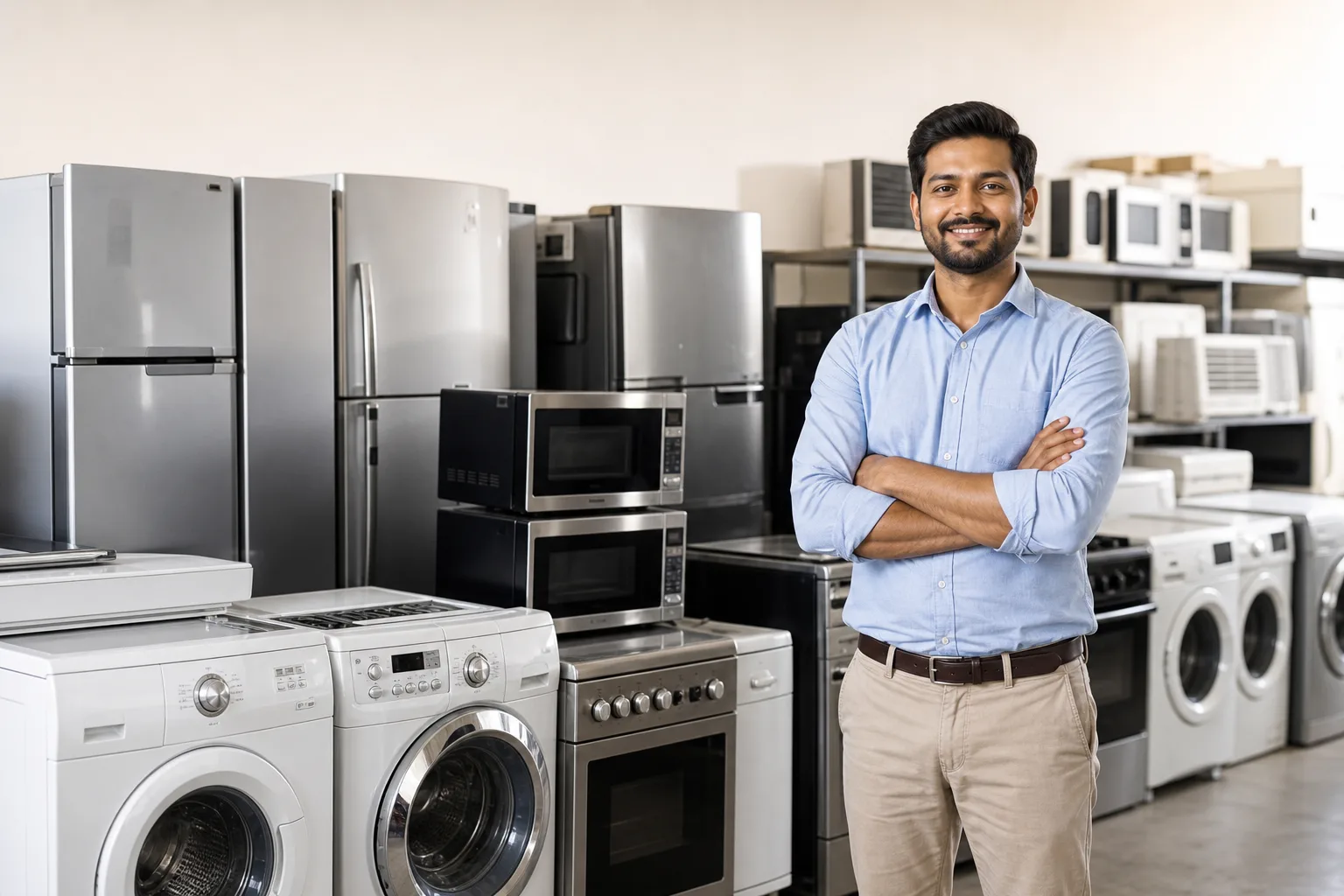
A used electrical appliances trading license covers buying, selling, and re-exporting second-hand electrical goods. That includes white goods such as fridges and washing machines, air conditioning units, and consumer electronics. You can source locally, import from Europe or Asia, and sell into the UAE retail market or export onward.
Dubai sits at the centre of a well-established re-export corridor. Stock flows from here to East Africa, West Africa, South Asia, and across the GCC. That gives traders two distinct revenue streams: domestic retail and export wholesale. The Mordor Intelligence data on the UAE's second-hand goods market reflects growing demand for cost-effective appliances, driven by a large, transient expat population and rising cost-of-living pressures.
| Activity | Used and second-hand electrical appliances trading |
|---|---|
| Ownership | 100% foreign ownership permitted in free zones and on the mainland – Invest in Dubai |
| Setup jurisdiction options | Mainland (DET) or Meydan Free Zone |
| VAT registration threshold | AED 375,000 taxable turnover – Federal Tax Authority |
| Regulatory body for product standards | Emirates Authority for Standardisation and Metrology (ESMA) |
Who Will Buy From You

Your buyer mix shapes everything: sourcing strategy, pricing, stock condition standards, and the location you pick. There are three main groups.
Retail buyers Lower-income residents, new arrivals, and short-stay expats furnishing apartments are your core walk-in trade. They want working appliances at a fraction of the new price. Condition matters, but they are price-led. This group is best served from a mainland retail unit or a well-located warehouse with a showroom section.
Trade buyers Wholesalers and exporters buying in volume to ship stock to African and South Asian markets are your highest-value accounts. They are less concerned with cosmetic condition and more focused on working units, consistent supply, and competitive per-unit pricing. A free zone setup works well here because you are essentially running an export business.
Scrap and parts buyers Repair shops and recyclers sourcing components from non-functional units are a smaller but consistent revenue stream. Broken appliances that cannot be sold retail can still be stripped and sold for parts. This keeps your waste low and your margins healthier than a pure retail model.
Most traders here operate across two of these three groups. Know which one anchors your model before you choose your setup structure.
Mainland vs Meydan Free Zone: Which Setup Works for This Trade
This is the biggest choice you will make when setting up. Let your trading model decide it, not the price.
| Factor | Mainland (DET) | Free Zone (Meydan Free Zone) |
|---|---|---|
| Client access | Open UAE retail and wholesale market | Best suited to export-focused or online models |
| Ownership | 100% foreign ownership permitted | 100% foreign ownership |
| Office or premises | Physical warehouse or retail unit required | Flexi-desk options available; warehousing via approved logistics partners |
| Setup speed | Standard DET processing timelines | Faster registration process |
| Setup cost | Generally higher due to premises requirements | Lower entry cost; Dubai Trade License from AED 12,500 |
| VAT position | FTA registration required once threshold is crossed | Same threshold applies; used goods margin scheme may apply |
Mainland via DET A mainland license from the Dubai Department of Economy and Tourism lets you sell directly into the UAE retail market, walk-in customers included. You need a physical premises, whether that is a retail shop, a warehouse, or both. This suits traders who want to build a local customer base and move stock face-to-face. The DET e-Services portal handles name reservation and initial application.
Meydan Free Zone Meydan Free Zone gives you 100% foreign ownership, a lower setup cost, and faster registration. It works well if your model is export-focused or if you plan to trade primarily online or through wholesale channels rather than walk-in retail. Free zone traders who need physical storage typically bond goods through approved logistics partners operating in Dubai's warehousing corridors. You can also explore remote business setup if you are not yet based in the UAE.
VAT on both structures Once your taxable turnover crosses AED 375,000, you must register with the Federal Tax Authority. The margin scheme for second-hand goods is worth checking before you set your pricing. It can reduce the VAT you owe on used stock, but the rules are specific. Check the Federal Tax Authority guidance directly before you price your first batch of stock.
Free Business Setup Cost Calculator
Calculate NowStep-by-Step Setup Guide
- Step 1, book your trade name: Use the DET e-Services portal for a mainland company, or the Meydan Free Zone portal for a free zone one. The name must not conflict with existing registered names. You can check your company name availability before you apply.
- Step 2, pick your activity code: Confirm the code covers used and second-hand electrical appliances trading in your chosen jurisdiction. The exact code reference differs between mainland and free zone registers, so verify this before you submit documents.
- Step 3, choose your legal structure: Most sole traders or small partnerships operate as a Free Zone Establishment (FZE) in a free zone, or as a sole establishment or LLC on the mainland. Submit your setup documents, passport copies, and any required business plan.
- Step 4, secure your premises: Mainland traders need a signed tenancy agreement for a retail unit or warehouse before the license is issued. Free zone traders on a flexi-desk arrangement can start without a physical unit, then add warehousing as volume grows. Check the full Business Activities List to confirm your activity is correctly coded.
- Step 5, get your trade license issued: Once documents are approved and fees are paid, the license is issued. Keep a copy accessible at your premises at all times.
- Step 6, open a corporate bank account: UAE banks require a valid trade license, proof of address, and shareholder documents. Free zone companies sometimes find this process slower than mainland companies. mCore includes business banking support to help free zone businesses navigate this step.
- Step 7, register for VAT if applicable: If your projected turnover crosses AED 375,000, register with the Federal Tax Authority before you start trading. Voluntary registration is available from AED 187,500.
- Step 8, source your stock: Local clearance sales, corporate disposals, hotel refurbishments, and construction project completions are reliable domestic sources. Import channels from Europe and Asia work well for higher volumes, particularly for white goods and air conditioning units.
Compliance, Costs, and What You Need in Place Before You Start
The compliance side of this trade is more involved than many new entrants expect. Get it wrong and you risk stock seizure, fines, or a license suspension.
Product safety and ESMA standards Used electrical goods sold in the UAE must meet Emirates Authority for Standardisation and Metrology (ESMA) standards. Non-compliant stock can be seized at the point of sale or at customs. This applies to imported used goods as well as locally sourced items. Do not assume that a working appliance automatically meets the standard. Some categories need inspection or certification before they can be sold.
Labelling requirements Certain product categories need labels showing energy ratings, safety marks, or country of origin. Check the ESMA requirements for each category you plan to stock before you import or list items for sale. Air conditioners and refrigerators are among the more tightly regulated categories.
VAT on second-hand goods The margin scheme may apply to your stock. Under this scheme, VAT is calculated on your profit margin rather than the full sale price. This makes a real difference to your pricing and cash flow. The Federal Tax Authority sets the rules, and they are specific about which goods qualify. Check the FTA guidance before you finalise your pricing model. If you need ongoing support, VAT registration support is available through mAccounting.
Staff and Emiratisation Mainland businesses must meet Ministry of Human Resources and Emiratisation quota rules as headcount grows. The ratio depends on your business category and size. Free zone companies have different rules and are generally not subject to the same Emiratisation quotas at small headcount levels. Check the Ministry of Human Resources and Emiratisation requirements before you hire.
Realistic cost expectations A free zone setup at Meydan Free Zone starts from AED 12,500 for the trade license. Add visa costs, flexi-desk fees, and initial stock investment. A mainland setup costs more once you factor in a physical premises lease, fit-out, and DET fees. Neither structure needs large capital to start, but you do need enough working capital to source your first batch of stock and cover three to six months of fixed costs while you build your buyer relationships.
For ongoing financial management, bookkeeping services in Dubai through mAccounting can keep your records clean from day one, which matters when it comes to VAT filing and any future audit.
Market Opportunity
Dubai's residential turnover is high. Expats arrive, furnish apartments, and leave. Corporate relocations, hotel refurbishments, and construction project completions all generate large volumes of used appliances entering the market at low cost. At the same time, demand from export markets, particularly East and West Africa, is consistent and growing as those markets absorb affordable second-hand goods from the Gulf.
The re-export corridor is the real opportunity. Traders who build reliable supply chains and consistent export relationships can move significant volumes without needing a large retail footprint. The margins on export wholesale are thinner per unit, but the volume makes up for it. Retail margins are better but require more customer-facing infrastructure and a good location.
Both models work. The traders who struggle are those who try to do both at once without enough capital or staff to manage the complexity. Start with one model, build your supply chain, then add the second channel once you have cash flow.
Conclusion
Used electrical appliances trading is a workable, low-barrier entry point into Dubai commerce. The demand is real, the supply is available, and the re-export opportunity adds a second revenue stream that pure retail businesses do not have. But the compliance side, particularly product standards under ESMA and the VAT treatment of second-hand goods, needs attention before you start moving stock. Getting those two things wrong early can cost you more than the license itself.
Speak to the Meydan Free Zone team to confirm the right activity code for your model and get a clear cost breakdown before you commit.
Ready to Launch Your Business in Dubai?
Let's ConnectReferences
- Invest in Dubai
- Federal Tax Authority (FTA)
- Ministry of Human Resources and Emiratisation (MOHRE)
- Mordor Intelligence
- Dubai Department of Economy and Tourism e-Services