

Table of Contents
Topic Summary
Understand What Activity Code 4710.00 Covers
This code licenses retail stores selling multiple product categories under one roof, including food, beverages, household goods, apparel, and general merchandise. The defining feature is breadth of range rather than store size, and food can be the anchor or just one category among several.
Know the One Key Exclusion to Watch
Retail sale of fuel combined with food and beverages, where fuel sales dominate, falls under a separate automotive fuel code rather than 4710.00. A forecourt shop attached to a petrol station is treated as a different activity entirely.
Choose the Right Store Format for Your Market
Formats covered include hypermarkets, supermarkets, cooperatives, convenience stores, mini stores, grocery shops, and specialty roasteries. Your chosen format determines which customers you reach and how large a catchment area you need to serve.
Distinguish 4710.00 from the Large-Variety Non-Food Code
A neighbouring code exists for stores where food and beverages are specifically not predominant, with apparel, household goods, or electronics anchoring the range instead. Your actual product mix determines which code applies before you submit your application.
Do Catchment Analysis Before Signing Anything
A mid-format supermarket in the wrong location will lose business to a well-sited convenience store, and no amount of merchandising can fix a poor catchment. Analysing population density, competition, and foot traffic patterns upfront is one of the most valuable steps in the setup process.
Compare Mainland and Free Zone Setup Options
A mainland DET license supports walk-in retail trade in malls and street units, while Meydan Free Zone suits online and business-facing models with 100% foreign ownership and 0% corporate tax on qualifying income. Neither option requires third-party approval for this specific activity.
Note the AML Exemption for This Activity
Retail sale in non-specialised stores under code 4710.00 is exempt from anti-money laundering compliance duties. This simplifies ongoing regulatory obligations compared to activities that fall within AML-regulated categories.
How to Start a Retail Sale in Non-Specialized Stores Business in Dubai with Meydan Free Zone
Walk through any UAE community in the evening and the retail mix shows itself: a hypermarket anchoring a mall, a supermarket on a main road, grocery stores clustered around residential towers, a roastery on a corner, a cooperative serving a whole neighbourhood.
That is non-specialised retail, and it is the commercial spine of everyday shopping here. Activity code 4710.00 covers it. This guide covers what the license permits, the formats available, the one exclusion to watch, and how to set up.
Key Stats at a Glance
What This License Covers
Under code 4710.00 you are licensed to run retail sale in non-specialised stores covering multiple product categories. The defining feature is breadth of range rather than size of floor, and food can be the anchor or simply one category among several.
There is one exclusion, and it is narrow. Retail sale of fuel combined with food and beverages, where the fuel sales dominate, falls under retail sale of automotive fuel instead. A forecourt shop attached to a petrol station is a different activity from a shop that happens to sell everything.
How this differs from large-variety non-food retail
Worth settling before you apply, because a neighbouring code exists. Code 4710.00 is general non-specialised retail, and food and beverages may be predominant. The separate large-variety code covers stores where food and beverages are specifically not predominant, meaning apparel, household and electronics anchor the range instead. Your product mix decides which one you need.
Who Your Clients Will Be
Your customers are UAE consumers doing their everyday shopping, and the format you pick decides which of them you reach.
- Hypermarket and large-format: food, grocery, general merchandise and household goods under one roof, in mall-anchor or standalone locations serving a large catchment
- Supermarket and mid-format: chains serving residential districts, with a food-predominant or mixed range and a smaller travel radius
- General stores and convenience: neighbourhood and community outlets, plus destination retail, where proximity and opening hours matter more than range
The commercial discipline is the same across all three. You are combining store format selection, meaning size, location and catchment, with product mix optimisation and operational capability across supply chain, merchandising and customer experience. Established operators add multi-emirate networks, brand portfolios and integrated logistics on top.
Catchment analysis is the part worth doing properly before you sign anything. A mid-format supermarket in the wrong location loses to a well-sited convenience store, and no amount of merchandising fixes a poor catchment.
Mainland or Free Zone
This is physical retail at its core, so if the plan is a store customers walk into, a mainland license from the Department of Economy and Tourism gives you the open local market and the widest choice of location.
Meydan Free Zone gives you full foreign ownership, no corporate tax on qualifying income and a digital setup, which suits an online-first grocery model or a holding structure while you negotiate retail space and supply terms. Let your customers decide it, not the price.
[blockCTACostCalculator]
Step by Step Setup Guide
- Step 1, settle your product mix first: It decides whether you need 4710.00 or the separate large-variety non-food code. Get this wrong and you amend the license later.
- Step 2, confirm the activity: Check 4710.00 against the business activities list for your chosen authority.
- Step 3, pick your format and catchment: Hypermarket, supermarket or convenience. Each needs different space, stock and staffing, and your lease follows this decision rather than preceding it.
- Step 4, book your trade name: Use the free company name check to confirm availability.
- Step 5, send in your setup documents: Passport copies for every shareholder and director, plus a No Objection Certificate if another employer sponsors your UAE visa.
- Step 6, collect your trade license: No third-party approval applies to this activity, so the licensing route itself is short.
- Step 7, build supply and logistics before you open: Supplier terms, delivery schedules and stock systems matter more to a retailer's survival than the shopfit. mAccounting covers the tax and bookkeeping side.
Compliance and What You Need in Place
No third-party approval, but product rules still apply
No third-party approval attaches to the activity itself. That is not the same as no rules. A non-specialised store carries categories with their own standards, and food in particular brings labelling, storage, handling and inspection duties that sit outside your trade license. Check each category you stock rather than assuming the license covers the shelf.
The fuel exclusion
If fuel sales would dominate a combined operation, you are in retail sale of automotive fuel and not here. Worth knowing if a forecourt site ever comes up as a location.
Watch the food and non-food balance
Because the neighbouring code turns on whether food and beverages are predominant, keep an eye on your range as it evolves. A store that drifts heavily into apparel and homeware may end up sitting more naturally under the other code.
Supply chain scale
Non-specialised retail runs on merchandising discipline and supply chain scale. Small operators compete on location and service rather than on price, because they cannot match the buying power of a multi-emirate network. Know which game you are playing before you set your margins.
Anti-money laundering
This activity is exempt from AML compliance duties.
Market Opportunity
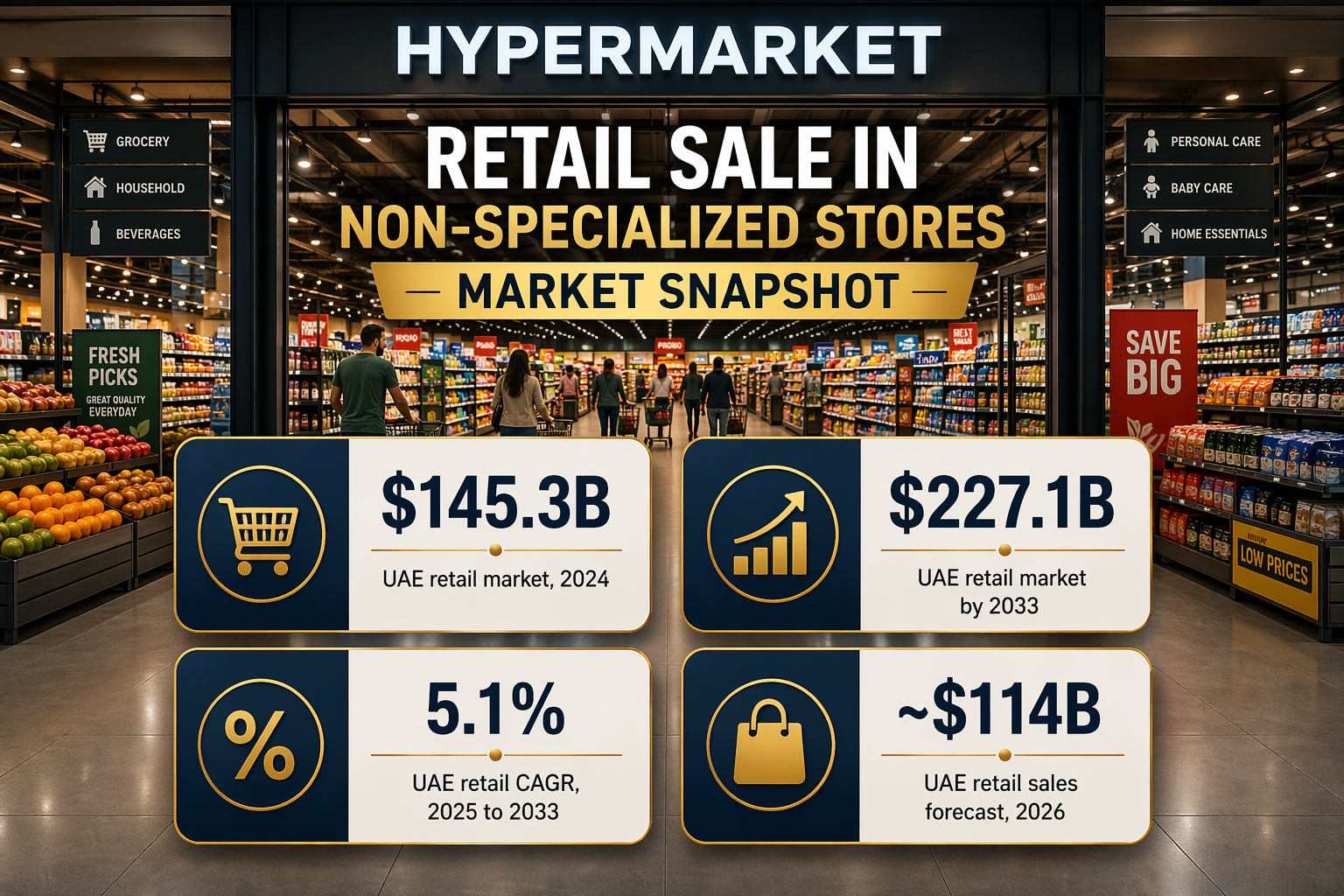
IMARC Group values the UAE retail market at USD 145.3 billion in 2024, growing to USD 227.1 billion by 2033 at 5.1% a year, with supermarkets and hypermarkets, convenience stores and specialty stores among the leading distribution channels. This code sits directly in those channels rather than at the edge of them.
Statista projects UAE retail sales volume at roughly USD 114 billion in 2026, driven by a growing population, rising disposable income, construction activity and international tourism. Those are structural drivers rather than a cycle, which is what makes everyday retail durable here.
The format diversity is the opportunity for a smaller entrant. Hypermarkets, supermarkets, cooperatives, convenience stores, mini stores, grocery shops and roasteries all coexist because each serves a different catchment size and shopper preference. You do not have to take on the large-format operators to find a viable position.
Conclusion
Retail sale in non-specialised stores under code 4710.00 puts you in the everyday shopping layer of a retail market on track to pass USD 227 billion by 2033. No third-party approval applies, and Meydan Free Zone adds full ownership with a digital setup.
Three things decide how smoothly this goes: a product mix that puts you in the right code from the start, catchment analysis done before you sign a lease, and supply terms settled before you open the doors. Sort those and the rest is routine.
[blockCTAContact]