

Table of Contents
Frequently Asked Questions
What does activity code 7310.86 cover in Dubai
Activity code 7310.86 covers telephone-based marketing of products and services, falling under ISIC Division 73 (Advertising), Group 731. It is a distinct commercial activity — not a subset of a general advertising licence.
The code applies to outbound and inbound telesales operations, outsourced telephone marketing agencies, lead generation businesses, appointment-setting operations, and in-house sales teams structured as a separate legal entity. Both B2B and B2C campaigns are within scope, including product promotion, direct sales, lead qualification, and customer follow-up by phone.
Do I need a separate licence specifically for telephone marketing or will a general advertising licence suffice
A separate, dedicated licence is required. Activity code 7310.86 is not a subset of a general advertising licence — the telephone channel is the defining characteristic that makes it a distinct commercial activity under UAE regulations.
Operating telephone marketing activities under an unrelated or general licence creates regulatory and compliance risk. You should confirm that code 7310.86 is explicitly listed on your commercial licence before commencing operations.
Which regulatory bodies govern telephone marketing businesses in the UAE
Two primary authorities are relevant. The Telecommunications and Digital Government Regulatory Authority (TDRA) governs telecommunications infrastructure and usage, including consumer-facing calling rules and do-not-call provisions that all telephone marketing businesses must follow.
The Ministry of Economy administers UAE consumer protection law, which applies to commercial outreach activities. Unsolicited marketing calls made to consumers without prior consent carry regulatory exposure under both frameworks, so compliance structures should be built in from the outset.
What is the difference between setting up a telephone marketing business on the mainland versus in a free zone
A mainland licence issued by the Dubai Department of Economy and Tourism (DED) allows direct contracts with UAE government entities and private sector clients without restriction. It is the preferred route for high-volume local telesales operations where the primary client base is UAE-based, though it typically carries higher fixed costs due to physical office requirements.
A free zone licence offers 100% foreign ownership, faster incorporation, and lower overheads — including flexi-desk options suited to lean telesales teams. It is better suited to regional or international operations where clients are outside the UAE. Free zone entities serving UAE-based clients directly may require a local service arrangement, which should be factored into the commercial structure from the start.
What are the advantages of licensing a telephone marketing business through Meydan Free Zone
Meydan Free Zone permits activity code 7310.86 under a commercial licence. Single-shareholder setup is allowed, making it accessible for solo founders or small teams without the need for a local partner.
Remote incorporation is available, meaning you do not need to be physically present in Dubai to complete the registration process. Visa packages are bundled with the licence, which is practical for founders who intend to build small telesales teams from the outset without managing visa logistics separately.
Is there a minimum share capital requirement for a telephone marketing licence in Dubai
For most free zones, there is no mandatory minimum share capital requirement to obtain a telephone marketing licence under activity code 7310.86. This lowers the barrier to entry for startups and small operators.
Mainland (DED) requirements can vary depending on the specific legal structure chosen. It is advisable to confirm the current capital requirements with the relevant authority or a registered business setup advisor before proceeding, as requirements can change and may differ by entity type.
Does VAT apply to telephone marketing services in the UAE, and when is registration required
Yes, standard UAE VAT at 5% applies to taxable supplies made by telephone marketing businesses. This covers telesales services, lead generation, and related telephone-based marketing activities provided to clients.
VAT registration with the Federal Tax Authority (FTA) is mandatory once annual taxable turnover exceeds AED 375,000. Businesses approaching this threshold should plan their registration in advance to avoid penalties for late registration. Export-focused free zone operations may have different VAT treatment depending on the nature and location of the supply.
Can a telephone marketing business in Dubai sponsor employee and investor visas
Yes, visa eligibility is included with a telephone marketing licence under activity code 7310.86, covering both investor visas for founders and employee visas for staff. The number of visas available typically depends on the licence package chosen and the size of the office or desk allocation.
Free zones such as Meydan bundle visa packages directly with the licence, which simplifies the process for founders building a team from incorporation. Mainland entities can also sponsor visas, with allocations generally tied to the physical office space leased.
Telephone Marketing for Products and Services License in Dubai
Telephone marketing is a licensed activity in Dubai. Operating without the right paperwork exposes your business to fines and cancelled contracts. That is not a risk worth taking in a market where large corporates check your license before they sign anything.
This guide covers what the license covers, who needs it, where to set up, and how to get started without wasting time.
Key Stats at a Glance
| License activity | Telephone Marketing for Products and Services |
|---|---|
| Regulator (telecom-linked activity) | Telecommunications and Digital Government Regulatory Authority (TDRA) |
| Mainland license issuer | Dubai Department of Economy and Tourism (DET) |
| Free zone option | Meydan Free Zone |
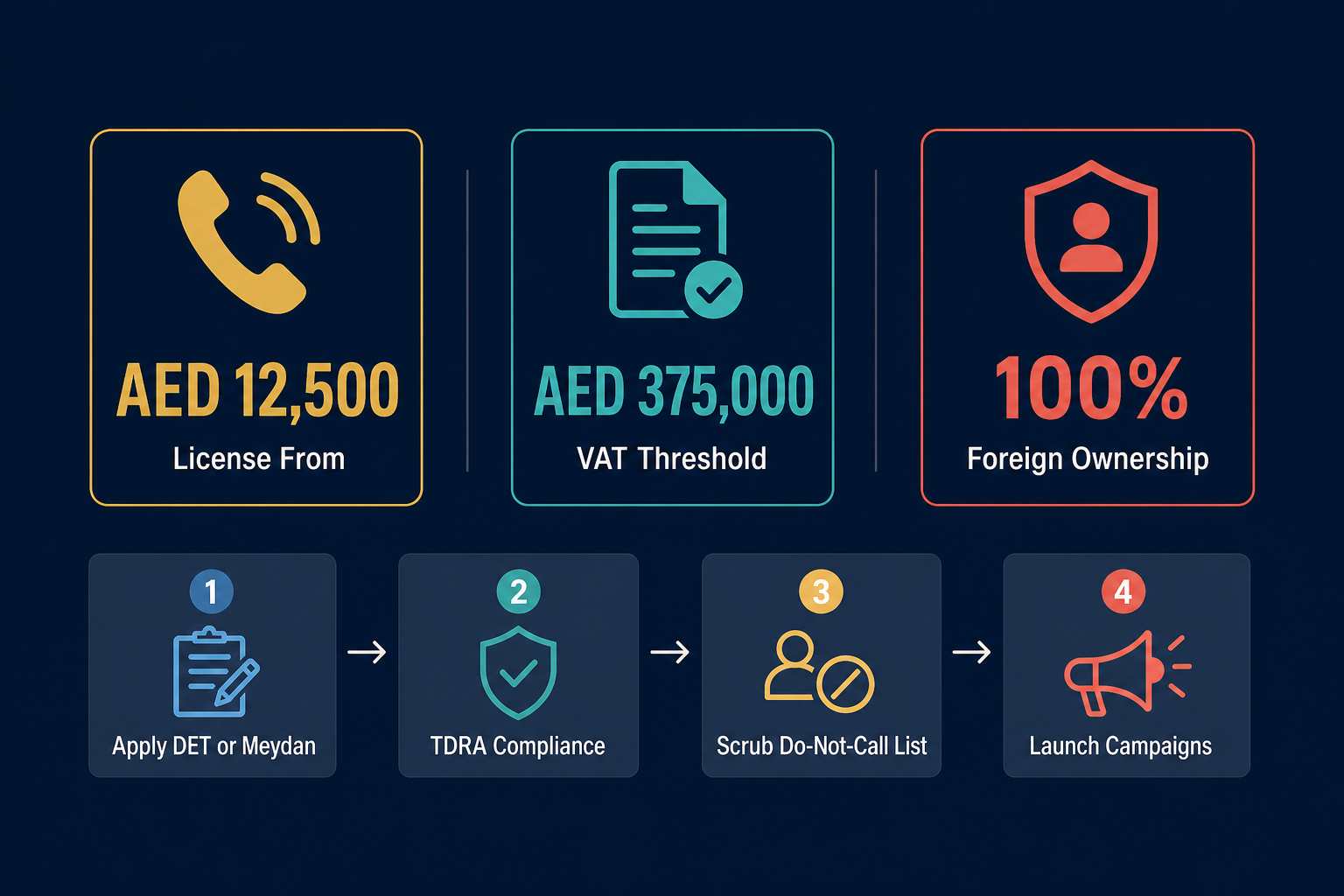
| Foreign ownership | 100% in Meydan Free Zone – Foreign Ownership rules explained |
| VAT registration threshold | AED 375,000 annual taxable turnover – Federal Tax Authority (FTA) |
| Trade license starting from | AED 12,500 |
What This License Covers
This license covers outbound and inbound telephone-based promotion of products and services. That means calling prospects to sell, taking inbound calls to convert leads, and running structured telephone campaigns on behalf of clients or your own brand.
The activity sits within Dubai's commercial classification system under telephone and direct marketing. It is a specific code, and you need to confirm the exact code with your chosen jurisdiction before you submit any application. You can browse the full Business Activities List at Meydan Free Zone to check how telephone marketing sits alongside related activities.
What this license does not cover is worth knowing early. If your team does field sales visits, that needs a separate code. Digital marketing, email campaigns, and social media advertising each fall under different classifications. Door-to-door selling is a separate activity entirely. Running more than one of these without the matching codes puts you in breach, so map out your full commercial model before you apply.
The Telecommunications and Digital Government Regulatory Authority (TDRA) oversees telecom-linked commercial activity in the UAE. This includes rules on how businesses use telephone networks for commercial purposes. TDRA sets the Do Not Call framework and can impose penalties on businesses that ignore it. Your license gives you the legal right to operate. TDRA compliance tells you how to operate within the rules.
Who Your Clients Will Be
The businesses that use telephone marketing services in Dubai tend to fall into a few clear categories. Banks and financial institutions run outbound campaigns for credit cards, loans, and investment products. Insurance firms use telephone teams for policy renewals and new customer acquisition. Real estate developers call qualified leads to book site visits and close off-plan sales. Retail brands and subscription services use inbound and outbound calling to manage customer relationships and reduce churn.
B2B and B2C calling carry different compliance duties. B2C campaigns, where you are calling individual consumers, bring stricter obligations under TDRA rules and the UAE Personal Data Protection Law. B2B campaigns, where you are calling businesses, give you more flexibility but still need clean data practices and proper consent records.
The Do Not Call register is not optional. TDRA maintains a list of numbers that have opted out of unsolicited commercial calls. Calling a registered number without consent is a breach. Any serious telephone marketing operation scrubs its call lists against this register before a campaign goes live.
Large UAE corporates check vendor credentials before they sign. They want to see a valid trade license, proof of regulatory compliance, and in many cases a data processing agreement. Having the right license is not just a legal requirement. It is what gets you onto their approved vendor list in the first place.
Mainland vs Free Zone: Which Setup Works for You
This is the biggest choice you will make when setting up. The right answer depends on who your clients are and how you work.
A mainland license from the DET lets you work directly with UAE government bodies and local corporates without restriction. If your target clients are government-linked entities or large private sector businesses that prefer mainland-registered vendors, this route makes commercial sense. The trade-off is that mainland setup needs a physical office address, and costs tend to be higher.
Meydan Free Zone gives you 100% foreign ownership, no paid-up capital requirement, and faster setup. You can run a lean operation from a flexi-desk rather than committing to a full office lease. This suits an outbound sales operation where your team works remotely or from a call centre, and where your clients are private sector businesses or international brands. You can also start a business remotely through Meydan Free Zone without needing to be physically present in Dubai during the setup process.
| Factor | Mainland (DET) | Free Zone (Meydan Free Zone) |
|---|---|---|
| Client access | Open UAE market including government | Mainly private sector and international clients |
| Foreign ownership | 100% in most activities | 100% |
| Office requirement | Physical office required | Flexi-desk options available |
| Paid-up capital | Varies by activity | Not required |
| Setup speed | Longer approval process | Faster, often within days |
| VAT registration | Mandatory above AED 375,000 turnover | Mandatory above AED 375,000 turnover |
VAT applies to both structures once your annual taxable turnover passes AED 375,000. At that point you must register with the Federal Tax Authority (FTA). This applies whatever jurisdiction you are in. Build it into your financial model from the start rather than treating it as an afterthought.
For a small direct-sales operation with two or three people, Meydan Free Zone is usually the more workable path. For a large outbound call centre with government or semi-government clients, mainland gives you wider market access. The two are not mutually exclusive. Some operators hold both, but start with the structure that matches your immediate client base.
Free Business Setup Cost Calculator
Calculate NowStep-by-Step Setup Guide
- Step 1, book your trade name: Use the DET e-Services portal for a mainland company, or the Meydan Free Zone portal for a free zone one. Your name must not conflict with an existing registered business. Use the Company Name Check tool to confirm availability before you go further.
- Step 2, confirm your activity code: Telephone marketing has a specific code within Dubai's commercial classification system. Confirm the exact code is approved in your chosen jurisdiction before you submit any application. Getting this wrong means delays and resubmission fees.
- Step 3, get initial approval: Submit your application with the required documents. For a free zone setup this is usually passport copies, a completed application form, and your chosen activity code. Initial approval is typically fast at Meydan Free Zone.
- Step 4, secure your address: For a mainland company, sign your office lease and get the Ejari registration. For Meydan Free Zone, select your flexi-desk or office package. Your address is part of your license documentation.
- Step 5, pay license fees and receive your license: Once your address is confirmed and documents are in order, pay the license fees and collect your trade license. A Dubai Trade License from AED 12,500 is available through Meydan Free Zone.
- Step 6, open a UAE business bank account: You need this before you start taking payments or paying staff. Free zone companies can use business banking support through mCore to navigate the account opening process, which can otherwise take time.
- Step 7, apply for staff visas if needed: If you are employing callers in the UAE, register with the Ministry of Human Resources and Emiratisation (MOHRE) and process visas through the standard UAE residency route.
Compliance and What You Need in Place
Getting your license is step one. Staying compliant is what keeps the business running. Telephone marketing in the UAE has several specific compliance layers that you need to build into your operations from day one.
TDRA Do Not Call obligations
TDRA maintains the Do Not Call register for the UAE. Before any outbound consumer campaign, your call list must be scrubbed against this register. Calling a registered number is a breach, and TDRA can act on complaints. This is not a bureaucratic formality. It is an active enforcement area.
UAE Personal Data Protection Law
The UAE Personal Data Protection Law sets out how you collect, store, and use personal data. For a telephone marketing business, this covers how you source call lists, how long you keep contact records, and how you handle requests to remove someone from your database. If you are handling data for clients, you may also need a data processing agreement in place with them. Check with a legal adviser before you start processing consumer data at scale.
Staff visas and MOHRE registration
If you employ callers based in the UAE, each person needs a valid UAE residence visa and a labour card issued through MOHRE. MOHRE registration is mandatory before staff start work. Employing people without the correct documentation is a serious breach that can result in fines and operational suspension.
Annual license renewal
Your trade license needs to be renewed every year. Renewal triggers a review of your registered activities and address. If your business has changed, for example if you have added digital marketing or field sales to your operation, you need to update your activity codes at renewal. Running activities not listed on your license puts you in breach, even if the license itself is current.
VAT and corporate tax
Once your turnover passes AED 375,000, VAT registration with the FTA is mandatory. UAE corporate tax at 9% applies to taxable income above AED 375,000. Both of these have filing deadlines. Missing them generates penalties. Use accounting services in Dubai through mAccounting to keep filings on track from the start.
Market Opportunity
Telephone marketing remains a high-volume activity in the UAE. Financial services, insurance, real estate, and telecoms all run large outbound campaigns. The UAE's high smartphone penetration and relatively small geographic market make telephone-based selling cost-effective compared to many other markets.
According to Statista, the UAE has one of the highest mobile penetration rates in the world. That means your target audience is reachable by phone, and businesses know it. Demand for licensed, compliant telephone marketing vendors is steady. Large corporates in particular are moving away from informal arrangements and towards properly licensed suppliers, partly because of data protection scrutiny and partly because of reputational pressure from regulators.
The compliance burden is real but manageable. Operators who build clean data practices and TDRA compliance into their process from the start find it easier to win and keep corporate clients. Those who cut corners find themselves locked out of the larger contracts where the real revenue sits.
Conclusion
A telephone marketing license in Dubai is simple to get if you choose the right jurisdiction, confirm your activity code early, and build TDRA compliance into your process from day one. The market is active, the demand from large corporates is real, and the barrier to entry is mostly paperwork rather than capital.
Meydan Free Zone gives you a fast, cost-effective path to a valid license with 100% foreign ownership and no paid-up capital requirement. If you want to work directly with government clients, a mainland setup through DET is the right route. Either way, get your activity code confirmed before you commit to anything.
Talk to the Meydan Free Zone team to confirm your activity code and get a cost estimate before you commit to any setup path.
Ready to Launch Your Business in Dubai?
Let's ConnectReferences
- Telecommunications and Digital Government Regulatory Authority (TDRA)
- Federal Tax Authority (FTA)
- Ministry of Human Resources and Emiratisation (MOHRE)
- Statista
- Dubai Department of Economy and Tourism (DET) e-Services
- Invest in Dubai