

Table of Contents
Frequently Asked Questions
What is a Dubai free zone in simple terms?
A Dubai free zone is a separate business jurisdiction run by its own authority, with its own licensing process, activity list, and fee structure. It can be a practical launch option for founders who want a lean setup, full foreign ownership, and a clear legal company without starting with a traditional office-heavy structure.
What are the main advantages and disadvantages of free zones?
The main advantages and disadvantages of free zones come down to fit. The upside is full foreign ownership, lower fixed overhead, and a faster launch path for many service, trade, and online models; the downside is that mainland access, banking outcomes, and tax treatment depend on how the business actually operates, not the free zone label alone.
Can a Dubai free zone company trade with mainland UAE customers?
Yes, but not as broadly as many founders first assume. A free zone company can work well with mainland customers in some structures, but direct onshore trading is not automatically unrestricted, so founders should check whether their model needs a distributor, a mainland branch, or a different setup altogether.
Do free zone companies in Dubai get 100% foreign ownership and 0% corporate tax?
Free zone companies generally allow 100% foreign ownership, which is a major draw for international founders. Tax is more nuanced: free zone status does not automatically mean 0% corporate tax, because outcomes depend on qualifying conditions, income type, and whether the company meets the relevant substance and compliance rules.
What costs sit outside the headline free zone license price?
The headline license price is rarely the full year-one number. Founders should usually budget separately for visas, health insurance, bank onboarding, medical-related steps, renewals, and any later workspace upgrades, so the smarter comparison is base license cost versus realistic all-in setup cost.
Topic Summary
Full Ownership, Faster Launch
A Dubai free zone appeals because it can offer 100% foreign ownership, a simpler setup path, and lower upfront overhead than a traditional office-led structure. This is strongest for consultants, service firms, and online-first businesses that want to start lean.
Lower Fixed Costs Early
Many free zone setups let founders begin without committing to expensive premises, which preserves cash for hiring, marketing, or stock. That cost advantage is real, although year-one budgets should still include visas, banking, and compliance support where needed.
Mainland Access Has Limits
The biggest misconception is assuming a free zone company gives unrestricted access to mainland UAE customers. If most revenue comes from onshore clients, founders should review whether a mainland structure, distributor arrangement, or branch is the better fit.
Banking Still Needs Proof
A free zone license helps, and it does not replace bank due diligence. Banks still review ownership, business activity, transaction logic, and source of funds, so founders should prepare a clean, consistent file before expecting a smooth account-opening process.
Tax Benefits Are Conditional
The advantages and disadvantages of free zones become clearer when tax is viewed realistically, not as a slogan. Free zone status alone does not guarantee a 0% outcome, since treatment depends on qualifying conditions, income type, and substance in the UAE.
Best for Specific Models
The advantages and disadvantages of free zones depend on fit. Free zones usually work best for cross-border services, trade, and e-commerce models, while businesses needing retail space, heavy warehousing, or regulated approvals should examine the structure much more carefully.
Advantages & Disadvantages of Dubai Free Zones
Free zones are the default choice for most foreign founders in Dubai, and for good reasons. Full ownership, quick licensing, and included workspace remove a lot of friction. The model is not without cost, though, and the trade-offs tend to surface in year two rather than week one.
This guide pairs each advantage with its matching limitation, because most of them are two sides of the same design decision. The structure that makes a free zone fast and cheap is also what restricts onshore selling and caps visa numbers. Rules and fees differ between zones and change over time. Confirm the current position with your chosen free zone before deciding.
Ownership and Control
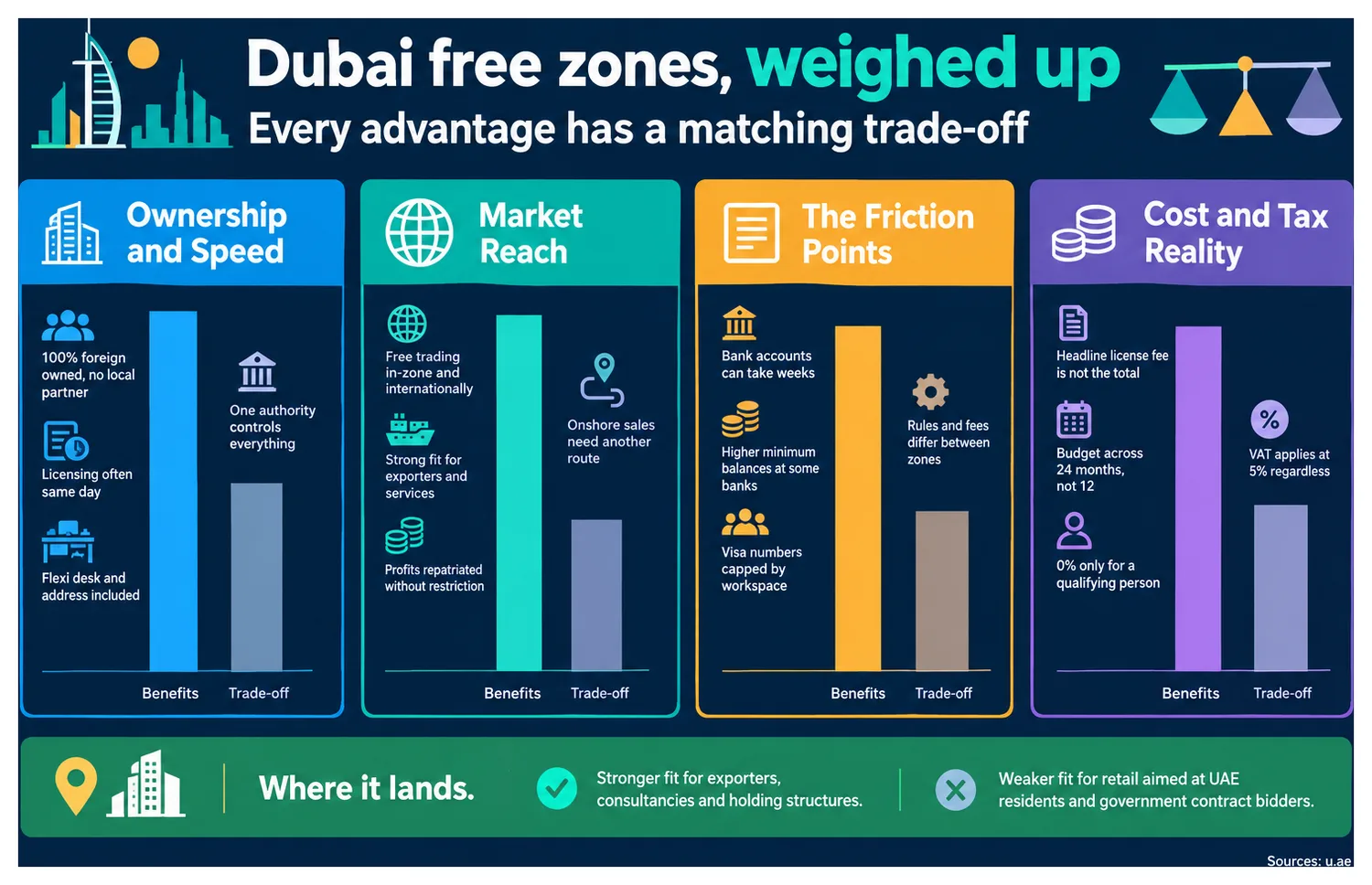
The advantage here is clean. A free zone company can be wholly owned by foreign shareholders, with no local partner and no nominee arrangement. This was true in free zones long before mainland rules changed in 2021. Profits and capital can generally be moved out without restriction.
The trade-off is dependence on a single authority. Your license, your visas, and your renewals all sit with one free zone. If its policies change, its fees rise, or its activity list shifts, you have limited room to negotiate. Moving to another zone means a fresh application rather than a transfer.
Cost and Setup Speed
Free zones are built for speed. Applications run online, documentation is lighter than the mainland route, and there is no notarised Arabic memorandum to arrange. Licenses can be issued the same day, and in some cases within the hour. Because a flexi desk and registered address are usually bundled in, there is no separate office lease at entry level.
The trade-off is that the headline license fee is not the full cost. Visas, medical tests, Emirates ID, insurance, establishment cards, and year two renewal all sit outside it. A license advertised at a low figure can look very different once a founder and one employee are sponsored. Budget across 24 months rather than 12.
Market Access and Customers
A free zone company trades freely inside its own zone and internationally. For exporters, service businesses with overseas clients, and holding structures, this covers almost everything they need.
The limitation is onshore. Selling directly to mainland UAE customers needs another route. The options are a distributor or agent, a mainland branch, or a dual license. Government contracts are generally not open to free zone companies directly. If most of your revenue will come from UAE mainland customers, this is the single most important factor in the decision.
Advantages Paired With Their Trade-offs
Banking and Compliance
Banking is the friction point founders least expect. Corporate account opening is assessed by the bank, not the free zone, and applications can take weeks. Banks apply their own compliance checks, and some set higher minimum balance requirements. A business can hold a valid license and still be unable to invoice properly for months.
This is worth asking about before you choose a zone rather than after. Some free zones maintain working relationships with banks, which shortens the process. Meydan Free Zone addresses this through mCore, which provides a guaranteed IBAN and access to partner banks.
Compliance is the other ongoing load. Free zone companies must meet corporate tax and VAT duties and maintain proper records. Ultimate beneficial owner information must be filed, and many will need audited accounts. Services such as Meydan Plus bundle accounting, tax, and renewals for owners who would rather not manage several providers.
Scaling and Visa Capacity
The included flexi desk is an advantage at the start and a constraint later. Visa allocation is generally tied to your license and the workspace you hold. A desk supports a small number of people. Growing the team means upgrading to a dedicated desk or a private office, which raises fixed costs.
Physical expansion also depends on availability inside your zone. If suitable space is not free when you need it, options are limited. Founders expecting headcount growth should model the workspace upgrade cost from the outset, not treat it as a later problem.
Activity scope is a related constraint. Many zones focus on particular sectors, and a license permits only the activities on that zone's list. Choosing a zone that does not cover a future revenue stream leads to amendments or, in the worst case, a move.
The Tax Position
This deserves care, because it is where expectations and reality diverge most.
Corporate tax applies to free zone companies. A 0% rate exists, but only for a Qualifying Free Zone Person and only on qualifying income. Other income is taxed at 9%. The conditions include adequate substance in the UAE and transfer pricing compliance. Audited financial statements are also required. Non qualifying revenue must stay within the de minimis threshold. That is the lower of AED 5 million or 5% of total revenue.
VAT applies at 5% in free zones as it does elsewhere. A separate designated zone classification affects the treatment of certain goods, not services, and not every free zone holds it.
This is general information only. It is not legal or financial advice. Speak to a qualified tax professional before relying on any tax outcome.
Who Dubai Free Zones Suit Best
The model fits some businesses far better than others.
- Strong fit. Exporters, international service providers, consultancies, e-commerce sellers shipping abroad, and holding structures.
- Workable fit. Businesses selling onshore through a distributor, where the margin supports the extra layer.
- Weaker fit. Retail and services aimed mainly at UAE residents, and businesses bidding for government contracts.
- Needs planning. Companies expecting fast headcount growth, where visa capacity and office upgrades should be modelled early.
Weighing It Up
Dubai free zones trade flexibility for simplicity, and that bargain suits most foreign founders well. If your customers are overseas or inside the zone, the advantages are substantial and the limitations rarely bite. If your revenue depends on mainland UAE buyers or public sector contracts, the picture changes. The mainland route then deserves serious consideration. Either way, model the full 24 month cost rather than the license fee. Ask about banking support before you commit. Check that your zone permits every activity you expect to run. The team at Meydan Free Zone can set out what a license covers, what it excludes, and what renewal looks like.







.jpeg)