
Table of Contents
Frequently Asked Questions
Can a free zone company in Dubai buy and retire carbon credits?
Yes. A company licensed in a free zone can buy credits to offset its own emissions, provided it pays through a traceable channel and holds an account with the relevant registry. Retirement in the registry is what proves the offset, so keep the retirement certificate with your sustainability records. Buying for your own use differs from reselling, which needs a licensed activity that covers trading or brokerage.
How do I confirm a carbon credit has not been sold twice?
Check the credit's unique serial number in the issuing registry before you pay. The registry shows whether the credit is active, transferred or retired. Ask the seller for the verification report and registry account details, and reject any seller that cannot provide serial numbers.
What is the difference between retiring and holding a carbon credit?
Holding a credit means you own it and can still resell it. Retiring a credit permanently removes it from circulation in the registry, and only then can you claim the offset. A credit that is held but not retired cannot support an emissions claim.
Do I need a specific license to broker carbon credits in the UAE?
Your license activity must match how the company earns revenue. Brokering, trading and consulting are separate activities, so choose the one that reflects your role. Exchange-based or securities-style activity may fall under the Capital Market Authority (formerly the Securities and Commodities Authority), so confirm the status of any platform you use.
Is VAT charged when a business sells carbon credits?
VAT treatment depends on the nature of the supply and the parties involved, so check Federal Tax Authority guidance for your specific transaction. VAT registration is mandatory once taxable supplies exceed AED 375,000 a year. Corporate Tax applies to taxable income from trading, and your invoices and registry records should match.
Which authority oversees exchange-based trading of environmental assets?
The Capital Market Authority, formerly the Securities and Commodities Authority, regulates securities and commodities activity at federal level. Federal climate policy sits with the Ministry of Climate Change and Environment, and the Central Bank of the UAE oversees payment channels. Free zone licensing is handled by the free zone authority, not by these bodies.
How should a company record carbon credit purchases in its accounts?
Record the credit price, platform or broker fees and registry charges as separate lines, and keep the contract, invoice, payment proof and retirement certificate together. Your accountant should decide the correct treatment based on whether the credits are held for offsetting or for resale. Meydan Free Zone's mAccounting pillar offers bookkeeping, VAT registration support and Corporate Tax support.
Can a sole founder start a carbon credit consulting business digitally?
Yes. Fawri is Meydan Free Zone's fully digital licensing option for single-shareholder companies, issuing a Business License in under 60 minutes. Choose an activity that reflects consulting rather than trading if you will advise clients and not hold credits for resale.
Topic Summary
What Carbon Credits in the UAE Are
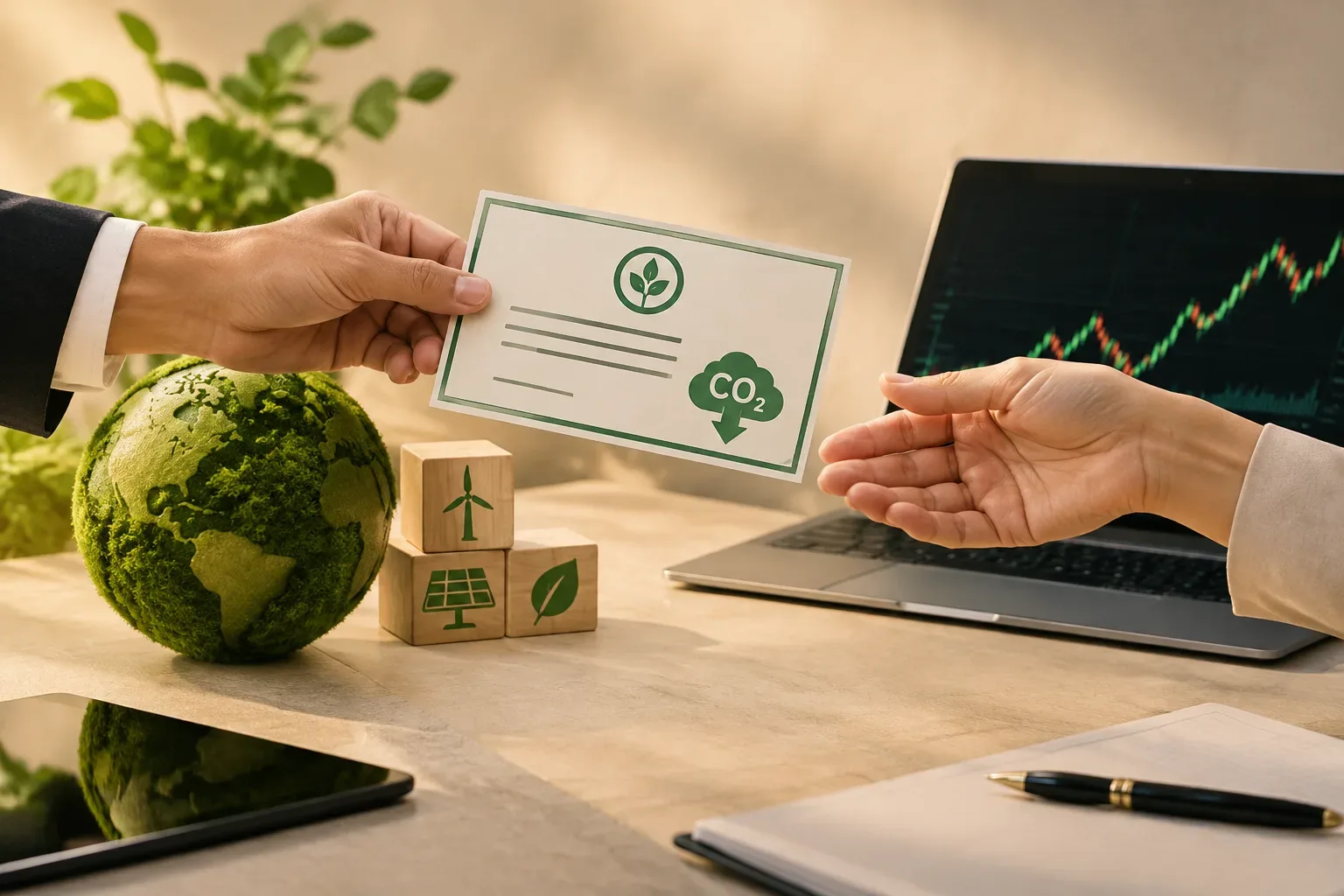
A carbon credit is a tradable certificate representing one tonne of carbon dioxide equivalent avoided, reduced or removed. Carbon credits in the UAE are bought to offset emissions voluntarily or to support reporting commitments, and they move through registries, brokers or exchanges under the relevant regulator.
Who Regulates Carbon Credits
Several authorities are involved. The Ministry of Climate Change and Environment leads federal climate policy. Exchange-traded and financial activity falls under bodies such as the Capital Market Authority (formerly the Securities and Commodities Authority), and the Central Bank of the UAE oversees payment channels.
How to Buy Carbon Credits in the UAE
To buy carbon credits in the UAE, define your target, pick a recognised standard, choose a registry-backed seller, verify documents, pay traceably and retire the credits. Retirement proves the offset. Ownership alone does not.
How Carbon Credit Trading in the UAE Works
Carbon credit trading in the UAE runs through brokers, over-the-counter deals and regulated platforms. Traders buy at one price and resell at another, carrying price, delivery and counterparty risk. Your legal structure, licensed activity and registry access define what you can lawfully do. If your model involves emissions monitoring, read how to set up a carbon control systems business in Dubai .
Cost, Tax and Compliance Mechanics
Costs include the credit price, broker or platform fees, registry charges and verification. Record-keeping, anti-money laundering checks and traceable payments are standard expectations for carbon credits in the UAE.
Setting Up a Carbon-Related Business in Meydan Free Zone
A Meydan Free Zone company is set up digitally with a business license matching its approved activity. After registration, Meydan Free Zone issues the Business License, Certificate of Formation, Share Register, and Memorandum and Articles of Association digitally.
Conclusion
Carbon credits in the UAE reward execution over theory: verified projects, traceable payments, registry retirement and a license that matches the activity. Founders who document each stage avoid most disputes and audit problems. With Meydan Free Zone, the Business License and company documents are issued digitally. The main early decision is whether you will buy, broker or advise, and which activity fits that role.
Carbon Credits in the UAE: How Businesses Buy and Trade Them
Carbon credits now reach well beyond large corporates: clients ask about offsets, banks review the payments and the quality of credits varies widely. For a UAE founder, the practical question is how to buy or trade credits without paying for low-quality or double-counted tonnes. This guide covers who regulates the market, how buying and trading work, the tax and banking points to plan for, and how to match your licensed activity to your role.
What Carbon Credits in the UAE Are
A carbon credit is a tradable certificate representing one tonne of carbon dioxide equivalent avoided, reduced or removed. Carbon credits in the UAE are bought to offset emissions voluntarily or to support reporting commitments, and they move through registries, brokers or exchanges under the relevant regulator.
How a Credit Is Defined and Measured
One credit equals one tonne of CO2e. Credits come from projects such as renewable energy, forestry or methane capture. Independent verification supports issuance, and registry serial numbers stop the same tonne being counted twice. A logistics company, for example, might offset part of its fleet emissions by buying verified credits from a renewable energy project.
Voluntary and Compliance Credits Compared
Voluntary credits are bought by choice to meet climate targets. Compliance credits belong to mandatory schemes. Most companies buying credits for their own climate targets use the voluntary market. A trading firm might buy voluntary credits to support a client's net-zero commitment. For background on carbon pricing, see the World Bank.
Who Regulates Carbon Credits
Several authorities are involved. The Ministry of Climate Change and Environment leads federal climate policy. Exchange-traded and financial activity falls under bodies such as the Capital Market Authority (formerly the Securities and Commodities Authority), and the Central Bank of the UAE oversees payment channels.
Federal Climate Policy and Reporting
Federal Decree-Law No. 11 of 2024 on reducing the effects of climate change, in force since 30 May 2025, sets emissions measurement and reporting duties. Obligations depend on the activity and the implementing rules, so a manufacturer should check whether it carries reporting duties before it buys.
Financial Regulators and Trading Platforms
- Check a platform's licensing status first.
- Never assume every platform is regulated.
- Pay only through regulated banking channels.
Where a Free Zone Company Fits
Meydan Free Zone issues the license and approves the activity. Activity wording must match what the company actually does. Federal rules on climate reporting, tax and financial services still apply.
How to Buy Carbon Credits in the UAE
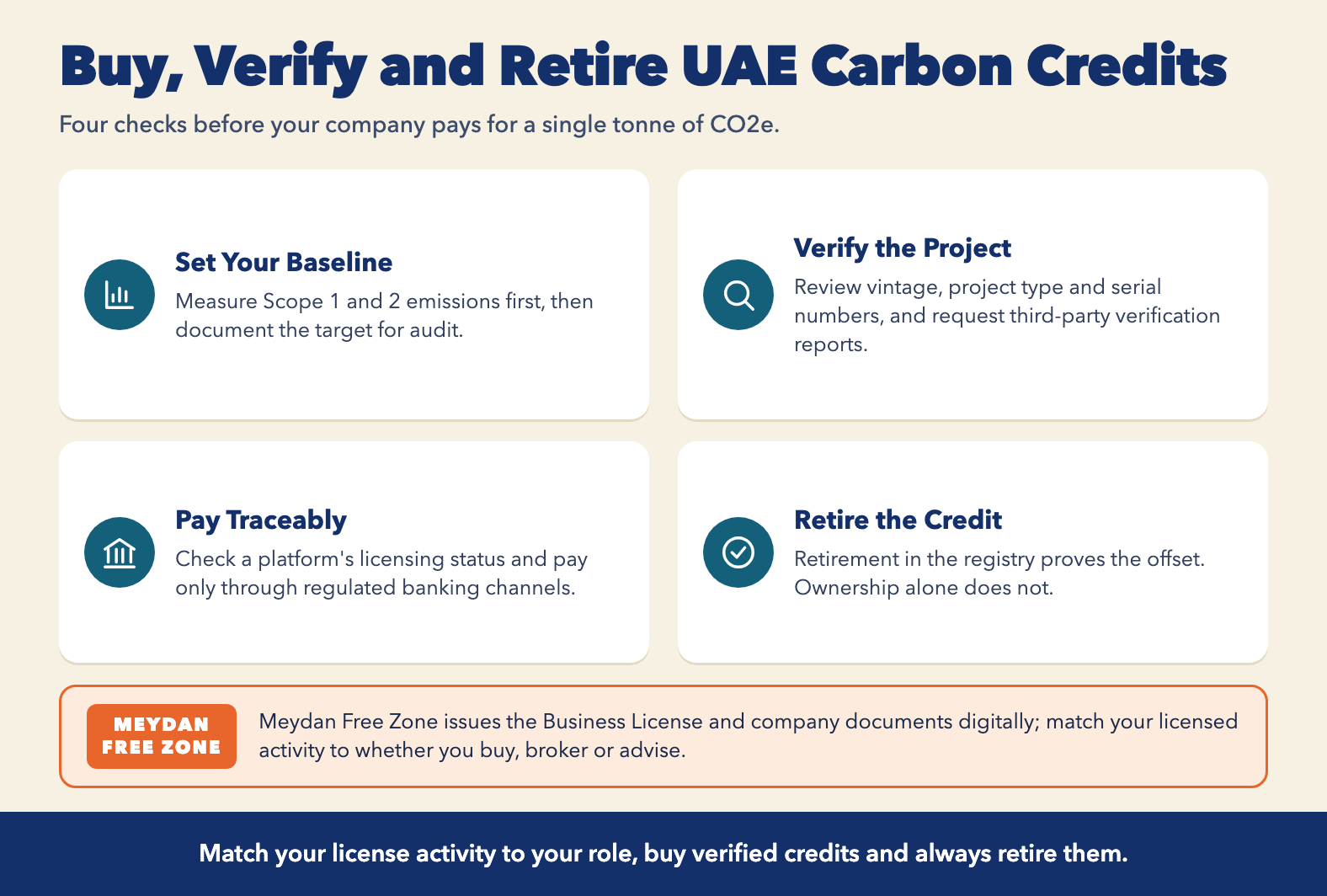
To buy carbon credits in the UAE, define your target, pick a recognised standard, choose a registry-backed seller, verify documents, pay traceably and retire the credits. Retirement proves the offset. Ownership alone does not.
Step 1: Set Your Emissions Baseline and Target
- Measure Scope 1 and 2 emissions first.
- Decide whether credits supplement or replace reductions.
- Document the target for audit.
An SME, for instance, can build its baseline from energy bills before sizing a purchase.
Step 2: Choose a Standard and Verify the Project
- Confirm issuance under a recognised standard.
- Review vintage, project type and serial numbers.
- Request third-party verification reports.
One buyer rejected a seller that could not show registry serial numbers. That was the right call.
Buying, Brokering and Trading Carbon Credits Compared
| Feature | Buying to Offset | Brokering or Trading |
|---|---|---|
| Main purpose | Offset your own emissions | Earn from matching or reselling credits |
| Revenue source | None; credits are a cost | Commission or price spread |
| Key risk | Low-quality or unverified credits | Price, delivery and counterparty risk |
| Registry action | Retire credits and keep the certificate | Transfer credits between accounts |
| Licensed activity focus | Your existing business activity | Trading or consulting activity |
Step 3: Pay, Transfer and Retire the Credits
- Use traceable bank payments.
- Confirm the transfer in the registry.
- Retire the credits and file the certificate.
One company files its retirement certificate with its sustainability report.
How Carbon Credit Trading in the UAE Works
Carbon credit trading in the UAE runs through brokers, over-the-counter deals and regulated platforms. Traders buy at one price and resell at another, carrying price, delivery and counterparty risk. Your legal structure, licensed activity and registry access define what you can lawfully do. If your model involves emissions monitoring, read how to set up a carbon control systems business in Dubai.
Brokerage, Over-the-Counter and Platform Routes
- Brokers match buyers and sellers for a fee.
- OTC deals are negotiated bilaterally.
- Platforms offer standard listings and settlement.
Pricing, Quality and Counterparty Risk
Prices vary by project type, vintage and standard. Two projects of equal size can price differently because of the verification standard. Quality concerns include additionality and double counting. Use escrow or delivery-versus-payment where possible.
Cost, Tax and Compliance Mechanics
Costs include the credit price, broker or platform fees, registry charges and verification. Record-keeping, anti-money laundering checks and traceable payments are standard expectations for carbon credits in the UAE.
What You Pay and What Is Indicative
- Budget the credit, platform fee and retirement cost separately.
- Treat market quotes as indicative, not guaranteed.
- Record every amount in AED in your accounts.
VAT and Corporate Tax Considerations
VAT registration is mandatory above AED 375,000 a year in taxable supplies. Corporate Tax applies to taxable income from trading. A trading company should check whether credit sales count toward the VAT threshold using Federal Tax Authority guidance. Ministerial Decision No. 229 of 2025 adds environmental commodities, such as carbon credits, to the qualifying commodities for Qualifying Free Zone Persons. Conditions apply, including a quoted price, so take tax advice.
Payment and Banking Considerations
Banks apply due diligence to counterparties. Keep contracts, invoices and registry records aligned, and prepare counterparty documents before a large inbound payment is reviewed. An IBAN does not guarantee account approval.
Setting Up a Carbon-Related Business in Meydan Free Zone
A Meydan Free Zone company is set up digitally with a business license matching its approved activity. After registration, Meydan Free Zone issues the Business License, Certificate of Formation, Share Register, and Memorandum and Articles of Association digitally.
Choosing the Right Licensed Activity
Consulting and carbon control systems appear as separate activities on the Meydan Free Zone activity hub. Match the license to how you earn revenue. A founder advising clients on credits could start from the environmental consulting activity. Confirm with Meydan Free Zone which activity, if any, covers brokering or trading credits. For wider context, see sustainable businesses in Meydan Free Zone.
Support Services for Carbon-Related Businesses
- mCore: business bank account support, subject to the bank's approval, and company stamps.
- mAccounting: bookkeeping, VAT registration support and Corporate Tax support.
- mResidency: residency visas, offered separately.
- Cost Calculator: an estimate of your setup costs.
Free Business Setup Cost Calculator
Calculate NowConclusion
Carbon credits in the UAE reward execution over theory: verified projects, traceable payments, registry retirement and a license that matches the activity. Founders who document each stage avoid most disputes and audit problems. With Meydan Free Zone, the Business License and company documents are issued digitally. The main early decision is whether you will buy, broker or advise, and which activity fits that role.
Ready to Launch Your Business in Dubai?
Let's Connect