

Table of Contents
Frequently Asked Questions
Does a UAE company have to use 31 December as its year end?
No. The default is the Gregorian calendar year ending 31 December, but a company can adopt a different 12-month financial year under the Corporate Tax Law, Federal Decree-Law No. 47 of 2022. The date must be applied consistently in accounting records, audit reports and tax filings.
When is the Corporate Tax return due after the year end?
The Corporate Tax return and any tax due must be submitted to the Federal Tax Authority within nine months of the end of the tax period. A 31 December year end gives a 30 September deadline. A 30 June year end gives a 31 March deadline.
Can a UAE company change its financial year end after the first year?
A company can change its year end, but the change affects the tax period and needs an application to the Federal Tax Authority. It can also produce a short or long accounting period that complicates comparatives and relief claims. Apply and get approval before making the change.
Does the financial year have to match the VAT return period?
No. VAT return periods run on their own schedule, set when the company registers with the Federal Tax Authority. They do not follow the accounting year. A company can have quarterly VAT periods that do not line up with its financial year end.
How long can the first accounting period be for a new UAE company?
The first period depends on the licensing date and the year end chosen. It can be shorter than 12 months, such as when a company licensed in March closes on 31 December. Decide the year end before the first period begins so the opening dates are clear.
Which year end works best for a seasonal business in the UAE?
A date shortly after the peak trading season usually works best. Stock counts and receivables are easier to verify, and profit is clearer when the Corporate Tax payment falls due nine months later. A business busiest from October to March might close on 31 March.
Should a subsidiary of a foreign group match its parent's reporting date?
Often yes. Aligning with the parent's year end avoids preparing a second set of numbers for group consolidation. The date still has to work for UAE Corporate Tax, so check the nine-month filing deadline it creates.
Do free zone companies have to prepare financial statements at year end?
Yes. Free zone companies keep accounting records and prepare financial statements for their financial year. Meydan Free Zone's mAccounting pillar covers bookkeeping, VAT registration support, Corporate Tax support and financial audit reports, so year-end support can sit with one provider.
Topic Summary
What a Financial Year End in the UAE Means
A financial year end is the closing date of the 12-month period a company uses to prepare its accounts. Under the Corporate Tax Law, it usually also sets the tax period. Many companies use 31 December, but other dates are allowed if you apply them consistently.
How the Financial Year End in the UAE Shapes Corporate Tax Deadlines
The year end sets the Corporate Tax return deadline. A UAE company must file its return and pay any tax due within nine months of the end of its tax period. A 31 December year end means a 30 September deadline, and a 30 June year end moves it to 31 March.
Common Year-End Dates and Who They Suit
The most common financial year end in the UAE is 31 December. It matches the calendar year, simplifies bank reporting and suits most trading and service companies. Dates such as 31 March or 30 June suit seasonal businesses or subsidiaries of parents reporting on a different schedule.
Five Checks Before You Confirm Your Financial Year End
Before confirming a financial year end in the UAE, check five things: your trading cycle, any parent company reporting date, the Corporate Tax deadline it creates, auditor availability, and Small Business Relief eligibility. Settle all five before the first accounting period begins.
Cost and Compliance Risks of the Wrong Year End
A poorly chosen financial year end in the UAE can compress audit timelines, strain cash flow when tax falls due, and complicate group reporting. Late Corporate Tax filing attracts administrative penalties set by the Federal Tax Authority, so a date that makes deadlines hard to meet is a real cost.
How Meydan Free Zone Companies Handle Year-End Reporting
Meydan Free Zone companies set their financial year end in line with their accounting and tax planning, then keep records to match it. The mAccounting pillar of Meydan Plus covers bookkeeping, VAT registration support, Corporate Tax support and financial audit reports, so year-end support sits with one provider.
Conclusion
The financial year end in the UAE is a structural decision. It sets Corporate Tax deadlines, audit timing and cash planning. Match the date to your trading cycle and any group reporting needs, then record it consistently. Confirm it with your accountant and map the deadlines. With Meydan Free Zone, the Business License and Certificate of Formation are issued digitally, giving your first accounting period a documented start date.
Choosing a Financial Year End for a UAE Company
Your financial year end decides when your first Corporate Tax return is due, when tax must be paid and when your auditor is busiest. Many founders accept the 31 December default without a second thought, yet changing it later needs an application to the Federal Tax Authority (FTA). This guide explains how the date shapes your deadlines, which dates suit which businesses, and five checks to run before you commit.
What a Financial Year End in the UAE Means
A financial year end is the closing date of the 12-month period a company uses to prepare its accounts. Under the Corporate Tax Law, it usually also sets the tax period. Many companies use 31 December, but other dates are allowed if you apply them consistently.
Financial Year and Tax Period Defined
The financial year is the accounting period. The tax period is the period covered by a Corporate Tax return. Under Federal Decree-Law No. 47 of 2022, the tax period is normally the 12-month financial year.
The first period can differ in length. Say a trading company is licensed in March. It might close its first period on 31 December, or on 31 March the following year. Plan the opening date with that in mind.
What Is Fixed and What You Can Choose
- The law sets the period length. You choose the closing date.
- Use the same date in your accounts, audit reports and tax filings.
- VAT periods run on their own schedule.
- Don't assume VAT quarters must match your accounting year.
How the Financial Year End in the UAE Shapes Corporate Tax Deadlines
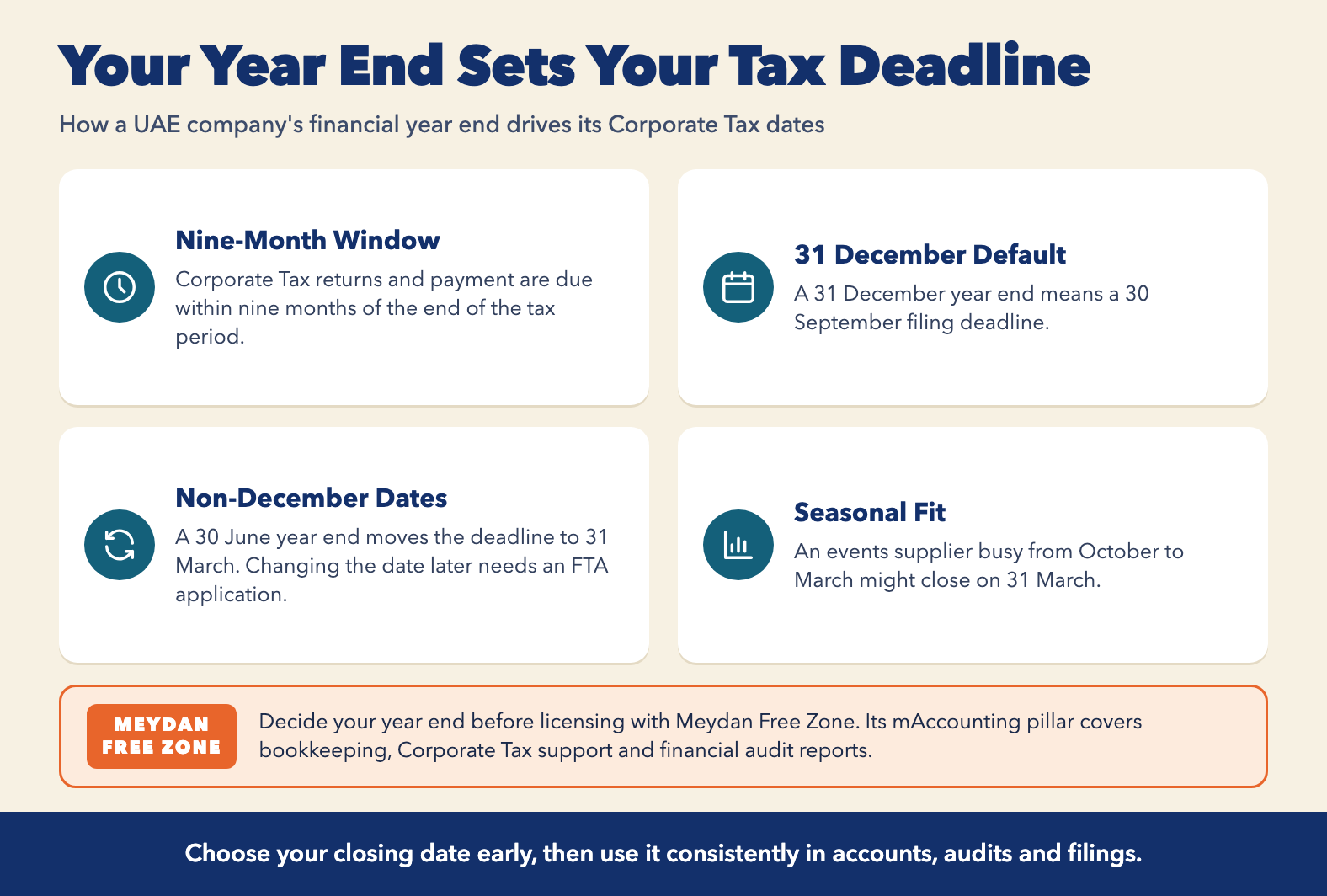
The year end sets the Corporate Tax return deadline. A UAE company must file its return and pay any tax due within nine months of the end of its tax period. A 31 December year end means a 30 September deadline. Under the same Federal Tax Authority rule, a 30 June year end moves it to 31 March.
The Nine-Month Filing Window
A consultancy closing on 30 June files by 31 March of the following year. A 30 September year end gives you 30 June. The window covers filing and payment. It isn't a reason to leave bookkeeping until the last quarter.
Common Year-End Dates Compared
| Feature | 31 December year end | Non-December year end |
|---|---|---|
| Corporate Tax return deadline | 30 September, nine months after the year end | 31 March for 30 June; 31 December for 31 March |
| Fit with the calendar tax period | Matches the calendar year, so nothing to explain | Tax period follows your own 12-month financial year |
| Auditor availability | Familiar to every auditor, but first-quarter capacity is tight | Earlier audit slots outside the January to March rush |
| Suitability for seasonal businesses | Works for steady monthly income | Can close after peak trading, when stock is easiest to count |
| Alignment with a foreign parent company | Suits groups reporting on a calendar year | Matches parents with dates such as 31 March |
Why Timing Affects Cash Planning
- Tax falls due nine months after the year end.
- Close right after a strong quarter to see profit clearly.
- An events supplier busy from October to March might close on 31 March.
- Track every deadline in your company compliance calendar.
Common Year-End Dates and Who They Suit
The most common financial year end in the UAE is 31 December. It matches the calendar year, simplifies bank reporting and suits most trading and service companies. Dates such as 31 March or 30 June suit seasonal businesses or subsidiaries of parents reporting on a different schedule.
31 December: The Default Choice
It matches the calendar tax period. Most auditors and banks are set up for it. The catch is audit capacity, which is tight in the first quarter. It fits a sole-owner consultancy with even monthly billing.
Non-December Dates for Seasonal or Group Businesses
- A seasonal business can close after peak trading, when stock and receivables are easier to verify.
- A subsidiary of a UK group with a 31 March year end avoids producing a second set of numbers.
- Pick the date once. Frequent changes create comparability problems for banks and auditors.
Five Checks Before You Confirm Your Financial Year End
Before confirming a financial year end in the UAE, check five things: your trading cycle, any parent company reporting date, the Corporate Tax deadline it creates, auditor availability, and Small Business Relief eligibility. Settle all five before the first accounting period begins.
Step 1: Map Your Trading Cycle
- Identify your peak and quiet months.
- Choose a date when stock and receivables are easiest to count.
- A retailer might close after the winter sales season.
Step 2: Check Group and Bank Reporting Dates
- Align with a foreign parent where one exists.
- Ask your bank which statements it expects, and when.
Step 3: Calculate the Resulting Deadlines
- Count nine months from the date. A 30 September year end gives a 30 June deadline.
- Enter it in your compliance calendar.
- Confirm the length of your first period with your accountant before the books open.
Step 4: Confirm Auditor Availability and Relief Eligibility
- Avoid the first-quarter rush where possible. A 30 June year end, for example, usually means easier access to audit slots.
- Agree the reporting timetable in writing.
- Check whether your revenue could qualify you for Small Business Relief.
Cost and Compliance Risks of the Wrong Year End
A poorly chosen financial year end in the UAE can compress audit timelines, strain cash flow when tax falls due, and complicate group reporting. Late Corporate Tax filing attracts administrative penalties set by the Federal Tax Authority, so a date that makes deadlines hard to meet is a real cost.
Penalty Exposure From Missed Deadlines
Late filing and late payment both carry penalties. The usual cause isn't the law, it's timing. A company that books its accountant after the nine-month window has started often finds it has too little time. See the Federal Tax Authority for current penalty amounts.
Changing the Date Later
- A change affects the tax period and needs an application to the Federal Tax Authority before it takes effect.
- Moving from 31 December to 30 June after year one can create a short period.
- Short or long periods complicate comparatives.
- Setting the right date at the start is cheaper than correcting it. The wider picture is in setting up a business in the UAE.
How Meydan Free Zone Companies Handle Year-End Reporting
Meydan Free Zone companies set their financial year end in line with their accounting and tax planning, then keep records to match it. The mAccounting pillar of Meydan Plus covers bookkeeping, VAT registration support, Corporate Tax support and financial audit reports, so year-end support sits with one provider.
Setting the Date Before Licensing
Decide the year end before your license is issued. A solo founder licensed through Fawri, which issues a business license in under 60 minutes, can set the date as the books open. Meydan Free Zone issues the Business License, Certificate of Formation, Share Register, and Memorandum and Articles of Association digitally, giving the first period a documented start date.
Keeping Records and Filings Aligned
- mCore supports business bank account setup. Banks may ask for statements at year end.
- A trading company using monthly bookkeeping has figures ready for the auditor.
No service guarantees bank approval or tax outcomes.
Free Business Setup Cost Calculator
Calculate NowConclusion
The financial year end in the UAE is a structural decision. It sets Corporate Tax deadlines, audit timing and cash planning. Match the date to your trading cycle and any group reporting needs, then record it consistently. Confirm it with your accountant and map the deadlines. With Meydan Free Zone, the Business License and Certificate of Formation are issued digitally, giving your first accounting period a documented start date.
Ready to Launch Your Business in Dubai?
Let's Connect