

Table of Contents
Frequently Asked Questions
Which assets can a UAE company depreciate?
A company depreciates tangible assets it expects to use for more than one year. Typical examples are equipment, vehicles, furniture, IT hardware and leasehold fit-out. The depreciation policy sets a capitalisation threshold, and items below that cost are expensed when purchased.
Is land depreciated under UAE accounting rules?
No. Land is not depreciated because it generally has an unlimited useful life. Buildings and fit-out on the land are depreciated separately over their own useful lives.
Which depreciation method suits office equipment best?
The straight-line method suits most office assets such as laptops, furniture and printers. It spreads the cost evenly over the useful life, so it is simple to apply and easy for auditors to verify. For example, AED 60,000 of equipment with a five-year life and no residual value gives AED 12,000 a year.
Can a company change its depreciation method later?
Yes, but only when the new method better reflects how the asset delivers value. The change is treated as a change in accounting estimate and must be disclosed in the financial statements. Changing methods to manage profit or tax outcomes will not be accepted by auditors.
Does depreciation reduce Corporate Tax in the UAE?
Corporate Tax starts from accounting profit, so depreciation recorded under the applicable accounting standards generally reduces taxable income. The Federal Tax Authority administers Corporate Tax and expects each charge to be supported by records. Treatment can differ for a Qualifying Free Zone Person, depending on its income and status.
What should a fixed asset register contain?
A fixed asset register should record each asset's description, purchase date, cost, useful life, residual value, depreciation method and location. It should also hold references to supporting invoices. Reconcile it to the general ledger regularly so the totals match.
How often should useful lives be reviewed?
Useful lives and residual values should be reviewed at least once a year, at the financial year-end. A review is also needed whenever an asset's use changes, such as a delivery van moving to heavier routes. Any resulting change is applied going forward, not backdated.
What happens to depreciation when an asset is sold?
Depreciation stops when the asset is sold or retired. The company compares the sale proceeds with the asset's carrying value, which is cost less accumulated depreciation. The difference is recorded as a gain or loss on disposal, and the asset is removed from the fixed asset register.
Topic Summary
What Fixed Asset Depreciation in the UAE Means
Depreciation is the systematic allocation of a fixed asset's cost over its useful life. A company records the expense each period rather than at purchase. The policy sets the method, useful life and residual value, and it must be applied consistently in the financial statements.
How Depreciation Affects Corporate Tax in the UAE
Corporate Tax in the UAE starts from accounting profit, so depreciation recorded under the accounting standards generally flows into taxable income. The Federal Tax Authority (FTA) administers Corporate Tax under Federal Decree-Law No. 47 of 2022. Keep a fixed asset register that supports every charge in the return.
Steps to Set Up a Depreciation Policy
You can set up a depreciation policy in four working steps, each feeding the next. The result is one written policy that your accountant and auditor can test.
Common Depreciation Mistakes for New Businesses
Common mistakes include expensing all purchases at once, depreciating land, using one useful life for every asset, skipping the fixed asset register and failing to update lives after a change in use. Each creates restatements at audit and weakens your Corporate Tax position.
Practical Examples for Founders
A Dubai trading startup buying AED 120,000 of warehouse equipment should capitalise it, depreciate it over its useful life and log it in the register. With a five-year life and no residual value, straight-line gives AED 24,000 a year. These figures are illustrative, not official rates.
Fixed Asset Depreciation Policies for UAE Companies
Most founders in Dubai buy equipment, vehicles or fit-out in the first year and book the cost as a single expense. Then the first financial statements fall due, and the accountant asks for a depreciation policy nobody has written.
That gap between purchase and policy is where depreciation usually goes wrong. This guide explains what a policy covers, how methods and useful lives are chosen, how depreciation interacts with Corporate Tax, and what to decide from day one.
What Fixed Asset Depreciation in the UAE Means
Depreciation is the systematic allocation of a fixed asset's cost over its useful life. A company records the expense each period rather than at purchase. The policy sets the method, useful life and residual value, and it must be applied consistently in the financial statements.
Assets That Are Depreciated
Depreciation applies to tangible assets with a life beyond one year: equipment, vehicles, furniture, IT hardware and leasehold fit-out. Land is not depreciated.
Your policy should also set a capitalisation threshold. Say a consultancy buys laptops and office furniture. It capitalises each item above the threshold and expenses everything below it.
Accounting Standard Behind the Policy
For Corporate Tax purposes, financial statements follow IFRS, or IFRS for SMEs where revenue does not exceed AED 50 million (Ministerial Decision No. 114 of 2023). Depreciation must reflect how the business consumes the asset, and useful life and residual value are reviewed annually. A trading company, for instance, should revisit a delivery van's life if the van moves from city runs to long-haul routes.
Depreciation Methods Compared
| Feature | Straight-Line | Reducing Balance |
|---|---|---|
| Expense pattern | Equal charge each year. AED 60,000 over five years gives AED 12,000 a year. | Larger charge early, shrinking each year as the carrying value falls. |
| Best suited assets | Furniture, IT hardware, leasehold fit-out. | Vehicles and equipment that lose value early. |
| Complexity | Low. Cost less residual value, divided by life. | Moderate. A rate applies to the opening carrying value each year. |
| Audit ease | High. Easy to recalculate and test. | Good, if you document why the rate fits the asset. |
| Typical use | Most SMEs, because it is the simplest method to apply. | Fleets and machinery with a steep early decline. |
A third method, units of production, ties the charge to usage. A delivery fleet depreciated by kilometres driven is the usual case. Whichever you choose, record why it fits.
How Depreciation Affects Corporate Tax in the UAE
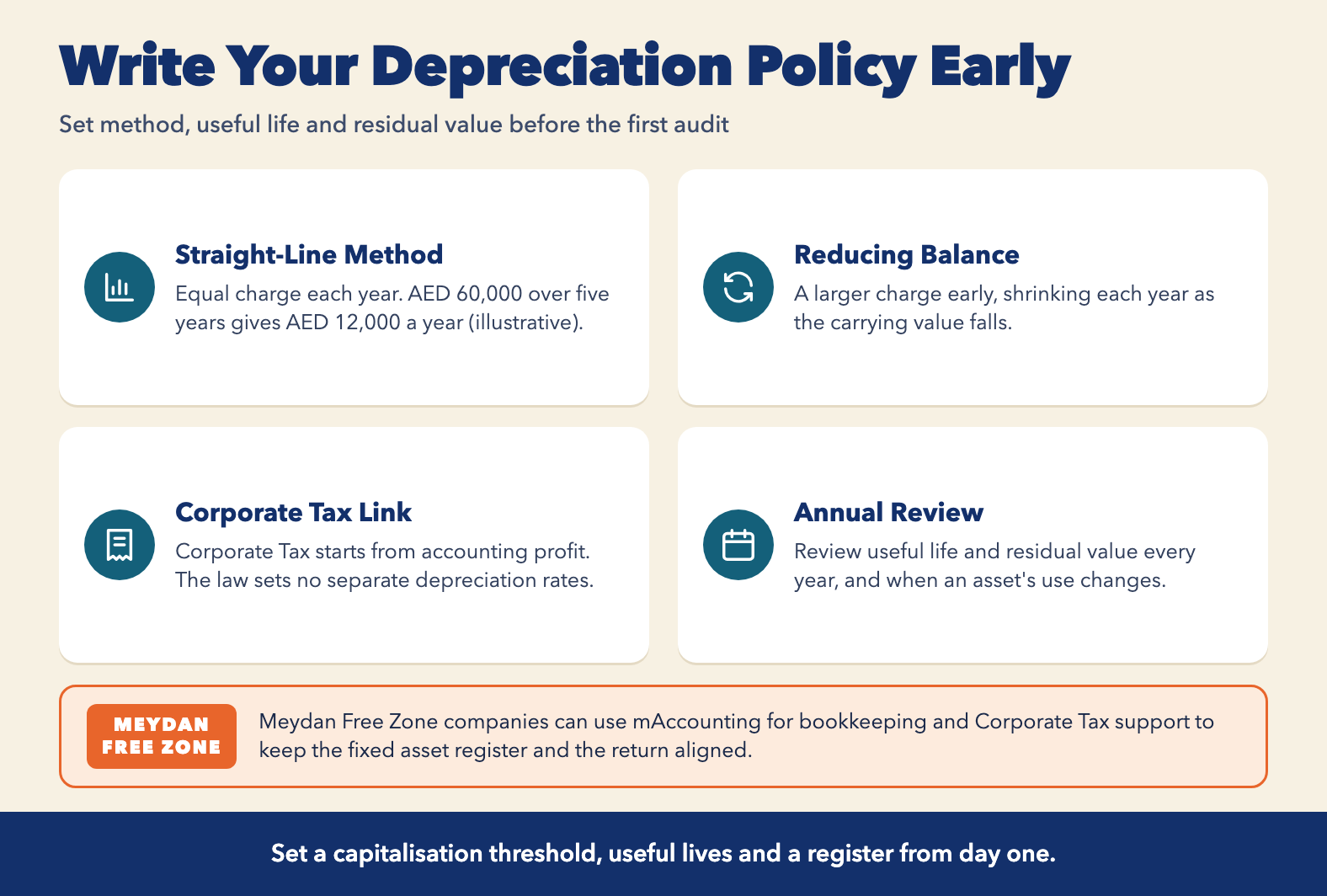
Corporate Tax in the UAE starts from accounting profit, so depreciation recorded under the accounting standards generally flows into taxable income. The Federal Tax Authority (FTA) administers Corporate Tax under Federal Decree-Law No. 47 of 2022. Keep a fixed asset register that supports every charge in the return.
Accounting Profit as the Starting Point
Depreciation reduces accounting profit, and taxable income begins from those financial statements. The Corporate Tax law does not set its own depreciation rates, so the accounting charge generally applies. Adjustments arise only where the law requires them, for example for investment property held at fair value. That makes a clean, standards-based policy your first line of defence.
Qualifying Free Zone Persons and Exempt Income
Treatment depends on your status. A Qualifying Free Zone Person must meet the legal conditions, and income outside the qualifying categories is taxed differently. Read the corporate tax exemptions rules before assuming any asset-related charge sits in an exempt bucket.
Evidence Auditors and the FTA Expect
- Purchase invoices for each asset.
- A current fixed asset register.
- A written policy note.
- The same methods, year to year.
Steps to Set Up a Depreciation Policy
You can set up a depreciation policy in four working steps, each feeding the next. The result is one written policy that your accountant and auditor can test.
- Set the capitalisation threshold. Decide the cost below which items are expensed, and write it into the policy.
- Assign useful lives and methods. Group assets by category. Base lives on expected use, not tax convenience.
- Build the fixed asset register. Record cost, date, life, method and location. Reconcile it to the ledger every month.
- Review and dispose. Review lives annually, and record any gain or loss on disposal. Add the review to your company compliance calendar.
Common Depreciation Mistakes for New Businesses
Common mistakes include expensing all purchases at once, depreciating land, using one useful life for every asset, skipping the fixed asset register and failing to update lives after a change in use. Each creates restatements at audit and weakens your Corporate Tax position.
Expensing Instead of Capitalising
A founder who expenses AED 90,000 of equipment in year one understates profit that year and overstates it later. Auditors will adjust it.
Inconsistent Policies Across Years
Switching methods needs justification. Changes in estimates, such as a shorter life, must be disclosed.
Practical Examples for Founders
A Dubai trading startup buying AED 120,000 of warehouse equipment should capitalise it, depreciate it over its useful life and log it in the register. With a five-year life and no residual value, straight-line gives AED 24,000 a year. These figures are illustrative, not official rates.
For a Meydan Free Zone company, the same logic applies. If the company seeks Qualifying Free Zone Person status, the conditions for that status shape the Corporate Tax outcome. Meydan Free Zone's mAccounting offers bookkeeping, VAT registration support and Corporate Tax support, which helps keep the register and the return aligned. Its Corporate Tax packages cover registration and return filing.
Free Business Setup Cost Calculator
Calculate NowA depreciation policy works best when it is set before the first audit, not after. Draft your threshold, useful lives and register this quarter, then have your accountant review them. A Meydan Free Zone company can use mAccounting bookkeeping support to keep that register in step with the ledger.
Ready to Launch Your Business in Dubai?
Let's Connect