

Table of Contents
Frequently Asked Questions
What does the new UAE salary rule require from June 1, 2026?
From June 1, 2026, private sector employers must pay salaries on or before the first day of each month through the updated Wage Protection System (WPS). Salary paid after the first day of the month is already considered delayed. There is no buffer period under the new rule.
When an employer misses the WPS deadline, what fines does MOHRE impose?
When an employer misses the deadline, MOHRE applies financial fines per affected employee, meaning a company with 20 staff faces 20 separate fine entries. Unpaid fines block all MOHRE transactions, including renewals.
What happened to the 15-day grace period under the old WPS rules?
The updated WPS removes the 15-day grace period that previously meant late payments were not immediately flagged. Under the new rule, there is no buffer period. Delayed payments trigger automatic compliance flags in real time.
Does the new UAE salary rule apply to Free Zone companies?
Yes. Free Zone companies with employees on MOHRE-registered contracts are subject to the same WPS obligation as Mainland employers. The rule applies regardless of company size, industry, or structure.
Can an employer pay salary in cash or via direct bank transfer instead of through WPS?
No. Payment is only considered complete when the WPS transfer is confirmed and funds are accessible in the worker's WPS-linked account. Cash payments and direct bank transfers do not satisfy the wage protection obligation.
What happens to work permit renewals if an employer has outstanding WPS violations?
Outstanding WPS violations block all work permit renewals across the entire establishment file, not just for affected employees. The block remains active until fines are paid and WPS compliance is restored.
Can MOHRE impose travel bans for wage payment non-compliance?
Yes. For persistent non-compliance, MOHRE can escalate to travel bans targeting company owners or managers listed on the establishment file. Resolving a travel ban requires full settlement of outstanding wages, payment of all fines, and formal clearance through MOHRE.
Topic Summary
From June 1, 2026: The Unified Deadline Is Live
From June 1, 2026, MOHRE enforces a hard unified deadline requiring private sector employers to pay salaries on or before the first day of each month via the Wage Protection System. Salary paid after the first day of the month is already considered delayed — there is no buffer period.
What the Updated WPS Removes
The updated Wage Protection System (WPS) removes the 15-day grace period under the old framework. Salaries must now be paid on or before the first day of each month, meaning a company that previously relied on mid-month processing must restructure its payroll calendar immediately.
When MOHRE Starts Taking Action
When an employer misses the deadline, MOHRE begins taking action. Financial fines apply per affected employee, and block on MOHRE transactions, including renewals, follows if violations remain unresolved. Unpaid fines compound and block all future permit activity.
Work Permit Blocks Hit the Entire File
A single unresolved WPS violation blocks every work permit renewal across the employer's full establishment file — not just for the employees paid late. A company planning visa renewals must clear all outstanding violations before any process can proceed.
Travel Bans Target Responsible Parties Directly
Persistent non-compliance escalates to travel bans on company owners and managers listed on the MOHRE establishment file. Resolving a travel ban requires full wage settlement, payment of all fines, and formal clearance — done only through MOHRE's official process.
The Clearing Time Trap Most Employers Miss
Many employers initiate WPS transfers on the deadline day without understanding that bank clearing adds one to two business days before the transfer registers as settled. Processing on the 1st every month but settling on the 3rd — due to clearing times — is already a violation.
Four Checkpoints Confirm Full Compliance
Checkpoint 1: Each employee appears on the WPS settlement report with the correct salary. Checkpoint 2: Settlement date falls on or before the first day of the month. Checkpoint 3: MOHRE portal shows no flags. Checkpoint 4: A documented trail — WPS report, bank confirmation, and portal screenshot — is filed for each pay period.
UAE's New Salary Rule by MOHRE: Unified Wage Deadline for Employers
What the New UAE Salary Rule Actually Requires
From June 1, 2026, private sector employers in the UAE face a hard, unified deadline: salaries must be paid by the first day of each month under the updated Wage Protection System (WPS). This isn't a soft guideline, it's a monitored, automated obligation enforced by MOHRE in real time.
The updated WPS removes the old 15-day grace period that previously meant late payments weren't immediately flagged. Under the new UAE salary rule, salary paid after the first day of the month is already considered delayed. MOHRE begins taking action in a phased manner from Day 2, with warnings escalating into fines and permit blocks if the delay continues.
| Requirement | Old WPS Rule | Updated WPS Rule (From June 1, 2026) |
|---|---|---|
| Payment Deadline | Within 10 days of the contractual pay date | On or before the first day of each month. No buffer period |
| Grace Period | 15-day grace period under the old WPS framework | No grace period. Salary paid after the first day of the month is already considered delayed |
| Accepted Payment Method | Various methods including informal transfers | Must flow through the updated Wage Protection System (WPS) only. Cash and informal transfers do not satisfy the obligation |
| Payment Completion Standard | Bank transfer initiation was often sufficient | Payment is only considered complete when the WPS transfer is confirmed and funds are accessible in the worker's WPS-linked account |
| Scope of Employers Covered | Private sector, with varying enforcement thresholds | All private sector employers regardless of size, industry, or Free Zone versus Mainland structure |
| MOHRE Monitoring | Periodic manual reviews | Automated, real-time monitoring. Late or missing WPS entries trigger automatic flags from Day 2 |
| Consequences for Non-Compliance | Warnings issued first; fines applied after extended delays | Financial fines apply per affected employee, meaning a company that employer misses the deadline faces escalating action, and block of MOHRE transactions, including renewals |
| Government Sector Applicability | Excluded from MOHRE's private sector wage framework | Still excluded. MOHRE's private sector wage rule does not apply to public entities |
The Unified Deadline Defined
The rule sets a single, non-negotiable standard: wages must reach the worker by the contractually agreed pay date, processed through the Wage Protection System. For employers with a monthly pay cycle set for the 1st of each month, the WPS transfer must be settled on that date. Not on the 11th, not end of month.
- The rule applies to all private sector employers regardless of company size, industry, or Free Zone versus Mainland structure
- Payment must flow through the Wage Protection System. Direct cash or informal transfers don't satisfy the obligation
- Government sector employees and public entities fall outside MOHRE's private sector wage framework
Payment is only considered complete when the WPS transfer is confirmed and funds are accessible in the worker's WPS-linked account. Initiating a bank transfer isn't sufficient. MOHRE's system monitors WPS data in real time, and late or missing entries trigger automatic flags.
Who Is Covered Under This Rule?
All private sector employees working under MOHRE-registered contracts are covered, which includes full-time, part-time, and fixed-term workers. Free Zone companies with employees on MOHRE-registered contracts face the same. A trading company in a Free Zone with 15 staff on MOHRE contracts must run all salaries through WPS on the same deadline schedule.
Domestic workers governed by Federal Decree-Law No. 10 of 2017 operate under a related but distinct framework. Employers shouldn't assume the same deadline applies identically.
How the Wage Protection System Works
The Wage Protection System is a federal electronic salary transfer mechanism operated by MOHRE in coordination with the Central Bank of the UAE. It records, monitors, and verifies that private sector wages are paid on time and in the correct amount to each registered employee.
How WPS Monitors Employer Compliance
MOHRE receives payroll data from WPS-linked banks and exchange houses after each pay cycle closes. The system cross-references the number of registered employees against the number of WPS transactions, and any gap is flagged automatically. A company with 50 staff that processes 48 WPS transfers on time will be flagged for the 2 missing entries. Partial compliance doesn't avoid the consequence.
This means employers who pay some employees on time but miss others are still recorded as non-compliant for the outstanding workers. MOHRE can access an employer's full WPS history, making retroactive disputes about payment timing very hard to win.
What 'Payment' Means Under WPS
An employer who initiates a WPS transfer on the 1st but whose bank processes it on the 2nd due to clearing times is already in breach. Allow two to three business days before the deadline, meaning your internal payroll run must complete by the 28th or 29th of the prior month, not on the 1st itself.
- Employers must ensure their WPS-registered bank account holds sufficient funds before the deadline day
- Any WPS transfer amount that doesn't match the registered salary figure in MOHRE's system can trigger a flag even if the transfer was made on time
- Salary advances paid outside WPS aren't credited against the monthly WPS obligation. The full monthly amount must still be processed through the system
Fines, Work Permit Blocks, and Travel Bans: The Consequence Sequence
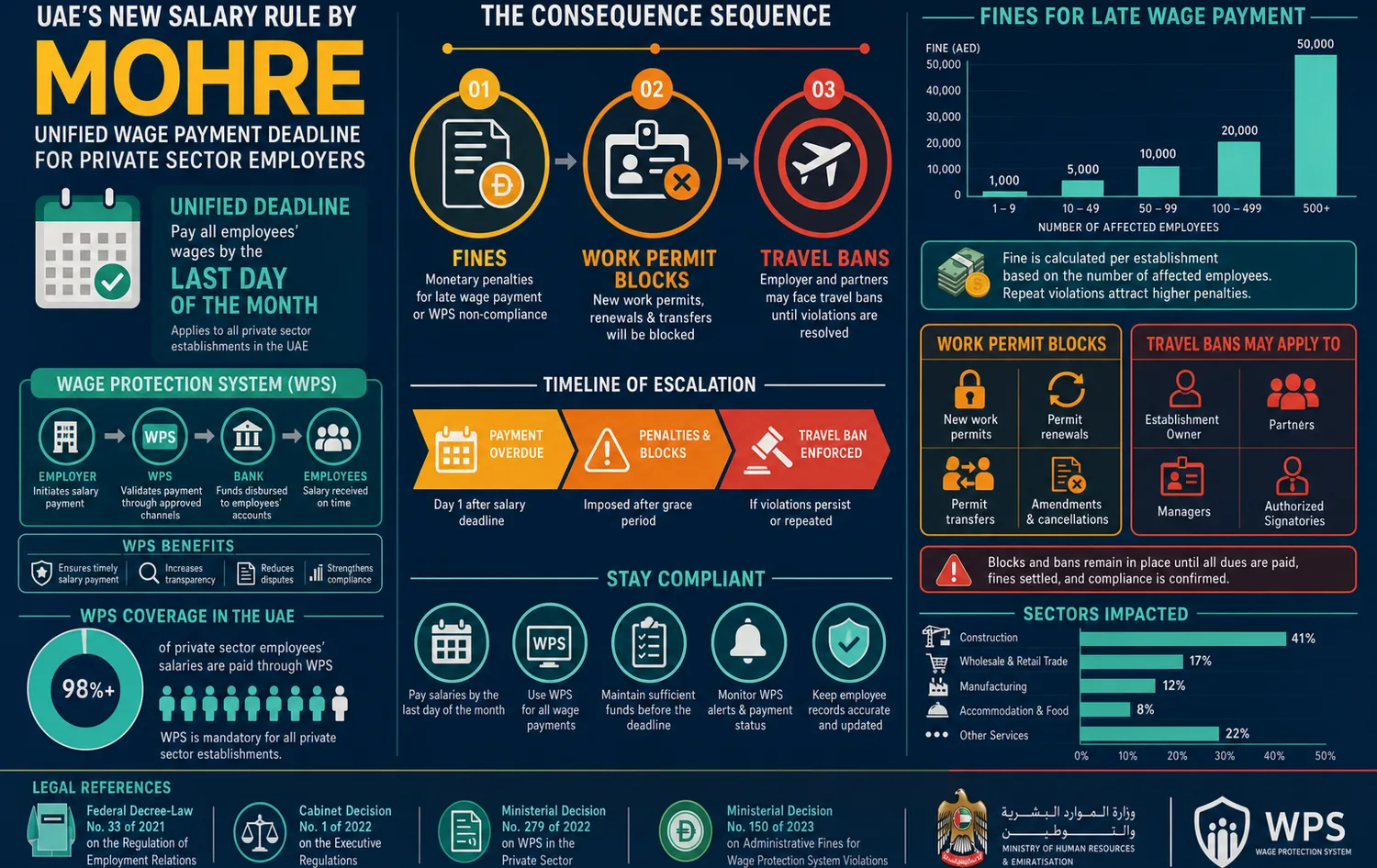
MOHRE enforces the new UAE salary rule through a staged consequence system. The escalation is fast, automated, and doesn't require an employee complaint to trigger.
Stage One: Warnings and Financial Fines
From Day 2 of a missed payment, MOHRE begins taking action. Financial fines apply per employee affected, not as a single flat charge. A company with 20 staff that misses the WPS deadline faces 20 of thousands of AED before any permit activity is possible. Unpaid fines compound, so an employer who ignores the first fine cycle will face a growing liability that blocks all MOHRE transactions.
Stage Two: Work Permit and Recruitment Blocks
Once a wage violation is recorded and unresolved, MOHRE blocks the employer from applying for new work permits or renewing existing ones. This block applies across the entire establishment file, not just for the employees who were paid late. A company that missed one WPS cycle in March and has five visa renewals due in April will find all five renewal processes blocked until the March violation and associated fines are cleared.
Stage Three: Travel Bans on Responsible Parties
For persistent or severe non-compliance, MOHRE can escalate to travel bans targeting company owners, PRO-registered managers, or individuals listed as responsible parties on the establishment file. A company director listed on a MOHRE establishment file who has three months of unpaid WPS cycles across 30 employees may find a travel ban applied before they're notified through formal channels. Resolving a travel ban requires full settlement of outstanding wages, payment of all fines, and a formal clearance process through MOHRE.
Most Expats and SME Owners Discover Too Late: Common Compliance Errors
The most common errors under the new UAE salary rule are structural gaps in how payroll is managed. Here's what catches employers off guard.
The Clearing Time Trap
Many employers initiate WPS transfers on the deadline day without understanding that bank clearing adds one to two business days before the transfer registers as settled in the WPS system. MOHRE's system records the settlement date, not the initiation date. An employer who runs WPS on the 1st every month during a week with a public holiday may find the settlement lands on the 3rd, a violation that generates fines despite the employer believing they were on time.
The fix is structural: move your internal payroll run to at least three business days before the contractual pay date, not on it.
New Hires Outside the WPS File
Employers who onboard new staff and pay them via bank transfer or cash while waiting to add them to the WPS file are in direct breach of the wage protection obligation. MOHRE's records show the new hire's start date. Any pay cycle after that date where the employee is absent from the WPS file is flagged as a violation. Build WPS registration into your onboarding checklist as a day-one task, not an end-of-probation task.
Partial Payment and Salary Advances
Paying part of a salary through WPS and the remainder in cash doesn't satisfy the WPS obligation. An employer who pays a AED 1,000 advance in cash mid-month and then processes only AED 8,000 through WPS against a registered salary of AED 9,000 has created both a WPS shortfall and a potential labour law issue in a single pay cycle.
A Numbered Process: How to Bring Your Payroll Into Compliance
Follow this sequence precisely before your next pay cycle closes.
- Audit your current payroll setup. Pull each employee's MOHRE-registered contract and confirm the contractual pay date recorded in the system matches your actual pay cycle
- Confirm WPS registration is active and covers each current employee, including any hired in the last 90 days who may not yet be on the WPS file
- Align your internal payroll processing date to allow three business days before the WPS deadline. If the contractual pay date is the 1st, your internal run must complete by the 28th or 29th of the prior month
- Process the WPS transfer through your registered bank or exchange house, confirming the full employee list is included and amounts match MOHRE-registered salary figures
- Obtain the WPS settlement confirmation from your bank and log it against the pay period in your internal records
- Log into the MOHRE employer portal within 48 hours of the WPS settlement to confirm compliant status is reflected for the relevant pay period
Keep a one-line tracker showing submission date, WPS settlement date, MOHRE portal confirmation date, and any flags. This documented trail is your protection if a dispute arises later. A payroll manager who completes this sequence for each cycle and maintains a monthly tracker can demonstrate full compliance to MOHRE within minutes if an audit or employee complaint is raised.
Tax Considerations and Ongoing Administration for Private Sector Employers
UAE private sector employers have no personal income tax obligation on wages paid to employees. However, ongoing administration under the new UAE salary rule requires maintaining active WPS records, keeping reliable wage records for each pay cycle, and tracking MOHRE compliance status to avoid permit blocks at renewal time.
Set calendar reminders 90 and 30 days before each permit renewal date to audit WPS compliance status and clear any outstanding flags before the renewal window opens. Factor in recurring fees: WPS bank charges, MOHRE renewal fees, and any mandatory health insurance renewals all fall due at predictable intervals and should be budgeted in advance.
Success Criteria: How to Know the Process Is Complete
Compliance with the new UAE salary rule is confirmed when four checkpoints are met for the current pay period:
- Checkpoint 1: Each employee on the MOHRE establishment file appears on the WPS settlement report with the correct salary amount
- Checkpoint 2: The WPS settlement date recorded by the bank falls on or before the first day of the month for each employee's MOHRE-registered contract
- Checkpoint 3: The MOHRE employer portal shows a compliant status with no outstanding flags for the current and prior two pay periods
- Checkpoint 4: The employer holds a documented trail (WPS report, bank confirmation, and MOHRE portal screenshot) filed against each pay period
An employer who can confirm all four checkpoints for the last three pay cycles is fully compliant and holds the evidence to demonstrate it. Once compliant, set a recurring internal calendar task to run the four-checkpoint audit within 72 hours of each WPS settlement. If any portal flag appears that you can't resolve within 48 hours, contact MOHRE's employer helpline or a registered PRO service immediately. Do not allow unresolved flags to accumulate.


.jpeg)