

Table of Contents
Frequently Asked Questions
Who pays the toll when an employee drives a company car through a Salik gate?
The toll is deducted from the prepaid Salik account linked to the vehicle's tag, so the company pays first. Salik charges follow the vehicle, not the driver. Whether the business recovers the cost from the employee depends on its own written vehicle policy.
Can a company register a Salik tag in its own name?
Yes. The tag and its prepaid account should be linked to the company and to the plate of a vehicle registered in the company's name. This keeps the cost and the record with the business, not with an individual employee. Vehicle registration needs to be in order before the tag is linked.
What happens if the Salik account balance runs out?
A low or empty balance can lead to fines, because the toll can no longer be deducted when the vehicle passes a gate. Salik allows five working days after a trip to top up, after which an AED 50 violation applies. Assign one person to own the account and set a regular top-up routine.
Do company vehicles need a separate Salik tag for each vehicle?
Yes. Each tag is linked to one vehicle's plate, so every van, car or truck the business runs needs its own tag. Several tags can be linked to company accounts, which lets the finance team track each vehicle's charges separately.
Who is responsible for a traffic fine on a company vehicle in Dubai?
Fines attach to the vehicle's registered owner, which is the company when the vehicle is registered in its name. The business settles the fine with the Roads and Transport Authority first. It can then recover the amount from the driver under its internal policy.
Can a company recover tolls and fines from an employee?
A company can recover them if a signed vehicle policy sets out who pays for personal-use tolls and driver-caused fines. Without a written policy, disputes over who was driving are hard to resolve. A driver and trip log helps match each charge to a person.
Are tolls and fines on company vehicles treated the same for tax purposes?
Not necessarily. Tolls are generally a vehicle operating expense, while fines are usually treated differently for Corporate Tax. Salik tolls have included 5% VAT since 1 June 2026. Record tolls and fines under separate codes and check FTA guidance before claiming deductions or input VAT.
Does a Meydan Free Zone company use the same Salik system as other Dubai businesses?
Yes. Meydan Free Zone licenses the company, while the Roads and Transport Authority governs vehicle registration, Salik tags and fines in Dubai. A Meydan Free Zone company runs its own Salik account. mAccounting offers bookkeeping, VAT and Corporate Tax support for recording these costs.
Topic Summary
What Salik Means for a Company Car
Salik is Dubai's automatic road toll system, operated under the Roads and Transport Authority. Each registered vehicle carries a tag that triggers a charge at a toll gate. For a company car, the charge is deducted from the prepaid account linked to the tag, which the business must keep funded.
Salik Tag for a Company Vehicle: Registration and Funding
A Salik tag is linked to the vehicle's plate and to an account in the company's name. The business tops up the account in advance, and each toll is deducted automatically. Registering the tag in the company's name, not an employee's, keeps the cost and the record with the business.
How to Control Salik for Commercial Vehicles in Five Steps
Controlling tolls on commercial vehicles takes five steps: register every vehicle in the company's name, link each tag to a funded account, log drivers and trips, review charges every month, and pay fines promptly. This keeps costs visible and driver accountability straightforward.
How the RTA Handles Tolls and Fines on Company Vehicles
The RTA issues and records traffic fines in Dubai, and they attach to the vehicle's registered owner. For a company car, that owner is the business. The company pays the fine, then decides whether to recover the cost from the driver under its own policy.
Accounting for Tolls and Fines in Company Books
Tolls are generally an operating expense of the vehicle, while fines are usually treated differently for tax purposes. Record both separately, keep statements, and check current treatment with the Federal Tax Authority (FTA), UAE before claiming deductions or input VAT on Salik charges.
How a Meydan Free Zone Company Manages Vehicle Costs
Meydan Free Zone licenses the company, while the RTA governs vehicle registration, Salik and fines in Dubai. A Meydan Free Zone company runs its own Salik account. mAccounting offers bookkeeping, VAT registration support and Corporate Tax support, and mCore offers business bank account support.
Conclusion
Salik tolls on a company car are small charges that become a control issue without a funded account, a driver log and a written policy. Tolls follow the vehicle, fines follow the registered owner, and both land on the business. If you are setting up with Meydan Free Zone, list the vehicles you plan to run, decide who owns the Salik account, and set a monthly review.
Salik, Tolls and Fines for Company Vehicles
Any Dubai company that runs a vehicle will pay road tolls and, sooner or later, a traffic fine. Both look like minor running costs until they surface as account shortfalls, unpaid fines and disputes over who was driving. How do you keep them under control? This guide explains how Salik works for a company car, how fines are assigned and how to budget and record both.
What Salik Means for a Company Car
Salik is Dubai's automatic road toll system, operated under the Roads and Transport Authority. Each registered vehicle carries a tag that triggers a charge at a toll gate. For a company car, the charge is deducted from the prepaid account linked to the tag, which the business must keep funded.
How the Salik System Charges a Vehicle
The gate detects the tag and deducts the toll from the linked account. The charge follows the vehicle and its plate, not the driver. Say a sales team of three shares one car: every toll lands on one account, with no driver-level record. Since 31 January 2025, Salik has used variable pricing. A crossing costs AED 6 at weekday peak times (6am to 10am and 4pm to 8pm) and AED 4 at other times and on Sundays. Crossings between 1am and 6am are free, and Ramadan has its own timings. From 1 June 2026, 5% VAT applies, taking these tolls to AED 6.30 and AED 4.20. Current rates and account rules are published by the Roads and Transport Authority (RTA), Dubai.
Why Founders Misjudge Toll Costs
A single toll looks small. Repeated across daily routes, it becomes a recurring cost, and peak-hour crossings cost more. A delivery start-up may budget for fuel and leasing, then find tolls adding up at the first month-end reconciliation. Shared vehicles make it worse, because nobody can say who drove where.
Salik Tag for a Company Vehicle: Registration and Funding
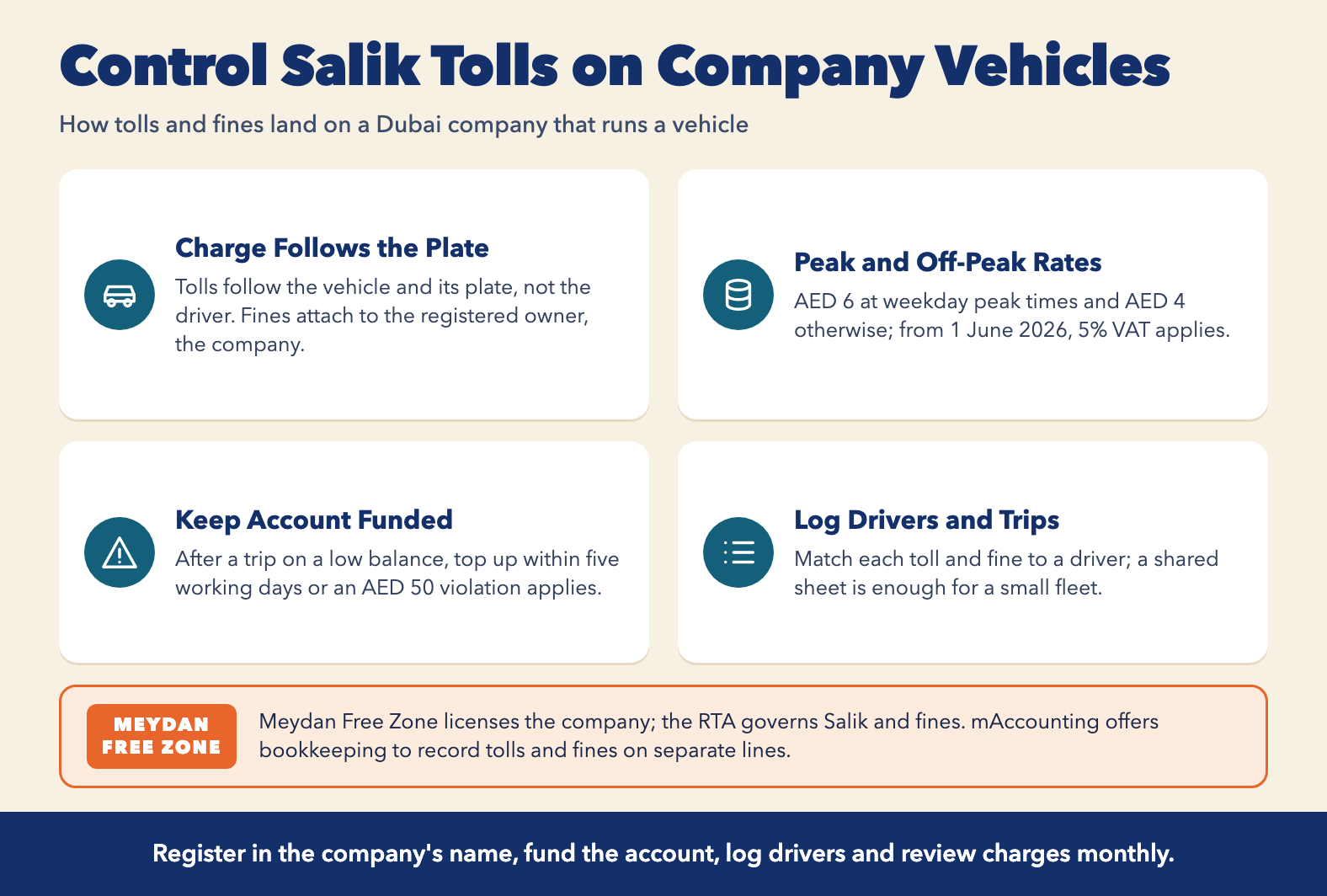
A Salik tag is linked to the vehicle's plate and to an account in the company's name. The business tops up the account in advance, and each toll is deducted automatically. Registering the tag in the company's name, not an employee's, keeps the cost and the record with the business.
Setting Up the Account in the Company's Name
Vehicle registration must be in order first. If you are still registering, read how to register a company vehicle in Dubai. One founder registered the tag personally, then struggled to claim the cost once the vehicle moved to the company. Keep tag and plate records aligned whenever a vehicle changes.
A low balance leads to fines. Set a routine:
- Assign one person to own the account.
- Review the balance and the statement every month.
- Top up before the balance drops below a set level.
One operations manager checks weekly and tops up early. According to Salik's FAQs, you have five working days after a trip to top up an insufficient balance. After that, an AED 50 violation applies.
How to Control Salik for Commercial Vehicles in Five Steps
Controlling tolls on commercial vehicles takes five steps: register every vehicle in the company's name, link each tag to a funded account, log drivers and trips, review charges every month, and pay fines promptly. This keeps costs visible and driver accountability straightforward.
Step 1: Register Each Vehicle in the Company's Name
- Ownership and tag records must match.
- Avoid personal registrations for business vehicles.
- A trading company with three vans gives each its own tag and account link.
Step 2: Fund and Monitor the Account
- Set a minimum balance rule.
- Name an account owner.
- A finance lead can run a standing weekly check.
Step 3: Keep a Driver and Trip Log
- Match each toll and fine to a driver.
- A shared sheet is enough for a small fleet.
- A courier firm records driver, date and route per vehicle.
Step 4: Reconcile Charges Every Month
- Compare statements against the log.
- Flag unusual charges early.
- One manager spotted a van on a route it should never have used.
Step 5 is paying fines promptly, covered in the next section. Running a larger fleet as a business? See how to start a fleet vehicles management business.
Who Handles Each Vehicle Cost Item
| Feature | Cost item | Responsible party |
|---|---|---|
| Salik toll charges: company account linked to the tag | Toll deducted per gate crossing | The company, through a funded prepaid account |
| Traffic fines: registered owner, which is the company | Fines recorded against the plate | The registered owner, which is the company |
| Recovery from driver: company vehicle policy | Personal-use tolls and driver fines | The company, under a signed vehicle policy |
| Vehicle registration and tags: RTA | Registration, renewal and tag issue | The RTA |
| Bookkeeping and tax records: company, supported by mAccounting | Separate ledger lines for tolls and fines | The company, supported by mAccounting |
How the RTA Handles Tolls and Fines on Company Vehicles
The RTA issues and records traffic fines in Dubai, and they attach to the vehicle's registered owner. For a company car, that owner is the business. The company pays the fine, then decides whether to recover the cost from the driver under its own policy.
Who Is Liable When a Fine Is Issued
The company is liable first, even when a driver caused the fine. Recovery is an internal matter. In one case a driver incurred a fine on a shared car, the company paid, then deducted the amount under a signed vehicle policy. Without that signature, the deduction becomes a dispute.
What Happens When Fines Go Unpaid
Unpaid fines can hold up vehicle registration renewal. In one case, a renewal was delayed because an old toll fine stayed open. Check outstanding fines with the RTA before renewal falls due, and settle them early.
Building a Vehicle Policy for Drivers
- State who pays tolls and fines.
- Recharge personal-use tolls to the employee.
- Have every driver sign.
- Review it alongside your company compliance calendar.
Accounting for Tolls and Fines in Company Books
Tolls are generally an operating expense of the vehicle, while fines are usually treated differently for tax purposes. Record both separately, keep statements, and check current treatment with the Federal Tax Authority (FTA), UAE before claiming deductions or input VAT on Salik charges.
Separating Tolls From Fines in the Ledger
Use separate expense codes. A bookkeeper might code tolls under vehicle running costs and fines on their own line. Keep Salik statements as supporting records.
Tax Treatment to Confirm With the FTA
Check Corporate Tax deductibility of fines in FTA guidance before claiming vehicle expenses. Since 1 June 2026, Salik tolls include 5% VAT, so confirm whether that VAT is recoverable before you claim it. Rely on published rules only.
How a Meydan Free Zone Company Manages Vehicle Costs
Meydan Free Zone licenses the company, while the RTA governs vehicle registration, Salik and fines in Dubai. A Meydan Free Zone company runs its own Salik account. mAccounting offers bookkeeping, VAT registration support and Corporate Tax support, and mCore offers business bank account support.
Where Meydan Free Zone Fits and Where the RTA Takes Over
After registration, Meydan Free Zone issues the Business License digitally. A founder licenses the company first, then registers vehicles in its name with the RTA. Tags, registration and fines sit with the RTA, not Meydan Free Zone.
Supporting Bookkeeping and Banking Through Meydan Plus
A small logistics company can use mAccounting bookkeeping to record toll and fine expenses separately each month. mCore supports the business bank account that funds the Salik top-ups. Meydan Free Zone's Cost Calculator shows setup costs, so add vehicle running costs to your budget separately.
Conclusion
Salik tolls on a company car are small charges that become a control issue without a funded account, a driver log and a written policy. Tolls follow the vehicle, fines follow the registered owner, and both land on the business. If you are setting up with Meydan Free Zone, list the vehicles you plan to run, decide who owns the Salik account, and set a monthly review.