
Table of Contents
Frequently Asked Questions
Is a shareholders agreement legally required for a company in the UAE?
No. UAE law does not make a shareholders agreement mandatory for a company. The Memorandum and Articles of Association is the required constitutional document. A shareholders agreement is a private contract that owners add to settle decisions, exits and funding in more detail.
Can a shareholders agreement override the Memorandum and Articles of Association?
Generally, no. The Memorandum and Articles of Association is the filed constitutional document, and it usually prevails where the two conflict. Owners should align both documents before signing. They should review the agreement whenever the constitutional document is amended.
Does a free zone company with two owners need a shareholders agreement?
It is not required, but two owners benefit most. A 50/50 company has no tie-break unless the agreement supplies one. Setting out reserved matters, deadlock steps and exit terms in writing avoids stalled decisions.
What happens to shares if an owner dies or leaves the company?
That depends on what the owners agreed in writing. A shareholders agreement can set buy-out rights, a valuation method and payment terms for a departing or deceased owner. Without these terms, the outcome falls to the constitutional documents and applicable law, which often leaves disputes unresolved.
Do shareholders agreements in the UAE need to be notarised?
Notarisation is not required for every agreement, but it is common practice. It strengthens the evidential weight of the signatures. Owners should have a UAE-qualified lawyer confirm whether notarisation is needed for their structure and any lender requirements.
Can a shareholders agreement stop an owner from competing after exit?
Yes, within limits. Non-compete and non-solicitation terms must be reasonable in scope, duration and location. Overbroad restrictions risk being unenforceable. Tying the restriction to the company's licensed activities makes it easier to defend.
How do owners resolve a 50/50 deadlock in a UAE company?
The agreement should set an escalation path. A common route is a fixed negotiation period, then mediation, then arbitration or court. Buy-sell clauses can also end a deadlock, but they favour the owner with more available cash.
How often should owners review their shareholders agreement?
Review it whenever shareholding, funding, owners or licensed activities change. Check it each time the Memorandum and Articles of Association is amended. The Share Register should always match the current ownership the agreement describes.
Topic Summary
What a Shareholders Agreement Covers in the UAE
A shareholders agreement is a private, legally binding document between a company's owners. It sets out how shares are held and transferred, how decisions are made, how profits are shared and how exits and disputes are handled. It fills the gaps the standard constitutional documents leave open.
Shareholders Agreement vs Memorandum and Articles of Association
The Memorandum and Articles of Association (MoA/AoA) is the company's constitutional document, filed with the licensing authority. A shareholders agreement is private and covers exit terms, funding duties and veto rights. Where the two conflict, the filed document usually prevails, so they must be aligned.
Key Clauses a Shareholders Agreement in Dubai Should Include
The clauses with the most weight cover ownership and capital, reserved matters, profit distribution, transfer restrictions, deadlock, exit, confidentiality, non-compete limits and dispute resolution. Each clause should state a trigger, a process and a consequence in plain terms.
Steps to Draft and Sign a Shareholders Agreement
List owners and shareholdings, agree reserved matters, and set transfer and exit terms. Then choose a dispute forum, have a UAE-qualified lawyer draft the document and sign, with notarisation where needed. Align the agreement with the MoA/AoA first.
Exit, Deadlock and Dispute Clauses That Protect Owners
Exit and deadlock clauses decide what happens when owners disagree or leave. Common tools include pre-emption, drag-along and tag-along rights, buy-sell mechanisms, valuation methods and staged dispute resolution. Clear triggers stop a disagreement from stalling the company.
How a Shareholders Agreement Works for a Meydan Free Zone Company
After registration, Meydan Free Zone issues the Business License, Certificate of Formation, Share Register and MoA/AoA digitally. A shareholders agreement sits beside these as a private arrangement between the owners. Shareholding changes should be reflected in the Share Register and constitutional documents.
What This Means for Your Decision as a Business Owner
Sign a shareholders agreement before capital goes in, not after a dispute starts. Settle ownership, decisions, exits and funding in writing, align it with the MoA/AoA, and review it when shareholding, activities or funding change.
Shareholder Agreement in the UAE: Key Clauses for Business Owners
Co-owners of a UAE company often leave the shareholders agreement until after the first disagreement. They assume the company's constitutional documents already settle who decides what, and they rarely do.
A handshake on the equity split holds only while revenue grows and everyone agrees on direction. This guide explains what a shareholders agreement covers, which clauses carry the most weight and what to settle before you sign.
What a Shareholders Agreement Covers in the UAE
A shareholders agreement is a private, legally binding document between a company's owners. It sets out how shares are held and transferred, how decisions are made, how profits are shared and how exits and disputes are handled. It fills the gaps the standard constitutional documents leave open.
Purpose and Legal Standing
The agreement stays between owners, separate from public company filings. On the mainland, the federal commercial companies law sets the framework, while a free zone company also follows its free zone's own regulations. The agreement is enforceable only where it doesn't conflict with mandatory provisions.
Say two co-founders hold 50% each and have no rule for a deadlock. The agreement supplies one before the first dispute.
Who Needs One
- Any company with two or more owners.
- Single owners planning to bring in investors later.
- Owners who also manage or finance the company.
A founder expecting an investor within a year should have terms ready before negotiations start. Our guide to shareholders' agreements in the UAE covers the reasoning in more detail.
Shareholders Agreement vs Memorandum and Articles of Association
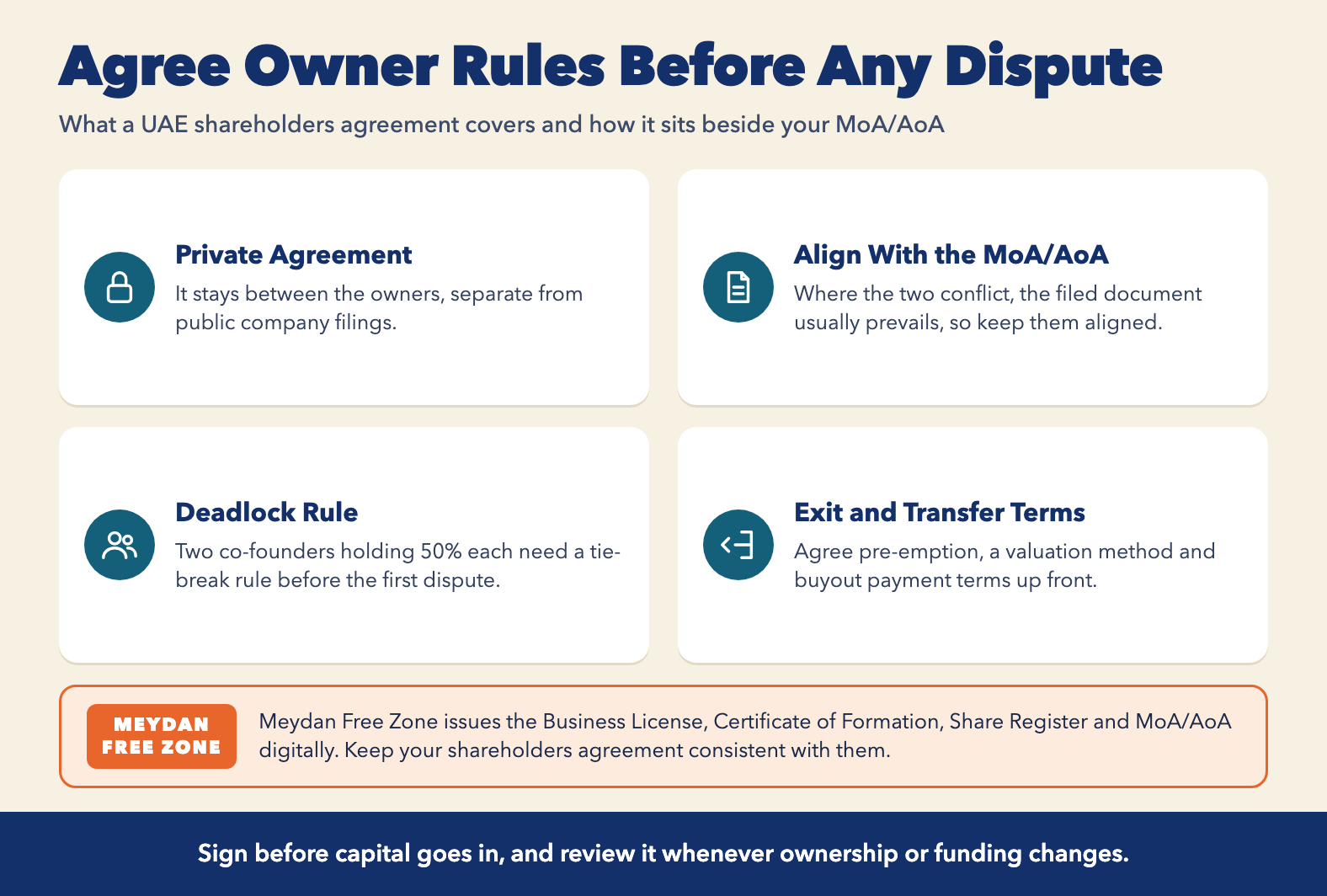
The Memorandum and Articles of Association (MoA/AoA) is the company's constitutional document, filed with the licensing authority. A shareholders agreement is private and covers exit terms, funding duties and veto rights. Where the two conflict, the filed document usually prevails, so they must be aligned.
| Feature | Shareholders Agreement | Memorandum and Articles of Association |
|---|---|---|
| Visibility | Private, kept by the owners | Filed with the licensing authority |
| Main purpose | Sets commercial terms between owners | Sets the company's constitution and structure |
| Who it binds | The owners who sign it | The company and its shareholders |
| Typical content | Exit terms, funding duties, veto rights, drag-along | Share classes, board structure, company objects |
| How it is amended | By written agreement of the parties | Through the licensing authority's amendment process |
Public Filing Versus Private Terms
Sensitive commercial terms belong in the private agreement. Don't assume a clause binds third parties. A drag-along clause might sit in the agreement while share class rules sit in the MoA/AoA.
Keeping Both Documents Aligned
Review the agreement whenever the constitutional document changes. Say owners change the board structure, then find the agreement still refers to the old arrangement. That mismatch creates enforcement risk in a dispute. Amendments follow the licensing authority's process, explained in our MOA amendment guide.
Key Clauses a Shareholders Agreement in Dubai Should Include
The clauses with the most weight cover ownership and capital, reserved matters, profit distribution, transfer restrictions, deadlock, exit, confidentiality, non-compete limits and dispute resolution. Each clause should state a trigger, a process and a consequence in plain terms.
Ownership, Capital and Profit Distribution
- Record each owner's shareholding and funding obligation.
- State what happens if an owner can't meet a capital call.
- Set the dividend policy and when profits are retained.
A 60/40 company might agree that 30% of annual profit is retained for working capital before any distribution.
Decision-Making and Reserved Matters
List the decisions needing unanimous or supermajority approval: new shares, borrowing, selling the business or changing activities. The aim is to protect minority owners without freezing daily operations. A minority owner might hold a veto on issuing new shares but not on routine hiring.
Confidentiality and Non-Compete Limits
Restrictions must be reasonable in scope, duration and location. Overbroad restraints risk being unenforceable, and they should match the company's licensed activities. A trading company might bar an exiting owner from soliciting its existing customers for a defined period. See non-compete clauses in the UAE for enforceability.
Steps to Draft and Sign a Shareholders Agreement
List owners and shareholdings, agree reserved matters, and set transfer and exit terms. Then choose a dispute forum, have a UAE-qualified lawyer draft the document and sign, with notarisation where needed. Align the agreement with the MoA/AoA first.
- Agree the commercial terms first. Settle equity, funding, roles and exit expectations in writing. Record disagreements early. One term-sheet meeting and a signed one-page summary works well.
- Draft with a UAE-qualified lawyer. Choose governing law and forum consistent with the company's jurisdiction. Confirm the language. In a bilingual agreement, state the controlling language.
- Align, sign and store. Check consistency with the Memorandum and Articles of Association, arrange notarisation where required, and update the Share Register when shares change hands. Keep a signed master copy and a version log.
Exit, Deadlock and Dispute Clauses That Protect Owners
Exit and deadlock clauses decide what happens when owners disagree or leave. Common tools include pre-emption, drag-along and tag-along rights, buy-sell mechanisms, valuation methods and staged dispute resolution. Clear triggers stop a disagreement from stalling the company.
Transfer Restrictions and Valuation
- Pre-emption gives existing owners first refusal.
- Agree a valuation method up front, such as an independent valuer.
- State payment terms for a buyout.
If an owner wants to sell 25% to an outsider, existing owners get a defined window to match the offer.
Deadlock and Dispute Resolution
Build an escalation path: negotiation, mediation, then arbitration or court. A 50/50 company might apply a 30-day negotiation period, then mediation, before any filing. Shotgun clauses are faster but favour the owner with more cash, so weigh that risk. Choose a forum consistent with the company's jurisdiction.
How a Shareholders Agreement Works for a Meydan Free Zone Company
After registration, Meydan Free Zone issues the Business License, Certificate of Formation, Share Register and MoA/AoA digitally. A shareholders agreement sits beside these as a private arrangement between the owners. Shareholding changes should be reflected in the Share Register and constitutional documents.
Documents Issued After Registration
The agreement isn't part of the issued set; the owners keep it. Co-founders can sign it before or soon after registration, ideally before money moves into the company's bank account.
Banking and Funding Considerations
Banks may ask who the owners are and who can sign. mCore supports business bank account opening, though approval remains at the bank's discretion, as set by the Central Bank of the UAE framework banks operate under. If a lender asks for a share pledge, the transfer clause needs a carve-out.
Essential Services for Entrepreneurs and Startups
Explore mCoreWhat This Means for Your Decision as a Business Owner
Sign a shareholders agreement before capital goes in, not after a dispute starts. Settle ownership, decisions, exits and funding in writing, align it with the MoA/AoA, and review it when shareholding, activities or funding change.
When to Sign and When to Review
Sign before funds or assets move into the company. Review at funding rounds, when new owners join, or when activities change. An owner adding a licensed activity should revisit the reserved matters.
Questions to Settle Before You Sign
- Who can bind the company?
- What happens if an owner leaves, dies or can't fund?
- Which forum resolves disputes?
- Which decisions need every owner's approval?
- How is a leaving owner's stake valued?
Before signing, list the decisions each owner must approve and the exit terms each accepts, then give that list to a UAE-qualified lawyer. For a Meydan Free Zone company, check that the agreement matches the Share Register and MoA/AoA issued at registration.
Ready to Launch Your Business in Dubai?
Let's Connect