
Table of Contents
Frequently Asked Questions
What happens when two equal shareholders cannot agree on a decision?
The company cannot pass any resolution that needs their approval. Budgets, manager appointments, bank mandates and license renewals can stall. For mainland companies, the Commercial Companies Law, Federal Decree-Law No. 32 of 2021, does not provide one automatic tiebreak, and free zone companies follow their free zone's regulations. The outcome depends on the constitutional documents, the shareholders' agreement and, if needed, arbitration or the courts.
Does a shareholders agreement settle a 50/50 stalemate?
It can, if it contains a deadlock procedure. A well-drafted agreement sets reserved matters, a cooling-off period, mediation and an exit route such as a buy-out. It turns a stalemate into a defined process, so the company keeps operating while the owners resolve the dispute.
How does a shotgun clause work between co-founders?
One founder names a price for the other's shares. The other founder must then either sell at that price or buy the first founder's shares at the same price. It only works if the agreement sets out the notice period and payment terms. Both founders should also be able to fund a purchase.
Can a shareholder be forced to sell their shares in a deadlock?
Only if a contractual mechanism allows it, such as a shotgun, put option or call option in the shareholders agreement. Without one, a shareholder cannot be compelled to sell simply because of a stalemate. The dispute then goes to the agreed forum, which is either arbitration or the competent court.
Is mediation compulsory before arbitration or court action in a shareholder dispute?
Mediation is compulsory only if the shareholders agreement or the company's constitutional documents say so. Many agreements require written notice and a fixed mediation period before any proceedings begin. Founders should check these steps first, because skipping them can delay or weaken a later claim.
Should a free zone company have a shareholders agreement?
Yes, particularly where there is more than one shareholder. The Memorandum and Articles of Association record ownership and basic governance but rarely cover exit terms or deadlock procedures. A separate agreement fills that gap and should be consistent with the Articles.
Which documents prove ownership in a Meydan Free Zone company?
Meydan Free Zone issues the Share Register, Certificate of Formation, Memorandum and Articles of Association and Business License digitally after registration. The Share Register records who holds the shares. It should be updated promptly after any transfer, such as a buy-out following a deadlock.
Topic Summary
What Is Shareholder Deadlock in a Dubai Company
Shareholder deadlock happens when owners with equal or blocking voting power cannot agree on a decision that needs their approval. The company can't approve budgets, appoint managers, change activities or sign major deals. It usually occurs in 50/50 companies or where reserved matters need unanimous consent. A shareholders' agreement negotiated early is the main tool for preventing it.
Legal Position on Shareholder Deadlock in the UAE
For mainland companies, the UAE Commercial Companies Law, Federal Decree-Law No. 32 of 2021, sets the governance rules. It does not give a single automatic tiebreak for every deadlock. Free zone companies follow their own free zone's regulations instead. In both cases, outcomes depend on the company's constitution, any shareholders' agreement and, if needed, the agreed forum or the courts.
Why a Shareholders' Agreement Matters
A shareholders' agreement sets voting rights, reserved matters, exit terms and a deadlock procedure in advance. It turns a future stalemate into a defined process with timelines, escalation steps and a buy-out route, so the company keeps operating while owners resolve the dispute. Read more on shareholders' agreements in the UAE .
Process for Resolving Shareholder Deadlock
Resolving deadlock usually follows an escalation order. Review the shareholders' agreement, hold a formal meeting, use mediation and apply the deadlock clause, such as a buy-out. Arbitration or court comes last. Document each stage and time-limit it.
When Disputes Escalate Further to Court or Arbitration
If negotiation and the contractual mechanisms fail, shareholders can pursue arbitration or court proceedings, depending on the agreed forum and the company's jurisdiction. Court proceedings are usually slower and public, so many founders treat them as a last resort. Take legal advice before starting either.
How Meydan Free Zone Documents Support Shareholder Control
After registration, Meydan Free Zone issues the Business License, Certificate of Formation, Share Register and Memorandum and Articles of Association digitally. These record ownership and voting rules, so they form the factual base for any deadlock decision or share transfer.
What Deadlock Planning Means for a Founder's Decision
Settle deadlock terms before capital is committed. Choose an odd voting structure or a casting vote, limit vetoes, set a buy-out route and name the forum. That means you spend a small amount on drafting now, instead of facing a frozen company later.
Deadlock Between Shareholders in a Dubai Company: Process and Key Requirements
An equal split between co-founders feels fair on day one, but it can freeze a company the first time the owners disagree. So what happens when neither owner can pass a resolution? This guide explains how deadlock arises, how it is usually resolved, and what to settle in your shareholders' agreement before it happens.
What Is Shareholder Deadlock in a Dubai Company
Shareholder deadlock happens when owners with equal or blocking voting power cannot agree on a decision that needs their approval. The company can't approve budgets, appoint managers, change activities or sign major deals. It usually occurs in 50/50 companies or where reserved matters need unanimous consent. A shareholders' agreement negotiated early is the main tool for preventing it.
How Deadlock Arises in Practice
Say two co-founders each hold 50% of an FZ LLC (a free zone limited liability company). One wants outside capital, the other refuses. No resolution passes, and the company drifts.
The usual causes are equal shareholding with no casting vote, unanimity for reserved matters, and disagreement over strategy, funding or exit.
Warning Signs Founders Often Miss
- Bank mandate approvals go unsigned.
- License renewals are delayed.
- One partner quietly stops responding.
A trading company that can't renew its license because one shareholder won't sign is already deadlocked, even if nobody has said so. A founders' agreement signed early covers many of these risks.
Legal Position on Shareholder Deadlock in the UAE
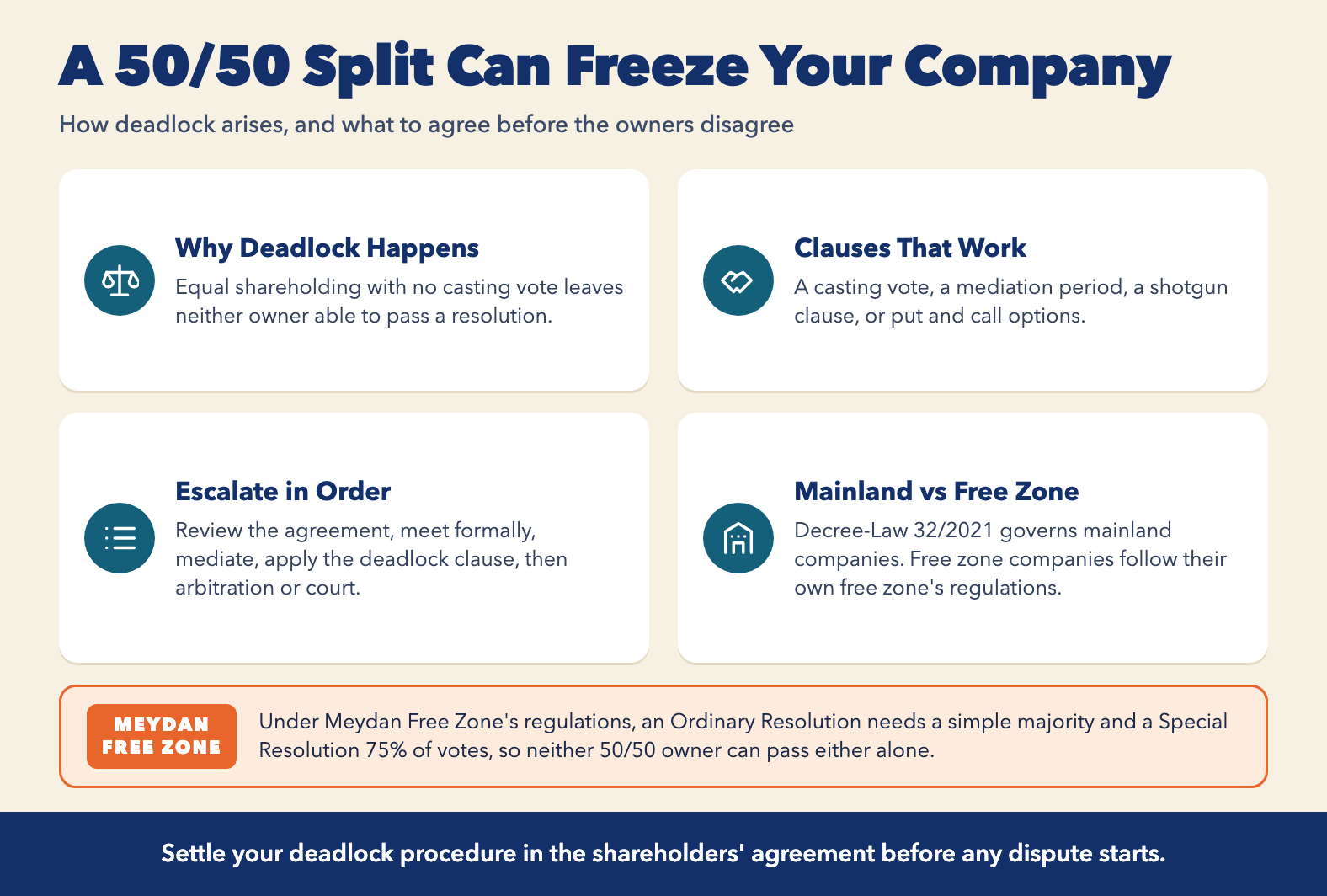
For mainland companies, the UAE Commercial Companies Law, Federal Decree-Law No. 32 of 2021, sets the governance rules. It does not give a single automatic tiebreak for every deadlock. Free zone companies follow their own free zone's regulations instead. In both cases, outcomes depend on the company's constitution, any shareholders' agreement and, if needed, the agreed forum or the courts.
What the Commercial Companies Law Covers
For mainland companies, the law provides the governance and voting framework, and the constitutional documents fill in the detail. If a Dubai LLC's articles are silent on tie votes, owners may have few options short of negotiation or proceedings, so take legal advice early. The Capital Market Authority (formerly the Securities and Commodities Authority) sets governance rules mainly for public joint-stock companies, not most private ones.
Free Zone Rules Versus Mainland Rules
A Meydan Free Zone company follows the Meydan Free Zone Companies and Licensing Regulations and its own Memorandum and Articles of Association. Those regulations state that the Commercial Companies Law does not apply within the free zone. An Ordinary Resolution needs a simple majority and a Special Resolution at least 75% of the votes, so in a 50/50 company neither owner can pass either alone.
Why a Shareholders' Agreement Matters
A shareholders' agreement sets voting rights, reserved matters, exit terms and a deadlock procedure in advance. It turns a future stalemate into a defined process with timelines, escalation steps and a buy-out route, so the company keeps operating while owners resolve the dispute. Read more on shareholders' agreements in the UAE.
Deadlock Clauses That Work
- A casting vote or independent chairperson.
- A cooling-off and mediation period.
- A shotgun clause: one founder names a price, the other must buy or sell at it.
- Put and call options for agreed exit triggers.
Deadlock Resolution Options Compared
| Feature | Contractual Mechanism | Court or Arbitration |
|---|---|---|
| Speed | Runs to the timelines written in the agreement, such as 30 days' notice. | Depends on the forum's procedure and the tribunal or court calendar. |
| Confidentiality | Handled privately between owners and advisers. | Arbitration can be confidential; court proceedings are generally public. |
| Control over outcome | Owners choose the mechanism and valuation method in advance. | A third party decides the result. |
| Relationship impact | Structured exit keeps the dispute commercial. | Adversarial and often ends the relationship. |
| Planning needed in advance | High: clauses must be drafted before a dispute. | Low, though an arbitration clause must be agreed beforehand. |
Reserved Matters and Voting Thresholds
Define which decisions need unanimity and keep day-to-day operations with the manager. Limit vetoes to material decisions. Many founders restrict them to share issues, debt and asset sales.
Choosing Governing Law and Forum
Set the dispute forum in the agreement and align it with the company's Articles. Founders often choose arbitration seated in the UAE for confidentiality.
Process for Resolving Shareholder Deadlock
Resolving deadlock usually follows an escalation order. Review the shareholders' agreement, hold a formal meeting, use mediation and apply the deadlock clause, such as a buy-out. Arbitration or court comes last. Document each stage and time-limit it.
Step 1: Review the Agreement and Articles
- Check voting rights and reserved matters.
- Find the deadlock clause.
- Confirm notice rules. One founder may find 30 days' written notice is required before escalation.
Step 2: Call a Formal Meeting and Record Positions
- Issue notice as the Articles require.
- Minute each position.
- Propose a defined resolution. The minutes prove the stalemate later.
Step 3: Use Mediation or an Independent Adviser
- Appoint a neutral third party.
- Set a fixed timeframe.
- Keep talks confidential. A neutral adviser can value the business before a buy-out.
Step 4: Trigger the Exit Mechanism
- Use the shotgun, put or call option.
- Record the transfer in the Share Register.
- Update company documents. One founder buys the other's 50%, and the register changes.
When Disputes Escalate Further to Court or Arbitration
If negotiation and the contractual mechanisms fail, shareholders can pursue arbitration or court proceedings, depending on the agreed forum and the company's jurisdiction. Court proceedings are usually slower and public, so many founders treat them as a last resort. Take legal advice before starting either.
Arbitration Versus Court
Founders with an arbitration clause avoid public proceedings and keep the dispute private. Check how an award would be enforced before you choose a seat, and treat any cost estimate as indicative only.
Dissolution as a Last Resort
If no buy-out works, equal owners may agree to wind up. At Meydan Free Zone, a shareholders' voluntary liquidation starts with a Special Resolution, so both 50/50 owners must agree. Winding up affects licenses, bank accounts and staff. See liquidating a free zone company for the process.
How Meydan Free Zone Documents Support Shareholder Control
After registration, Meydan Free Zone issues the Business License, Certificate of Formation, Share Register and Memorandum and Articles of Association digitally. These record ownership and voting rules, so they form the factual base for any deadlock decision or share transfer.
Aligning the Articles With the Agreement
The Articles and your shareholders' agreement must not conflict. Reflect reserved matters in both, and update the Articles after a negotiated buy-out.
Keeping the Share Register Accurate
Record each transfer promptly. At Meydan Free Zone, a transfer needs a signed instrument of transfer, the register is updated within two business days, and the Authority is notified within ten business days. The register is prima facie evidence of ownership.
Free Business Setup Cost Calculator
Calculate NowWhat Deadlock Planning Means for a Founder's Decision
Settle deadlock terms before capital is committed. Choose an odd voting structure or a casting vote, limit vetoes, set a buy-out route and name the forum. That means you spend a small amount on drafting now, instead of facing a frozen company later.
Questions to Settle Before Signing
- Who holds the casting vote?
- Which decisions need unanimity?
- How are shares valued on exit?
Choosing an Ownership Structure
Avoid a pure 50/50 split where possible. A 51/49 split lets the majority pass ordinary resolutions, while decisions that need a special resolution still need both owners. Revisit terms as the company grows.
Deadlock is a drafting problem before it is a legal one. A well-built shareholders' agreement signed early gives the company a defined process and a clear exit. For a Meydan Free Zone company, the Articles and Share Register issued digitally by Meydan Free Zone are the starting point for that review. Confirm voting, exit and forum terms with a lawyer before your next funding or partnership decision.
Ready to Launch Your Business in Dubai?
Let's Connect