

Table of Contents
Frequently Asked Questions
1. Who can I sponsor on a UAE dependent visa?
You can sponsor your spouse, children (sons up to age 25; unmarried daughters of any age), and parents (subject to salary and deposit conditions).
2. What is the minimum salary to sponsor family in the UAE?
To sponsor a spouse and children, you need a minimum salary of AED 4,000 per month or AED 3,000 plus accommodation. To sponsor parents, you typically need AED 20,000+.
3. Can I sponsor my family if I’m on an investor visa from a free zone?
Yes. Meydan Free Zone investor visa holders are eligible to sponsor dependents if they meet the income and accommodation requirements.
4. How long does the UAE dependent visa process take?
The process usually takes 1 to 4 weeks, depending on document readiness, medical test timelines, and Emirates ID processing.
5. Do I need health insurance to sponsor a dependent?
Yes. Health insurance is mandatory for each dependent and must be valid for the entire duration of the visa.
6. What documents are required for a UAE family visa?
You’ll need your Emirates ID, passport copies, tenancy contract (Ejari), salary certificate, and attested marriage or birth certificates.
7. Can I sponsor my parents and spouse at the same time?
Yes, but each category has its own requirements. Sponsoring both parents requires higher income and a refundable security deposit.
Topic Summary
1. Gather Necessary Documentation
Ensure you have all required documents, including a valid Emirates ID or residence visa of the sponsor, passport copies of the dependent(s), passport-sized photographs, proof of relationship (marriage certificate or birth certificate), and proof of the sponsor’s income.
2. Submit Entry Permit Application
Apply for an entry permit for the dependent via the Federal Authority for Identity and Citizenship (ICA) website or through the General Directorate of Residency and Foreigners Affairs (GDRFA) portal in the relevant emirate. Pay the applicable fees online during submission.
3. Medical Fitness Test
Once the dependent arrives in the UAE or if residing locally, schedule a medical fitness test at an authorised health centre. This is mandatory for applicants aged 18 and above, and it includes blood tests and chest X-rays.
4. Apply for Emirates ID
After passing the medical test, submit biometric data for the Emirates ID card at an authorised reception centre. This is essential for finalising the dependent visa process.
5. Collect Visa Stamped Passport
Upon approval, the dependent’s passport will be stamped with the residence visa. Collect the passport from the relevant immigration department or visa processing centre and ensure the visa details are accurate before use.
How to Apply for a UAE Dependent Visa in 2026: Step-by-Step Guide
Thinking of bringing your family to the UAE?
According to the UAE Government¹, expats make up around 88 percent of the UAE's population of 11.8 million, making the country one of the world's most expatriate-dense economies and a major hub for family relocation. And according to Khaleej Times², the UAE's Federal Authority for Identity, Citizenship, Customs and Port Security (ICP) introduced 11 new entry and residency reforms in 2025, including extended visa validities, simplified family sponsorship pathways, and faster processing through digital channels.
Whether you're settling in as an entrepreneur or professional, sponsoring your loved ones through a UAE dependent visa ensures they can live, study, or even work (if eligible) while based in the Emirates.
At Meydan Free Zone, we simplify this journey. If you're already licensed with us or plan to set up your business, our team can help you navigate the dependent visa process with clarity and speed.
[blockCTABizSetupRemotely]
Dubai's population is growing at the fastest pace in its history, with family-led migration anchoring the inflow.
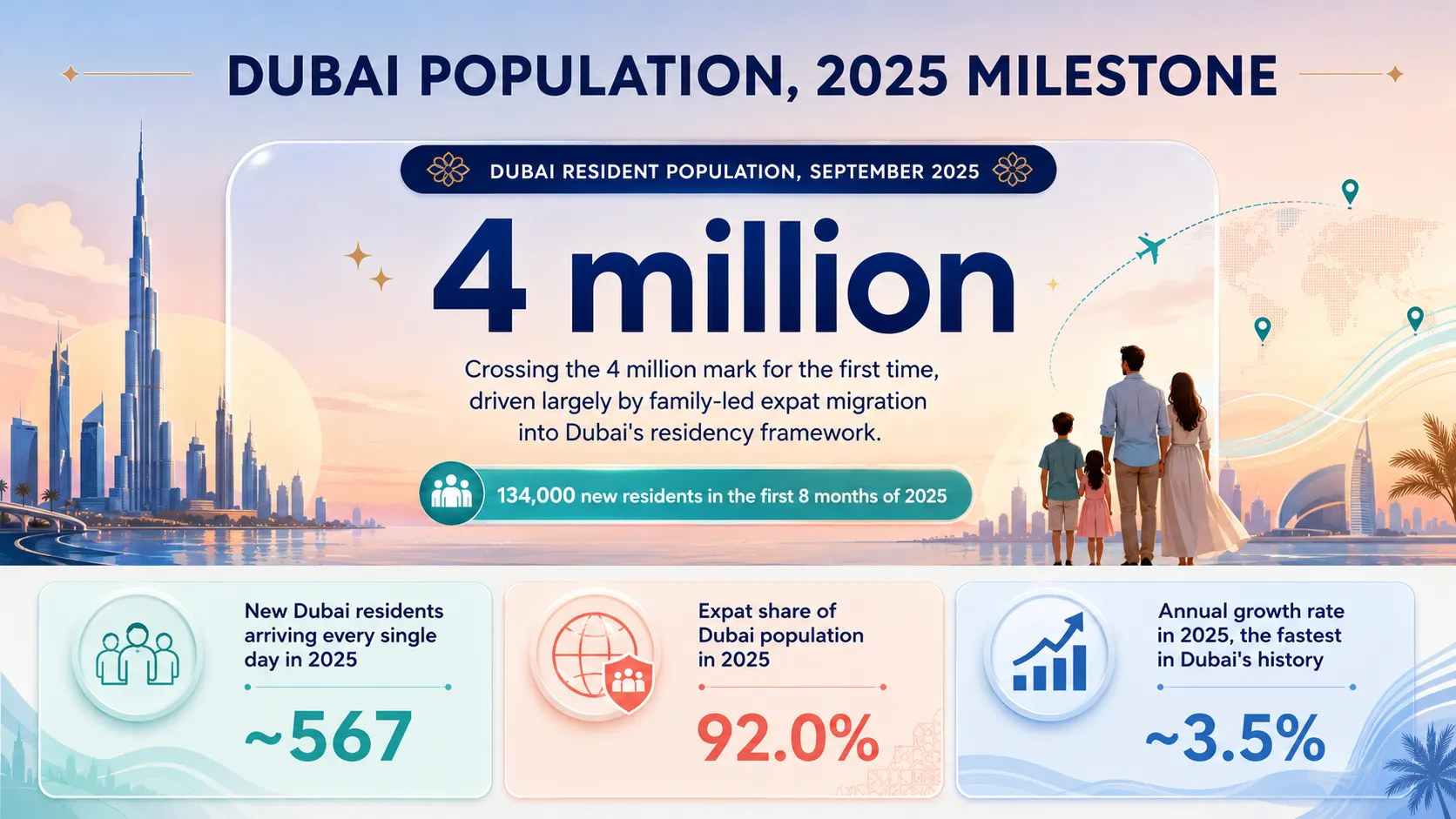
Source: Dubai Statistics Centre Population Clock, September 2025 milestone announcement.
What Is a UAE Dependent Visa?
A UAE dependent visa allows residents to legally sponsor immediate family members—such as spouses, children, and parents—to live in the country. This is typically issued for 1–2 years and can be renewed as long as the sponsor maintains valid residency and meets the eligibility criteria.
You can sponsor:
- Spouse (must present an attested marriage certificate)
- Children (Sons up to age 25, daughters of any age if unmarried)
- Parents (subject to higher salary requirements and deposit conditions)
Key Requirements:
- A valid UAE residency visa (investor or employment)
- Minimum monthly salary: (AED 4,000 or AED 3,000 + accommodation for spouse and children, AED 20,000 (or more) to sponsor both parents)
- Tenancy contract (Ejari) in the sponsor’s name
- Attested birth and marriage certificates
- Health insurance for each dependent
- Medical fitness test for dependents aged 18+
Who You Can Sponsor and What You Need
What to Know Before You Apply
Before you begin the process, it’s important to assess two key areas:
- Your Eligibility as a Sponsor
Make sure your visa type allows sponsorship, your income meets the minimum threshold, and your documents (like Ejari and salary proof) are current and valid. - Your Dependent’s Status
Is your family member currently inside or outside the UAE? This will determine whether a status change is needed and how your timeline is managed.
A well-prepared file reduces processing time and the likelihood of rejection. With Meydan Free Zone’s mResidency service, you can avoid delays and ensure all your paperwork is in order before you apply.
Step-by-Step Application Process
The UAE dependent visa process follows six clear stages, from gathering your documents to receiving the stamped residence visa. Here is what to expect at each step.
[blockAccordionSteps]
Common Mistakes to Avoid
Many applications are delayed or rejected due to preventable errors. Here’s what to look out for:
[blockFaqsCategory]
Avoid these issues by getting professional support at the start of your process. Meydan Free Zone’s visa consultants help ensure every document and requirement is fulfilled accurately.
In Conclusion
Reuniting with your loved ones in the UAE is entirely possible—as long as the process is handled correctly.
With accurate documents, proper guidance, and support from a licensed provider like Meydan Free Zone, you can complete your dependent visa process smoothly and confidently.
Whether you're sponsoring your spouse, children, or parents, Meydan Free Zone’s visa support team ensures your application is handled with care, speed, and compliance.
[blockCTATradeLicense]
Citations
¹ UAE Government, "Fact Sheet," UAE Government Portal.
² Khaleej Times, "UAE: 11 entry, residency rules introduced in 2025 to attract investment, talent," 2025.