Table of Contents
Frequently Asked Questions
Why does this license restrict trading to outside the UAE?
Diesel sold inside the UAE falls under a different license aimed at operational supply to local customers. This activity is for international wholesale trading: sourcing diesel and selling it on to buyers in other markets, with Dubai as the trading desk.
What does an actual trade flow look like under this license?
A Dubai desk buys a diesel cargo from a Gulf or Asian refinery, prices it against a published benchmark like the Singapore strip, contracts it to a wholesale buyer abroad, and arranges freight, finance, and paperwork to deliver the cargo to its destination port.
Which markets typically buy from a Dubai-based diesel desk?
Africa is the biggest receiving market by volume, especially East and West African ports where local refining capacity is limited. South Asia takes large volumes through Mombasa, Karachi, and Indian ports. Mediterranean and intra-Asia routes round out a typical book.
What regulatory approval does this license need?
DOPA, the Department of Petroleum Affairs, pre-approves every diesel trading license before Meydan Free Zone issues it. The activity is exempt from AML compliance, though DOPA's broader petroleum trading framework still applies in full to the business.
Are renewable and biodiesel blends covered, or just conventional diesel?
Yes, the activity covers all the main diesel grades traded as wholesale cargoes, including conventional automotive diesel, ULSD, low-sulphur diesel, marine gas oil, and renewable and biodiesel blends. The trade is by product, not by sourcing pathway.
How to Start a Diesel Fuel Trading Business with Meydan Free Zone
Dubai does not refine diesel. It does not consume it at global scale either. But it is one of the world's most important cities for trading it. From offices across the city, traders source diesel from Gulf and Asian refineries, contract it to buyers across Africa, South Asia, and the Mediterranean, and orchestrate the freight, finance, and paperwork that get the cargo to its destination. A diesel fuel trading business is one of those desks.
Diesel powers more of the world's economy than any other liquid fuel. The global diesel as fuel market was worth USD 253.29 billion in 2025 and is forecast to reach USD 310.03 billion by 2031, growing at 3.33 percent a year, according to Mordor Intelligence¹.
The UAE has positioned itself as a major node in the trade. Non-oil foreign trade hit AED 3.8 trillion (USD 1.03 trillion) in 2025, up 27 percent on the prior year, with refined petroleum oils named among the country's principal export categories, per the UAE federal government announcement².
For a Dubai-licensed diesel trader, that means plugging into a city whose entire economic model is built around moving products like this one between continents.
Dubai Trade License from AED 12,500
Get Your LicenseWhat This Trading Base Looks LikeA Dubai-based diesel trader plugs into a UAE non-oil trading ecosystem that broke the $1 trillion mark in 2025, five years ahead of its 2031 target.
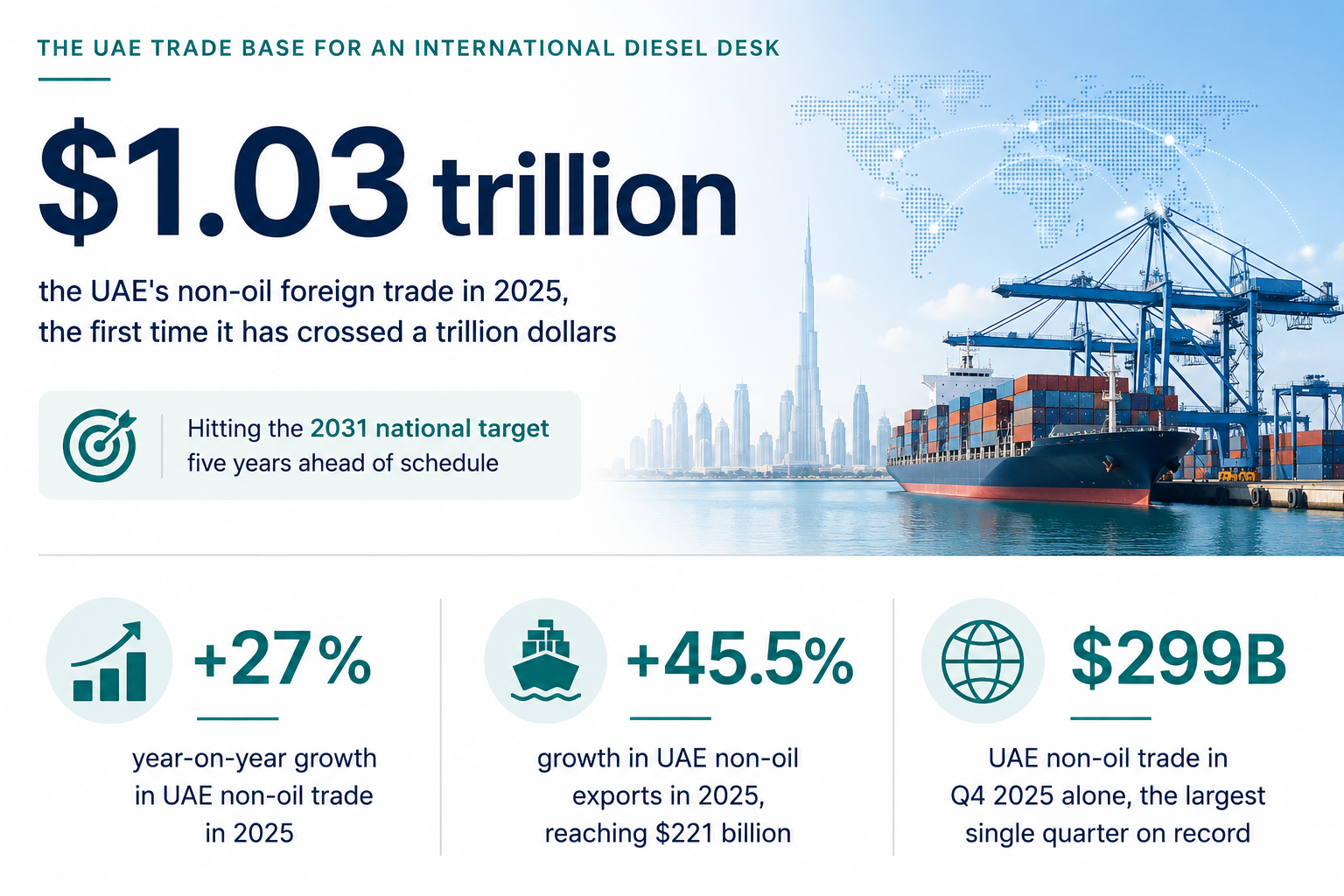
Source: UAE Federal Government 2025 non-oil trade report announced by Sheikh Mohammed bin Rashid in January 2026, via The National
A typical day on a Dubai diesel desk runs across multiple time zones. The Asia book might open with a 50,000-tonne ULSD cargo from a Gulf refinery, priced against the Singapore 10ppm strip, bound for a South Asian buyer. The Africa book fixes a smaller parcel into a West African coastal terminal on letters of credit.
The Europe book takes a position around a refinery turnaround in the Mediterranean. Each trade gets sourced, priced, freighted, financed, hedged where useful, and documented. The desk earns the spread between buy and sell, after freight, finance, insurance, and inspection.
A start-up book trading a few parcels a month, or an established desk moving millions of tonnes a year, runs on the same footing here: no refinery, no fleet, just the desk and the spread.
Who is this for?
- Wholesale diesel cargo traders: Businesses trading diesel cargoes and parcels between refiners, distributors, and downstream wholesale buyers across international markets.
- Regional and route-specific diesel traders: Operators focused on specific corridors, such as Middle East-to-Africa, Asia-to-Africa, or intra-Asia trade lanes.
- Specialty diesel and grade traders: Firms trading specific diesel grades like ultra-low sulphur diesel (ULSD), low-sulphur diesel, marine gas oil, or renewable and biodiesel blends.
Meydan Free Zone offers 100% foreign ownership, zero percent corporate tax on qualifying income, full profit repatriation, and a fully digital licensing process. It is a regulated, cost-efficient base for a diesel fuel trading business, in a city built on the world's busiest tanker routes and home to one of the largest commodities trading communities on the planet.
4661.98 - Diesel Fuel Trading
Under this activity, your business is licensed to wholesale trade diesel fuel as an international commodity, between producers and downstream buyers outside the UAE.
A diesel fuel trading business runs the wholesale desk for the world's most-consumed liquid fuel. The day-to-day work: sourcing diesel cargoes from refineries and producers, pricing against international benchmarks, contracting with downstream buyers, arranging freight, finance, hedging, and documentation, and routing the product into the destination market.
The clients sit outside the UAE: regional distributors, fuel wholesalers, traders in other markets, and large industrial or commercial off-takers. The margin is the spread between buy and sell after costs.
| Products | Sourcing & Contracting | Buyers | The Business |
|---|---|---|---|
| Diesel fuel cargoes across the main grades. Examples: ultra-low sulphur diesel (ULSD), low-sulphur diesel, automotive diesel, marine gas oil, and renewable and biodiesel blends. | Cargo and parcel trading priced against international benchmarks, contracted by spot or term. Examples: a 50,000-tonne ULSD cargo from a Gulf refinery priced against the Singapore strip, or a parcel into a West African terminal on letters of credit. | Wholesale diesel buyers across international markets. Examples: regional distributors and wholesalers in Africa, South Asia, and the Mediterranean, downstream traders, and large industrial off-takers. | Margin business earning on the spread. Examples: a back-to-back trader on freight and timing arbitrage, a corridor specialist on Middle East-to-Africa flows, or a grade specialist on ULSD and biodiesel blends. |
| Global Market | Market Forecast | UAE Non-Oil Trade | Trade Growth |
|---|---|---|---|
| Global diesel as fuel market worth USD 253.29 billion in 20251. | Global diesel as fuel market forecast to reach USD 310.03 billion by 20311. | UAE non-oil foreign trade hit USD 1.03 trillion in 2025, a first2. | UAE non-oil trade grew 27% year on year in 20252. |
This license is for one role: trading diesel as an international commodity, with buyers outside the UAE. Trading crude oil, jet fuel, LPG, or other refined products each falls under its own license. Supplying diesel inside the UAE, distributing it, refining it, or running terminals are each separate activities too.
If you trade diesel cargoes internationally from a Dubai desk, you are in. If your customers are inside the UAE, or your business is in refining, distribution, retail, or any other fuel product, the right license is elsewhere.
Third-Party Approval: Yes. Pre-approval from the Department of Petroleum Affairs (DOPA) is required before a license is issued by Meydan Free Zone.
Anti-Money Laundering Compliance: This business activity is exempt from AML compliance requirements.
Note: This business activity can only be practiced outside UAE.
Business Activities List
Explore Over 2,500+Citations
¹ Mordor Intelligence, Diesel as Fuel Market Size, Share, Trends, global diesel-as-fuel market worth USD 253.29 billion in 2025, forecast USD 310.03 billion by 2031, 2026.
² The National, UAE Non-Oil Foreign Trade Report 2025, UAE non-oil foreign trade reached AED 3.8 trillion (USD 1.03 trillion) in 2025, up 27% year on year, 2026.