Table of Contents
Frequently Asked Questions
Do I need third-party approval to start a medical equipment repair business?
No third-party approval is required at the license stage under code 3319.97. Operational compliance still runs through MOHAP, DHA, and the Department of Health Abu Dhabi for medical device servicing standards. Register with the right authority before you start quoting on hospital work.
Can I sell medical devices under this license?
Not as a standalone business. Fitting spare parts as part of a repair is fine. Running a medical device trading or wholesale operation alongside needs a separate trading code added to your license, and medical device trading in the UAE needs MOHAP registration.
Do I need OEM authorised service partner status?
Not a legal must, but it opens the door to warranty repair, factory training, and long-term hospital contracts that non-authorised firms cannot compete for. Siemens Healthineers, GE Healthcare, Philips, Canon Medical, and Fujifilm all run partner programmes with their own qualification requirements.
Can I run this business from a flexi-desk?
The license itself can be issued to a flexi-desk address, and mobile on-site service operators do run this way. A real repair workshop needs bench space, calibration kit, static-free surfaces, and secure parts storage. Most serious firms run a small workshop even in the early days.
Can foreigners own a medical equipment repair business in Dubai?
Yes. You get 100% foreign ownership when you set up with Meydan Free Zone, and the same is true for most mainland activities registered through DET.
Medical & Laboratory Equipment Repair Business in Dubai
Every hospital, clinic, and lab in the UAE runs on complex equipment: MRI scanners, ultrasound machines, blood analysers, autoclaves, centrifuges, patient monitors, ventilators, and dental chairs.
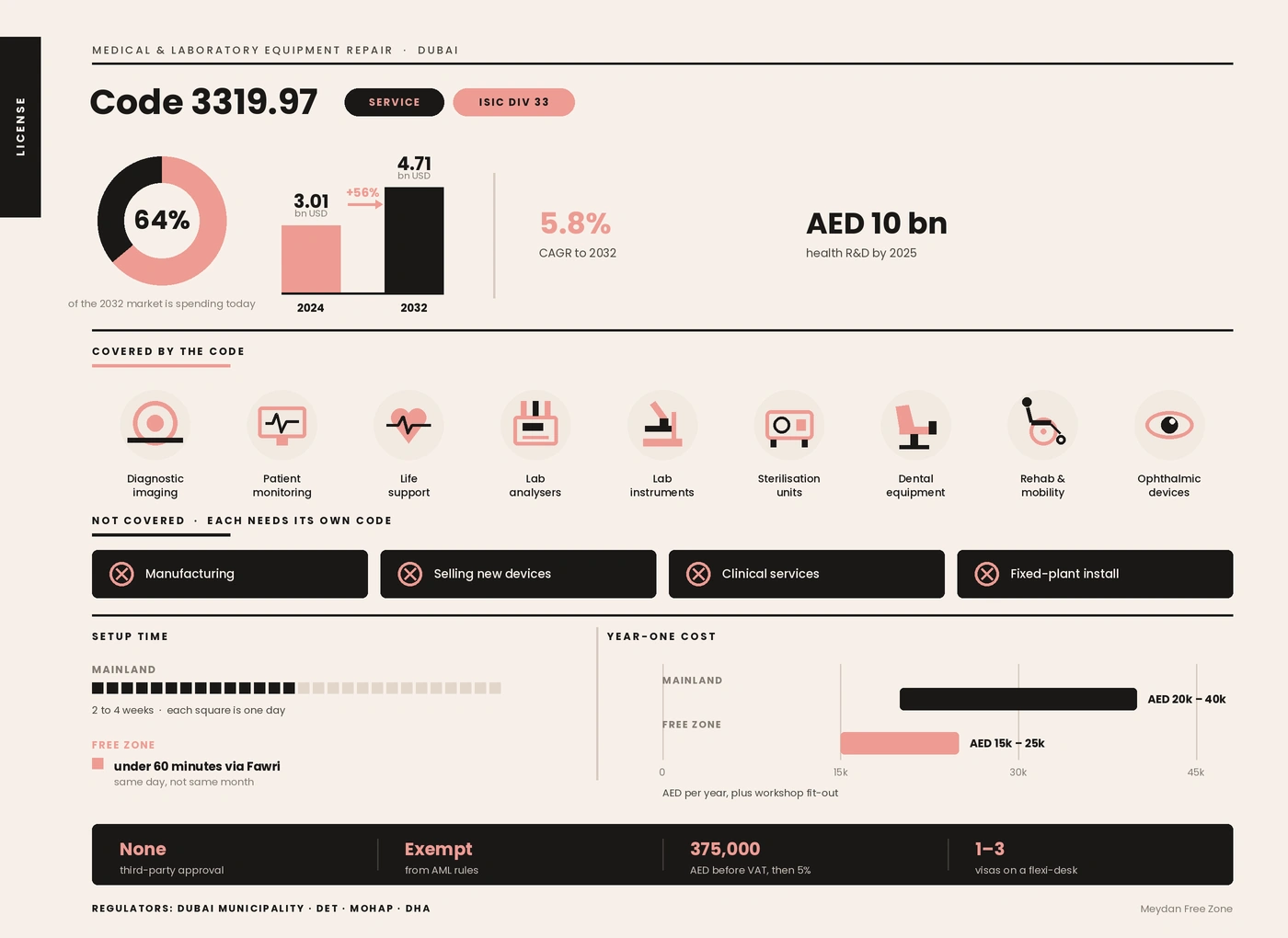
When any of it goes down, patient care slows down. UAE medical device spending sits at USD 3.01 billion in 2024 and is on track to hit USD 4.71 billion by 2032. Behind every device in that number is a service contract keeping it running. Activity code 3319.97 is the license that lets you sell that service.
This guide covers what the code permits, the boundary you cannot cross, the jurisdiction choice, and how to get set up.
Key Stats at a Glance
What This License Covers
Code 3319.97 authorises the repair and maintenance of medical and laboratory equipment across hospital, clinic, and research settings:
- Diagnostic imaging equipment: MRI, CT, ultrasound, X-ray, and mammography systems
- Patient monitoring equipment: ECG, vital signs monitors, and telemetry systems
- Life-support equipment: ventilators, anaesthesia machines, and defibrillators
- Laboratory analysers, blood chemistry systems, and haematology equipment
- Centrifuges, microscopes, pipettes, and general lab instruments
- Sterilisation equipment: autoclaves, washer-disinfectors, and hydrogen-peroxide vapour units
- Dental equipment: chairs, imaging systems, and sterilisation kit
- Physiotherapy, rehabilitation, and mobility equipment
- Ophthalmic diagnostic and treatment devices
This is a repair and maintenance license, not a manufacturing, sales, or clinical services one. Manufacture of medical devices, sale of new medical equipment, clinical service provision, and installation of major fixed-plant systems all fall outside it and need separate codes.
That boundary is the one most likely to catch you out, because hospitals who like your service work will ask you to sell them new machines and install them too.
Who Your Clients Will Be
- Public and private hospitals running large diagnostic and life-support equipment fleets
- Specialist clinics: dental, dermatology, ophthalmology, physiotherapy, and diagnostic imaging
- Medical and clinical laboratories running analysers, centrifuges, and sample preparation kit
- Research institutions, universities, and pharmaceutical R&D facilities
- Medical device distributors contracting warranty and out-of-warranty service work
- OEM authorised service partner arrangements with Siemens Healthineers, GE Healthcare, Philips, and Canon Medical
- Home healthcare providers running portable diagnostic and monitoring devices
- Veterinary clinics running smaller-scale medical and diagnostic equipment
Work is a mix of scheduled preventive maintenance contracts, warranty repair, emergency callouts, and calibration cycles. That is a large part of why this license is workable: recurring service revenue, high margins on specialist repair work, and long-standing client relationships that stay in place once you are on the approved supplier list.
Mainland or Free Zone
This is the biggest choice you will make when setting up. Let your clients decide it, not the price.
[blockCTACostCalculator]
Step-by-Step Setup Guide
[blockAccordionSteps]
Compliance and What You Need in Place
MOHAP and health authority alignment
Medical device repair is not on the pre-license third-party approval list, but operational compliance still runs through the Ministry of Health and Prevention, Dubai Health Authority, and Department of Health Abu Dhabi.
Each has rules on medical device servicing, technician qualifications, and reporting of incidents. Register with the right authority before you quote your first hospital job.
Biomedical engineer qualifications
Medical device repair needs qualified biomedical engineers and certified technicians. OEMs typically require their own training for authorised service partner status, and hospitals will ask for CVs and certificates before onboarding you as a supplier. Keep team qualifications on file and current, and renew them as OEM programmes update.
Calibration and traceability
Medical equipment repair almost always includes calibration checks. Use ISO 17025-accredited calibration standards where possible, keep traceable calibration records, and provide calibration certificates on every service visit. Hospitals need these for their accreditation audits, and losing that trail loses the contract.
Data protection and patient safety
Some medical devices hold patient data. The UAE Personal Data Protection Law sets the rules on how you handle that data during a repair. Get written consent before you access patient data, and wipe test drives properly. A leak of patient records will end the relationship with a hospital faster than any technical mistake.
Biomedical waste handling
Repair work generates its own waste stream: dead batteries, mercury lamps from older imaging systems, biological residues on returned laboratory kit, and contaminated packaging. Register with the right medical waste contractors and keep clean disposal records.
OEM authorised service partner status
Not a legal must, but it opens the door to warranty repair, factory training, and long-term contracts that non-authorised firms cannot compete for. Siemens Healthineers, GE Healthcare, Philips, Canon Medical, and Fujifilm all run partner programmes with their own qualification requirements.
Insurance
Public liability, professional indemnity, and property-in-your-care cover are all standard. Medical equipment can be six-figure kit, and any damage on your watch comes out of your pocket without the right cover.
Tax
VAT registration is required once taxable turnover passes AED 375,000, and repair services supplied within the UAE are standard-rated at 5%. Keep clean books from the first invoice.
Visas
Quota follows your setup. A flexi-desk typically supports one to three visas. A dedicated workshop unlocks more, which matters when you are hiring a full team of biomedical engineers and technicians.
Renewal
Annual and mandatory. Non-renewal brings fines and can lead to blacklisting, which then complicates banking, OEM partner status, and any future application.
Market Opportunity
Demand is tied to the UAE's healthcare build-out under the We The UAE 2031 vision, the steady growth of private hospital groups, and Dubai's positioning as a medical tourism hub.
UAE healthcare R&D spending is projected to pass AED 10 billion by the end of 2025, and the medical device market itself is growing at a 5.8% CAGR through 2032. Every new hospital that opens, every AI-enabled diagnostic centre commissioned by DHA, and every smart-hospital upgrade at a private group adds to the installed base of equipment that needs ongoing service.
The cost structure is workable. A small firm with two or three qualified biomedical engineers can be servicing clinics and mid-sized labs within a month of setup. Growth comes from adding OEM authorised partner status, then hospital preventive maintenance contracts, then specialist high-value diagnostic imaging service work as the team builds.
Conclusion
A medical and laboratory equipment repair license under 3319.97 is a well-defined services category suited to biomedical service firms, OEM authorised service partners, boutique calibration specialists, and independent medical technology maintenance operators working in one of the region's fastest-growing healthcare markets.
Three decisions shape your setup: jurisdiction, scope clarity, and how quickly you can get your OEM authorised partner status and biomedical engineering team in place. Settle those at the outset and the rest follows a predictable path.
Use the cost calculator for an estimate, or speak to the Meydan Free Zone team to confirm the right activity code before you commit.
[blockCTAContact]


%20Business%20in%20Dubai%20with%20Meydan%20Free%20Zone.webp)