Table of Contents
Topic Summary
Understand Which Activity Codes You Need
Group 6920 contains multiple sub-codes covering everything from broad accounting and auditing to narrow tasks like tax return preparation and recovery analysis. Choosing the right codes upfront determines your service scope and whether you face extra approval steps before licensing.
Four Codes Require Ministry of Economy Approval
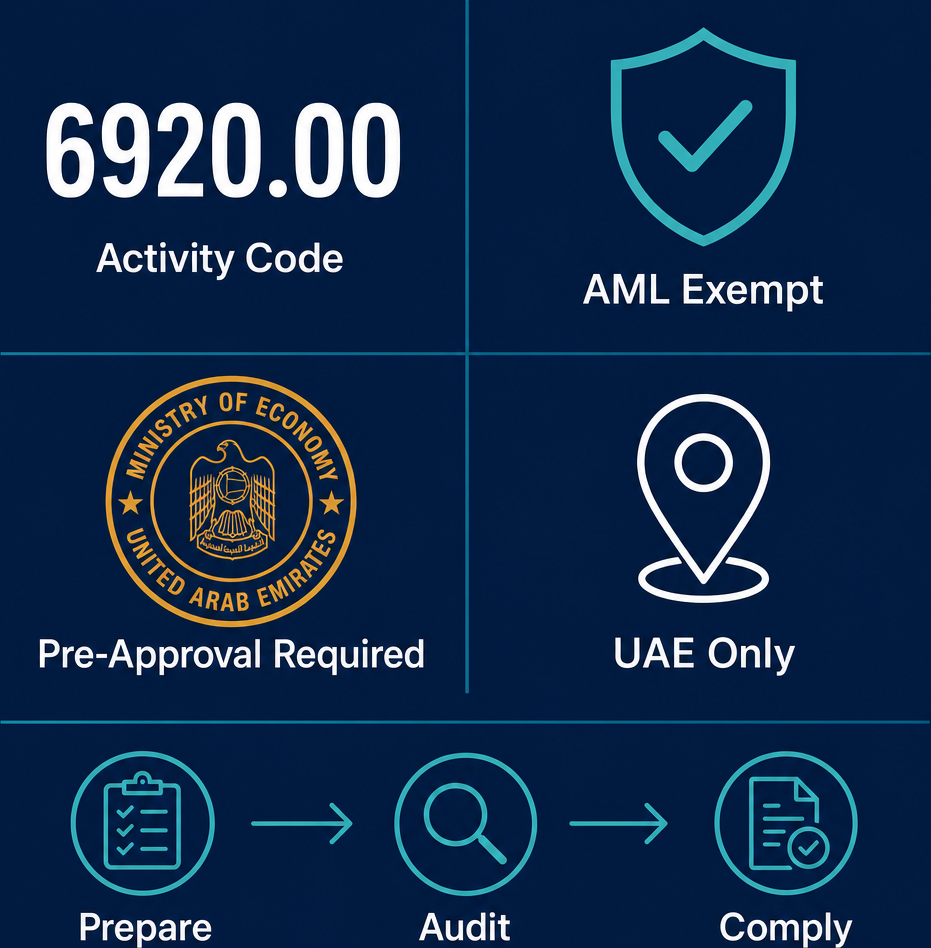
Codes 6920.00, 6920.02, 6920.03, and 6920.94 all require Ministry of Economy sign-off before your license is issued. If you only plan to offer tax advisory or compliance tracking services, you can skip this step entirely.
Tax Advisory Codes Have a Simpler Path
Codes covering tax return preparation, advisory and representation, tax consultancy, recovery analysis, and compliance follow-up require no third-party approval. These are often a practical starting point for new practices wanting to get licensed quickly.
Know the Clear Boundaries of These Activities
All work must be performed inside the UAE, and certain adjacent services like data processing, management consultancy on accounting systems, and bill collection fall outside the permitted scope. Staying within these boundaries keeps your license compliant.
Your Client Base Is Predictable and Recurring
Most clients will be UAE-based SMEs, free zone companies needing renewal audits, and business owners requiring tax guidance. Compliance work like bookkeeping and quarterly filings generates steady retainer income, while advisory work commands higher fees and often grows from existing client relationships.
Free Zone Setup Allows Full Foreign Ownership
Meydan Free Zone permits 100% foreign ownership, making it attractive for international founders entering the UAE market. Mainland setup under DET follows different rules, so comparing both structures against your target client base is an important early decision.
Register for VAT Once You Cross the Threshold
Any practice generating more than AED 375,000 in taxable turnover annually must register with the Federal Tax Authority for VAT. Tracking this threshold from day one avoids penalties and keeps your own compliance in order while you manage it for clients.
Tax and Audit Services Business Setup in Dubai
Since corporate tax arrived, every UAE company has a tax position to manage and books that must stand up to inspection. Most do not want to do that work themselves. That is the business case for a tax and audit practice here.
The activities sit under group 6920. This guide covers the codes you can hold, which ones need Ministry of Economy approval first, who your clients will be, how mainland and free zone setup compare, and the steps to get licensed.
Key Stats at a Glance
What This License Covers
A tax and audit practice helps people and companies handle what they owe and prove that their numbers are right.
On the tax side that means preparation, planning and advice. On the audit side it means examining records and processes to check they are accurate and follow the rules.
Group 6920 splits into separate codes, and which ones you pick decides whether you need approval before your license is issued.
- 6920.00, accounting, bookkeeping and auditing activities and tax consultancy: The broad code. Recording transactions, preparing and auditing accounts, certifying accuracy, preparing tax returns, and advising or representing clients before the tax authorities. Ministry of Economy approval needed first.
- 6920.02, preparation or auditing of financial accounts: Pulling financial data together for accurate reporting, and independently examining accounts against accounting standards. Ministry of Economy approval needed first.
- 6920.03, examination of accounts and certification of their accuracy: Verifying the numbers and giving a certification or opinion on them. Ministry of Economy approval needed first.
- 6920.94, auditing of accounts: The systematic examination of records and transactions to test accuracy and compliance. Ministry of Economy approval needed first.
- 6920.04, preparation of personal and business income tax returns: Calculating liabilities and filing returns. No third-party approval needed.
- 6920.05, advisory and representation before tax authorities: Advice on tax matters, plus acting for clients in audits and appeals. No approval needed.
- 6920.95, tax consultant: Tax planning, compliance and optimisation advice. No approval needed.
- 6920.97, recovery analysis services: Finding overpayments and errors in tax payments, then recovering the money. No third-party approval needed.
- 6920.98, taxation procedures follow-up: Tracking filings, payments, deadlines and queries so clients stay compliant. No third-party approval needed.
Two boundaries are worth knowing. Code 6920.00 leaves out data processing and tabulation work, management consultancy on designing accounting systems and budget controls, and bill collection. And none of these activities can be carried out outside the UAE.
Who Your Clients Will Be
Your clients are UAE-based companies and the people who own them. Small and medium companies that need books kept and returns filed. Free zone companies that need an audit for renewal. Groups that need advice on where their tax position sits.
The buying pattern is worth understanding.
Compliance work is recurring and predictable: monthly bookkeeping, quarterly filings, yearly audits. Advisory work is lumpier and better paid, and it usually arrives because a deadline or a query arrived first.
Most practices start with compliance work to build a base of retainers, then sell advice into the same client list. It is easier that way round.
Mainland or Free Zone
The Ministry of Economy approval applies either way, so that is not the deciding factor. What changes is reach.
A mainland license from the Dubai Department of Economy and Tourism (DET) opens the whole local market.
A Meydan Free Zone license is quicker and fully yours, and it suits a practice serving free zone companies and international clients.
The work is a report, a return or an opinion, so you do not need a shopfront either way. You need credibility and the right approvals before you take on regulated work.
Let your clients decide it, not the price.
[blockCTACostCalculator]
Step by Step Setup Guide
- Step 1, choose your codes: Decide which of the 6920 activities you actually want to sell. This is the step that sets your approval path, so do it properly rather than ticking everything.
- Step 2, get Ministry of Economy approval where it applies: For 6920.00, 6920.02, 6920.03 and 6920.94 you need that approval before Meydan Free Zone issues the license. Start it early.
- Step 3, book your trade name: Names must follow UAE naming rules. Professional practices often trade under a partner name, so check availability first.
- Step 4, send in your setup documents: Passport copies for shareholders and directors, plus professional qualification certificates for whoever will sign the work.
- Step 5, collect the license and open a bank account: Corporate banks want a valid license and clean compliance papers, so have them ready before you apply.
- Step 6, register for VAT when the threshold applies: Register with the Federal Tax Authority once your own taxable turnover passes AED 375,000 a year. A tax practice with a late registration is not a good look.
Compliance and What You Need in Place
Ministry of Economy approval
Four of these codes need approval from the Ministry of Economy before licensing: 6920.00, 6920.02, 6920.03 and 6920.94. All of them involve auditing or certifying accounts, which is why the extra check exists. Plan the time for it.
Anti-money laundering duties
Every activity in this group is exempt from AML duties, which saves the internal policy work that other professional activities carry.
Where you can work
These activities cannot be carried out outside the UAE. Your license covers UAE work, so build your client base accordingly.
Qualifications
The codes do not run themselves. Whoever signs an audit or a tax opinion needs the credentials to stand behind it, and clients will ask for them before they appoint you.
Your own tax position
Register for VAT once your turnover passes AED 375,000 a year, and keep your own books to the standard you sell. Clients notice.
Staff
If you hire in the UAE, Ministry of Human Resources and Emiratisation rules apply from your first employee, covering contracts and payroll registration.
Market Opportunity
The demand here is structural. UAE corporate tax and VAT both create yearly, unavoidable work for every registered company, and the volume of new companies formed each year keeps adding to the pool.
When rules are new, businesses want someone else to hold the risk of getting them wrong.
The rule that this work cannot be done outside the UAE cuts both ways. It limits where you can sell, and it means offshore providers cannot undercut you on the regulated parts of the job.
Compliance work also compounds. A bookkeeping client this year is an audit client next year and an advisory client the year after, provided the filings were handled properly the first time.
Conclusion
A tax and audit practice is a steady business to build in Dubai, with recurring work and clients who cannot opt out of needing it.
Two things shape your setup. Which codes you take, because four of them need Ministry of Economy approval first. And who you want to serve, because that decides mainland or free zone.
Sort the approvals early, put qualified people behind the signature, and keep your own compliance spotless. The rest is client work.
[blockCTAContact]
References