
Table of Contents
Frequently Asked Questions
1. How does the UAE services/finance visa application process work for French nationals moving to Dubai?
Once the company's Trade License & Establishment Card are approved, the company can apply for your entry permit. You then proceed with a medical fitness test, which screens for communicable diseases, biometrics, & visa stamping, typically valid for two years. The full sequence from company setup to Emirates ID in hand takes 6–10 weeks for standard processing.
2. What is the difference between a Free Zone & a Mainland company for French expats setting up in Dubai?
Each has distinct rules regarding ownership, office space, & the scope of business you can conduct. Free Zone offers 100% Foreign Ownership & mandatory virtual or flexi-desk office requirements, while a Mainland company allows you to trade directly within the local UAE market. Your right choice depends entirely on your business model & visa eligibility.
3. How much does it cost to set up a Free Zone company in Dubai & secure in the first year?
A simple setup with one visa costs between AED 15,000–AED 30,000 in the first year, covering the jurisdiction's fees, Trade License, & steps. The primary cost drivers are the license activity, visa allocation, & office requirements. However, more complex setup requirements for a Mainland company can cost over AED 50,000.
4. Can a French national sponsor family members for UAE & what documents are required?
Yes - once your own services/finance visa is stamped & active, you can sponsor dependents. These typically include an attested marriage Certificate, birth certificates, & passport copies, all attested by the French Ministry of Foreign Affairs & the UAE Embassy in Paris. In total, a realistic timeline for a family of three is 10–14 weeks.
5. What are the corporate tax & VAT obligations for a UAE company owned by a French national?
As of June 2023, a federal Corporate Tax of 9% is essential for taxable profits exceeding AED 375,000, with startups below that threshold at 0%. Businesses with annual revenues over AED 375,000 must register with the Gov.ae for VAT at 5%. The UAE does not levy capital gains tax on the sale of most assets.
6. What is the Establishment Card & why is it essential before applying for a UAE visa?
The Establishment Card, also known as the immigration file, registers your company with the UAE's General Directorate of Residency and Foreigners Affairs (GDRFA). Without it, your company cannot sponsor anyone for a residence visa - including the founder. The sequence is fixed: Trade Licence first, Establishment Card second, residence visas third. Fees are separate from the Trade Licence and typically run AED 1,200–2,000, with annual renewal required to keep every visa sponsored under it active.
Topic Summary
1. Company First, Residency Second
In essence, your own business provides the legal basis for you to live & work in the UAE, the company acts as your sponsor on record. French nationals don't need a prior job offer; forming a Free Zone or Mainland company triggers the entire services/finance visa sequence.
2. Choose Free Zone or Mainland
Each has distinct rules regarding ownership, office space, & the scope of business you can conduct, Free Zone or Mainland is not a cosmetic choice. Free Zones offer 100% foreign ownership & packages tailored to consultants & tech entrepreneurs, while a Mainland company allows you to trade directly within the local UAE market.
3. Gather Documents Before You Proceed
Having these ready saves time at every subsequent stage: your passport (with at least six months' validity), a high-quality digital photograph with a white background, & a clear, color copy for the Trade License application. If bringing family, collect attested marriage & birth Certificates early.
4. Establishment Card Is Non-Negotiable
This is a critical milestone that bridges the gap between company formation & the residency process, without it, the company cannot sponsor anyone. Without this file, no entry permit can be issued regardless of how well-formed the Trade License is.
5. In-Country Steps: Fitness Test & Stamping
In total, you must complete a medical fitness test, which screens for communicable diseases, submit biometrics, an Emirates ID application, & proceed to visa stamping, typically valid for two years. This part can range from 3–5 business days for standard processing.
6. Sponsoring Your Family From France
Your services/finance visa must be active before you can sponsor dependents, documents issued in France require attestation by the French Ministry of Foreign Affairs & the UAE Embassy in Paris. In total, a realistic timeline for a family of three is 10–14 weeks.
7. UAE Tax & French Reporting Obligations
As of June 2023, a federal Corporate Tax of 9% is essential for taxable profits exceeding AED 375,000, with Businesses with annual revenues over AED 375,000 required to register with the Gov.ae for VAT at 5%. French nationals must also assess whether ties to France mean French tax residency hasn't been cleanly severed.
Moving from France to Dubai: Residency & Business Setup Explained
Each year, a growing number of French nationals are choosing to relocate to Dubai, drawn not by lifestyle marketing, but by a structurally different tax environment, 100% foreign ownership in Free Zones, & a residency system that is logical once you understand how it is built. Moving from France to Dubai involves three interlocking decisions: how you structure your company, how that company sponsors your residency, & how you bring your family into the same legal framework. This guide covers each stage in sequence, with the cost & compliance mechanics that matter most.
What Moving from France to Dubai Actually Requires
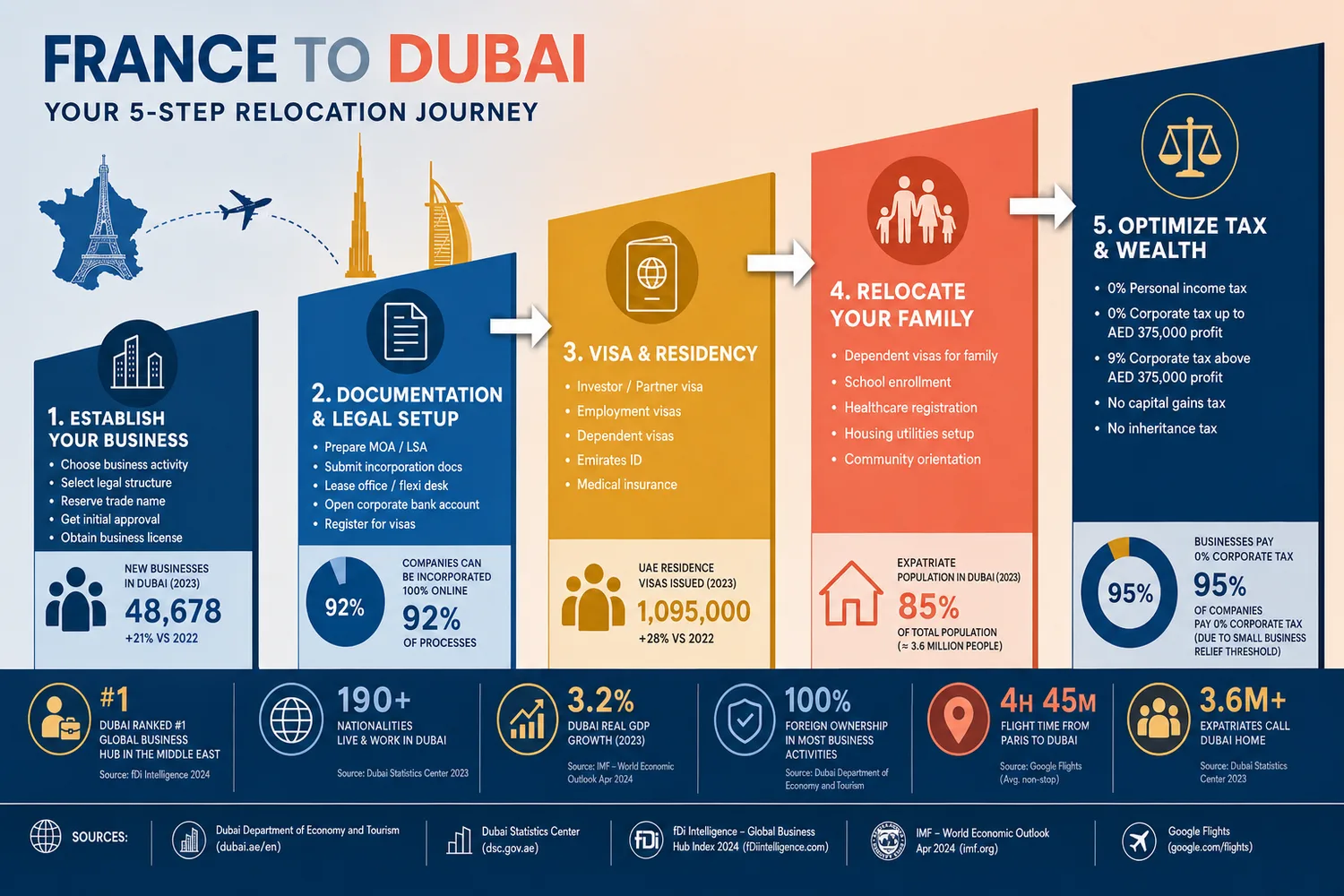
Moving from France to Dubai requires forming a UAE company, obtaining a trade license, opening an immigration file (Establishment Card), applying for a residence visa, & completing in-country fitness tests & biometrics. The full sequence typically takes 6–10 weeks from company application to Emirates ID in hand.
In essence, your own business provides the legal basis for you to live & work in the UAE, the company acts as your sponsor on record. The mechanics are logical & checkpoint-driven: each stage unlocks the next, from trade license issuance to Establishment Card to visa stamping. French nationals don't require a prior job offer; company ownership is sufficient to trigger the residency sequence.
Budget range for a simple Free Zone setup with one visa: AED 15,000–AED 30,000 in year one, covering license, immigration file, & residency steps. Express services can reduce the standard 6–10 week timeline for those with firm deadlines.
Prerequisites: Documents, Decisions, & Preparation
Before moving from France to Dubai, you need a valid passport, a defined business activity from the UAE government-approved list, a chosen jurisdiction (Free Zone or Mainland), & a clear plan for your office requirements. Having these ready prevents delays at every subsequent stage.
- A clear, colour copy of your passport (with at least six months' validity)
- A high-quality digital photograph with a white background
- Your current address, professional email, and phone number ready
- Dependents' passports, marriage certificate, and birth certificates (if bringing family)
- A summary of your projected annual revenue
- Your chosen business activity from a government-approved list
Step 1: Choose Your Jurisdiction, Free Zone or Mainland
French nationals moving to Dubai must choose between a Free Zone company (100% foreign ownership, ease of setup, best for international business) or a Mainland company (can trade directly within the local UAE market, more complex setup requirements). The right choice depends entirely on your business model & visa eligibility.
Each has distinct rules regarding ownership, office space, & the scope of business you can conduct. Free Zones offer 100% foreign ownership, packages tailored to consultants, tech entrepreneurs, & freelancers, with mandatory virtual or flexi-desk office options. A Mainland company allows you to trade directly within the local UAE market & take on government contracts, but comes with more complex setup requirements & mandatory physical office space.
For French expats focusing on consulting, tech, or services with international clients, a Free Zone is a perfect fit. A Mainland company is necessary only when direct UAE market trading is central to the business model. Meydan Free Zone is a digital-first option worth assessing for those focusing on activities with international clients who don't rely on a physical UAE storefront.
Step 2: Company Formation & Trade License
Company formation in Dubai involves submitting documents, reserving the company name, selecting a specific activity from the government-approved list, paying license fees, & receiving a trade license & Memorandum of Association. This typically takes 5–10 business days in a Free Zone for standard processing.
Submit documents's authority. Pay fees to get the trade license issued, the license is renewed annually, so factor in recurring fees from year one. With the trade license in hand, the company can open its immigration file, also known as the Establishment Card stage.
The primary cost drivers are the jurisdiction's fees, the license activity category, visa allocation, & office requirements. A simple Free Zone setup with one visa costs between AED 15,000–AED 25,000 in the first year; more complex setup requirements for Mainland can cost over AED 50,000.
Step 3: Establishment Card & Entry Permit
After the trade license is issued, the company must open its immigration file (Establishment Card) with the UAE immigration authority. Without this file, the company cannot sponsor anyone for residency. Once approved, the company can apply for an entry permit for its owners & employees.
This is a critical milestone that bridges the gap between company formation & the residency process. Without this file, the company cannot proceed to the visa application stage, regardless of how well-formed the trade license is. Fees for opening the immigration file are separate from the trade license fees, budget for both upfront.
In With an approved Establishment Card, the company can apply for your entry permit to enter the UAE & complete the in-country residency steps. Once issued, the entry permit is typically valid for 60 days. If you're outside the UAE when the permit is issued, you'll use it to enter; if you're already inside, the company can apply for a status adjustment.
Step 4: In-Country Residency Steps, Fitness Test, Biometrics, & Visa Stamping
Once inside the UAE on an entry permit, you must complete a medical fitness test, which screens for communicable diseases, submit biometrics, an Emirates ID application, & proceed to visa stamping. The residence visa is then stam fitness test is mandatory for all residence visa applicants, book it promptly after entering on the entry permit. Biometrics (fingerprints & photograph) are taken at an approved center. This part can range from 3–5 business days for standard processing.
Visa Stamping: Your passport is submitted for the final visa sticker, which is stamped into a page in your passport, typically valid for two years. Your Emirates ID is issued & in your possession within 5–10 business days of biometrics submission. Set a calendar reminder for renewal 60 days before expiry to maintain your residency without interruption.
Step 5: Family Visas, Sponsoring Dependents from France
Once your own UAE residence visa is stamped & active, you can sponsor dependents including a spouse & children. Each dependent requires their own entry permit, fitness test, & Emirates ID. The process mirrors the primary applicant's residency steps & typically takes 3–5 weeks per dependent.
Your residence visa must be active before you can sponsor your spouse & children. These typically include: attested marriage certificate, birth certificates for children, passport copies of all dependents, & your own Emirates ID. Documents issued in France must be attested by the French Ministry of Foreign Affairs & then by the UAE Embassy in Paris before they are accepted by UAE immigration.
In total, a realistic timeline for a family of three from first application to all Emirates IDs in hand is 10–14 weeks. Medical insurance is mandatory for all visa holders in Dubai, factor in insurance costs for each family member from the date of visa stamping.
Tax Considerations & Ongoing Administration for French Nationals
The UAE does not have personal income tax. As of June 2023, a federal Corporate Tax of 9% applies to taxable profits at 0% (Gov.ae, 2023). French nationals must also assess their French tax residency status & any ongoing reporting obligations to French authorities after relocation.
Businesses with annual revenues over AED 375,000 must register for VAT at 5% with the Gov.ae Federal Tax Authority, a key consideration for service businesses scaling quickly. The UAE does not levy capital gains tax on the sale of most assets, & dividends drawn from your UAE company are yours to keep at the personal level.
France uses a residency-based tax system. French nationals who move to Dubai but maintain a home, key clients, or economic interests in France may remain subject to French tax obligations. The France-UAE double tax treaty provides a framework to avoid double taxation, but it does not automatically eliminate French reporting obligations, you must stay on top of compliance from day one. Keep corporate documents organized, maintain clear banking relationships, & ensure your business is compliant.
Conclusion
Moving from France to Dubai is a structured, sequential process: choose your jurisdiction, form the company, obtain the Establishment Card, secure your own residency, then sponsor your family. Tax considerations, both UAE corporate tax & French residency obligations, require careful planning before you proceed. Execution over theory: get the company set up correctly, the right jurisdiction matters, & annual renewals must be tracked from day one.
Use the Meydan Free Zone Setup Cost Calculator to map your year-one costs, then contact a UAE-qualified legal or tax advisor to assess your French residency exit position before submitting any applications.