
Table of Contents
Frequently Asked Questions
1. What is the cheapest way to transfer money from France to the UAE?
For small amounts, a specialist service like Wise using the mid-market rate is usually cheapest. For large sums, an FX broker often beats a bank. Always compare the exchange-rate spread, not just the fee.
2. Do I have to declare a bank transfer from France to Dubai?
No, not personally. Your bank or provider reports the transfer automatically. The €10,000 declaration rule applies only to physical cash carried across the border, not to bank or online transfers.
3. Why does less money arrive than I sent?
Usually the exchange-rate spread, plus SWIFT and intermediary bank fees. A bank can advertise low fees and still cost the most, because it hides its margin in the exchange rate.
4. Is it legal to transfer large sums from France to the UAE?
Yes. Moving money through a regulated bank or licensed service is completely legal and reported automatically. Keep proof of where the funds came from, and a large transfer is straightforward.
5. How does Meydan Free Zone help with money transfers?
Meydan Free Zone sets up your company, banking pathway and residency, and connects you to regulated forex partners. It does not move money itself, but gives it a compliant UAE destination.
Transferring Money From France to the UAE: Costs & Options
Most of what it costs to transfer money from France to the UAE is invisible.
The fee on your screen is the small part. The real cost hides in the exchange rate, where many banks quietly add 3% or more, on top of their fees, according to Wise.¹ On a large relocation transfer, thousands are gone before the money lands.
You are not alone in making this move. The UAE hosts the largest French community in the Gulf, around 35,000 residents and 600-plus French companies, per the French Consulate.² For a founder, the transfer is rarely just rent: it is company capital, business revenue or relocation savings meant to build a UAE base.
Two things to know: France to the UAE sits outside the SEPA zone, so transfers usually run through SWIFT, slower and pricier than inside Europe. But the money lands on stable ground, the dirham is pegged to the dollar at 3.6725.
This is where Meydan Free Zone helps: it builds the UAE side, giving you a business license in under 60 minutes, plus an investor visa backed residency route and a guaranteed IBAN pathway, whilst connecting you to regulated forex partners.
What It Costs to Transfer Money From France to the UAE
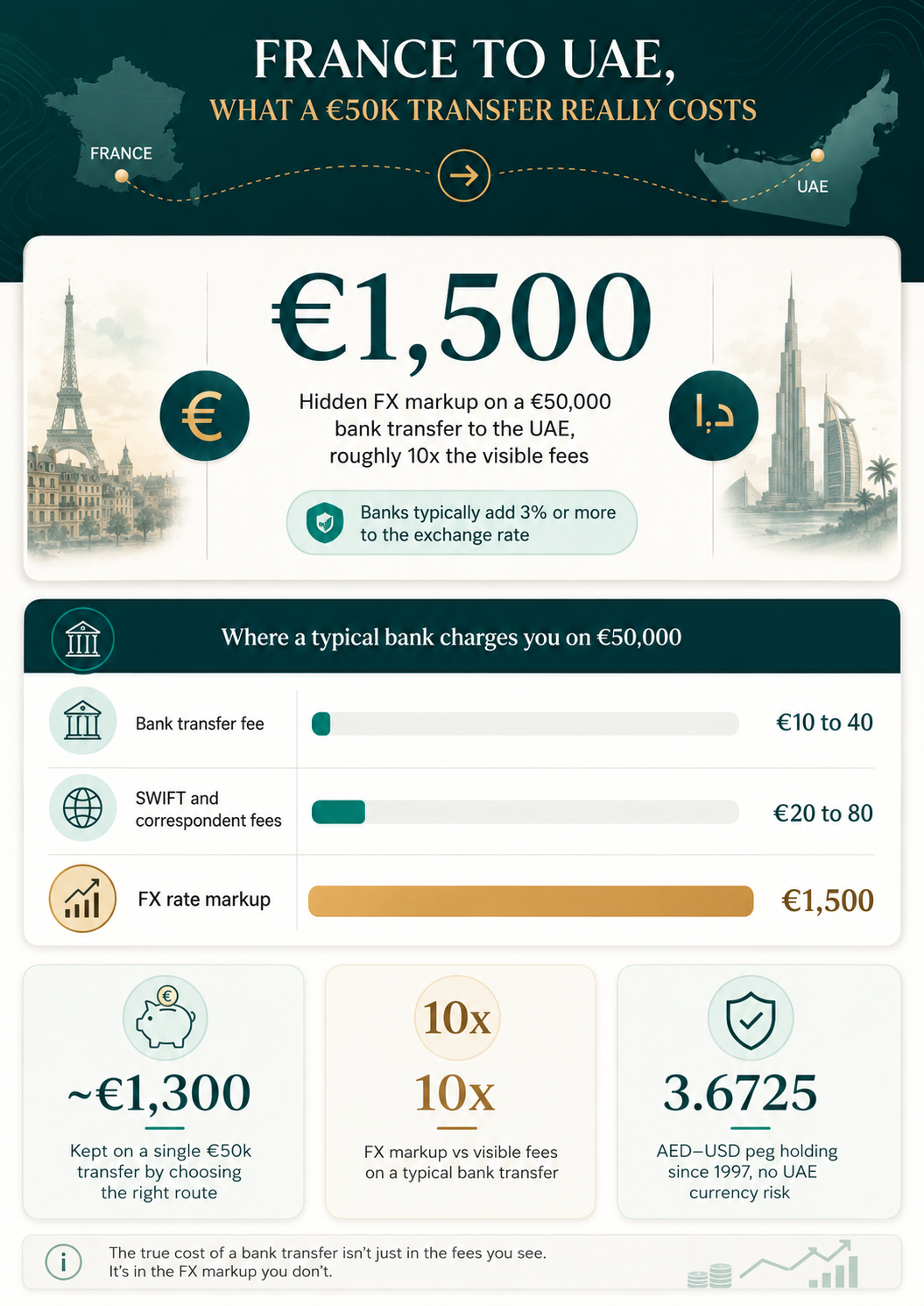
The cheapest transfer is not always the one with the lowest visible fee. Take a €50,000 transfer and watch where the money actually goes:
| Cost Layer | What It Typically Costs on €50,000 |
|---|---|
| Bank transfer fee | €10 to €40 flat, the part you see |
| SWIFT and correspondent bank fees | €20 to €80, for sending on the international network |
| FX spread | The big one: at a 3% markup, that is €1,500 lost in the rate |
The visible fees add up to maybe €50 to €150. The exchange-rate spread alone can be €1,500.
Put the two routes side by side on that same €50,000, and the gap is hard to ignore:
| Route | What It Costs | What Actually Arrives |
|---|---|---|
| Typical bank | ~3% in the rate, plus fees, around €1,550 | ~€48,450 |
| Mid-market service | A small upfront fee, no rate markup, around €250 | ~€49,750 |
That is roughly €1,300 kept on a single transfer, just by choosing the right route. A bank can advertise “low fees” and still cost you the most, because it makes the money back in the rate.
So the cheapest-looking transfer is rarely the cheapest. The best one arrives cleanly and converts fairly.
Source: Wise Cross-Border Transfer Report 2026 and published SWIFT correspondent bank fee ranges, via Wise
France to UAE Transfer Options
The right way to move your money depends on how much you are sending, and why. Here are the four main routes, and where each one fits.
| Option | Best For | Watch Out For |
|---|---|---|
| Bank SWIFT transfer | Large bank-to-bank moves you want handled by your own bank | Weak exchange rates and the highest hidden spread |
| Specialist service, e.g. Wise | Smaller personal transfers at the real mid-market rate | Transfer limits; not built for large business sums |
| FX broker | Large or planned transfers, with the option to lock a rate | Onboarding and source-of-funds checks before you can send |
| Exchange house | Cash and smaller remittances | Rates vary by branch; airport kiosks are the costliest |
Personal vs Business Transfers to the UAE
The bank reads a personal transfer very differently from a business one, so they should not land in the same place.
Send €30,000 for rent, and that is personal money: it goes to a personal account with proof of source. But €30,000 from clients is business revenue: it goes to a UAE corporate account with invoices and contracts behind it. The rule is simple:
- Personal savings and living costs go to a personal account, with proof of source.
- Business revenue and client payments go to a corporate account, with the license and invoices.
- Property sale proceeds go to a personal account, with the sale deed.
Expert Financial and Tax Compliance Services in Dubai
Explore mAccountingWhat France's Rules Say About Sending Money Abroad
Moving money from France to the UAE is simpler than most people expect. The key is knowing what your bank handles for you, and what you need to handle yourself.
Your bank handles these automatically:
- Reporting: Transfer through a regulated bank or licensed service, and it reports the transfer for you. You file nothing.
- The €10,000 rule: If you physically carry €10,000 or more in cash across the border, you must declare it to customs. This does not apply to bank or online transfers, which are handled through the banking system. So it will not affect your transfer.
You handle these:
- Proof of source: Keep a document showing where the money came from, a property sale, salary, or business income. If a bank asks, you are ready.
- Foreign account declaration: If you keep a French account after moving, declare it each year on form 3916.
Documents Your UAE Bank May Ask For
Large transfers are as much about documentation as money. A UAE bank may want to see who owns the receiving account and where the funds came from. Having these ready keeps a transfer from stalling:
- Passport and Emirates ID, your identity and UAE residency
- UAE trade license, the company receiving or using the funds
- Source-of-funds proof, where the money came from
- Invoice or contract, for business or client payments
- Property sale deed, for sale proceeds
Setting up the UAE side early is what makes this painless. Leave it until the money needs to move, and a single missing document can hold up the whole transfer.
Building Your UAE Base With Meydan Free Zone
The UAE base comes first. A company, a corporate account and clean records give your money a clear reason to be there, and a paper trail that answers questions before they are asked. Meydan Free Zone builds that destination, then connects you to the partners who move the money.
| What You Need | How Meydan Free Zone Helps |
|---|---|
| A UAE company | A 100% owned Free Zone LLC (FZ LLC), giving your money a clear commercial destination |
| Fast licensing | Fawri issues an instant license in under 60 minutes, so you build the UAE side before moving larger funds |
| Banking pathway | Guaranteed IBAN support to receive client payments and business transfers through UAE accounts |
| Forex and remittance | Access to regulated exchange and transfer partners, including GCC Exchange, Lari Exchange, Wall Street Exchange and CurrencyFair |
| Residency | mResidency handles the investor visa, medicals, biometrics and Emirates ID, building the personal UAE file that banks and providers ask for |
| Records | mAccounting keeps your accounting, UBO and company records in order, so you can always show where money came from and why it entered the UAE |
Once your money is in Dubai, these are the channels you use day to day: converting currency, paying suppliers, or sending money back to France. Meydan Free Zone does not provide licensed forex or banking services itself; it facilitates access through regulated partners.
The regular license starts from €2,971 (AED 12,500), or Fawri from €3,566 (AED 15,000) for instant setup. For a French founder, the point is simple: you are not just sending money once, you are building a UAE base with the company, banking, forex and records ready for every transfer that follows.
In Conclusion
A transfer has two prices: the one the bank shows you, and the one you actually pay. The gap between them, hidden in the exchange rate and the charges you never see, is where the real money goes. On a large transfer, choosing the right route can keep well over a thousand euros in your pocket.
The rest is simple. Send through regulated channels, keep proof of where the money came from, and match each transfer to the right account. Get that right, and moving money to Dubai is clean and predictable.
Meydan Free Zone builds the UAE side of that move: the company, banking pathway, residency and records. If you are planning yours, book a free consultation with a setup advisor at Meydan Free Zone.
Ready to Launch Your Business in Dubai?
Let's ConnectFootnotes
¹ Wise, How to Send Money Abroad From France, banks often add 3% or more to the exchange rate on international transfers, 2026.
² French Consulate / France Diplomatie, France and the United Arab Emirates, around 35,000 French residents and over 600 French companies in the UAE, 2026.