

Table of Contents
Frequently Asked Questions
Is it better to rent an apartment or a villa in Dubai?
It depends on your life stage. Apartments suit solo founders and couples wanting central access and low costs; villas suit families needing space and privacy, at higher rent and running costs.
How much more does a villa cost to run than an apartment?
Considerably more. Cooling a large villa plus garden irrigation can add AED 15,000 or more a year in DEWA and cooling charges, well above a comparable apartment's utility bills.
What is the cheapest way to rent a family home in Dubai?
Townhouses are typically 10% to 20% cheaper than detached villas in the same community, and value areas like JVC lower the rent further. Unfurnished is cheaper over a longer stay.
Should I rent furnished or unfurnished in Dubai?
Furnished suits a fast or short move but adds a 15% to 25% rent premium. Unfurnished is cheaper over a two- or three-year stay, though you carry the furniture cost upfront.
Do I need residency before renting a home in Dubai?
Yes. You need a residence visa and Emirates ID to sign a tenancy and register Ejari. These come from your employment or, for a founder, from a Meydan Free Zone company via mResidency.
Topic Summary
Residency Comes Before the Lease
You need a UAE residence visa and Emirates ID before most Dubai landlords will sign a twelve-month tenancy contract. A Meydan Free Zone Trade License from AED 12,500 triggers the investor visa, giving you the residency that makes renting one possible.
Apartment or Villa: The Core Trade-Off
Apartments are cheaper to run, put you close to business districts, and suit solo founders or couples who value a short commute over space. Villas offer space, privacy, and family life at a higher rent and noticeably higher running costs.
Ejari Registration Is Non-Negotiable
Every Dubai tenancy contract must be registered through Ejari, the federal digital platform, at roughly AED 220. Without it, you cannot connect DEWA utilities, activate your Emirates ID address, or sponsor your family on dependent visas.
RERA Protects You as a Tenant
The Real Estate Regulatory Agency governs all residential leasing under Law No. 26 of 2007. Run a RERA title check on every property before signing, and know that rental disputes go to the Rental Dispute Settlement centre, not civil courts.
Neighbourhood Choice Shapes Your Daily Life
Business Bay and Downtown suit entrepreneurs needing DIFC access; Dubai Marina and JBR deliver beachfront lifestyle; Jumeirah and The Greens serve families wanting French schools nearby. Your commute, your running costs, and your daily life all flow from where you choose to live.
French Documents Need Legal Translation Early
Birth certificates, marriage certificates, and civil status documents must be certified by the French authorities and then attested for use in the UAE — a process that can run from fifteen to twenty-five working days per document. Get certified documents in place before you travel.
Try the City Before You Sign an Annual Lease
A practical tip: use short-term or furnished accommodation for your first few weeks to stay to test neighbourhoods and commutes before committing to an annual lease. That also lets you school runs and neighbourhoods before locking in a long contract.
Renting a Home in Dubai, UAE as a French Expat: The Full Guide
Once your residency is sorted, the first real lifestyle decision most French expats face sounds simple: apartment or villa? In Dubai the choice is bigger than it looks, shaping your rent, your commute, your running costs and your daily life, and the right answer depends more on your stage of life than on budget alone.
The market gives you plenty to choose from. Dubai registered 1.38 million tenancy contracts worth AED 126.4 billion in 2025, according to the Dubai Land Department,¹ across everything from studios to family villas. Demand is strong on both sides: apartment rents rose around 29% and villa rents around 28% year on year into 2026, per Numbeo data,² so the apartment-or-villa decision now carries real financial weight.
This guide is about making that choice well. For the mechanics, the tenancy contract, Ejari, cheques and deposits, see our guide to renting your first home in Dubai. Getting there, though, starts with residency: you need a residence visa and Emirates ID to sign any lease, and a Meydan Free Zone company provides exactly that, with mResidency coordinating the visa and Emirates ID before you choose your home.
Dubai Trade License from AED 12,500
Get Your LicenseApartment or Villa: The Core Trade-Off
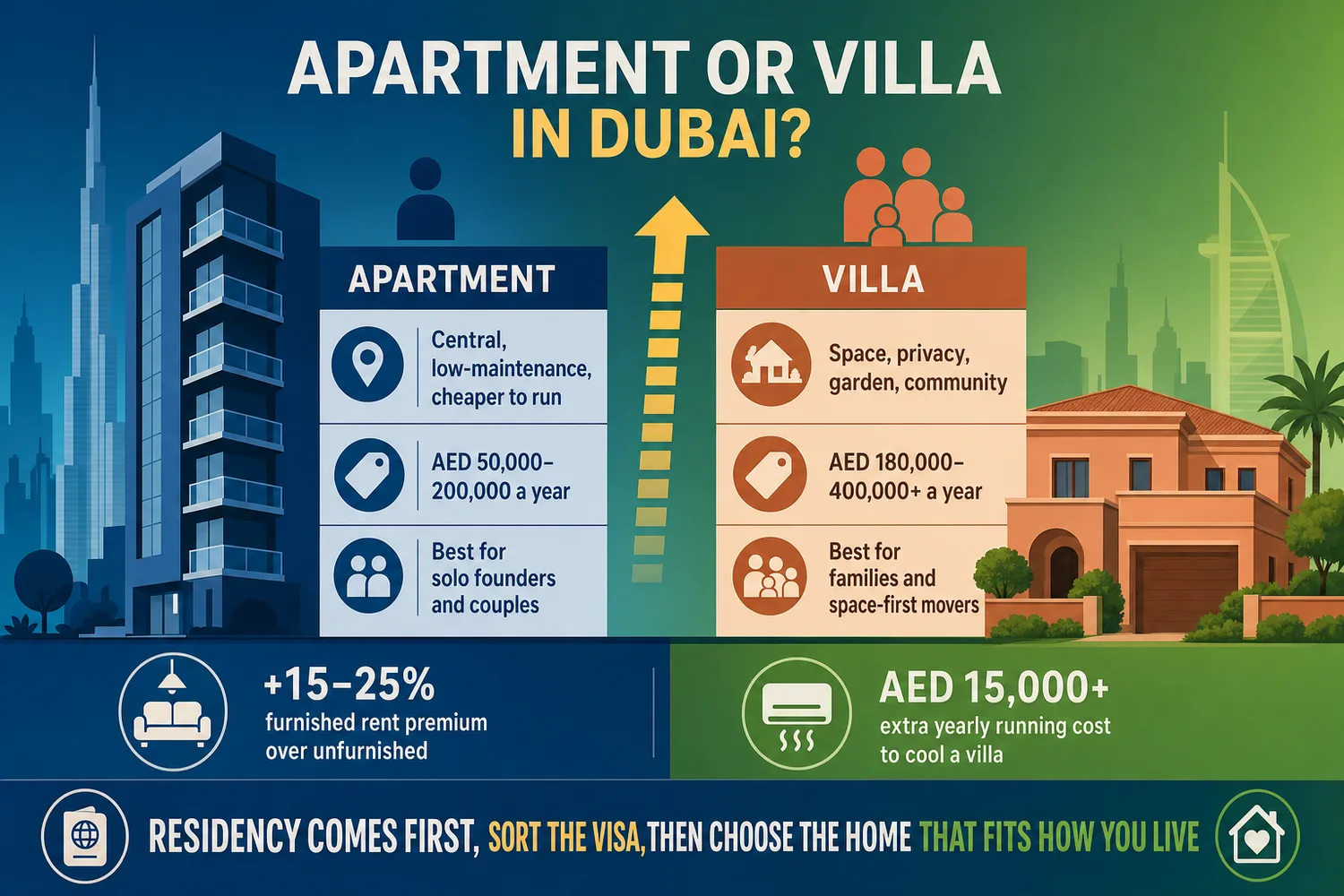
The two options suit different lives:
- Apartments are central, lower-maintenance and cheaper to run. They put you close to business districts, the Metro and nightlife, and they suit solo founders, couples and anyone who values a short commute over space.
- Villas offer space, privacy, a garden and often a community feel, at a higher rent and higher running costs. They suit families, those working from home who need room, and anyone prioritising lifestyle over location.
Neither is objectively better. A single founder in Business Bay and a family of four in Arabian Ranches have made equally sensible, opposite choices.
What Each Option Costs
Cost is where the decision often gets made. Broad 2026 ranges:
| Home type | Typical annual rent | Suits |
|---|---|---|
| Studio / 1-bed apartment | AED 50,000–115,000 | Solo founders, couples |
| 2–3 bed apartment | AED 100,000–200,000 | Small families, sharers |
| Townhouse | AED 120,000–250,000 | Families wanting space for less |
| Villa (3+ bed) | AED 180,000–400,000+ | Families, space-first movers |
Two things French renters often miss. First, villas cost much more to run, air conditioning a large villa plus garden irrigation can add AED 15,000 or more a year in DEWA and cooling, well above an apartment. Second, furnished units carry a 15% to 25% premium over unfurnished, and townhouses typically run 10% to 20% cheaper than detached villas in the same community.
Rents are indicative and vary sharply by area, floor, view and building. Always sense-check a figure against the RERA rental index on the Dubai REST app before you commit.
Where French Expats Tend to Look
Location interacts with the apartment-or-villa choice:
- Apartment communities: Business Bay, Dubai Marina, JLT and Downtown for central lifestyle; Jumeirah Village Circle and Arjan for value.
- Villa and townhouse communities: Arabian Ranches, Dubai Hills, Tilal Al Ghaf and Town Square for families; the Meydan district for a mix of both near the free zone.
For families with children, one factor often overrides the rest: proximity to a French school. Dubai's main French lycées sit around Oud Metha, Al Quoz, Meydan and, from 2026, Mudon, so villa and townhouse communities within a reasonable school run tend to win out over a fashionable but distant address.
Furnished or Unfurnished
A practical sub-decision:
- Furnished suits a fast or short move, you arrive and live immediately, at a 15% to 25% rent premium and a lower up-front furniture cost.
- Unfurnished is cheaper over a longer stay and lets you set up the home your way, but you carry the cost of furnishing it, which adds to your first-month spend.
For a founder watching cash flow in the early months, unfurnished plus a modest furniture budget often works out cheaper across a two- or three-year stay.
Where Meydan Free Zone Fits In
Choosing between an apartment and a villa is the enjoyable part. But there is a step that has to come first, and it catches some French movers out: you cannot sign a tenancy or register its Ejari without a UAE residence visa and Emirates ID. The home decision depends on your residency being in place.
This is the logical order, and where Meydan Free Zone fits:
- Set up the company: A Meydan Free Zone license from AED 12,500 (roughly EUR 2,979), or a Fawri license from AED 15,000 (roughly EUR 3,575) in under 60 minutes, can be arranged remotely from France, before you travel.
- Get your residency: mResidency coordinates your investor visa, medical test and Emirates ID, the documents every landlord and the Ejari system will ask for.
- Then choose your home: With residency in hand, you can sign a lease, register Ejari and activate DEWA, whether you have chosen an apartment or a villa.
The practical benefit is timing. Because the company and residency can be underway before you land, you arrive able to sign, rather than losing weeks in temporary housing waiting for paperwork. That also lets you use a short stay to test neighbourhoods and commutes before committing to an annual lease, so your apartment-or-villa decision is made with real experience of the city, not a map.
Meydan Free Zone gives you the residency that makes renting one possible, and gets you to that point faster.
In Conclusion
Apartment or villa comes down to how you live and work. Apartments win on cost, commute and low maintenance; villas win on space, privacy and family life, at a higher rent and noticeably higher running costs. There is no wrong answer, only the one that fits your stage.
Get your residency in place first, try the city before you sign, and choose the home that matches how you actually live. To set up the company and residency that make renting possible, book a free consultation with a setup advisor at Meydan Free Zone.
Footnotes
¹ Dubai Land Department, via Gulf News, Dubai rental contracts reach Dh126 billion in 2025, Dubai registered 1.38 million tenancy contracts worth AED 126.4 billion in 2025, 2026.
² Numbeo, via DMCC, Cost of Living in Dubai for Expats, apartment rents rose around 29% and villa rents around 28% year on year into early 2026, 2026.