Table of Contents
Frequently Asked Questions
1. What registrations does an Indian spice exporter need before shipping to Dubai?
Three are mandatory: an Importer Exporter Code (IEC) from the DGFT, APEDA registration, and a Certificate of Registration as Exporter of Spices (CRES) from the Spices Board of India. The CRES also functions as the RCMC under India's Foreign Trade Policy, so a separate RCMC is not required for spice exporters.
2. What is FIRS and why does it matter for an Indian spice trading company Dubai?
FIRS is the Food Import and Re-export System operated by Dubai Municipality. Supermarket chains, hotel procurement teams, and institutional buyers in the UAE require their suppliers to be FIRS-registered. Without it, direct access to organised retail and HORECA is not possible.
3. Is Halal certification required for spice products entering the UAE?
Yes. All food products entering the UAE food supply chain - including packaged and processed spice products - must carry Halal certification from a body recognised by UAE authorities. Whole unprocessed spices have a more straightforward path, but blended products and masala mixes require it.
4. What are the UAE labelling requirements for imported spice products?
Labels must display the product name, brand, ingredients, country of origin, manufacture and expiry dates, net weight, and Arabic language text. Non-compliant labelling can result in fines of AED 10,000 to AED 100,000 and shipment rejection at port.
5. What does CEPA mean for Indian spice exports to the UAE?
The India-UAE CEPA, in force since 1 May 2022, eliminated duties on approximately 90% of Indian spice lines entering the UAE. This reduces the landed cost of Indian spices relative to non-CEPA competitors and directly improves margin at the destination.
6. Why does an Indian spice exporter need a UAE trading entity rather than selling through an agent?
An agent holds the buyer relationship, invoices in AED, and collects the margin between Indian supply price and UAE end-buyer price. A UAE-registered entity with its own IBAN invoices buyers directly, accesses FIRS-required retail and HORECA channels, and captures the distribution margin for the Indian exporter.
7. What corporate tax applies to a UAE free zone spice trading company?
Free zone companies pay 0% corporate tax on qualifying income under the QFZP framework, and 9% above AED 375,000 on non-qualifying income. There is no personal income tax. VAT at 5% applies to UAE domestic sales; re-exports are typically zero-rated.
8. How long does it take to set up a trading entity through Meydan Free Zone?
The Fawri license issues digitally in under 60 minutes. The standard license route completes within one working day once documentation is submitted. Both include a guaranteed IBAN pathway through partner banks.
Topic Summary
1. Choose the Appropriate Business Structure
Decide on a suitable legal entity for your spice trading company, commonly a Free Zone Limited Liability Company (FZ-LLC) or a Mainland Limited Liability Company (LLC), depending on your business model, ownership preferences, and target market.
2. Select the Relevant Free Zone or Jurisdiction
Identify and select a Dubai Free Zone that specializes in trading activities, such as Meydan Free Zone, or opt for Mainland registration through the Department of Economic Development (DED) if direct trading within the UAE market is desired.
3. Reserve a Trade Name and Obtain Initial Approvals
Submit the proposed company name for approval ensuring it complies with UAE naming conventions and obtain initial approvals from the relevant authority to proceed with the licensing process.
4. Prepare and Submit Legal Documentation
Compile required documents including passport copies, proof of address, business plan, and Memorandum of Association (MOA). Submit these along with the application forms to the chosen Free Zone authority or DED for issuance of the trade license.
5. Complete Licensing, Visa, and Office Space Requirements
Finalize payment of licensing fees, secure a physical office or flexi-desk as per regulatory requirements, and apply for investor or employee visas if necessary to complete the company registration process and begin operations legally in Dubai.
How To Register An Indian Spice Trading Company In Dubai
An Indian spice exporter with 15 years of experience shipping cumin from Unjha to buyers across the Middle East is still transacting through a Dubai-based commission agent. The agent handles customs clearance, invoices the UAE buyer in AED, collects payment, and remits a portion back, 30 to 45 days later, after deducting margins the exporter never sees. The exporter knows the product. The agent owns the buyer relationship.
This is the default structure for most Indian spice exporters entering the Dubai market. And it works, until you calculate what it costs.
Per Spices Board of India (Ministry of Commerce)¹, India is the world's largest spice producer and exports more than 200 spices and value-added spice products to over 180 countries. India produces 75 of the 109 spice varieties recognised by the International Organization for Standardization, the most diverse spice production base of any country.
Setting up an Indian spice trading company Dubai-side means taking both sides of that transaction under your own commercial control. It requires registration on two fronts: the Indian export compliance stack and the UAE trading entity.
Neither is complicated individually. Together, they give you direct access to the buyer channels and re-export corridors that define the real margin in this trade.
This guide walks through both sides of the registration process for an Indian spice trading company Dubai, and what each layer of compliance actually unlocks commercially.
Why Dubai Is the Right Base for Indian Spice Traders
Per Spices Board of India (Ministry of Commerce)², India exported spices worth USD 4.72 billion in FY 2024-25, a record high, up 6% on the previous year, shipped to over 200 destinations. The UAE was among the top destinations by value, absorbing a significant share of Indian spices including chilli, cumin, turmeric, cardamom, black pepper, coriander, and ginger: the full range of whole, ground, and blended varieties consumed in the Gulf's retail, HORECA, and re-export channels.
Dubai is not just a consumption market. It is a redistribution hub. Indian spices clearing Jebel Ali move onward into Saudi Arabia, Oman, Qatar, Kuwait, Bahrain, and East African markets through a single import and re-export structure.
A licensed Indian spice trading company Dubai-based handles that onward flow under one entity, without the Indian exporter needing separate trade relationships with every downstream buyer across six countries.
Per the UAE Ministry of Economy³, under the India-UAE Comprehensive Economic Partnership Agreement in force since 1 May 2022, duties have been eliminated on approximately 90% of Indian spice lines entering the UAE.
The landed cost advantage over non-CEPA origin competitors is real and sustained. For cumin specifically, where UAE demand absorbs a meaningful share of India's total cumin exports, the duty elimination is a direct margin input on every shipment.
Free Business Setup Cost Calculator
The India Side: Three Registrations Every Spice Exporter Needs
Before a single container of turmeric leaves Nhava Sheva, three registrations need to be in place. Skip any one of them and the shipment does not move.
- Importer Exporter Code (IEC) is the foundational export identity. Issued by the DGFT at dgft.gov.in, it is free, permanent, and linked to the exporter's PAN. Without it, no export can be processed by Indian customs. Application is fully online and typically resolved within one to two working days.
- APEDA Registration - the Agricultural and Processed Food Products Export Development Authority covers all agri-exports including spices. APEDA registration is mandatory for any exporter shipping spices commercially and is now processed through the e-RCMC portal at ercmc.gov.in alongside Spices Board registration in a single login flow.
- Spices Board CRES - the Certificate of Registration as Exporter of Spices, issued by the Spices Board of India, is mandatory for all commercial spice exporters. Crucially, it also functions as the RCMC under India's Foreign Trade Policy, meaning registered spice exporters do not need a separate RCMC. This single certificate covers quality certification, export eligibility, and access to government export promotion schemes including the SPICED programme, which offers subsidies on quality testing. Registration costs approximately INR 5,000 to INR 10,000 and is valid from April to March annually.
These three registrations cover the Indian side. They take 7 to 10 working days in total if documentation is in order and the applicant uses the e-RCMC portal.
The UAE Side: What a Spice Trading Company Actually Needs
Registering an Indian spice trading company Dubai-side involves a different set of requirements. The UAE layers do not mirror India's. They are designed around import clearance, buyer access, and food safety compliance - and each layer unlocks a different commercial channel.
| Requirement | Issuing authority | What it unlocks |
|---|---|---|
| UAE trading license | Free zone authority or DED | Legal entity to import, trade, and re-export |
| FIRS registration | Dubai Municipality Food Control | Access to retail chains, HORECA procurement |
| Halal certification | Approved certifying body | Volume contracts, weekly delivery, AED invoicing |
| Product label compliance | Dubai Municipality | Required for all packaged spice products |
| Corporate bank account (IBAN) | UAE partner bank | AED invoicing, direct payment receipt |
[blockFaqsCategory]
Free Company Name Check
The Compliance Stack in Practice: What It Changes Commercially
Think about what each registration actually enables.
An Indian spice exporter with IEC, APEDA, and CRES in place can ship legally and access India's export promotion benefits. Without a UAE entity, they still sell through an agent who controls the buyer relationship.
Add a Meydan Free Zone trading license and an IBAN, and the exporter can now receive AED payments directly, negotiate supplier terms with UAE buyers, and invoice local food businesses without an intermediary.
Add FIRS registration, and Lulu, Carrefour, and the procurement managers of Dubai's hotel groups are accessible directly.
Add Halal certification and label compliance, and packaged spice blends - masala mixes, turmeric powder, ground cumin - can sit on a retail shelf under the exporter's own brand.
Each registration layer is not just a compliance cost. It is a channel unlock. And the channels at the top of that stack - organised retail, branded packaged goods, HORECA supply - carry margins that bulk commodity trading into Al Aweer wholesale market simply cannot match.
Each compliance layer in a spice trading setup does more than tick a regulatory box, it opens a specific buyer channel that was closed before.
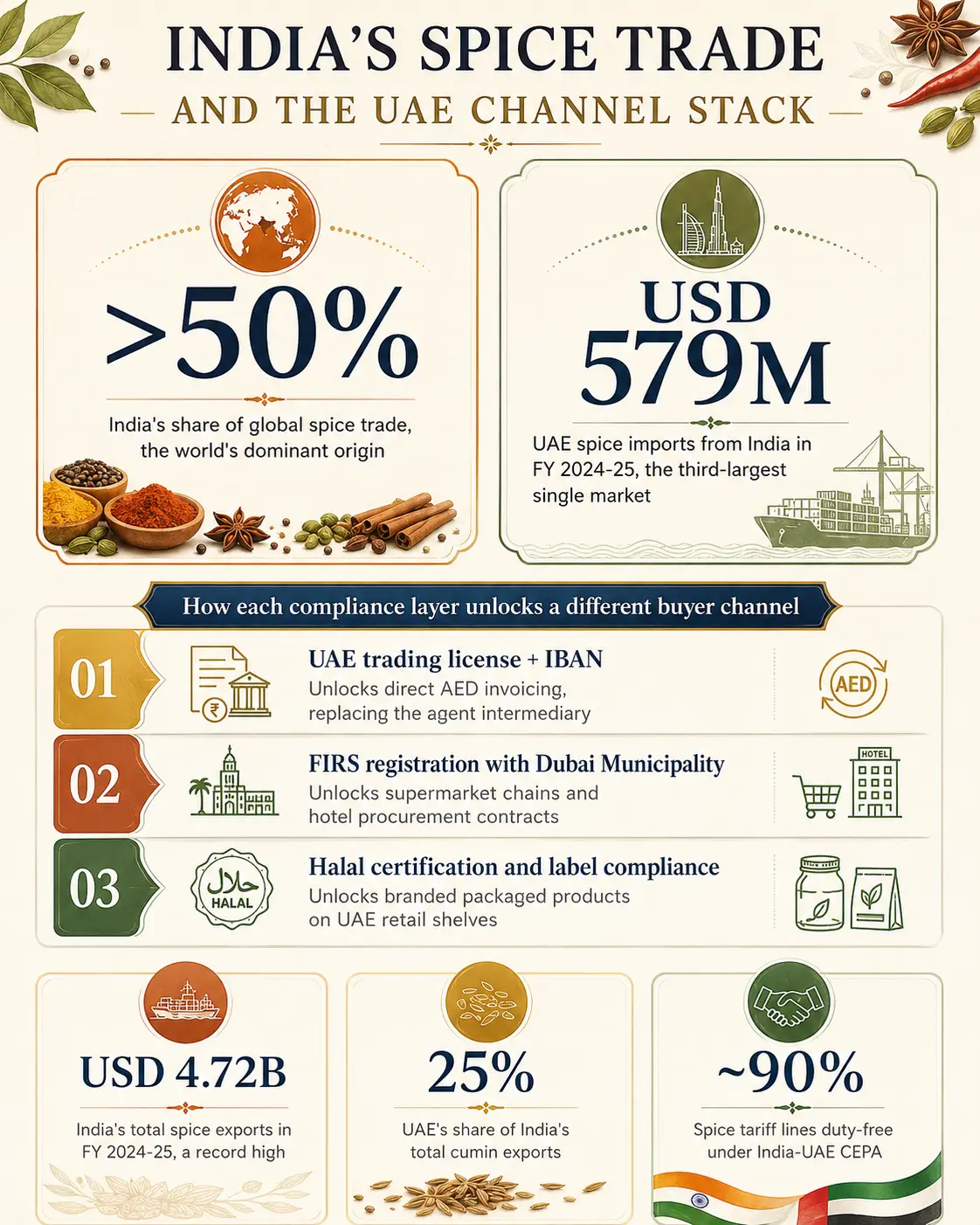
Source: India Brand Equity Foundation (IBEF), Spices Board of India, Dubai Municipality, and UAE Ministry of Economy, via IBEF India
Registering Your Spice Business Through Meydan Free Zone
An Indian spice trading company Dubai requires a UAE-registered entity, directly applicable business activity mapping for food commodity trading, and an IBAN pathway to operational banking.
Meydan Free Zone supports digital company formation with business activity mapping that covers import, export, and distribution of food commodities including spices. The Fawri license is issued digitally in under 60 minutes. The standard route is completed within one working day. Both include access to a guaranteed IBAN pathway through partner banks - the specific gap that separates a trade relationship managed by an agent from one owned directly by the Indian exporter.
Use the Meydan Free Zone cost calculator to find out your exact cost commitment before you even sign up.
In Conclusion
India is the world's largest spice producer, consumer, and exporter¹. The UAE is among the top destinations for Indian spice exports², and Dubai functions as the re-export gateway to the wider GCC and African markets beyond it. The duty environment under CEPA has never been more favourable.
But the commercial architecture of an Indian spice trading company Dubai is not built by shipping more product through the same agent. It is built by holding the registrations - on both sides of the trade - that give direct access to every buyer channel worth being in.
IEC, APEDA, and CRES handle the Indian side. A UAE trading license, FIRS registration, Halal certification, and an operational IBAN handle the Dubai side. Together, they replace the agent with a structure that earns the full margin.
Visit our business activities page to confirm the spice and foodstuff trading activities available under a Meydan Free Zone license, and contact Meydan Free Zone to begin your setup today.
Ready to Launch Your Business in Dubai?
Citations
¹ Spices Board of India, Ministry of Commerce, Government of India, "Global Processing Hub of Spices," 2025.
² Spices Board of India, Ministry of Commerce, Government of India, "Major Itemwise Export," FY 2024-25.
³ UAE Ministry of Economy, "UAE-India Comprehensive Economic Partnership Agreement," 2022.