Table of Contents
Frequently Asked Questions
1. Can Indian entrepreneurs open a UAE corporate bank account without a residence visa?
No. UAE banks will not treat the entity as commercially real without a stamped residence visa inside the passport. The Trade License must be issued and the Establishment Card opened and functional before any corporate account process starts, having confirmation alone is not sufficient.
2. What is the difference between an NRE and NRO account for UAE-based Indian founders?
An NRE account holds foreign earnings converted to INR and is fully repatriable; interest earned is tax-free in India. An NRO account manages India-sourced income like rental income or dividends, which remains subject to Indian tax. Both are maintained with Indian banks, not UAE banks.
3. When must an Indian founder convert their savings account to NRO status after UAE residency?
The timeline is triggered by the UAE residence visa stamp date, there is no grace period extension under FEMA regulations. Failing to convert creates personal liability. Contact the Indian bank that week with a copy of the stamped residence visa and Trade License to initiate the conversion.
4. Which UAE banks are best for Indian entrepreneurs opening a Dubai business bank account?
Emirates NBD suits relationship banking and international founders, with minimum balance running AED 25,000–50,000 for corporate accounts. ADCB offers personal accounts with fast setup. Mashreq suits digital-first founders. Confirm the exact threshold before proceeding, as minimum balance is a recurring price that erodes working capital.
5. Does a Free Zone Trade License affect which UAE corporate bank account a founder can open?
Yes. UAE banks assess the account purpose against the Trade License activity. Free Zone companies cannot trade directly within the local UAE market, and banks are aware of this. A Mainland company is the appropriate structure for founders who want direct UAE market access or government contracts.
6. What documents do UAE banks require from Indian entrepreneurs for a corporate account?
Banks require the Trade License, Memorandum of Association, Certificate of Incorporation, passport copies of all partners, a stamped residence visa, Emirates ID in process or being compiled, a projected annual revenue summary, a local address, and a high-quality photograph with a white background. Incomplete submissions cause delays.
Topic Summary
1. Four Prerequisites Before Any Bank Appointment
Banking in UAE for Indian entrepreneurs cannot proceed without four foundations: a valid Trade License, a stamped UAE residency inside the passport, an opened and functional Establishment Card, and Emirates ID in process or being compiled. UAE banks will not treat the entity as commercially real without all four.
2. Four Account Types Every Indian Founder Needs
The complete structure covers a UAE corporate bank account for operations, a personal current account for salary and living costs, an NRE account for tax-free repatriation of foreign earnings, and an NRO account for India-sourced income. All four must be active before the first transaction clears.
3. What Most Indian Founders Discover Too Late
A Trade License with no real business story, projected annual revenue, client base, and account purpose, faces rejection. UAE banks need a real business story; booking a bank appointment before the Establishment Card is opened and functional causes a wasted visit that adds weeks to the timeline.
4. The Numbered Process for Corporate Account Opening
Follow this process precisely: confirm the Trade License and Establishment Card first, gather corporate documents, submit everything to the chosen bank, then attend the compliance review and Account Activation appointment. The account is not functional until the compliance review runs three to seven business days for a standard case.
5. Choosing the Right Bank: Minimum Balance and Onboarding Speed
Emirates NBD suits international founders with AED 25,000–50,000 minimum balance; Mashreq suits digital-first founders; ADCB offers fast personal account setup with no minimum balance for basic current accounts. Minimum balance requirements aren't one-size, confirm the exact threshold before proceeding, as this is a recurring price that erodes working capital.
6. NRO Conversion: The FEMA Obligation Most Founders Miss
Under FEMA, the timeline is triggered by the UAE residency stamp date, there is no grace period extension. Failing to convert a resident savings account to NRO status creates personal liability, and NRE accounts cannot receive India-sourced income like rental income or dividends.
7. UAE Corporate Tax and India-UAE DTAA Obligations
As of June 2023, a federal Corporate Tax of 9% applies to taxable profits above AED 375,000 annually, and businesses must register for VAT at 5% once revenues cross that threshold. The India-UAE DTAA governs how income is taxed in both jurisdictions, seeking specialist advice to address Indian tax exit obligations before the process starts is not optional.
Opening Corporate, Personal, NRE, and NRO-Linked Banking Options for Indian Entrepreneurs in Dubai
Banking in UAE for Indian entrepreneurs isn't automatic after company setup, and most founders discover this too late. Before any bank will treat the entity as commercially real, four things must be in place.
- A valid Trade License is the foundation, without it, no corporate process starts
- A stamped UAE residence visa inside the passport is mandatory; confirmation alone is not sufficient
- The Immigration File (Establishment Card) must be opened and functional
- Emirates ID in process or the ICP application receipt is accepted at most banks, the physical card does not need to be stamped
What Most Indian Founders Discover Too Late
UAE banks need a real business story: projected annual revenue, a client base documentation, and the purpose of the account for legitimate activities. A Trade License with no residence visa and no real business story, account rarely gets approval.
The founder who books a bank appointment the day after Trade License issuance, before the Establishment Card is opened and functional, will find the entire sequence stalls, a wasted visit that adds weeks to the timeline.
Defining the Four Account Types: What Each One Does
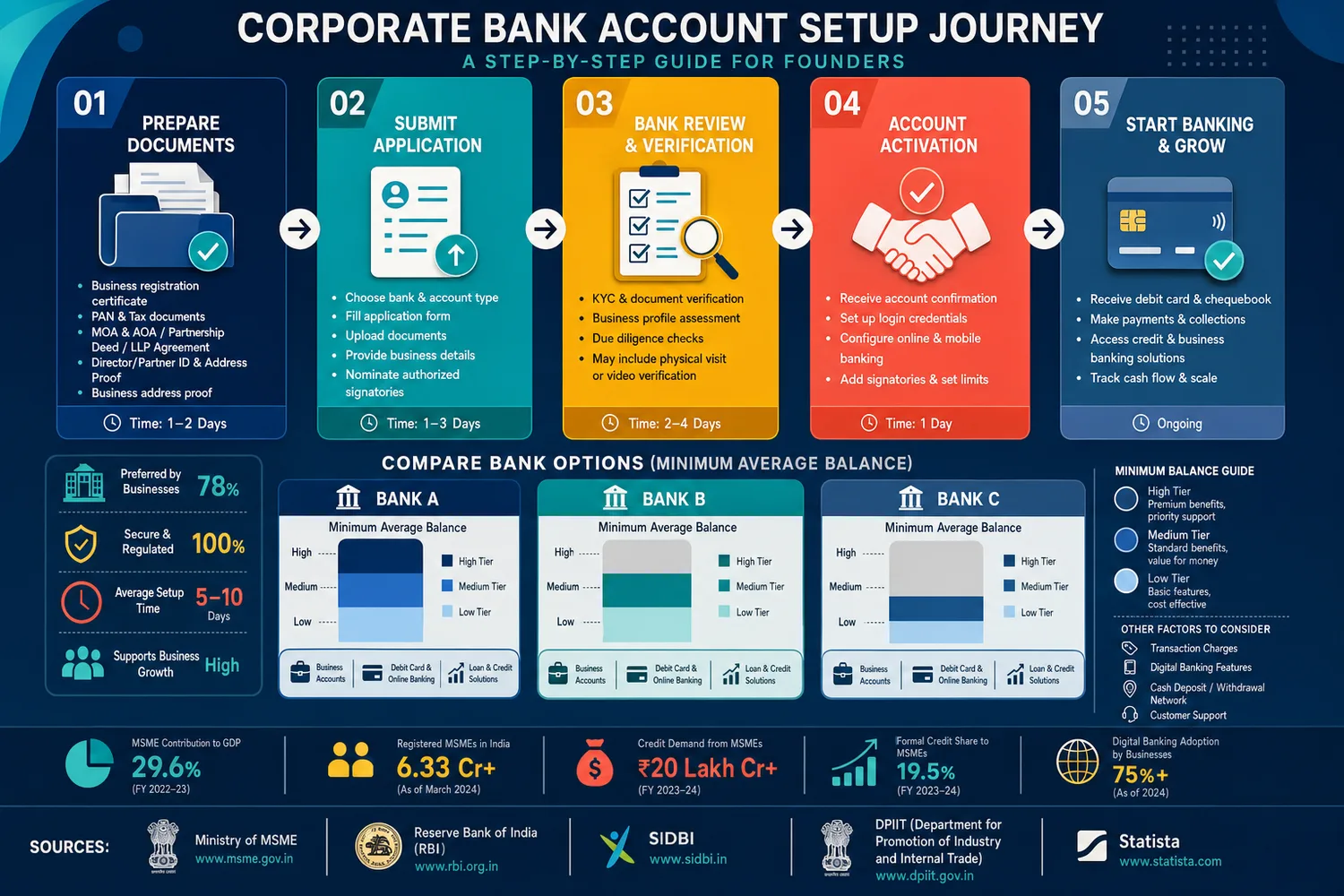
UAE banking options for Indian entrepreneurs: comparison of three major banks with minimum balance requirements and onboarding timelines.
Corporate and Personal UAE Accounts
A UAE corporate bank account is the operational engine, it receives client payments, processes payroll, and holds working capital. A personal current account is separate and is used for salary transfers and living costs. Both accounts require the residence visa stamped inside the passport and Emirates ID in process or the ICP application receipt.
NRE and NRO Accounts: The India-Linked Layer
NRE and NRO accounts are maintained with Indian banks, not UAE banks. An NRE (Non-Resident External) account holds foreign earnings converted to INR and is fully repatriable; interest earned is tax-free in India. An NRO (Non-Resident Ordinary) account handles India-sourced income like rental income or dividends, and is subject to Indian tax on interest.
Failing to convert a resident savings account to NRO status after the UAE residence visa is stamped creates personal liability under FEMA, there is no grace period extension.
| Bank | Best For | Min. Balance (AED) | Onboarding Speed |
|---|---|---|---|
| Emirates NBD | International founders, relationship banking | 25,000–50,000 | 5–10 business days |
| Mashreq | Digital-first founders | 25,000 | 5–7 business days |
| ADCB | Personal accounts, fast setup | None (basic current) | Within 5 business days |
A Numbered Process: How to Open a Corporate Bank Account
Follow this process precisely before booking any bank appointment.
- Confirm the Trade License is issued, the license activity must accurately reflect the business
- Verify the Establishment Card is opened and functional, without it, no corporate process starts
- Submit everything, Trade License, Memorandum of Association, passport copies, stamped residence visa, Emirates ID in process, projected annual revenue documentation, a local address (a flexi-desk arrangement is accepted), and a high-quality photograph with a white background, phone number ready
- Bank completes AML and KYC review, runs three to seven business days for a standard case
- Attend the compliance interview and Account Activation, the account is not functional until this activation appointment is complete, it is not same-day
This gives you a functional corporate account, typically within ten business days of submitting a complete document set.
Choosing the Right Bank for Indian Entrepreneurs
Minimum balance requirements aren't one-size, confirm the exact threshold before proceeding, as this is a recurring price that erodes working capital.
NRE and NRO Account Process for UAE-Based Indian Founders
Under FEMA, the timeline is triggered by the UAE residence visa stamp date, not Emirates ID issuance. Contact the Indian bank with a copy of the UAE residence visa and Trade License; HDFC, ICICI, SBI, and Axis Bank all process this conversion within three to five business days.
An Indian founder whose UAE residence visa is stamped must initiate the NRO conversion that same week. An NRE account is opened separately for foreign earnings, the balance and interest are fully repatriable and tax-free in India. NRE accounts cannot receive India-sourced income; that must route through the NRO account.
Tax Considerations and Ongoing Administration for Indian Founders
As of June 2023, a federal Corporate Tax of 9% applies to taxable profits above AED 375,000 annually; startups below this threshold are taxed at 0%. Businesses with annual revenues over AED 375,000 must register for VAT at 5%, mandatory, not optional. The UAE does not have personal income tax, but dividends drawn from the UAE company are yours to keep at the federal level, but only with genuine substance and active operations.
The India-UAE DTAA governs how income is taxed in both jurisdictions. Indian-sourced income remains taxable in India regardless of UAE residency status, seeking specialist advice to address Indian tax exit obligations before the process starts is not optional.