

Table of Contents
Frequently Asked Questions
Is health insurance mandatory for Russian expats in Dubai?
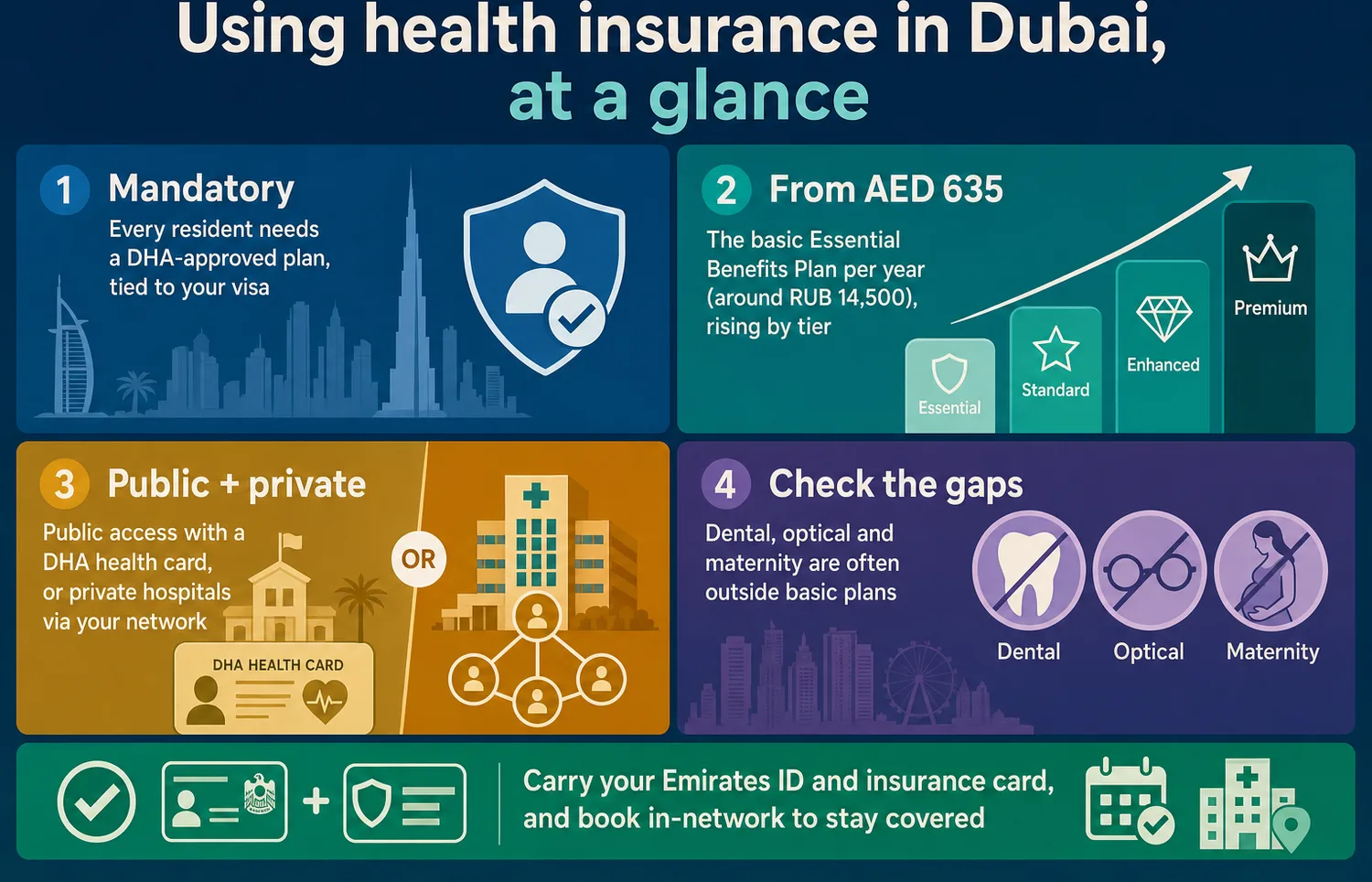
Yes. Every Dubai resident must hold a DHA-approved health plan, checked before your visa and Emirates ID are issued. Unlike Russia's state system, there is no free public cover for expats, so a plan is required to complete your residency.
Can I use public hospitals in Dubai as an expat?
Yes, with a DHA health card, which costs around AED 120 to 320 a year and gives access at reduced rates. Care is good but public hospitals are busier. Most expats use private hospitals through their insurance instead.
What does a basic Dubai health plan cover?
The Essential Benefits Plan covers doctor visits, specialists, hospital stays, emergencies, diagnostics, medicine and basic maternity, up to a AED 150,000 annual limit. Dental and optical are often excluded, so check before you rely on them.
How much does health insurance cost in Dubai?
A basic plan starts around AED 635 a year, mid-range plans run AED 1,000 to 5,000, and comprehensive cover more. The ruble rate moves, so treat any RUB conversion as a guide, and premiums rose across the market in 2026.
How does Meydan Free Zone handle my insurance?
mResidency builds it into your setup. Your DHA-approved plan is processed alongside your visa, all online, with a choice of Essential or customisable cover, renewal support through mPlus, and the option to add dependants or staff anytime.
Topic Summary
Insurance Comes First
For Russian expats in Dubai, cover is the real key to care. Before booking anything, make sure your policy is active, your digital card is visible in the insurer app, and your Emirates ID or policy details match the file.
Private Care Is the Default
Most expats use private hospitals and clinics for everyday treatment because that is where insurer networks, faster appointments, and direct billing usually sit. Public facilities still matter, but mainly for emergencies or selected services rather than routine family care.
Public vs Private Matters
The choice is less about labels and more about cost, speed, and provider access. A cheaper plan can look fine until it excludes the hospital group, pediatric clinic, or specialist your family actually wants to use in Dubai.
Read the Plan Before You Go
Check co-pays, deductibles, annual limits, pharmacy rules, and pre-approval triggers before any appointment. Scans, planned procedures, maternity care, and some specialist treatments are the common areas where billing surprises start.
Stay Inside the Network
Use the insurer’s provider finder to shortlist in-network clinics near home or work, then call to confirm the listing is current. This one step can save Russian expats from rejected claims, out-of-network bills, and wasted visits.
Dependants Need Separate Attention
Do not assume a spouse or children are automatically covered just because the main member is insured. Check each dependant is enrolled, confirm pediatric access, and review maternity and chronic-care conditions if your family plans are changing.
Use a Simple Visit Routine
Follow the same sequence each time: confirm policy status, pick an in-network provider, review approval rules, present your card and Emirates ID, and check the final bill before leaving. That routine keeps healthcare in Dubai simple, predictable, and far less stressful.
How Russian Expats Can Use Health Insurance in Dubai: Public vs Private Healthcare Explained
In Dubai, health insurance is not optional. Unlike Russia, where the state covers basic care, every Dubai resident must hold a private health plan. It is tied to your visa. For a Russian expat, the questions that matter are practical. What does your plan actually cover, where can you use it, and how do you choose the right level? This guide explains how to use health insurance in Dubai, and how the public and private systems really work.
Once you understand the tiers, the networks and the difference between public and private care, the system is easy to navigate. Here is everything you need to use your cover with confidence.
Key Facts at a Glance
| The rule | Every Dubai resident must hold a DHA-approved health plan |
| The minimum | The Essential Benefits Plan, with a AED 150,000 annual limit |
| Public access | Expats can use public facilities with a DHA health card |
| Private access | Most expats use private hospitals through their insurance network |
| Watch for | Dental, optical and maternity are often not in basic plans |
How Health Insurance Works in Dubai
The system is simple once you know the basics. Insurance is mandatory, and it is checked before your visa and Emirates ID are issued or renewed.
If you set up a company and sponsor yourself, you arrange your own plan. Your insurance links to your Emirates ID. Your cover is then verified electronically whenever your residency is processed. You choose your insurer and your tier. The only rule is that the plan meets the minimum standard set by the Dubai Health Authority, known as the DHA.
Once your plan is active, you use it at the hospitals and clinics in its network, showing your Emirates ID and insurance card.
The Insurance Tiers, Explained
Plans in Dubai range from a basic legal minimum to full international cover. Here is how the levels compare.
| Tier | Rough annual cost | What you get |
|---|---|---|
| Essential Benefits Plan | From around AED 635 (RUB 14,500) | The legal minimum, basic hospitals and care |
| Mid-range plan | AED 1,000 to 5,000 (RUB 23,000 to 115,000) | Wider network, higher limits, more extras |
| Comprehensive plan | AED 5,000 to 20,000+ (RUB 115,000+) | Top private hospitals, dental, maternity, global cover |
The Essential Benefits Plan meets the law, but it is basic. It has a AED 150,000 annual limit and a co-payment, usually 20% up to a yearly cap. For a family, or anyone wanting the best private hospitals, a mid-range or comprehensive plan is worth the extra. The ruble rate moves, so treat the RUB figures as a guide.
Public vs Private: Where You Get Treated
This is the part most new arrivals ask about. In Dubai, you can use both systems, but they work differently.
Public hospitals, run by the DHA, include Rashid, Dubai, Latifa and Hatta. They are subsidised for Emiratis. Expats can use them at reduced rates with a DHA health card, which costs around AED 120 to 320 a year. Care is good, but public hospitals are busier, so non-urgent waits can be longer.
Private hospitals, such as Mediclinic, Aster and American Hospital, are where most expats go. They are modern, fast and comfortable. Doctors are internationally trained and English-speaking, with Russian-speaking staff at many clinics. Your insurance decides which private hospitals you can use. So the network is what matters most.
[blockCTACostCalculator]
What Your Plan Covers, and What It Might Not
Knowing the gaps is what stops a surprise bill later. A standard plan covers the essentials, but not everything.
- Usually covered: Doctor visits, specialists, hospital stays, emergencies, diagnostics and prescribed medicine.
- Often limited or excluded: Dental and optical care are frequently left out of basic plans.
- Check maternity: Basic plans include only basic maternity, so a family plan needs a closer look.
- Mind the network: Treatment outside your network may not be covered, except in emergencies.
Before you pick a plan, check the hospital network, the co-payment, and whether dental, optical and maternity are included. These details matter more than the headline price.
How to Use Your Insurance Day to Day
Using your cover is straightforward once you are set up.
- Book in-network: Choose a clinic or hospital in your insurer's network, through their app or website.
- Bring your documents: Take your Emirates ID and insurance card to every appointment.
- Know your co-pay: Expect to pay a small share of the cost, with the insurer covering the rest.
- Keep receipts if you pay first: Some plans reimburse you later, so keep documentation for claims.
Most insurers have an app to find network clinics, book visits and track claims, which makes the whole process quick.
How Meydan Free Zone Helps
Because health insurance in Dubai is tied to your residency, mResidency builds it straight into the setup, so you meet the visa-linked requirement without chasing external policies or approvals.
- DHA-approved cover, built in: Your plan meets Dubai Health Authority standards and is processed alongside your visa, so there are no separate steps to manage.
- A plan to fit you: Choose the Essential Benefits Plan for the basics or a customisable plan for wider cover, with access to a broad network of clinics and hospitals.
- Fully online, easy to renew: The whole setup is paperless through your digital dashboard, with renewal reminders and mPlus support when cover is due.
- Family and staff included: You can extend cover to dependants or team members whenever you need to.
Instead of sorting your company, visa and insurance separately, mResidency handles them as one connected process, so your cover is in place the moment you become a resident.
Conclusion
Health insurance in Dubai is mandatory, but it is easy to use once you understand it. Pick a tier that fits your needs. Check the network and exclusions, and carry your Emirates ID and insurance card. You can use public facilities with a DHA health card. But most expats rely on private hospitals through their plan, where care is fast and high quality.
For a Russian expat, the smart move is to match your cover to your life, then let it run in the background. To set up your company and start the residency process that includes your health cover, book a free consultation with a setup advisor at Meydan Free Zone.
[blockCTAContact]