
Table of Contents
Frequently Asked Questions
1. What is an e-commerce license for UK entrepreneurs in Dubai?
A UAE trade license that permits online trading, import, and distribution of goods within the UAE and for re-export. It is required to list on UAE platforms like Amazon.ae and Noon, invoice UAE buyers directly, and hold inventory in the UAE.
2. What does a Dubai e-commerce license cost through Meydan Free Zone?
The standard license starts from AED 12,500. The Fawri license for solo founders is AED 15,000 and issues in under 60 minutes. The mCore E-commerce Starter add-on is AED 1,000, covering platform onboarding and payment gateway access.
3. How is the UAE e-commerce market different from the UK?
The UAE consumer base is high-income, predominantly expatriate, and less price-sensitive than UK consumers under current cost-of-living conditions. Platform saturation is lower, marketplace fees are more competitive, and a UAE entity also provides access to GCC re-export distribution.
4. Do I need a UAE license to sell on Amazon.ae or Noon?
Yes. Both platforms require a valid UAE trade license to onboard as a seller. A UK-registered business cannot access these seller programmes directly.
5. What tax applies to a UAE free zone e-commerce company?
If you choose Meydan Free Zone, you pay 0% corporate tax on qualifying income under the QFZP framework. 9% above AED 375,000 in taxable profits. 5% VAT on UAE domestic sales. No personal income tax. Exports and re-exports are generally zero-rated for VAT.
6. Will HMRC still tax my UAE e-commerce company?
If the company is managed from the UK - decisions made, contracts directed from the UK - HMRC may treat it as UK tax resident under the central management and control test. The UAE entity needs genuine operational substance and UAE-based management to hold its UAE tax position.
7. Can a UAE free zone e-commerce entity ship across the GCC?
Yes. A UAE-registered trading entity can import through Jebel Ali and re-export to Saudi Arabia, Kuwait, Qatar, Bahrain, and Oman under standard commercial documentation. This is one of the primary structural advantages of Dubai as a regional e-commerce base.
Topic Summary
1. Understand the Benefits of a Dubai E-commerce License
Dubai offers strategic advantages such as zero personal and corporate income tax, access to a burgeoning Middle Eastern market, and a robust logistics infrastructure. For UK entrepreneurs, this facilitates cost-efficient cross-border trade and expansion beyond saturated domestic markets.
2. Choose the Appropriate Free Zone
Dubai hosts several free zones tailored for e-commerce businesses, including Dubai Internet City and Dubai CommerCity. Selecting the right free zone impacts ownership structure, visa eligibility, office requirements, and permissible business activities. Free zones generally allow 100% foreign ownership and simplified business setup procedures.
3. Meet Licensing Requirement
To obtain an e-commerce license, applicants must provide valid passport copies, proof of business activity, a business plan, and tenancy agreements if physical office space is required. Some free zones mandate a minimum capital deposit or presence of a local service agent depending on company structure.
4. Register Your Business and Apply for the License
The process involves company name reservation, initial approval, submission of required documents, signing legal agreements, and payment of fees. Upon approval, entrepreneurs receive the e-commerce license permitting online retail operations within Dubai and international export.
5. Comply with Regulatory and Operational Obligations
License holders must comply with UAE e-commerce laws including consumer protection, electronic transactions regulations, and data privacy rules. Maintaining valid trade licenses, timely renewal, and obtaining necessary permits for logistics and customs clearance ensure uninterrupted business activities.
Dubai E-commerce License For UK Entrepreneurs: Complete Setup Guide
Run a product brand in the UK and the structural pressures are familiar. Amazon takes 15 to 20% in referral fees plus fulfillment costs. Temu and Shein have compressed prices in every category they enter. Paid acquisition costs have risen sharply as competition for Google and Meta inventory intensifies.
Per the UK Office for National Statistics¹, internet sales accounted for approximately 27% of total UK retail spending in 2025, reflecting a mature e-commerce market where the customer base is digital-first but increasingly contested. The margin between revenue and profit for independent product sellers has narrowed to the point where the business case for staying exclusively UK-focused is genuinely worth questioning.
Per the UAE Federal Competitiveness and Statistics Centre², approximately 88% of the UAE's population is expatriate, forming a high-income, brand-literate, and import-dependent consumer base that operates very differently from the UK retail environment. For UK founders operating product businesses online, the case for an e-commerce license for UK entrepreneurs in Dubai is not primarily a tax story.
It is a market access and commercial structure story. Dubai sits at the intersection of a high-income, import-dependent consumer base, a regional redistribution network stretching across the GCC and into Africa, and a logistics infrastructure specifically designed to move product fast.
This guide covers what an e-commerce license for UK entrepreneurs in Dubai actually involves, how the UAE market differs from the UK, and what the setup looks like in practice.
The UK E-commerce Baseline
Per ecommercegermany.com³, the UK is the third-largest e-commerce market globally, but maturity cuts both ways. Over 90% of UK internet users already shop online. New customer acquisition is increasingly expensive. Amazon commands more than 400 million monthly UK visitors, and the platform's own logistics network and private label expansion mean that independent brands compete for visibility, margin, and customer relationships on terms that Amazon sets.
The structural pressures for independent product sellers are consistent:
- Marketplace fees that consume 25 to 35% of revenue once fulfilment, advertising, and referral costs are combined
- Price compression from Asian direct-to-consumer platforms now operating UK distribution centres
- Customer acquisition costs that have roughly doubled since 2020 as digital advertising inventory has become more contested
- A consumer base under sustained cost-of-living pressure, which rewards price rather than brand
None of this makes the UK e-commerce market unviable. It makes it a margin-management exercise rather than a growth play for most independent brands. The question is what the structural alternative looks like.
Why the UAE E-commerce Market Behaves Differently
Per Invest in Dubai and the Dubai Department of Economy and Tourism⁴, Dubai's e-commerce market was valued at AED 32.3 billion (USD 8.8 billion) in 2024 and is projected to reach AED 50.6 billion (USD 13.8 billion) by 2029.
The market is growing - not in the mature, incremental way the UK market grows, but in the mode of a market where e-commerce penetration is still expanding into a consumer base with high disposable income and high smartphone usage.
The structural differences that matter commercially:
The Dubai E-commerce Market in Numbers
UK e-commerce is mature and margin-compressed. Dubai's is still expanding into a high-income, import-dependent consumer base. Here is the scale and the trajectory.
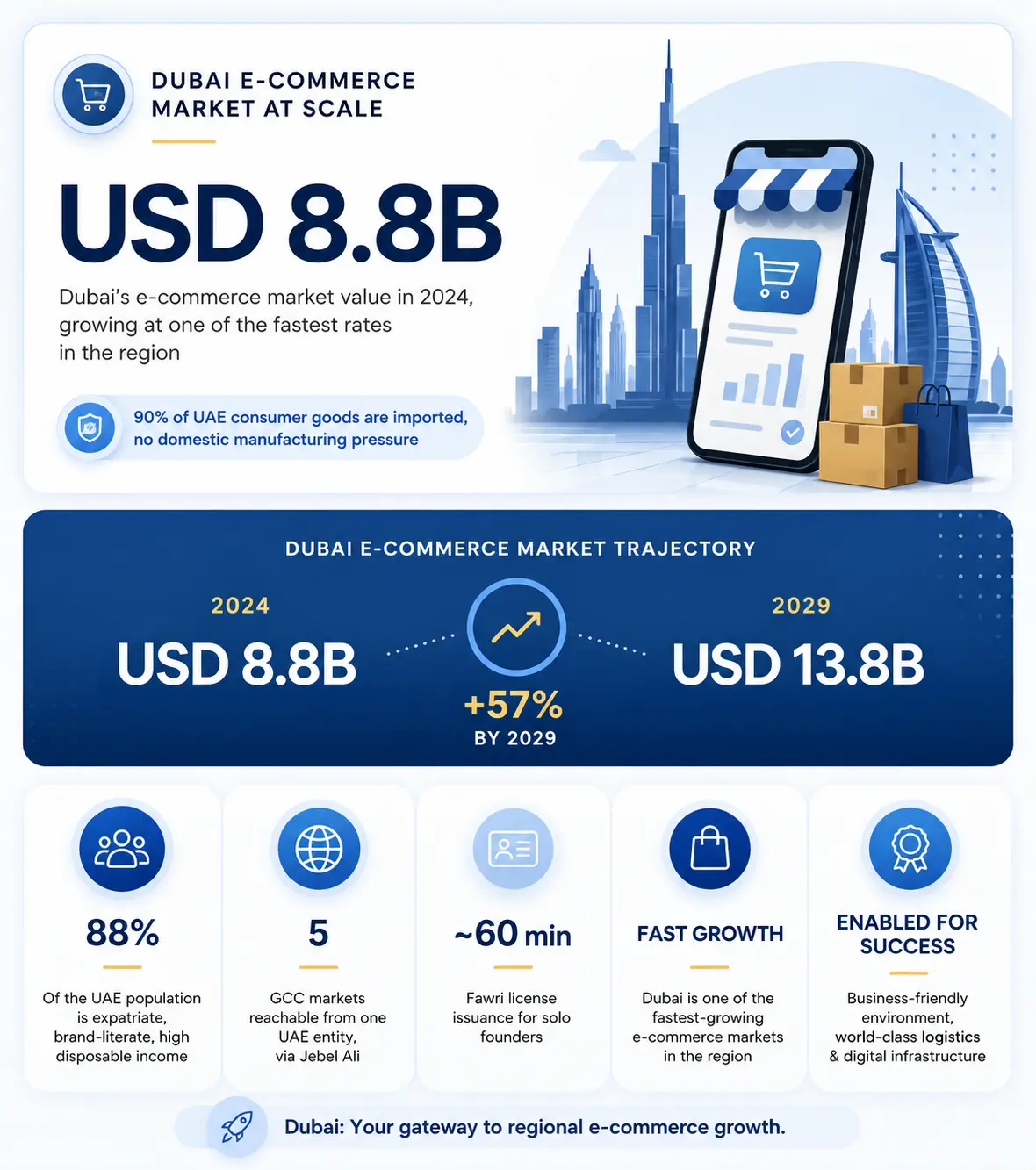
Source: Invest in Dubai, Dubai Department of Economy and Tourism, and Digital Commerce 360 UAE Market Report, via Digital Commerce 360
What an E-commerce License for UK Entrepreneurs in Dubai Covers
An e-commerce license in Dubai is not just permission to sell online. It is what allows you to operate as a legally recognised business, invoice customers, receive payments, and build relationships with suppliers and platforms at scale.
For UK entrepreneurs, this typically covers the ability to:
- Sell products through your own website or marketplaces like Amazon and Noon
- Import and export goods into and out of the UAE
- Run digital-first business models, including dropshipping and hybrid trading setups
- Issue invoices from a UAE-registered entity and transact in multiple currencies
The distinction matters. Without a licensed structure, you are limited to informal selling. With one, you are operating as a business that can plug into payment gateways, logistics providers, and regional supply chains.
In practical terms, it is the difference between testing an idea and building something that can scale.
The Setup Process: What to Expect
The process itself is structured, but it is far more streamlined than most UK founders expect.
It typically starts with selecting the right business activities. This step is more important than it seems, as your activity choice directly affects what you can sell, how you bank, and which platforms you can onboard to.
From there, you:
- Select Meydan Free Zone and confirm the e-commerce and trading activities required
- Reserve a trade name and submit incorporation documents
- Receive the license and begin the bank account application process
- Register with UAE platforms using the issued license
The key shift compared to the UK is speed and centralisation. You are not navigating multiple disconnected systems. The process is consolidated, and once your documents are in order, license issuance can move quickly.
What tends to slow founders down is not the system itself, but avoidable issues: mismatched activities, incomplete documentation, or unclear business models. Getting those right upfront keeps the process predictable.
Tax: What Changes and What Does Not
An e-commerce license for UK entrepreneurs in Dubai, held through a UAE free zone entity, carries a corporate tax position of 0% on qualifying income under the QFZP framework. The rate is 9% above AED 375,000 in taxable profits. There is no personal income tax. UAE VAT at 5% applies to domestic UAE sales; exports and re-exports are generally zero-rated.
The same HMRC caveats that apply to any UAE entity apply here. If the business is strategically managed from the UK - decisions made, contracts signed, operations directed from a UK address - HMRC may treat the entity as UK tax resident regardless of UAE incorporation.
An e-commerce business that operates its UAE entity genuinely from the UAE, with UAE-based management and operational substance, is in a different position to one that is registered in Dubai but run from a flat in Manchester.
UK-sourced income, including any revenue from UK-facing sales, UK-held inventory, or UK-registered platform accounts, remains within the UK tax perimeter regardless of where the company is incorporated.
Registering Through Meydan Free Zone
The entire Meydan Free Zone business setup process is digital. You can apply, submit documents, and receive your trade license without being in the UAE. For UK founders, that removes a layer of coordination that typically slows things down.
There is also flexibility in how you begin.
If you are starting lean, the Fawri pathway allows solo founders to receive a license in under 60 minutes. If your setup requires more flexibility from the outset, a regular license is typically issued within one working day once documents are complete and approved. In both cases, you are establishing a UAE entity that can operate commercially from day one - issuing invoices, working with suppliers, and onboarding onto platforms.
What tends to matter more is what comes next.
After incorporation, the focus shifts to getting your business operational. This includes setting up your bank account (Meydan Free Zone offers a guaranteed IBAN and has 26+ banking partners), connecting to payment systems, and preparing your storefront or marketplace presence.
For founders entering e-commerce specifically, there is also the option to use an Ecommerce Starter service priced at AED 1000. This is a structured add-on that supports initial marketplace onboarding, including setting up seller accounts on two platforms and listing one SKU on each. For founders unfamiliar with how marketplace onboarding works in the UAE, it can simplify the early stages and help avoid delays between setup and first transactions.
Founder Decision Logic
If you are running a product business in the UK with customers predominantly in the UK, a UAE entity does not automatically change your trading economics. It adds a compliance layer without addressing the core commercial challenge.
If your product has genuine cross-regional appeal, or if you are building distribution rather than defending existing UK market share, the UAE structure becomes commercially relevant. Access to Amazon.ae, Noon, and GCC re-export channels requires a UAE entity. Without one, those channels are inaccessible or intermediated.
If you are building a brand and want to position it in a market less susceptible to the race-to-the-bottom pricing dynamics of the UK, the UAE consumer profile is structurally different in your favour.
In Conclusion
An e-commerce license for UK entrepreneurs in Dubai is not a workaround for UK market pressure. It is an entry point to a different market with different structural characteristics - higher consumer purchasing power, lower platform saturation, direct access to a regional distribution network, and a tax environment that rewards qualifying activity genuinely conducted there.
The setup is faster and less complex than most UK founders expect. The HMRC exposure is real and needs professional advice to structure correctly. The market is there - but it rewards those who enter with an operational plan, not just a license.
Take the leap and start your UAE business setup
Footnotes
¹ UK Office for National Statistics, "Retail Sales, Great Britain: Internet Sales as a Percentage of Total Retail Sales," 2025.
² UAE Federal Competitiveness and Statistics Centre, 2025.
³ ecommercegermany.com, "European E-commerce Overview: United Kingdom," 2025.
⁴ Invest in Dubai and Dubai Department of Economy and Tourism, via Digital Commerce 360, "Dubai's E-commerce Market: USD 13 Billion by 2029," May 2025.
⁵ UN Food Systems Hub, "United Arab Emirates Food Systems Profile," 2025.