Table of Contents
Frequently Asked Questions
1. What license does a UK cybersecurity firm setup in the UAE need?
A professional services or technology consultancy license covers advisory, penetration testing, managed services consulting, and data protection work. No sector-specific cybersecurity regulatory license is required for these activities.
2. Is a free zone entity suitable for UK cybersecurity firm setup in the UAE?
Yes, for advisory, consultancy, and private sector managed services. If the firm intends to bid on UAE government contracts, a mainland DET-licensed entity may be required by the procurement process.
3. What is driving demand for cybersecurity services in the UAE?
Mandatory compliance with NESA Information Assurance Standards, Federal Decree-Law No. 45 of 2021 on Personal Data Protection, sector-specific regulatory frameworks, and the UAE National Cybersecurity Strategy 2025-2031. Ransomware attacks affected 73% of UAE organisations between 2021 and 2023, adding threat-driven spending on top of regulatory compliance.
4. What corporate tax applies to a UK cybersecurity firm setup in the UAE?
A free zone entity qualifying as a QFZP pays 0% corporate tax on qualifying income. The 9% rate applies above AED 375,000 on non-qualifying income. UK corporation tax may still apply if HMRC determines the entity is centrally managed from the UK.
5. Do UK cybersecurity certifications like CREST, CHECK, or ISO 27001 carry weight in the UAE?
Yes. UK certifications are recognised in the UAE market, particularly for financial services, healthcare, and multinational clients.
6. What is the difference between a free zone and mainland setup for a cybersecurity firm?
A free zone entity is suited to advisory, consulting, and private sector engagements with 100% foreign ownership and a fully digital setup. A mainland entity is needed for direct participation in UAE government procurement or for certain regulated activity categories. Most British firms start with a free zone structure.
7. How long does a UK cybersecurity firm setup in the UAE take?
A Fawri license issues digitally in under 60 minutes. The Regular license route completes within one working day.
Topic Summary
1. Rapid Digital Transformation in the UAE
The UAE's aggressive digitalization agenda, exemplified by initiatives such as Smart Dubai and the UAE National Innovation Strategy, fuels strong demand for advanced cybersecurity solutions, creating a substantial market opportunity for UK firms with proven expertise.
2. Growing Regulatory Focus on Cybersecurity
With the introduction of comprehensive data protection laws and cybersecurity regulations, including the UAE’s Information Assurance Standards and the DIFC Data Protection Law, the market requires specialist services in compliance and risk management, sectors where UK companies excel.
3. Government and Critical Infrastructure Security Investment
Significant UAE government investment in protecting critical infrastructure sectors—such as energy, transportation, and finance—opens avenues for UK cybersecurity providers specializing in industrial control systems security and threat intelligence.
4. Increasing Demand for Cybersecurity Talent and Training
The UAE’s evolving cybersecurity landscape is facing a skills shortage, mirroring global trends. UK firms can capitalize on this by offering advanced training programs, certification courses, and managed security services to bridge the talent gap.
5. Bilateral Trade Relations and Export Support
The strong economic ties and established export frameworks between the UK and the UAE, supported by government trade missions and cybersecurity partnerships, facilitate market entry and expansion opportunities for UK cybersecurity companies.
Opportunities For UK Cybersecurity Firms In The UAE Market
The UK is the third largest exporter of cybersecurity services worldwide.
The UK cybersecurity sector had a strong 2024 on paper. Per the UK Government's Cyber Growth Action Plan 2025, revenue grew 12% to £13.2 billion. The sector now employs around 67,300 full-time professionals across over 2,100 active firms.¹
But the domestic market is tightening. The UK Government's Cyber Security Skills in the UK Labour Market 2025 report shows core cyber job postings fell 33% between 2023 and 2024. It also found that 49% of UK businesses report basic cybersecurity skills gaps.² The competitive landscape is consolidating fast. Larger firms are absorbing the advisory and managed services work that independent specialists used to own.
The UAE is running a different trajectory. TechSci Research values the UAE cybersecurity market at USD 620 million in 2024. It projects growth to USD 1.29 billion by 2030, at a CAGR of 12.8%.³ The regulatory environment has been expanding since 2022. Managed security services are growing faster than the overall market. And Mordor Intelligence reports that 58% of UAE organisations face a cybersecurity skills shortage they cannot fill domestically.⁴
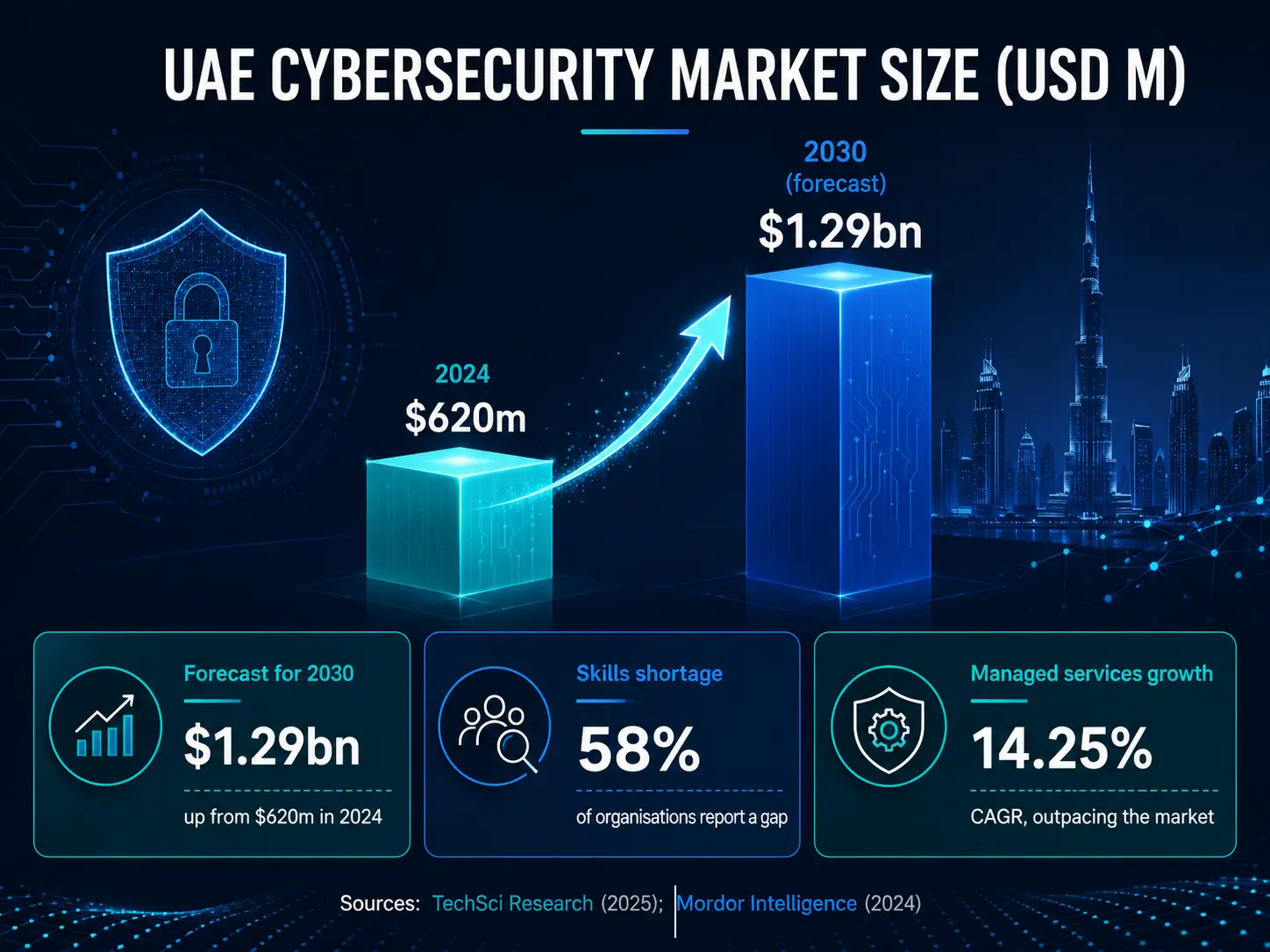
Sources: TechSci Research (2025); Mordor Intelligence (2026).
For a UK cybersecurity firm weighing international expansion, this is a commercially direct question with a specific answer.
Here is what the demand looks like, where it comes from, and what structure actually works.
What Is Driving UAE Cybersecurity Demand
The demand is regulatory before it is commercial.
The UAE has built a multi-layer compliance framework. It creates mandatory spending across every sector it touches:
- Federal Decree-Law No. 34 of 2021 on Combating Cybercrimes took effect in January 2022. It established the primary legal framework for cybersecurity obligations across the country.
- Federal Decree-Law No. 45 of 2021 on the Protection of Personal Data introduced GDPR-adjacent data protection obligations. The implementing regulations are still being developed. That creates ongoing advisory demand as organisations position for enforcement.
- The UAE Information Assurance Standards, developed by the National Electronic Security Authority, mandate 188 security controls. These apply to organisations in critical information infrastructure sectors. That spans financial services and healthcare through to utilities and transportation.
The UAE's National Cybersecurity Strategy 2025 to 2031 adds a government-led push. It targets zero-trust architecture, sovereign cloud adoption, and sector-specific compliance frameworks. The Abu Dhabi Media Office reports that Abu Dhabi's AED 13 billion Digital Strategy requires 100% sovereign cloud adoption for government services by 2027.⁵ Mordor Intelligence projects managed and professional services to grow at a CAGR of 14.25%. That outpaces the overall market.⁴
Threat volume has also risen. GlobeNewswire, carrying GlobalData research, reports that ransomware attacked 73% of UAE organisations in the period 2021 to 2023.⁶
Cybersecurity spend is not discretionary for most UAE enterprises. It is a compliance cost that has become a permanent line item.
[blockCTABizActivityList]
What UAE Organisations Are Buying
The demand concentrates in five areas. British firms have directly transferable capability in each.
[blockFaqsCategory]
How the UK and UAE Markets Compare
The client maturity point matters commercially. In the UK, a new entrant competes against established supplier lists and incumbent relationships. In the UAE, many organisations are building their first structured cybersecurity programme.
A British firm with ten years of GDPR and ISO 27001 delivery is genuinely useful in that context.
Setting Up a UK Cybersecurity Firm in UAE
A UK cybersecurity firm in the UAE operates under a professional services or technology consultancy license. There is no sector-specific cybersecurity license required for advisory, penetration testing, managed services consulting, or data protection work.
What changes the picture is the target client. Is the firm going after government and critical infrastructure contracts specifically? For those engagements, UAE Cybersecurity Council credentials and NESA-aligned certifications carry weight in procurement.
These are worth pursuing once the client base is established. They are not a prerequisite to entering the market.
The structural question is free zone versus mainland:
- Free zone suits advisory, consulting, remote managed services, and project-based engagements with private sector clients. It offers 100% foreign ownership and fully digital setup, with no physical visit required.
- Mainland is the right structure if the firm intends to bid directly on government entity contracts or join UAE public procurement. A mainland entity is often required there.
Most British cybersecurity firms start with a free zone structure. They serve private sector and multinational clients first. Then they pursue government procurement pathways later. That sequencing matches how client relationships actually develop.
Tax Treatment
A free zone entity qualifying as a QFZP pays 0% corporate tax on qualifying income. The 9% rate applies on non-qualifying income above AED 375,000. VAT at 5% applies on taxable UAE domestic supplies.
For UK founders, the same analysis applies here as for any UAE structure. HMRC's central management and control test matters. A Dubai-registered company whose decisions are made from the UK may be treated as a UK tax resident. That holds regardless of its registration address.
A UAE visa does not change HMRC's assessment.
The UK-UAE Double Taxation Agreement has been in force since 2016. It prevents double taxation where income is genuinely taxed in one jurisdiction. But it does not apply automatically. And it does not resolve contested residency. UK corporation tax sits at 25% for profitable companies above £250,000.
Setting Up Through Meydan Free Zone
Some UK cybersecurity firms work in advisory, managed services, or project-based engagements. For them, a free zone structure aligns with how delivery typically works. Meydan Free Zone provides the licensing layer to contract with UAE clients, invoice locally, and establish a compliant presence without relocating.
The setup is fully digital and passport-based. It comes with 100% foreign ownership and no physical visit required during incorporation. There is access to over 2,500 business activities across technology, consultancy, and professional services. That gives cybersecurity firms the flexibility to select activity codes that reflect their actual service model. Meydan Free Zone's guide to company setup in Dubai walks through the full process.
Banking is usually the most time-sensitive step. Retainers, audit fees, and managed service contracts need a reliable payment layer from the start. Meydan Free Zone's guaranteed IBAN pathway through one of 26+ banking partners supports this early.
The Fawri license starts from AED 15,000 and issues in under 60 minutes. The Regular license starts from AED 12,500. For founders building a team, mResidency handles investor and employee visas digitally. For ongoing tax and compliance obligations, mAccounting covers registration, filing, and bookkeeping as the business scales.
[blockCTABizSetup]
In Conclusion
The case for setting up in the UAE rests on a straightforward structural gap. The UAE market has 12.8% annual growth and 58% of organisations lacking adequate in-house skills. The UK domestic market has a compressed job market and intensifying competition for advisory mandates.
The firms that may struggle:
- Those that arrive expecting a direct replica of their UK client relationship model
- Those that attempt government procurement without the right credentials and a mainland entity
- Those that try to deliver remotely without a local entity. It rarely gets past procurement.
The firms that may benefit:
- Specialists with structured delivery methodology in GDPR, ISO 27001, penetration testing, or cloud security architecture
- Firms with existing multinational client relationships that have UAE regional offices
- Practices that can demonstrate compliance outcomes, not just technical capability
British credentials carry authority in this market. Most organisations are building formal compliance programmes for the first time. And the local talent pipeline cannot yet meet the volume of demand.
[blockCTACostCalculator]
Citations
¹ UK Government, "A UK Cyber Growth Action Plan: Final Report," 2025.
² UK Government, "Cyber Security Skills in the UK Labour Market 2025," 2025.
³ TechSci Research, "UAE Cyber Security Market," accessed 2026.
⁴ Mordor Intelligence, "UAE Cybersecurity Market," accessed 2026.
⁵ Abu Dhabi Media Office, "Abu Dhabi Government Launches Digital Strategy 2025-2027," 2025.
⁶ GlobeNewswire, "UAE Cyber Security Market Outlook Report 2025-2034," October 2025, carrying GlobalData research.
⁷ Fortinet, "2024 Cybersecurity Skills Gap Report," 2024.