Table of Contents
Frequently Asked Questions
1. What does it mean to set up a UK company in Dubai?
It means incorporating a new UAE legal entity - on the mainland or in a free zone - rather than relocating an existing UK company. Both entities have separate tax obligations.
2. Does setting up in Dubai remove my UK tax liability?
Not automatically. HMRC's central management and control test can make a Dubai-registered company a UK tax resident if its decisions are made from the UK. Personal residency depends on the Statutory Residence Test, not visa status.
3. What is the tax rate for a UAE free zone company?
0% on qualifying income under the QFZP framework, 9% above AED 375,000 in taxable profits. No personal income tax. VAT at 5% on domestic UAE supplies.
4. What is the UK-UAE Double Taxation Agreement?
A bilateral treaty in force since 2016 that prevents the same income being taxed in both jurisdictions. It requires a Tax Residency Certificate to apply and does not resolve contested company residency cases.
5. What is the difference between a free zone and mainland company in Dubai?
Free zone: 100% foreign ownership, suited to international trade and services, some restrictions on direct UAE mainland trade. Mainland: unrestricted UAE market access, also 100% foreign ownership for most activities since 2021.
6. How long does it take to set up a company in a Dubai free zone?
A Fawri license issues in under 60 minutes. The standard route completes within one working day. Banking setup typically takes two to six weeks.
7. What is the central management and control test?
HMRC's test for where a company's strategic decisions are made. If a Dubai company is directed from the UK, HMRC may treat it as UK tax resident regardless of where it is incorporated.
8. Do I need a UAE residence visa to run a Dubai company?
Not to incorporate. But to manage the company from the UAE and claim UAE tax residency, a visa and genuine operational presence become practically necessary.
Topic Summary
1. Select the Appropriate Business Structure
UK entrepreneurs must determine whether to establish their company in a Dubai Free Zone or on the Mainland. Free Zones offer full foreign ownership and tax advantages, while Mainland companies require a local sponsor but enable direct access to the UAE market.
2. Choose the Right Free Zone or Jurisdiction
Dubai hosts over 30 Free Zones, each catering to specific industries and activities. Entrepreneurs should select a Free Zone aligned with their business sector to benefit from tailored licensing, operational regulations, and incentives.
3. Obtain the Necessary Trade License
Securing the correct trade license - commercial, professional, or industrial - is essential. The license type depends on the nature of the services or products offered and dictates permissible business activities within Dubai.
4. Complete Registration and Incorporation Procedures
The registration process involves submitting required documentation, including passports, business plans, and proof of capital. This process varies between Free Zones and Mainland, with timeframes typically ranging from one to four weeks.
5. Open a Corporate Bank Account and Comply with Regulatory Requirements
Once incorporated, entrepreneurs must open a corporate bank account with a UAE-based financial institution to facilitate business transactions. Compliance with UAE laws, including anti-money laundering and economic substance regulations, is mandatory for ongoing operations.
How UK Entrepreneurs Can Set Up a Company In Dubai
A founder running a profitable services business in the UK watches their corporation tax bill reach 25% as profits cross £250,000. Employer National Insurance contributions hit 15% from April 2025. Dividend allowances have been cut to £500. The business is growing, but after taxes, the retained capital tells a different story.
This is not an unusual position. It is the structural reality of building a commercially successful company in the UK today. The decision to set up a UK company in Dubai is increasingly a response to that reality, not an escape from it, but a deliberate structural choice made by founders who understand the difference between where a business is registered and where the value from it can be retained.
Per the Dubai Chamber of Commerce¹, in 2024, 2,588 new British firms registered with the chamber, a 14.2% increase year-on-year. Per Bloomberg via Insurance Journal², over 240,000 British nationals already live and work in the UAE, forming one of the largest Western expat communities in the region. The reasons are practical and legible.
This guide covers what it actually means to set up a UK company in Dubai, where the risks sit, and what a founder needs to understand before making the decision.
UK entrepreneurs aren't just considering Dubai, they're moving in record numbers. Here is the scale of the 2024 inflow and the tax pressure behind it.
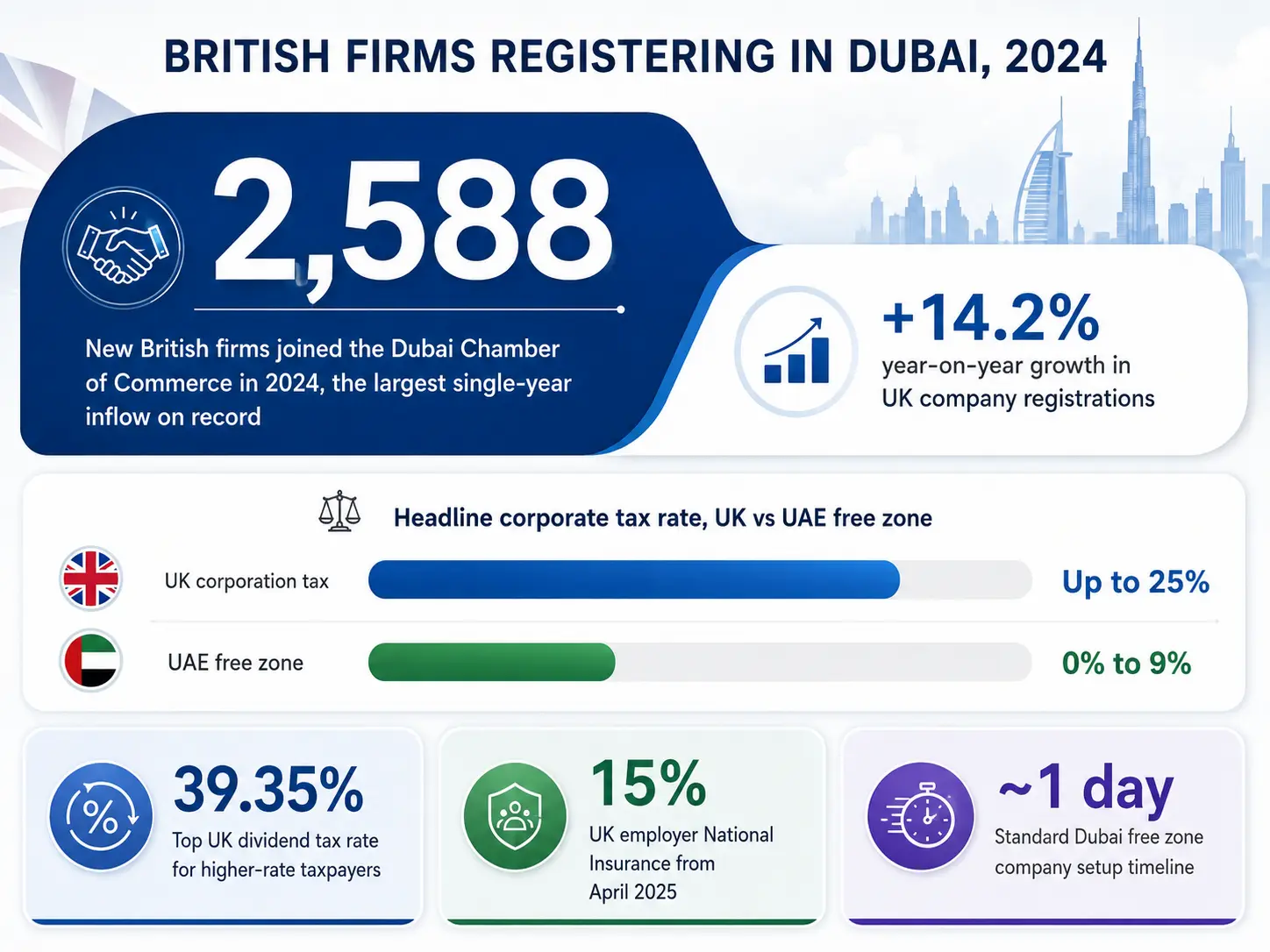
Source: Dubai Chamber of Commerce Foreign Member Companies Report 2024, HMRC Rates and Allowances 2025-26, and UAE Federal Tax Authority, via Dubai Chambers
Free Business Setup Cost Calculator
The UK Starting Point vs. Dubai
The UK tax environment is not hostile by global standards, but it has compressed in one direction consistently. The UAE offers a structurally different position. Here's how the two compare across the dimensions that matter most for UK founders:
For a founder extracting value from a growing business, the effective combined rate on retained profits and distributions in the UK can approach 50% or higher. The math is clear. What is less clear to many UK founders is how to structure the transition so that it actually applies to them. to many UK founders is how to structure the transition so that it actually applies to them.
What You Are Actually Setting Up in the UAE
To set up a UK company in Dubai, a founder is not relocating a UK legal entity. They are incorporating a new legal entity in the UAE - either on the mainland under the Department of Economy and Tourism, or within a free zone under that zone's own regulatory authority.
The practical differences matter.
A free zone entity allows 100% foreign ownership, a digital setup process, and suits service businesses, consulting, trading, and e-commerce. This structure is also commonly used by founders exploring British biscuits trading in Dubai, as it supports international sourcing, distribution, and re-export operations. It is generally the faster and lower-friction route for UK founders who are not primarily focused on direct retail trade with UAE consumers.
For example, founders launching a British sustainable fashion business in the UAE often choose a Free Zone because it supports international trading, e-commerce, and brand expansion without requiring a physical retail presence from day one.
Meydan Free Zone, for instance, covers over 2,500 business activities and allows founders to combine trading and professional service activities under a single business license.
A mainland entity allows unrestricted trade across the UAE market - with government entities, retail consumers, and commercial counterparties.
The right choice depends on how the business will operate: who it sells to, where its clients sit, and whether local trading rights matter from day one or only later.
The HM Revenue & Customs (HMRC) Risk Most Founders Get Wrong
Choosing to set up a UK company in Dubai does not automatically remove UK tax exposure. This is the point where enthusiasm meets legal reality, and it matters enough to address directly.
Under UK tax law, a company is considered a UK tax resident if it is incorporated in the UK or if its central management and control is exercised in the UK. That second test is what catches founders who incorporate in Dubai while continuing to make strategic decisions, sign contracts, and run board meetings from their home in Surrey.
If HMRC concludes that a Dubai-registered company is effectively managed from the UK, it can treat that company as a UK tax resident and subject its global profits to UK corporation tax. The 0% UAE rate then becomes irrelevant.
The UK-UAE Double Taxation Agreement, in force since 2016, provides relief where income is genuinely taxed in both jurisdictions, but it does not resolve a situation where the company's residency is contested. Founders who want the UAE tax position to apply need to ensure that the company's strategic decisions are genuinely being made in the UAE, not simply registered there.
For personal tax residency, HMRC's Statutory Residence Test determines whether a founder remains a UK tax resident based on days spent in the UK, UK ties including property and family, and the pattern of UK workdays. Holding a UAE visa does not automatically make a person non-UK resident.
Founders planning to relocate personally need to understand the SRT before structuring the transition.
Free Company Name Check
What the Business Setup Process Looks Like in the UAE
The mechanics of incorporating in a UAE free zone are genuinely straightforward for UK founders.
Passport-based registration, no requirement for physical presence in the early stages, and a fully digital process from name reservation to license issuance. The process is faster and less document-heavy than UK company formation in practice, not just in theory.
The main friction points come after incorporation:
- Banking is the most common early-stage bottleneck. UAE banks conduct thorough due diligence on new entities, particularly those with international ownership. Some decline applications from companies in early trading stages. A free zone with established banking partner relationships and an IBAN pathway built into the setup process makes a material difference to how quickly a company can begin operating.
- VAT registration becomes relevant once taxable UAE supplies exceed AED 375,000 annually. UK founders accustomed to UK VAT mechanics will find the framework broadly familiar, though the administrative touchpoints differ.
- Substance matters beyond compliance. A UAE entity that exists only on paper creates exposure under UAE economic substance regulations and under HMRC's central management and control analysis. Building genuine operational substance - even modestly at first - reduces both risk profiles simultaneously.
Tax: What Applies and What Does Not
UAE free zone companies qualifying under the QFZP framework pay 0% corporate tax on qualifying income.
The 9% rate applies on taxable income above AED 375,000. No personal income tax applies to UAE resident founders. VAT at 5% applies to taxable supplies within the UAE domestic market; exports are generally zero-rated.
The UK-UAE Double Taxation Agreement prevents the same income from being taxed twice where both jurisdictions have a legitimate claim - but claiming treaty relief requires a Tax Residency Certificate and proper documentation. It is not automatic.
UK-sourced income - rental income from UK property, dividends from UK companies, capital gains on UK assets - remains subject to UK tax regardless of UAE residency status.
Registering Through Meydan Free Zone
For UK founders looking to set up a UK company in Dubai through a free zone structure, Meydan Free Zone offers a fully digital incorporation process with 100% foreign ownership, passport-based registration, and no requirement for physical presence during setup.
The Fawri license is issued in under 60 minutes digitally. The standard license route is completed within one working day. Both include a guaranteed IBAN pathway through partner banks - directly addressing the banking bottleneck that slows down most international incorporations.
Founders can read more about why an FZ LLC structure works for international founders before committing to the setup.
Founder Decision Logic
If your business is predominantly UK-facing - UK clients, UK employees, decisions made in the UK - setting up a UAE entity does not automatically change your tax position.
HM Revenue & Customs (HMRC) looks at where the company is run, not where it is registered.
If you have genuine international clients, a remote-first model, or the ability to exercise strategic management outside the UK, the UAE structure can legitimately shift the arithmetic. The 0% rate on qualifying free zone income is real. It requires a real UAE operation to apply to.
If personal relocation is part of the plan, UK residency exit requires satisfying HMRC's Statutory Residence Test - a year-level planning exercise that turns on days, ties, and timing, not just intent.
In Conclusion
The decision to set up a UK company in Dubai is commercially rational for the right founder profile.
The tax differential is real, the setup process is faster than most expect, and the commercial reach from a Dubai base is structurally different from operating solely from the UK.
But HMRC's central management and control test does not care where a company is registered. The Statutory Residence Test does not care about UAE visa status. These are reasons to approach the decision properly, with a qualified cross-border tax adviser involved before the first document is signed.
Structure reduces friction. Discipline determines outcome.
If you are ready to explore what a UAE free zone entity looks like in practice, read our guide on free zone vs mainland company formation or speak to the Meydan Free Zone team directly.
Ready to Launch Your Business in Dubai?
Citations
¹ Dubai Chamber of Commerce, "Iraq, Türkiye, and the United Kingdom Record Highest Growth in New Foreign Member Companies Joining Dubai Chamber of Commerce in 2024," 2024.
² Bloomberg, via Insurance Journal, "The Luxury Life of British Expats in Dubai Faces a Reality Check," March 2026.