
Table of Contents
Frequently Asked Questions
What is dropshipping and how does it work in the UAE
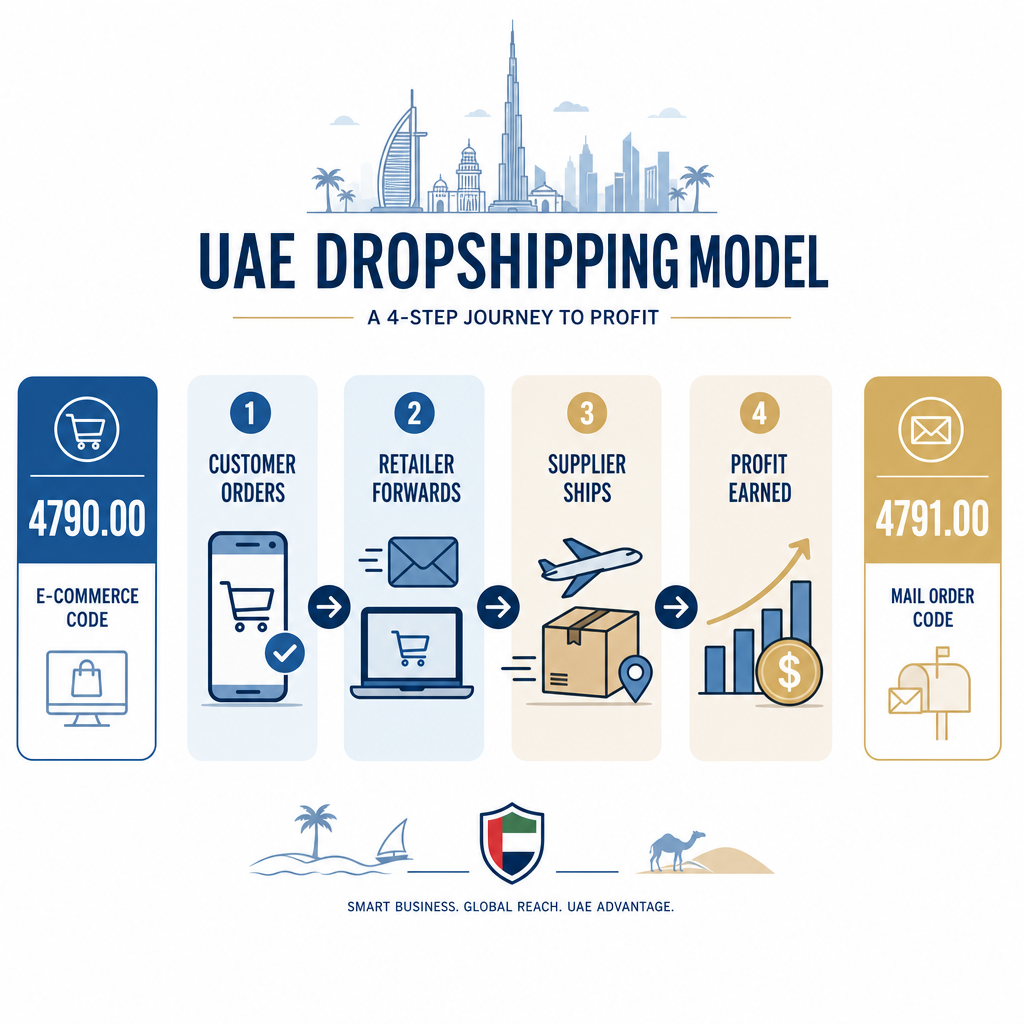
Dropshipping is a retail model where you sell products without ever holding stock yourself. You run the online store, a supplier warehouses the goods, and when a customer places an order you forward the details to the supplier who ships directly to the buyer. Your profit is the margin between the supplier's price and your selling price.
In the UAE, this model is particularly attractive because it removes the two biggest barriers for new retailers: inventory costs and warehousing. What remains is marketing and customer service, which is where the real work lies.
Which activity codes cover dropshipping at Meydan Free Zone
Three activity codes cover dropshipping businesses at Meydan Free Zone: 4790.00 (E-Commerce), 4791.00 (Retail sale via mail order houses or via the Internet), and 4799.00 (Other retail sale not in stores, stalls or markets).
Each code is suited to a slightly different selling method. Code 4790.00 covers broad online retail including door-to-door and vending machines. Code 4791.00 covers catalogue, advertisement, and internet-based selling. Code 4799.00 is a catch-all for non-store selling including direct sales agents and vending machines.
Which dropshipping activity code requires third-party approval
Only code 4790.00 (E-Commerce) requires a third-party approval, and this approval comes after your license is issued by Meydan Free Zone, not before.
The approving authority is either the Public Health Department at Dubai Municipality or the Roads and Transport Authority, depending on your specific business activities. Codes 4791.00 and 4799.00 require no third-party approval at all.
What does activity code 4791.00 cover for dropshippers
Code 4791.00 covers retail selling where the customer purchases based on an advertisement, catalogue, website, or similar medium. Orders arrive by mail or online, you pass them to your supplier, and the supplier ships directly to the customer.
This code also includes direct sales through television, radio, and telephone, as well as internet retail auctions. Importantly, no third-party approval is required for this code, making it a straightforward option for many dropshipping operations.
What does activity code 4799.00 cover and what does it exclude
Code 4799.00 is the catch-all for retail selling that falls outside the other two codes. It covers direct and door-to-door selling by salespeople who take orders and forward them to a supplier, sales through vending machines, non-store auctions, and retail selling by non-store commission agents.
There is one important exclusion: this code does not apply to delivery of products by a traditional bricks-and-mortar store. If there is a physical shop behind the operation, code 4799.00 is not the right choice. Like 4791.00, it requires no third-party approval.
Are dropshipping businesses in the UAE subject to anti-money laundering requirements
All three dropshipping activity codes available at Meydan Free Zone — 4790.00, 4791.00, and 4799.00 — are exempt from anti-money laundering obligations under the current framework.
This is a notable advantage for entrepreneurs setting up a dropshipping operation, as it reduces the compliance burden compared with some other business activities in the region.
How large is the dropshipping market and what is the UAE e-commerce opportunity
The global dropshipping market was valued at over USD 225 billion in 2022 and is growing at more than 23% per year through 2030, making it one of the fastest-expanding segments in retail.
Within the UAE specifically, e-commerce revenues are expected to exceed USD 8 billion by 2025. Combined with internet penetration above 99% and zero personal income tax, the UAE offers a compelling environment for dropshipping businesses targeting both domestic and international customers.
Who can a UAE-based dropshipping business sell to
A UAE-based dropshipping business can sell to customers virtually anywhere in the world. Dubai's geographic position between major markets, its world-class logistics infrastructure, and near-universal internet penetration at home make it an ideal hub for reaching the GCC, Europe, Asia, and beyond.
Because the domestic UAE market is relatively small, most operators end up selling outward rather than focusing solely on local customers. You can source from global suppliers and fulfil orders internationally without holding a warehouse in any of those markets.
Topic Summary
What Dropshipping Actually Means for You
Dropshipping lets you sell products without ever handling stock — your supplier stores and ships goods directly to customers. Your job is marketing and customer service, while you pocket the difference between supplier cost and your sale price.
Three Activity Codes Cover Dropshipping in Dubai
Meydan Free Zone recognises dropshipping under codes 4790.00, 4791.00, and 4799.00, each suited to a slightly different selling method. Choosing the right one upfront saves complications later, so map your sales model before you apply.
Only One Code Requires Outside Approval
Code 4790.00 (E-Commerce) is the only dropshipping code that needs a third-party approval, issued after your license by Dubai Municipality's Public Health Department or the Roads and Transport Authority. Codes 4791.00 and 4799.00 carry no such requirement.
Code 4791.00 Covers Catalogue and Internet Sales
This code is designed for sellers who take orders through advertisements, websites, catalogues, TV, radio, or phone, then pass them to a supplier for direct shipping. No third-party approval is needed, making it a straightforward option for many online retailers.
Code 4799.00 Is the Catch-All Non-Store Option
This code covers door-to-door selling, vending machines, non-store auctions, and commission agents — any retail that falls outside a physical shop or the other two codes. One important exclusion: it does not apply if a traditional bricks-and-mortar store is behind the operation.
Dubai's Market Reach Goes Far Beyond the UAE
With internet penetration above 99% and world-class logistics infrastructure, Dubai-based dropshippers can sell across the GCC, Europe, Asia, and beyond without holding a single warehouse. Most operators end up selling outward rather than focusing on the domestic market alone.
The Global Dropshipping Market Is Growing Fast
The global dropshipping market was valued at over USD 225 billion in 2022 and is growing at more than 23% annually through 2030. UAE e-commerce revenues alone are expected to surpass USD 8 billion by 2025, and there is zero personal income tax to eat into your margins.
Dropshipping in Dubai: The Business Model
Dropshipping means selling products you never touch. You run the shop, a supplier holds the stock, and when an order comes in you pass the details on and the supplier ships straight to your customer. You make your money on the difference between what the supplier charges and what you sell for.
That removes the two things that usually sink a new retailer: inventory and warehousing. What it leaves you with is marketing and customer service, which is where the work actually is. Three activity codes cover this at Meydan Free Zone, and only one of them needs an outside approval.
Key Stats at a Glance
| Activity codes | Three: 4790.00, 4791.00 and 4799.00 |
|---|---|
| Approval needed | Code 4790.00 only, after your license is issued |
| Who approves it | Public Health Department at Dubai Municipality, or the Roads and Transport Authority |
| Approval for the other two codes | None |
| Anti-money laundering | All three codes are exempt |
| Global dropshipping market | Valued at over USD 225 billion in 2022, growing at more than 23% a year through 2030 |
| UAE e-commerce | Revenues expected to pass USD 8 billion by 2025 |
| Internet penetration | Over 99% |
| Personal income tax | Zero |
The Three Activity Codes
| Code | Activity name | Best fit for |
|---|---|---|
| 4790.00 | E-Commerce | Running an online store where customers browse and buy |
| 4791.00 | Retail sale via mail order houses or via the Internet | Selling from advertisements, catalogues and websites, including TV, radio and phone |
| 4799.00 | Other retail sale not in stores, stalls or markets | Direct and door-to-door selling, vending machines, non-store auctions and commission agents |
What Each Code Covers
E-commerce, code 4790.00
This covers retail selling through several channels: mail order houses, the internet, door-to-door and vending machines. Dropshipping is one method inside that. You run the store, customers browse and buy, and your supplier handles the stock and ships direct. This is the code that lets you offer a wide catalogue without owning any of it.
It is also the only one of the three with an approval attached. After Meydan Free Zone issues your license you need third-party approval from the Public Health Department at Dubai Municipality or the Roads and Transport Authority. That comes after the license, not before.
Retail sale via mail order houses or via the internet, code 4791.00
This covers selling where the customer buys on the strength of an advertisement, a catalogue, a website or similar. The order comes in by mail or online, you pass it to the supplier, the supplier ships. It also takes in direct sales by television, radio and telephone, plus internet retail auctions. No third-party approval applies.
Other retail sale not in stores, stalls or markets, code 4799.00
This is the catch-all for selling that happens outside the other two. Direct or door-to-door selling by salespeople who take orders and forward them to a supplier. Sales through vending machines. Non-store auctions, and retail selling by non-store commission agents. No third-party approval applies.
One exclusion worth knowing: this code does not cover delivery of products by a traditional bricks and mortar store. If there is a physical shop behind the operation, this is not your code.
Who Your Clients Will Be
Your customers are wherever you can reach them, which is the real advantage of basing this in Dubai. You can source from global suppliers and sell across the GCC, Europe, Asia and beyond without holding a warehouse anywhere.
That reach comes from three things: the UAE's position between those markets, its logistics infrastructure, and internet penetration above 99% at home. The domestic market is small compared with what you can reach from here, so most operators end up selling outward rather than only inward.
Free Business Setup Cost Calculator
Calculate NowStep by Step Setup Guide
- Step 1, pick your codes: Work out how you will actually sell before you choose. Purely online, mail order, through agents, or unconventional channels each point to a different code, and the approval that follows differs too.
- Step 2, check the wider activity list: Make sure your license covers all the retail and e-commerce activity you plan, rather than discovering a gap after you launch.
- Step 3, price the setup: Use the cost calculator to work out your first year number.
- Step 4, apply for your license: Remote setup means you can launch without being in Dubai, and Fawri speeds up licensing and payment processing.
- Step 5, sort your approval if you took 4790.00: That one comes after the license is issued. The other two codes need nothing.
Compliance and What You Need in Place
Approval, but only for one code
Code 4790.00 needs post-license approval from Dubai Municipality's Public Health Department or the RTA. Codes 4791.00 and 4799.00 need none. Choosing your code carelessly means either an approval you did not expect or a license that does not cover how you sell.
Anti-money laundering
All three codes are exempt from AML rules. That exemption applies to the activity file and nothing else, so keep clean books from your first sale.
Consumer protection
UAE e-commerce law obliges online retailers to give clear product descriptions, transparent pricing and accessible return and refund policies. According to the Ministry of Economy, consumer protection regulations apply to all online retail transactions conducted within the UAE. This is not just a legal box. In a business where customers cannot handle the goods before buying, a visible returns policy is what gets the first order placed.
Your suppliers are your operation
You do not control the warehouse or the shipping, but your customer holds you responsible for both. Vet suppliers properly on product quality, shipping times and returns handling before you list anything of theirs.
Currency
The dirham is pegged to the US dollar, but if you source internationally you still carry currency risk on the supplier side. Multi-currency payment tools and negotiated supplier terms both help protect the margin.
Market Opportunity
The numbers behind this model are large and still moving. According to Mordor Intelligence, the global dropshipping market was valued at over USD 225 billion in 2022 and is projected to grow at more than 23% a year through 2030. UAE e-commerce revenues were expected to pass USD 8 billion by 2025, on the back of internet penetration above 99%.
What makes Dubai work specifically is the combination of reach and cost. You get access to GCC, European and Asian customers from one base, no personal income tax, and free zone licensing that does not demand a warehouse. For a model whose whole appeal is low fixed cost, that matters more than it would for a conventional retailer.
The honest difficulty is differentiation. You are selling products that other retailers can list too, often from the same suppliers, so nothing about the product itself sets you apart. What does is brand, search visibility and paid social. Dubai's high social media usage, particularly on Instagram, TikTok and Snapchat, gives you large addressable audiences for targeted campaigns, which is where most successful operators put their money instead of into stock.
Key Takeaways
- Dropshipping lets you sell without holding inventory, with suppliers storing and shipping direct to your customer
- Three codes apply: 4790.00 E-Commerce, 4791.00 retail via mail order or internet, and 4799.00 other non-store retail
- Only 4790.00 carries a third-party approval, from Dubai Municipality's Public Health Department or the RTA, and it comes after your license
- All three codes are exempt from AML rules
- Pick the code that matches how you actually sell, because it decides both your approval and your permitted channels
- Success rests on supplier quality, digital marketing, compliance with UAE consumer protection law, and payment processing that works
In Conclusion
Dropshipping suits Dubai well. The reach is real, the tax position is favourable, and the licensing does not ask you to fund a warehouse before you have proved anything.
The decision that matters is which of the three codes matches your selling channels, because that choice sets your approval path. Get it right at the start rather than amending later.
Two things then decide how it goes: suppliers you can rely on, and marketing good enough to make you the one customers buy from rather than the next shop selling the same item.
Ready to Launch Your Business in Dubai?
Let's ConnectReferences
- Roads and Transport Authority (rta.ae)
- internet penetration above 99% (dsc.gov.ae)
- Ministry of Economy (u.ae)
- dirham is pegged to the US dollar (centralbank.ae)
- Mordor Intelligence (mordorintelligence.com)