Table of Contents
Topic Summary
Two Activity Codes Cover All Film Work
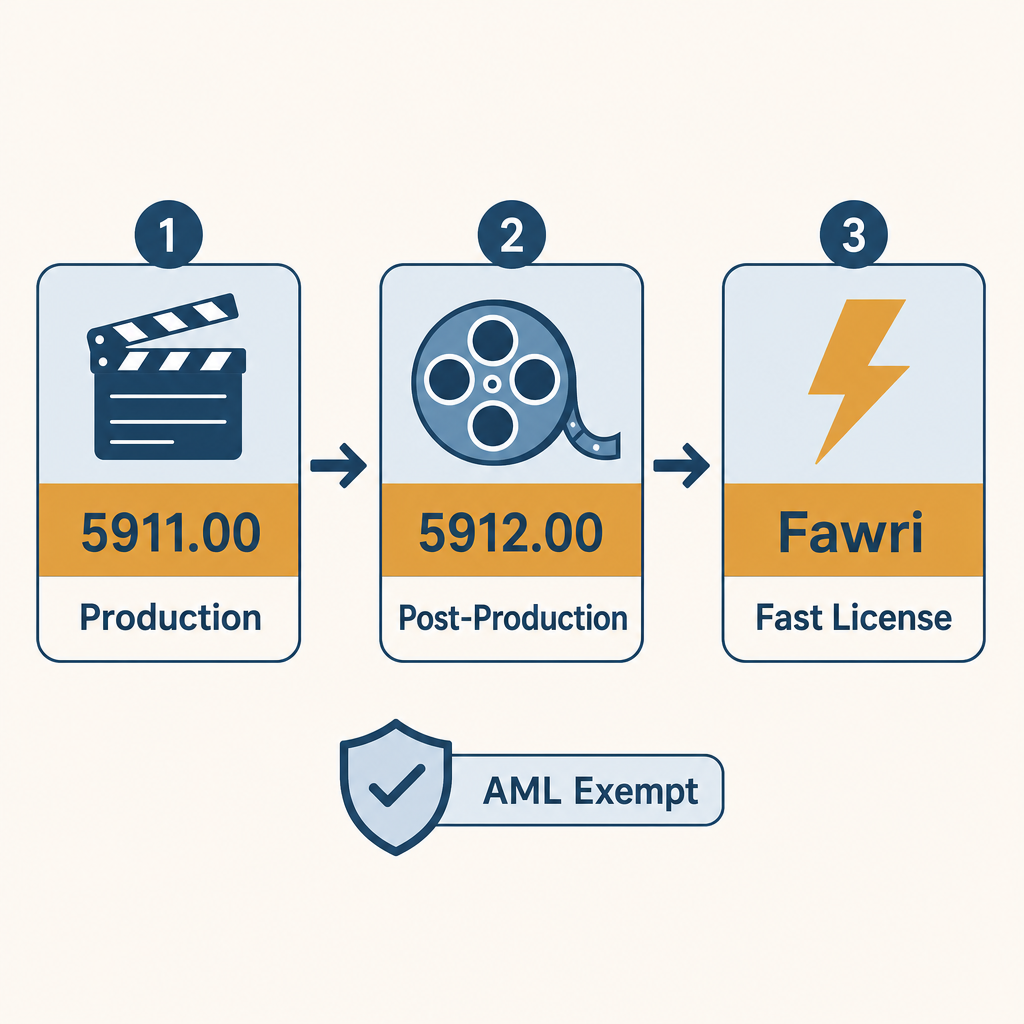
Code 5911.00 handles production tasks like scripting, casting, filming, and directing, while 5912.00 covers post-production work including editing, animation, subtitling, and stock footage libraries. Most firms hold one code and subcontract the other to keep overheads lean.
Ministry Approval Is a Must After Licensing
Both activity codes require sign-off from the Ministry of Culture and Youth after your license is issued. Factor this approval step into your timeline before committing to any client delivery dates.
Pre-Production Determines Whether Projects Profit
Pre-production turns a creative idea into a costed, scheduled plan covering scripts, storyboards, permits, locations, crew, and insurance. Skipping or rushing this phase is the single most common reason shoots run over budget.
Dubai Attracts Post-Production Work From Abroad
Productions shot elsewhere increasingly finish in Dubai, drawn by competitive costs compared to Western markets, a time zone that bridges Europe and Asia in one working day, and strong existing technical infrastructure. This gives post-production firms a client base well beyond the local market.
A Fast-Growing Global Market Backs the Opportunity
The global film production market exceeded USD 90 billion in 2023 and is projected to surpass USD 130 billion by 2030. The post-production segment alone is growing at around 7% a year through 2028.
Meydan Free Zone Offers 100% Foreign Ownership
Setting up in Meydan Free Zone allows full foreign ownership with no local partner requirement. Both production codes are also exempt from anti-money laundering obligations, and VAT only applies once taxable turnover exceeds AED 375,000 annually.
Know What Each License Explicitly Excludes
Code 5911.00 does not cover broadcasting, sound recording, or individuals acting in a personal capacity as directors or technicians. Code 5912.00 excludes tape or DVD duplication from masters, retail of recorded media, and film processing unrelated to the motion picture industry.
Setup Film Production And Pre-Production Business in Dubai with Meydan Free Zone
Film production covers everything from a first script note to a finished master file. Two activity codes carry that work in Dubai: 5911.00 for production and 5912.00 for post-production. Most firms hold one and subcontract the other.
This guide covers what each code lets you do, why pre-production decides whether a project makes money, how post-production has changed, and how to set up. Both codes need sign-off from the Ministry of Culture and Youth after your license is issued, so plan for that before you promise a delivery date.
Key Stats at a Glance
What This License Covers
Code 5911.00 is the production code. It covers planning, scripting, casting, filming, directing and producing motion pictures, videos, television programmes and commercials, across formats that run wide: feature films, shorts, television series, reality programming, branded content, music videos, corporate video and content made for streaming platforms. It does not cover film duplicating, wholesale or retail of recorded media, sound recording, building a full television channel schedule, broadcasting, or the work of individual actors, directors and technical specialists acting for themselves.
Code 5912.00 is the post-production code. It covers editing, titling, subtitling, credits, closed captioning, computer-generated graphics, animation and effects. It also covers motion picture film laboratories, animated film laboratories, and running stock footage libraries. It excludes duplicating outside theatrical distribution, reproducing tapes, CDs or DVDs from masters, retail of recorded media, and film processing unrelated to the motion picture industry.
If your business spans retail, distribution, photography or live arts as well, those sit under separate codes covered in the wider entertainment and media guide.
Why Pre-Production Decides the Budget
Pre-production is where a creative idea becomes a plan someone can cost. It covers script and screenplay development, storyboards, assembling the crew, casting, scouting and securing locations, arranging permits and insurance, building sets, sourcing props and costumes, and setting the budget and schedule.
Done properly it cuts the risk of delays and overruns once the camera rolls. Done badly it is the single most common reason a shoot runs over. Clients who have been burned once will ask about your pre-production process before they ask about your rate.
Who Your Clients Will Be
Your buyers are broadcasters, streaming platforms, ad agencies, corporate marketing teams and other production houses that need a local partner. Regional streaming services commission alongside the global platforms, which widens the field.
On the post-production side the client list is different. Work often arrives from productions shot elsewhere and finished here, drawn by cost against major Western markets, a time zone that reaches both Europe and Asia in one working day, and the technical kit already installed in the city.
Money comes as project fees, retainers for ongoing content, and rights income where you hold something that keeps earning.
Mainland or Free Zone
Project work that crosses borders usually points to a free zone license, because full ownership and clean profit repatriation matter more than local walk-in trade. A mainland license from the Department of Economy and Tourism makes more sense if most of your billing will be to UAE government bodies. Let your clients decide it, not the price.
[blockCTACostCalculator]
Step by Step Setup Guide
- Step 1, pick your code: Production, post-production, or both. Adding the second code later costs more than adding it now, so decide up front.
- Step 2, book your trade name: Use DET e-Services for a mainland company, or the Meydan Free Zone portal for a free zone one.
- Step 3, send in your setup documents: Passport copies for every shareholder and director, plus a short description of the activity.
- Step 4, get the trade license: This is your commercial approval, and it is not the last step for either code.
- Step 5, apply to the Ministry of Culture and Youth: Both 5911.00 and 5912.00 need this sign-off once the license is issued.
- Step 6, sort project permits separately: The company license and a filming permit are two different things. Permits are applied for per shoot.
- Step 7, open a bank account and register for VAT: Banks want a valid trade license and your compliance papers. Register with the Federal Tax Authority once the turnover threshold applies.
Meydan Free Zone supports remote setup for these codes, so founders outside the UAE can clear the first stage without flying to Dubai.
Compliance and What You Need in Place
Ministry of Culture and Youth
Approval comes after the license for both codes. Do not commit to a client delivery date that assumes it is already in hand.
Filming permits
Shoots in Dubai need a permit from the Dubai Film and TV Commission for each project. A company based outside the UAE has to apply through a locally licensed partner, which is one practical reason international producers set up here.
Content standards
Work made for or shown to UAE audiences has to meet national content standards. Build the review into your schedule rather than finding out at delivery.
Anti-money laundering
Both codes are exempt from anti-money laundering registration, which takes one compliance layer off the setup.
VAT and books
Register for VAT with the Federal Tax Authority once taxable turnover passes AED 375,000 a year. Project billing is lumpy, so watch the rolling total rather than a single month.
Staff and freelancers
If you hire in the UAE, MOHRE rules apply from your first employee. Crew engaged per project still needs the right permits, so check status before the call sheet goes out.
Market Opportunity
The global film production market was worth more than USD 90 billion in 2023 and is projected to pass USD 130 billion by 2030, pushed by streaming, digital consumption and international co-productions. Post-production is growing at around 7% a year through 2028, because every hour of content shot has to be finished by someone.
Dubai sells a specific advantage. Ultramodern architecture, desert, historic districts and coastline sit within driving distance of each other, so a production gets four looks without four border crossings. Add studio facilities, a working logistics network and a growing local crew base, and the pitch holds up.
The gap worth aiming at is the handover. Most firms do production or post-production. Carrying a project from shoot to delivered master without subcontracting the middle removes the point where schedules usually slip, and clients pay for that.
Conclusion
Production and post-production are two codes, two skill sets and two client lists, and there is a real argument for holding both. Setup is light, ownership is full in a free zone, and neither code carries anti-money laundering registration.
The thing that catches people out is sequence. The trade license is not the finish line, the Ministry approval follows it, and filming permits are separate again and apply per project.
Get the code right, start the Ministry approval early, and treat permits as part of every project budget. The rest is routine.
[blockCTAContact]