Table of Contents
Frequently Asked Questions
What licences are required to open a dental clinic in Dubai
Opening a dental clinic in Dubai requires satisfying two separate regulatory tracks simultaneously. First, you need a trade licence from a mainland authority or a free zone such as Meydan, with the correct business activity code — 8620.8 for dental surgery — listed on the application.
Second, you must obtain a Dubai Health Authority (DHA) facility licence, which authorises the physical premises to operate as a clinical environment. This involves physical inspection of the clinic, verification of equipment, infection control protocols, and waste disposal procedures. Neither licence substitutes for the other, and both must be valid before any patient is treated.
Do all dental practitioners need individual DHA licences
Yes. Every clinical professional working in a Dubai dental clinic — including dentists, dental surgeons, hygienists, and clinical support staff — must hold an individual DHA professional licence. This is separate from the facility licence that covers the premises.
Obtaining an individual licence typically involves credential verification, an examination where applicable, and submission of good standing certificates from any prior jurisdiction where the practitioner has worked. Practitioners cannot legally treat patients until their personal licence is issued and current.
What physical standards must a dental clinic meet to pass DHA inspection
The DHA prescribes detailed facility standards that are non-negotiable. These include minimum room dimensions, sterilisation unit specifications, X-ray shielding requirements, and mandatory contracts for medical waste disposal.
Infection control protocols and equipment verification are also assessed during the physical inspection. A fit-out that does not meet these prescribed standards will not pass inspection, meaning the clinic cannot open until all deficiencies are corrected and a re-inspection is passed.
Can a foreign national own 100% of a dental clinic in Dubai
Yes, through certain structures. Establishing your clinic via a free zone such as Meydan Free Zone allows 100% foreign ownership, full repatriation of profits, and no corporate tax on qualifying income. This makes it a popular route for international founders and healthcare groups entering the Dubai market.
Free zones accommodate healthcare and medical services under their activity classifications, though the DHA facility licence and all clinical regulatory requirements still apply regardless of the ownership structure chosen.
What rules apply to controlled substances and anaesthetics in a dental clinic
Clinics that dispense or administer anaesthetics, sedatives, or other scheduled drugs must obtain specific approvals beyond the standard DHA facility licence. These approvals are governed by Ministry of Health and Prevention (MOHAP) regulations.
All controlled substance procurement and usage must align with MOHAP requirements, and clinics are required to maintain fully auditable records of any controlled substances held or administered. Failure to comply with these rules is treated as a serious regulatory breach.
How large is the dental market in Dubai and what is driving its growth
The UAE healthcare market was valued at approximately USD 21 billion in 2023, with dental services accounting for a meaningful share of private clinic revenue. The dental segment is estimated to grow at a CAGR of 7–9% through 2028, according to IMARC Group.
Key demand drivers include a large expatriate population — representing roughly 88–90% of Dubai's residents — rising disposable incomes, and strong appetite for cosmetic procedures such as veneers, implants, and orthodontics. Dental tourism from Europe, CIS countries, and the broader GCC adds a further demand layer, with patients attracted by competitive pricing and internationally trained practitioners.
Which dental specialisms offer the strongest commercial opportunity in Dubai
Cosmetic dentistry is identified as a particularly strong growth segment in Dubai's private dental market. Treatments such as veneers, dental implants, and orthodontics are increasingly treated by patients across the Gulf as routine expenditure rather than elective luxury.
Complex restorative procedures also attract medical tourists from Europe, CIS countries, and other GCC states who travel specifically for high-quality dental work at prices that remain competitive relative to Western markets. Clinics that can offer these specialisms with internationally credentialled practitioners are well positioned to capture both resident and tourist demand.
What is the difference between a trade licence and a DHA facility licence for a dental clinic
These are two distinct approvals issued by different authorities and serve different purposes. The trade licence is obtained through a free zone or mainland authority and establishes the legal commercial entity. It must accurately list the correct business activity — activity code 8620.8 for dental surgery — to be valid for clinical operations.
The DHA facility licence is issued separately by the Dubai Health Authority and specifically authorises the physical premises to function as a clinical environment. Both licences must be current and valid at all times; holding one does not satisfy the requirement for the other, and treating patients without both in place constitutes a regulatory violation.
How to Open a Dental Surgery Clinic in Dubai
Dubai's dental sector is growing fast. A large expatriate population, rising incomes and a government that courts medical tourism all push demand up. The opportunity is real, and so is the regulatory work behind it.
This guide covers the two licenses you need, who issues them, and the order to do things in. It does not pretend the process is quick, but it tells you what to expect.
Key Stats at a Glance
What This License Covers
The Dubai Health Authority regulates every health facility in Dubai, dental clinics included. It sets the rules on premises, staff, equipment and ongoing compliance, and nothing opens without its approval.
Two licenses, not one
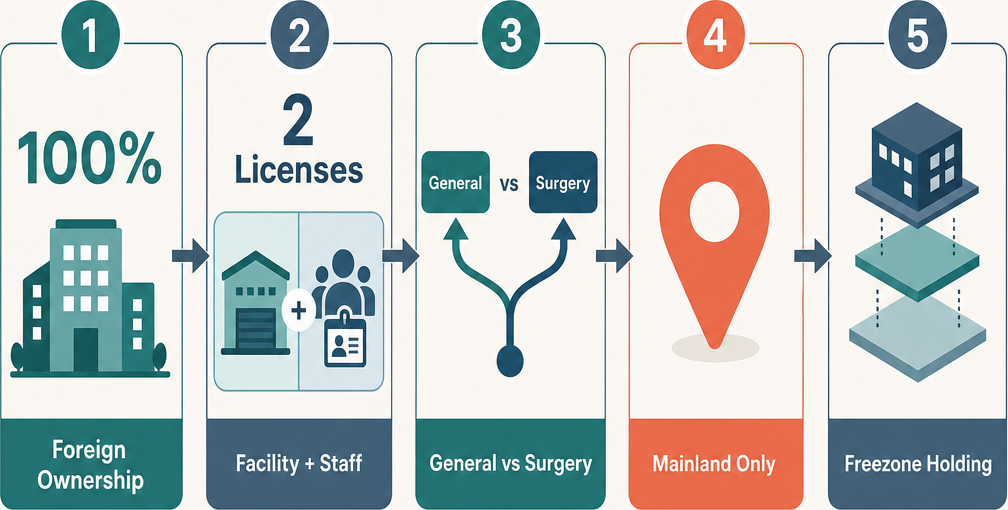
The trade license creates the company and carries activity code 8620.8. The DHA facility license authorises the premises to work as a clinical space. Different authorities, applications and timelines. Holding one does nothing for the other, and treating a patient without both is a breach.
General clinic or dental surgery
A general dental clinic license covers routine work: fillings, extractions, scaling. A dental surgery license, sometimes called a day surgery facility, covers complex procedures under sedation or general anaesthetic. They are not interchangeable, and the wrong one costs time and money.
Facility category shapes what you can do
A general dentistry facility cannot carry out specialist surgery. If implantology, oral surgery or sedation is in your plan, the category must reflect that from the start. Changing it later means a fresh application.
Who Your Clients Will Be
Insured residents
Most employed residents carry employer-provided cover and prefer in-network clinics. Registering with major insurers such as Daman and AXA drives your volume. It is separate from DHA licensing and takes time, so start before you open. Without panel access you compete for self-pay patients only.
Cosmetic and elective patients
Veneers, implants and orthodontics are now treated across the Gulf as normal spending rather than luxury, and this is the strongest growth segment in private practice.
Medical tourists
Patients travel from Europe, the CIS countries, the GCC and South Asia for implants, orthodontics and complex restorative work, drawn by internationally trained dentists at prices below Western markets. Building that referral network is slow but adds a revenue stream most markets lack.
Mainland or Free Zone
This is the biggest choice you will make when setting up, and for a clinic it is settled: a patient-facing dental clinic operates on the mainland. The Dubai Health Authority does not issue a facility license to a free zone company.
That does not make a free zone irrelevant. Many owners put a free zone holding company above the mainland operation, holding brand, intellectual property, management or consultancy work. It keeps the structure tidy and simplifies profit distribution later. Meydan Free Zone suits that layer, with full foreign ownership and a simple setup.
Foreign ownership is no longer the barrier it once was. Under Federal Law No. 26 of 2020, 100% foreign ownership is open across most activities, healthcare included, so no local partner is needed.
[blockCTACostCalculator]
Step by Step Setup Guide
- Step 1, book your trade name: Use the DET e-Services portal. The name must not clash with existing registrations and must follow DET naming rules. Do it early, because the reservation expires.
- Step 2, get initial approval from DET: Apply against the dental activity code. This confirms the activity is permitted and you are eligible, and you cannot start the DHA application without it.
- Step 3, submit your facility application to DHA: The heaviest stage. DHA wants floor plans drawn to its own specifications, an equipment list, an infection control plan and your clinical governance structure. Use a fit-out consultant who has delivered DHA-approved premises before, because non-compliant plans cause most delays here.
- Step 4, register your clinical staff with DHA: Every dentist, hygienist and clinical team member registers individually: credential checks, a good standing certificate from their home regulator, and sometimes a DHA exam. Start early, because this track runs on its own clock.
- Step 5, pass the DHA facility inspection: With the fit-out done and equipment installed, inspectors check the premises against the approved plans and test your infection control. The license follows a successful inspection, not before.
- Step 6, register with the Federal Tax Authority where it applies: Dental services are generally zero rated for VAT, but registration and filing apply once turnover crosses the threshold.
Compliance and What You Need in Place
Premises standards
DHA does not negotiate on these: minimum room dimensions, sterilisation unit specifications, X-ray shielding and a medical waste disposal contract. A fit-out that misses any of them fails inspection, and you stay closed until the fixes pass a re-inspection.
Staffing and qualifications
Minimum staffing ratios depend on your facility category and the procedures you offer. Specialist surgery needs registered specialists, not general dentists, and every person's registration must cover the work they do.
Controlled substances
If you administer or dispense anaesthetics, sedatives or other scheduled drugs, you need approvals beyond the facility license, governed by Ministry of Health and Prevention rules. Keep fully auditable records of everything held and given. This is inspected seriously.
Insurance and medical waste
Every practitioner must hold malpractice cover, checked at licensing and renewal. Sharps, contaminated materials and chemical waste fall under Dubai Municipality rules, so you need a licensed waste contractor under contract before opening. Inspectors ask for both.
Renewals and staff
The facility license and every individual professional license renew annually, and neither renews itself. Employment contracts sit under MOHRE rules, with Emiratisation targets for larger clinics.
Market Opportunity
The UAE healthcare market was worth around USD 21 billion in 2023, with dental taking a meaningful share of private clinic revenue. IMARC Group puts dental growth at a 7% to 9% CAGR through 2028.
The demand behind it is easy to read. Expatriates make up roughly 88% to 90% of Dubai's residents, incomes are rising, and appetite for cosmetic work keeps climbing. Complex restorative work pulls in patients from Europe, the CIS countries and neighbouring GCC states on top of that.
Two realities deserve modelling before you sign. Location is the biggest variable, because prime clinic space is expensive and a surgery-grade fit-out costs more than a general clinic, with its own demands on ventilation, plumbing and equipment. Second, the gap between signing a lease and seeing your first patient is longer than most owners expect. Fund it properly.
Conclusion
Opening a dental surgery clinic in Dubai means running two approval tracks at once: the trade license from the Department of Economy and Tourism and the facility license from the Dubai Health Authority, with staff registration alongside both. None of it can be skipped and none of it is fast.
The market rewards the effort. Use a fit-out consultant who knows DHA standards, start staff registration on day one, and hold enough working capital to cover the wait. A free zone holding company can sit above the mainland clinic and keep the structure simple as you grow.
[blockCTAContact]