
Table of Contents
Frequently Asked Questions
What does activity code 6399.96 cover for a press materials editing business in Dubai
Activity code 6399.96 is classified under information service activities and permits the editing, proofreading, and distribution of press materials on a commercial basis. This includes press releases, media kits, corporate announcements, investor communications, and executive statements.
Core permitted services include copy-editing for grammar, tone, and house style; structural editing for clarity and newsworthiness; wire distribution to local and international media outlets; and media list management. Adjacent services such as translation, content strategy, or social media adaptation may require separate activity codes, so it is advisable to confirm scope with Meydan's business setup team before applying.
How is press materials editing different from publishing or advertising under UAE licensing rules
Press materials editing is legally and operationally distinct from both publishing and advertising. Publishing involves producing and disseminating original content under your own editorial control, while advertising involves paid media placement on behalf of a client.
Press materials editing positions you as a service provider to the client's communications function — you refine and distribute content the client owns, rather than acting as a publisher or media buyer. This distinction is important when selecting the correct licence activity and when drafting client contracts to define scope and liability clearly.
Why is Dubai a strong market for press materials editing services
Dubai hosts over 30 free zones and more than 40 international media organisations, creating dense and consistent demand for professionally edited press content. The emirate is also a leading MENA destination for foreign direct investment, meaning a continuous flow of multinationals, government entities, and fast-scaling SMEs are generating corporate communications that require editorial precision.
International companies entering the UAE frequently underestimate the editorial gap between their home-market communications style and what resonates with Gulf-region journalists. A specialist editor with regional knowledge can command a clear premium in this segment, particularly for clients preparing market-entry announcements or investor communications.
Who are the primary target clients for a press materials editing business in Dubai
The main client types include mid-to-large PR agencies outsourcing overflow editing work, corporates without in-house editorial capacity, government-linked entities requiring bilingual or English-language press output, and SMEs preparing for funding rounds or market launches.
Event organisers represent a particularly significant segment given Dubai's high volume of trade shows, summits, and exhibitions — these clients generate recurring demand for press kits and post-event releases. International firms entering the UAE market are also a strong target, as they often need editorial guidance on adapting their communications style for Gulf-region media.
What is the recommended licensing route for this type of business in Dubai
The guide specifically references Meydan Free Zone as the licensing pathway for activity code 6399.96. Free zone licensing is a common route for service-based media and communications businesses in Dubai, offering streamlined setup processes and the ability to operate with full foreign ownership.
Before submitting a licence application, it is recommended to confirm the exact scope of permitted activities with Meydan's business setup team, particularly if you intend to offer adjacent services such as translation or content strategy, which may require additional activity codes to be included on your licence.
When does VAT registration become mandatory for a press materials editing business in the UAE
VAT registration is mandatory once a business's taxable turnover exceeds AED 375,000 per annum, as set by the Federal Tax Authority UAE. This threshold applies to the total value of taxable supplies and imports made within the UAE.
For a growing press materials editing business, it is important to monitor revenue against this threshold from the outset. Registering late or failing to register can result in penalties, so building VAT compliance into your financial processes early — including issuing VAT-compliant invoices and maintaining proper records — is strongly advisable.
What role does the National Media Authority play in overseeing this type of business
The National Media Authority (NMA) sets the regulatory framework for content-related communications activities in the UAE. Media-related business activities operate under its oversight, meaning businesses in the press materials editing sector must be aware of and compliant with NMA guidelines governing the nature and distribution of press content.
While the article excerpt does not detail every NMA requirement, understanding the authority's remit is an important part of operating legally and professionally in this sector. Engaging a business setup specialist familiar with UAE media regulations can help ensure your licence application and operational practices align with current NMA requirements.
How should a press materials editing business position itself to win retainer contracts rather than competing on price
Competing on price against individual freelancers is a difficult position for a structured business to sustain. Instead, the recommended approach is to offer a bundled service proposition — combining guaranteed turnaround times, editorial consistency, and wire distribution — that justifies a premium over freelance alternatives.
This positioning targets clients who value reliability and accountability over the lowest possible cost, such as PR agencies managing multiple accounts, corporates with regular press output, and event organisers with fixed publication deadlines. A retainer model built around these clients creates predictable recurring revenue and reduces dependence on one-off project work, which is a more sustainable foundation for a growing agency.
How to Start a Press Materials Editing Business in Dubai
Dubai's media and communications sector runs on polished press releases, pitch decks, and editorial content. The demand for skilled editors who understand both English and the regional market is real and growing. PR agencies, listed companies, government departments, and fast-growing startups all need someone who can turn rough copy into clean, credible press material.
This guide covers what a press materials editing license covers, how to choose the right jurisdiction, and the practical steps to get your business running in Dubai.
Key Stats at a Glance
| Activity | Press Materials Editing |
|---|---|
| Jurisdiction options | Mainland (DET) or Meydan Free Zone |
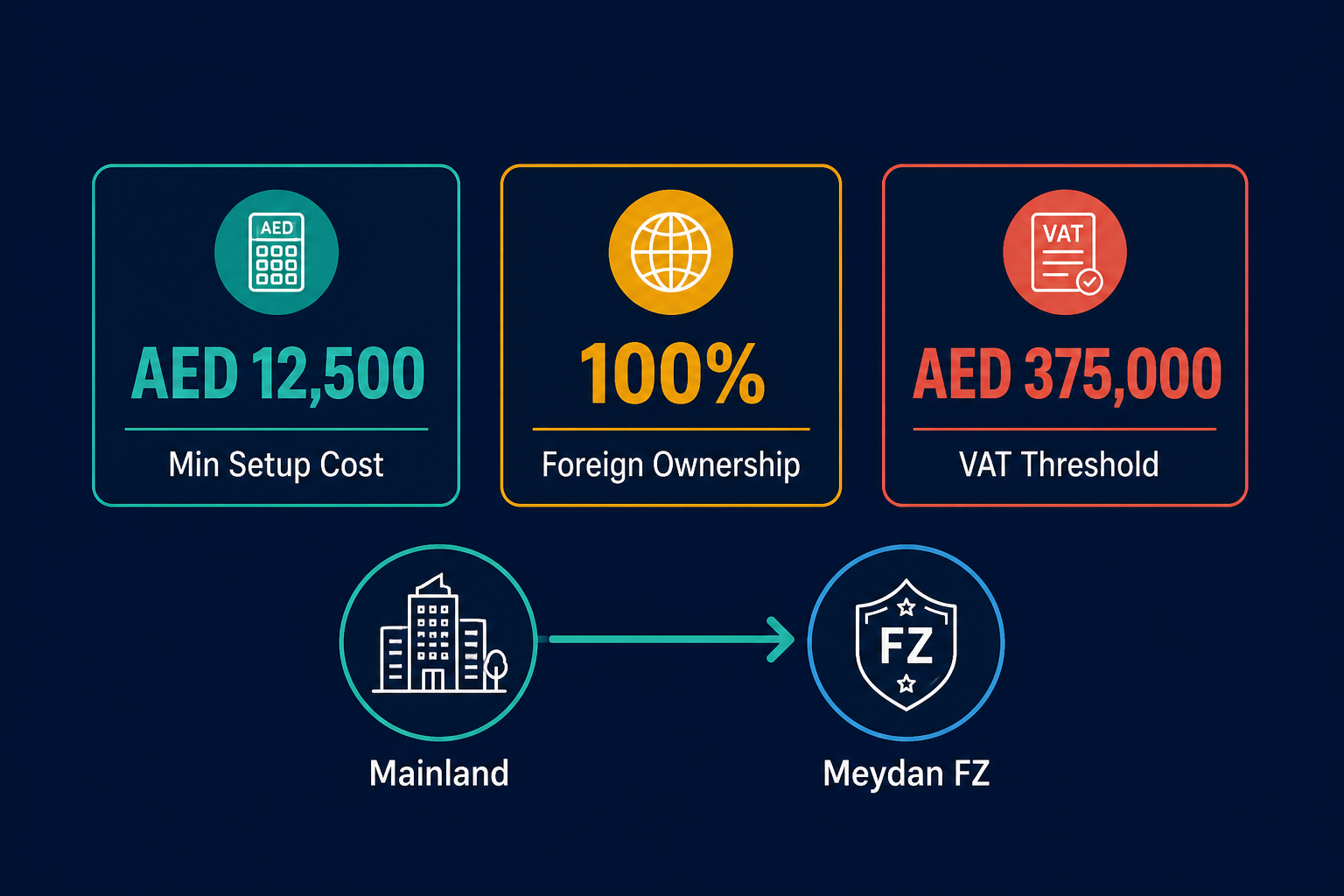
| Foreign ownership | 100% in Meydan Free Zone |
| Regulatory oversight | UAE Media Council |
| VAT registration threshold | AED 375,000 annual taxable turnover |
| Minimum setup cost | From AED 12,500 with Meydan Free Zone |
What a Press Materials Editing License Covers
A press materials editing license lets you edit, proofread, and refine content that clients intend to distribute through media channels. That covers press releases, media kits, corporate announcements, executive statements, and editorial copy prepared for publication.
It does not cover translation, public relations consultancy, or publishing. Those are separate licensed activities. Staying inside your licensed scope matters. If a client asks you to write a press release from scratch and pitch it to journalists, that is PR consultancy work, not editing. Keep the two separate, or add the relevant activity to your license before you start offering it.
The UAE Media Council oversees content produced and distributed in the UAE. Any business working in the media and editorial space needs to understand what the council regulates. Content that touches on news, public affairs, or official communications sits within its remit.
Your clients will mostly come from four groups:
- PR agencies that need a reliable editorial layer before content goes out
- Corporates and listed companies managing investor relations and public announcements
- Government communications teams producing English-language press material
- Startups and scale-ups preparing for funding rounds, product launches, or media coverage
All four groups have a consistent need for clean, accurate, well-structured editorial copy. None of them want to manage a full-time in-house editor if they can avoid it. That is where a specialist editing business fits.
You can browse the full Meydan Free Zone business activities list to confirm which codes apply to your specific scope before you apply.
Mainland vs Meydan Free Zone: Which Setup Works for You
This is the biggest choice you will make when setting up. Let your clients decide it, not the price.
| Factor | Mainland (DET) | Free Zone (Meydan Free Zone) |
|---|---|---|
| Client access | Open UAE market, including government | Mainly international and free zone clients |
| Foreign ownership | 100% in most service activities | 100% |
| Office requirement | Physical office required | Flexi-desk options available |
| Setup cost | Higher, due to office and DET fees | Lower – from AED 12,500 |
| Corporate tax | 9% on taxable profit above AED 375,000 | 0% on qualifying income within the free zone |
| Best for | UAE government and large corporate clients | International clients, agencies, remote work |
A mainland license from the Dubai Department of Economy and Tourism lets you work directly with UAE government bodies and sign contracts with any local company without restriction. You will need a physical office address, and setup costs are higher.
Meydan Free Zone gives you 100% foreign ownership, a flexi-desk setup, and a lower cost to get started. If your clients are international PR agencies, regional corporates, or businesses that do not require a mainland-registered supplier, the free zone works well. You can also start a business remotely through Meydan Free Zone without needing to be in Dubai during the setup process.
On VAT: once your annual taxable turnover crosses AED 375,000, you must register with the Federal Tax Authority. This applies whatever your jurisdiction. If you are billing multiple retainer clients, you may reach that threshold faster than you expect. Plan for it early.
If most of your work will come from international clients or Dubai-based agencies that are comfortable working with free zone suppliers, Meydan Free Zone is the more workable and cost-efficient option. If you are targeting UAE government communications contracts directly, a mainland setup gives you cleaner access.
Free Business Setup Cost Calculator
Calculate NowStep-by-Step Setup Guide
- Step 1, book your trade name: Use the DET e-Services portal for a mainland company, or the Meydan Free Zone portal for a free zone one. The name must not conflict with existing registered names. Use the company name check tool to confirm availability before you apply.
- Step 2, confirm your activity code: Make sure the code covers press materials editing specifically. Check it is approved in your chosen jurisdiction before you go further. Adding the wrong code at this stage creates delays later.
- Step 3, choose your office format: For a free zone setup, a flexi-desk is enough to get your license issued. For mainland, you need a physical office address registered with DET. Factor the rent into your cost model before you commit.
- Step 4, submit your application and documents: You will need your passport copy, chosen activity code, trade name approval, and a completed application form. Meydan Free Zone handles this through its online portal. For mainland, you submit through DET e-Services.
- Step 5, get your initial approval: Once initial approval comes through, you sign your Memorandum of Association and pay the license fee. Meydan Free Zone issues licenses from AED 12,500. See the full Dubai Trade License from AED 12,500 offer for current pricing.
- Step 6, collect your trade license: Your license is issued digitally. Print a copy and keep it accessible. You will need it for bank account opening and any client contracts that ask for it.
- Step 7, open a business bank account: UAE banks need your trade license, passport, visa, Emirates ID, and proof of address. Free zone companies can use the business banking support service through mCore to navigate the process. Some banks take two to four weeks to approve accounts, so start this early.
- Step 8, apply for your residence visa: If you are relocating to Dubai, your free zone license supports a residence visa application. Meydan Free Zone's mResidency service covers the full process, including medical fitness screening and Emirates ID.
Compliance and What You Need in Place
Running a press materials editing business in Dubai is not heavily regulated compared to financial or healthcare services. But there are real duties you need to keep on top of.
UAE Media Council The UAE Media Council oversees content produced and distributed in the UAE. If you are editing content that will be published or broadcast, understand what falls within its scope. Content touching on public affairs, news, or official communications is subject to its rules. Check the UAE Media Council website for current guidelines.
MOHRE registration and Emiratisation If you hire staff in the UAE, you must register with the Ministry of Human Resources and Emiratisation. Emiratisation duties apply once you reach a certain headcount. A solo operator or micro-team is unlikely to hit the threshold immediately, but plan for it if you intend to grow. Check the current rules on the MOHRE website before you hire.
VAT registration Once your annual taxable turnover reaches AED 375,000, you must register for VAT with the Federal Tax Authority. For a service business billing retainer clients, this threshold can arrive within the first year. Register on time. Breaking the rules on VAT registration carries financial penalties. Meydan Free Zone's mAccounting service covers VAT registration support if you need help with the process.
Corporate tax The UAE introduced a 9% corporate tax on taxable profits above AED 375,000. Free zone businesses earning qualifying income may be exempt, but the rules are specific. Get proper advice before you assume exemption applies to you. The corporate tax services through mAccounting can help you stay compliant.
Annual license renewal Your trade license needs renewing every year. Missing the renewal date means your license lapses, which can affect your visa status and your ability to operate legally. Set a calendar reminder 60 days before your renewal date. Meydan Free Zone sends reminders, but do not rely on that alone.
Bookkeeping Keep clean financial records from day one. UAE corporate tax rules need you to show accurate accounts. Good bookkeeping services from the start will save time and cost when tax filings are due.
Market Opportunity in Dubai
Dubai sits at the centre of regional media activity for the Middle East, Africa, and South Asia. Multinationals use it as their regional headquarters. Government entities produce a high volume of English-language communications. Listed companies on the Dubai Financial Market and Abu Dhabi Securities Exchange need clean, accurate press material for every announcement.
Corporate communications, investor relations content, and government media output have all grown in volume over the past five years. That growth has not been matched by a proportional increase in skilled English-language editors who understand the regional context. The gap is real.
One area worth considering as a differentiator: Arabic-to-English press material editing. Many regional companies produce their primary communications in Arabic and need them adapted, not just translated, for English-speaking media. Translation is a separate licensed activity, but editing an already-translated document for tone, clarity, and media-readiness sits within an editing license. That is a niche with limited competition and strong demand.
On revenue model: retainer clients are more stable than project work. A PR agency that sends you five press releases a month is worth more than ten one-off jobs. Price your retainers to reflect the reliability you provide, not just the hours. Project work is useful for cash flow early on, but build toward retainers as fast as you can.
Realistic entry-level pricing in Dubai for press release editing runs from AED 500 to AED 2,000 per document, depending on length and turnaround. Retainer packages for agencies typically start at AED 3,000 to AED 5,000 per month. A small book of five to eight retainer clients puts you at a workable annual revenue with very low overhead.
Conclusion
A press materials editing business in Dubai is a low-overhead, high-margin service business. The main variables are jurisdiction choice, the right activity code, and staying inside your licensed scope. Get those three things right at the start and the operational side is simple.
Meydan Free Zone gives you 100% ownership, a fast setup process, and a Dubai Trade License from AED 12,500. If your clients are international or agency-based, it is the most workable starting point. If you need direct access to UAE government contracts, a mainland setup through DET is the right call.
Confirm your activity code and get a cost breakdown before you commit to a structure. The setup decisions you make on day one are harder to change later than they look.
Ready to Launch Your Business in Dubai?
Let's ConnectReferences
- UAE Media Council
- Federal Tax Authority (FTA)
- Ministry of Human Resources and Emiratisation (MOHRE)
- Invest in Dubai
- Dubai Department of Economy and Tourism e-Services