
Table of Contents
Frequently Asked Questions
What does activity code 9329 cover for a recreation business in Dubai
Activity code 9329 — "Other Amusement and Recreation Activities N.E.C." — is a broad classification for recreational businesses not assigned to a more specific code. It permits a wide range of leisure and entertainment operations under a single trade licence.
Permitted services typically include escape rooms, trampoline parks, mini-golf facilities, arcade operations, hobby and craft clubs, recreational classes, laser tag arenas, and indoor play centres. The N.E.C. (Not Elsewhere Classified) designation gives operators flexibility to run multi-format or hybrid concepts without requiring licence amendments at each pivot.
What falls outside this code includes dedicated sports clubs (governed by the Dubai Sports Council), cinemas and theatrical venues, and any gambling or gaming-for-cash operations — each of which carries its own separate regulatory framework and licence category.
How large is Dubai's recreation and leisure market
Dubai's leisure and entertainment sector is one of the fastest-growing segments of the city's non-oil economy. The UAE leisure and entertainment market is projected to grow at a CAGR of over 8% through 2029, according to IMARC Group.
Dubai welcomed over 17 million international overnight visitors in 2023, per the Department of Economy and Tourism, and over 3.6 million residents live in the city, with a median age below 35 — a core demographic for recreational spend.
Demand drivers are structural rather than cyclical. Expo 2020 legacy venues have been repurposed into active leisure destinations, and government investment in sports and lifestyle infrastructure remains a stated priority under the Dubai Economic Agenda D33.
What are the main revenue streams for a recreation activities business in Dubai
Revenue in the recreation sector typically runs across four core streams: pay-per-session walk-ins, membership or subscription packages, corporate bookings, and private event hire. Most successful operators blend at least three of these from the outset to smooth weekly and seasonal variability.
The B2B channel is frequently underutilised by new entrants. Hotel concierge partnerships, mall concession agreements, and school excursion programmes can deliver reliable volume without heavy marketing spend. These relationships take time to build but generate predictable revenue once established.
Walk-in tourists generally tolerate premium pricing, while resident families tend to respond better to membership value propositions — meaning your pricing and packaging strategy should account for both segments from the start.
Who are the target customers for a recreation business in Dubai
The core customer segments for a recreation activities business in Dubai are families with children, corporate wellness and team-building groups, inbound tourists seeking curated experiences, and the under-35 resident demographic.
Each segment has different price sensitivity and booking behaviour. Walk-in tourists tolerate premium pricing, while resident families respond to membership value. Corporate groups often book in advance and spend more per head, making them a high-value segment worth targeting early.
Supply in several niches — particularly adult-oriented recreational concepts and tech-integrated experiences — remains thin relative to footfall, representing a genuine commercial opportunity for disciplined operators entering the market.
Can I set up a recreation activities business in a Dubai free zone
Yes. Recreation businesses operating under activity code 9329 can be established through a free zone trade licence, with Meydan Free Zone cited as an option that provides full operational flexibility for leisure and entertainment operators.
A free zone licence allows you to operate across several activity formats under a single licence, which is particularly useful for founders building multi-format or hybrid concepts, or those testing a business model before committing to a single niche.
It is worth confirming with your chosen free zone authority which specific permitted activities are included under your licence and whether any physical venue requirements apply, as these can vary between free zones and the activity type.
Does VAT apply to recreation and leisure services in Dubai
VAT applies at 5% on most recreational services in the UAE. Registration for VAT is mandatory once your annual turnover exceeds AED 375,000.
Operators should factor VAT into their pricing strategy from the outset, particularly when targeting price-sensitive resident segments. Corporate and tourist clients are generally more accustomed to VAT-inclusive pricing and less likely to be deterred by it.
It is advisable to consult a UAE-registered accountant or tax agent early in the setup process to ensure your invoicing, record-keeping, and filing obligations are correctly structured from day one.
What role does the Dubai Sports Council play in regulating recreation businesses
The Dubai Sports Council governs dedicated sports clubs and facilities, which fall under a separate regulatory framework from the general recreation activities code 9329. Businesses operating specifically as sports clubs must obtain the appropriate approvals from the Council rather than relying solely on a standard trade licence.
However, the Council has also mandated active lifestyle programming as part of wider urban planning, which creates institutional appetite for private recreation operators. This means there is government-level support for the sector, even for businesses that do not fall directly under the Council's jurisdiction.
Operators building concepts that blend sport and general recreation — such as fitness-adjacent leisure activities — should clarify at the licensing stage which regulatory body has primary oversight of their specific activity type.
What makes Dubai a commercially attractive location for a recreation activities business
Several structural factors make Dubai attractive for recreation operators. The city has a large, young expatriate and resident population with a median age below 35 and strong discretionary spending capacity, alongside year-round tourism volumes that exceeded 17 million overnight visitors in 2023.
Government investment in lifestyle infrastructure — including the repurposing of Expo 2020 legacy venues into active leisure destinations — has expanded the physical footprint available to operators. The Dubai Economic Agenda D33 explicitly prioritises sports and lifestyle development, signalling continued public sector support.
Crucially, supply in several niches remains thin relative to footfall, particularly for adult-oriented and tech-integrated experiences. For commercially disciplined operators, this gap represents a real and near-term market opportunity rather than a speculative one.
How to Start a Recreation Activities Business in Dubai
Dubai's population is young, active, and spending heavily on leisure. That makes recreation one of the more resilient sectors to enter right now. Demand is not seasonal in the way it is in other markets. Residents train, play, and book activities year-round, and the corporate wellness channel is growing fast on top of that.
This guide covers what a recreation activities license covers, how to choose the right setup, and what you need in place before you start trading.
Key Stats at a Glance
| Sector | Recreation and leisure activities |
|---|---|
| Licensing authority (mainland) | Dubai Department of Economy and Tourism (DET) |
| Licensing authority (free zone) | Meydan Free Zone |
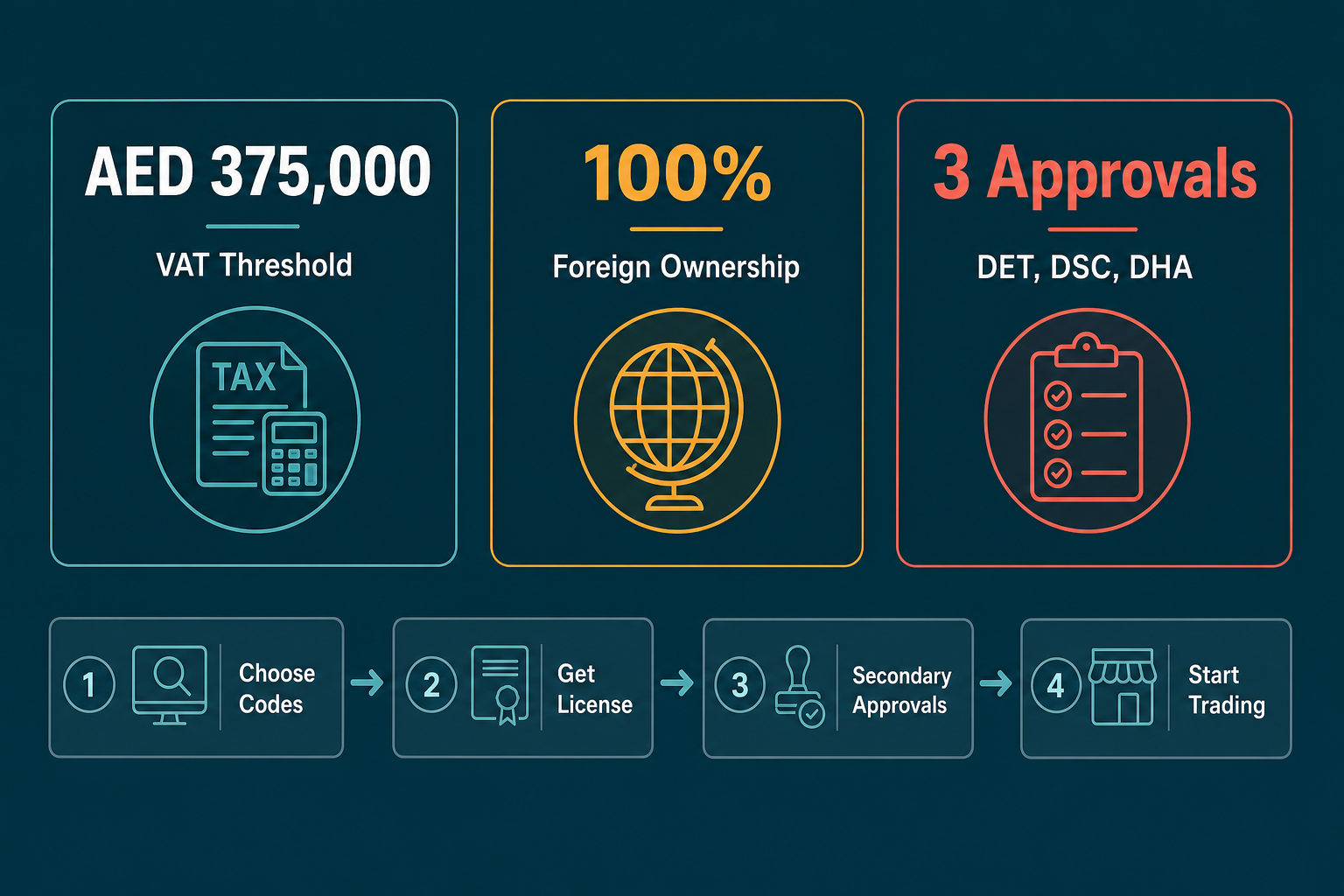
| Secondary approvals | Dubai Sports Council, Dubai Health Authority (DHA) for wellness-adjacent services |
| VAT registration threshold | AED 375,000 annual taxable turnover – Federal Tax Authority |
| Foreign ownership | 100% permitted in free zones and on the mainland for most recreation activities |
| Market data | Dubai's leisure and recreation spending is tracked by the Dubai Statistics Center |
What a Recreation Activities License Covers
A recreation activities license covers a broad range of services. Sports coaching, fitness classes, adventure activities, leisure clubs, and indoor play facilities all fall within this category. The exact scope depends on which activity codes you register and which authority approves them.
On the mainland, DET handles the license. But depending on what you actually do, you will also need sign-off from other bodies. The Dubai Sports Council oversees competitive and coached sports. The Dubai Health Authority gets involved when your offering crosses into wellness, rehabilitation, or anything with a clinical edge. These are not optional extras. They are part of your legal right to operate.
Check the Business Activities List to confirm which codes apply to your specific offering before you go any further.
The license does not automatically cover tourism packages, hospitality services, or food and beverage. If your recreation centre includes a café, or if you plan to run guided tours alongside your activities, you need separate codes for those. Scope creep is one of the most common compliance problems in this sector. Keep your activity codes tight and accurate from day one.
- Sports coaching and group fitness classes
- Adventure activities such as climbing, obstacle courses, and water sports
- Indoor play centres and family leisure facilities
- Corporate team-building and wellness programmes
- Leisure club memberships and recreational sports leagues
Secondary approvals vary by activity. A yoga studio may only need DET. A martial arts academy with competitive bouts needs Dubai Sports Council clearance. A facility offering physiotherapy alongside training needs DHA involvement. Map this out before you apply, not after.
Who Your Clients Will Be
The core market is resident families and the expat community. Dubai has a large, settled population that spends on structured leisure. Parents look for after-school sports programmes and weekend activities for children. Adults book fitness classes, sports leagues, and outdoor adventures. This is your B2C base, and it is consistent.
Corporate wellness is a growing B2B channel. Companies in Dubai are increasingly buying team-building sessions, group fitness programmes, and wellness days for their staff. If you can offer packages to HR teams and office managers, you add a revenue stream that books in advance and pays on invoice.
Schools, hotels, and real estate developers also contract recreation operators. A school may outsource its after-school sports programme. A hotel may bring in a specialist to run pool activities or a kids' club. A residential developer may want a managed recreation facility as part of a community amenity. These are longer-term contracts, and they take time to win, but they provide reliable income once signed.
Seasonal tourist demand is real but should not be your planning base. Visitor numbers rise in the cooler months from October to April. That period can boost revenue, but you should not build your cost structure around it. Plan for resident demand as your floor, and treat tourist traffic as upside.
Mainland vs Free Zone: Which Setup Works Here
This is the biggest choice you will make when setting up. Let your client base decide it, not the price.
| Factor | Mainland (DET) | Free Zone (Meydan Free Zone) |
|---|---|---|
| Client access | Full UAE market, including government venues | Mainly international clients or online bookings |
| Physical premises | Commercial lease required (Ejari registered) | Flexi-desk options available |
| Foreign ownership | 100% for most recreation activities | 100% |
| Secondary approvals | Dubai Sports Council, DHA where applicable | Same, if operating inside UAE |
| Visa allocation | Linked to office space size | Packages available from Meydan Free Zone |
| Best suited for | Client-facing venues, schools, hotels, government contracts | Management companies, online platforms, regional franchises |
Most client-facing recreation businesses need a mainland setup. If you are running a physical venue where people come to train, play, or participate, you need a commercial lease in the right zone and a mainland license from DET. That is what lets you sign a tenancy agreement, get your Ejari, and legally operate from a fixed location accessible to the public.
Meydan Free Zone works well for a different model. If you are running the management company behind a recreation brand, handling online bookings and memberships, or building a regional franchise structure, a free zone setup gives you 100% foreign ownership, lower overhead, and a clean corporate structure. You can also start a business remotely through Meydan Free Zone without needing to be in Dubai during the setup process.
Some operators run both: a free zone holding company and a mainland operating entity. This is a workable structure if you plan to scale, but it adds cost and administrative complexity. Get clear on your actual operating model before you decide.
Free Business Setup Cost Calculator
Calculate NowStep-by-Step Setup Guide
- Step 1, book your trade name: Use the DET e-Services portal for a mainland company, or the Meydan Free Zone portal for a free zone one. The name must not duplicate an existing registered business. You can check your company name availability before you apply.
- Step 2, confirm your activity codes: Make sure each code you need is approved in your chosen jurisdiction. Do this before you go further. Codes that are permitted on the mainland are not always available in a free zone, and vice versa.
- Step 3, secure your premises: For a mainland setup, you need a tenancy contract registered through Ejari. The size and type of premises affects your visa allocation. For a free zone setup, flexi-desk options are available through Meydan Free Zone.
- Step 4, get initial approval and any NOCs: DET issues initial approval before the license is finalised. If your activity needs Dubai Sports Council or DHA clearance, you apply for those no-objection certificates at this stage. Do not skip this step. Operating without the right approvals puts your license at risk.
- Step 5, pay license fees and get your establishment card: Once approvals are in place, you pay the license fee and get your establishment card. This is what lets you apply for staff visas and open a corporate bank account. A Dubai Trade License from AED 12,500 is available through Meydan Free Zone for qualifying setups.
- Step 6, apply for staff visas: Visa allocation depends on your license type and premises. Coaches, instructors, and support staff all need employment visas. Factor in the time this takes. UAE visa processing is generally efficient, but it is not instant.
- Step 7, open your bank account: A corporate account is not automatic. Banks run their own due diligence. Having your documents clean and your business plan clear speeds this up. Meydan Free Zone's mCore service includes business banking support to help you through this process.
Compliance and Market Opportunity
Running a recreation business in Dubai means staying inside a clear regulatory framework. The rules are not complicated, but they are enforced. Get them right from the start.
Dubai Sports Council oversight
If your business involves coached or competitive sports, the Dubai Sports Council sets the rules. You need to register with them and follow their standards for facility safety, coaching qualifications, and event management. This applies to everything from football academies to swimming clubs.
Staff qualifications and insurance
Coaches and instructors need recognised certifications in their discipline. First aid cover is required for most activity types. Public liability insurance is not optional. If a client is injured during an activity you run, you need to be covered. Get this in place before you open, not after your first incident.
VAT registration
Once your annual taxable turnover passes AED 375,000, you must register for VAT with the Federal Tax Authority. Most recreation services are subject to the standard 5% rate. Some wellness services may have different treatment depending on how they are classified. Check this with a tax adviser before you price your packages. Meydan Free Zone's mAccounting service includes VAT registration support if you need it.
Market opportunity
Dubai's leisure and recreation sector is growing. The city's population has expanded steadily, and resident spending on sport, fitness, and leisure has grown with it. Data from the Dubai Statistics Center and Statista both track this trend. Corporate wellness spending is also rising as employers compete for talent and invest in staff retention.
The barriers to entry in this sector are real. Venue costs in Dubai are high. Approvals take time. Qualified staff are in demand and not cheap. These same barriers protect your margins once you are established. A well-run recreation business with the right approvals, a loyal membership base, and strong corporate accounts is hard to displace.
The operators who struggle are usually those who underestimate setup costs, launch without all their approvals in place, or try to run client-facing venues on a free zone license that does not support that model. Avoid those mistakes and the commercial fundamentals are sound.
Conclusion
A recreation activities business in Dubai is commercially workable if you match your license scope to your actual offering, choose the right jurisdiction for your client base, and get the secondary approvals sorted before you open. The market is there. The regulatory path is clear. The work is in the detail.
Speak to Meydan Free Zone to confirm which activity codes fit your model and get a clear cost breakdown before you commit. Getting that right at the start saves a lot of time and money later.
Ready to Launch Your Business in Dubai?
Let's Connect