
Table of Contents
Frequently Asked Questions
What does UAE activity code 4923.87 cover for truck transport businesses
Activity code 4923.87 — Transport by Specialized Trucks covers heavy haulage, abnormal load movements, flatbed operations, lowbed trailer haulage, and crane-truck services. It is a distinct classification from standard freight forwarding or general goods transport licences in the UAE.
The sectors served under this single activity code include construction and civil engineering, oil and gas infrastructure, manufacturing and industrial plant, and port and terminal operations. Each sector has its own load profiles, scheduling requirements, and contract structures, but all can be served from one licence.
How large is the UAE logistics market and what growth is projected
According to IMARC Group, the UAE logistics market was valued at approximately USD 29 billion in 2023 and is projected to grow at a compound annual rate of around 6% through 2032. Growth drivers include rising trade volumes, e-commerce infrastructure investment, and sustained government capital expenditure on transport and energy projects.
Heavy and specialized transport remains a thinner segment relative to general freight, which creates defensible commercial positioning for operators who invest in the right fleet, permits, and driver qualifications.
What RTA permits are required to move oversized or overweight loads in Dubai
The Roads and Transport Authority (RTA) governs all overweight and oversized load movements in Dubai. Operators must obtain load movement permits on a per-trip or periodic basis, submit route plans for approval, and in many cases arrange police escort or pilot vehicles alongside the load.
Permit categories are tiered by load dimensions and axle weights. These are not administrative formalities — they determine whether your fleet can legally operate on Dubai's road network and under what conditions. Non-compliance carries fines and potential fleet impoundment.
Why does specialized truck transport have less competition than general freight in the UAE
General trucking in the UAE is saturated with operators competing on price for standard loads. Specialized haulage, by contrast, requires significant capital investment in appropriate fleet equipment, qualified drivers, and active permit management capability — barriers that thin the competitive field considerably.
Operators who cannot meet these requirements are not licensed or equipped to handle loads such as construction plant, prefabricated structures, transformers, and process equipment. This creates a structurally more defensible market position for compliant specialists.
What role does Jebel Ali Port play in driving demand for specialized haulage
DP World's Jebel Ali Port handles over 14 million TEUs annually, generating consistent port-side haulage demand. Terminal volumes at this scale require regular movement of heavy machinery, port equipment, and oversized cargo between the port, industrial areas, and project sites across Dubai and into the Northern Emirates.
This demand is structural rather than cyclical — it is tied to the ongoing operational throughput of one of the world's largest container ports, making it a reliable commercial anchor for a specialized transport operator.
What construction-related demand exists for specialized truck transport in Dubai
Dubai's construction sector accounts for a significant share of heavy haulage requirements, with infrastructure spending running into hundreds of billions of dirhams across active mega-projects. Ongoing work across roads, utilities, urban development, and industrial zones generates consistent demand for moving construction plant, prefabricated structures, transformers, and process equipment.
These are loads that general freight operators are neither licensed nor equipped to handle, meaning construction clients must engage specialists operating under activity code 4923.87 or equivalent classifications.
Can a specialized truck transport business be set up through Meydan Free Zone
Yes. The article specifically identifies Meydan Free Zone as a route to setting up a specialized truck transport business under activity code 4923.87 with minimal friction. Free zone incorporation in Dubai can offer streamlined licensing processes compared to mainland setup in some cases.
Fleet registration must be completed under the licensed entity, and the business must still comply with all RTA permit requirements and other regulatory obligations regardless of the jurisdiction through which the trade licence is issued.
What are the main compliance obligations for operating under activity code 4923.87
Operating under activity code 4923.87 carries compliance obligations across several regulatory domains. The RTA requires per-trip or periodic load movement permits, approved route plans, and escort or pilot vehicle arrangements for loads that exceed defined dimension and axle-weight thresholds.
Fleet registration must be held under the licensed entity. Operators also need to ensure drivers hold appropriate qualifications for the vehicle categories being operated. Failure to maintain compliance can result in fines and fleet impoundment, making permit management a core operational capability rather than a back-office function.
How to Start a Specialized Truck Transport Business in Dubai
A transformer, a prefabricated bridge section and a 40-tonne excavator all have to get from the port to the site somehow. Ordinary trucking companies cannot move them and are not licensed to try. That gap is a business, and in Dubai it has more work than it has operators.
This guide covers what activity code 4923.87 lets you haul, who pays for it, how to set up your license through Meydan Free Zone, and the RTA permit regime that governs every oversized load on the road. The permits are not admin. They decide whether your fleet can legally move at all.
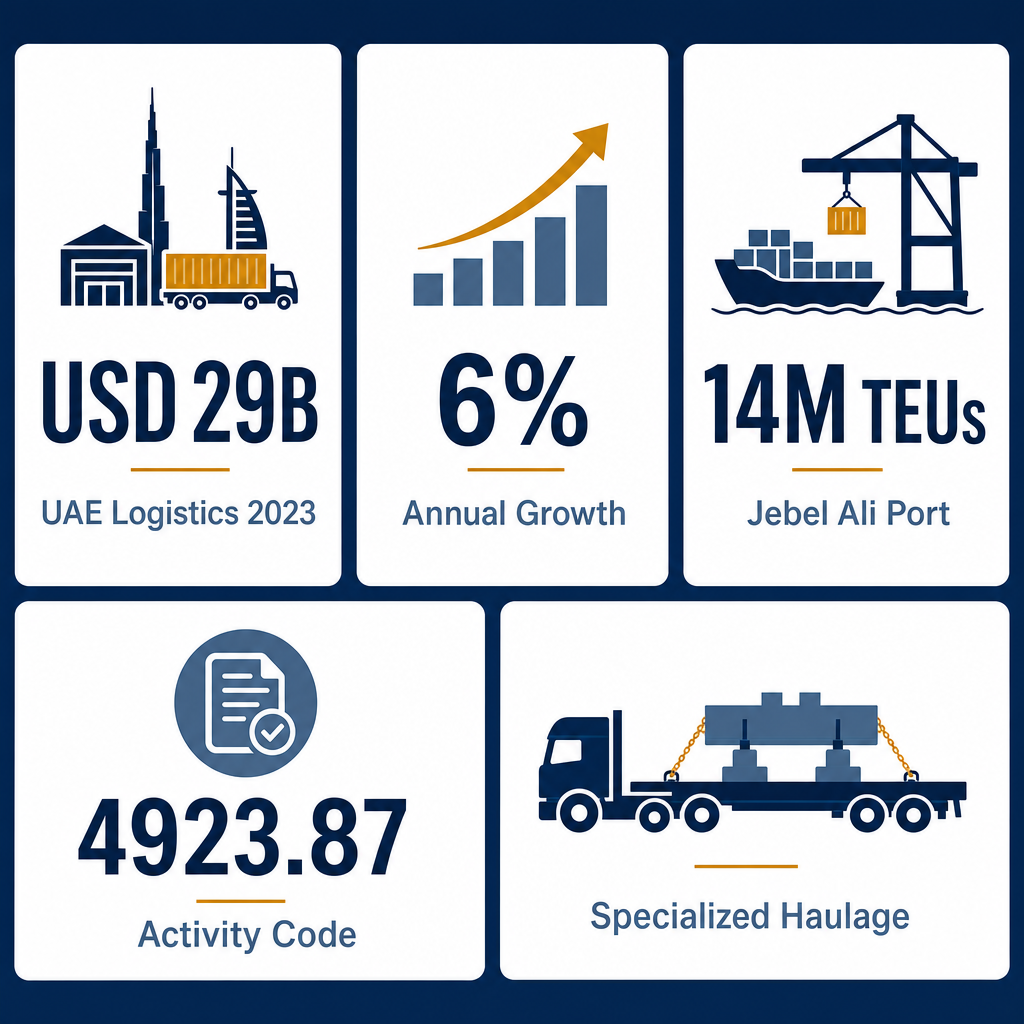
Key Stats at a Glance
What This License Covers
Activity code 4923.87, Transport by Specialized Trucks, covers heavy haulage, abnormal load movements, flatbed operations, lowbed trailer haulage and crane-truck services. It is a separate activity from standard freight forwarding or general goods transport, and the difference is operational rather than cosmetic.
Under RTA rules, oversized and overweight loads need dedicated route permits, escort vehicle arrangements and restrictions on when they can move. That is the whole job. A general haulier cannot simply decide to take a wide load, because the permit regime will not let them.
The core sectors you can serve on one license are construction and civil engineering, oil and gas infrastructure, manufacturing and industrial plant, and port and terminal operations. Each has its own load profiles, scheduling patterns and contract shapes, but you do not need a separate license for each.
Who Your Clients Will Be
Every buyer here has something too big or too heavy for a normal truck, and no realistic alternative.
- Construction and civil engineering contractors
- Oil and gas infrastructure operators
- Manufacturers moving industrial plant
- Port and terminal operators
Construction is the largest single source. Ongoing work across roads, utilities, urban development and industrial zones creates steady demand for moving construction plant, prefabricated structures, transformers and process machinery, none of which a general freight operator is licensed or fitted out to handle.
Port-side work is the other anchor, and it is more reliable than it looks. Jebel Ali's terminal volumes mean a constant flow of heavy machinery, port plant and oversized cargo between the port, the industrial areas and project sites across Dubai and into the Northern Emirates. That demand tracks the port's throughput rather than the economic cycle.
Mainland or Free Zone
Meydan Free Zone gives you full foreign ownership and a simple setup covering transport and logistics under 4923.87. Whichever route you take, your fleet must be registered under the licensed entity and every RTA permit rule applies in full. A mainland license from the Department of Economy and Tourism is worth weighing against how you intend to contract. Let your clients decide it, not the price.
[blockCTACostCalculator]
Step by Step Setup Guide
- Step 1, confirm your activity scope: Check 4923.87 is on the Meydan Free Zone activity register and confirm any conditions attached before you go further.
- Step 2, book your trade name: Submit your preferred name for approval. It must follow UAE naming conventions and cannot clash with a registered company.
- Step 3, send in your setup documents: Shareholder passport copies, proof of address and the application forms. Single-shareholder structures are supported, which suits solo founders.
- Step 4, take your trade license: Once approved, the license is issued. This is what permits you to carry out transport by specialised trucks within the scope of the code.
- Step 5, sort visas and residency: Your license entitles you to apply for investor and employee visas, with your quota set by your office package.
- Step 6, open a corporate bank account: You need this before you can procure fleet or invoice contracts, so start it as soon as the license lands.
- Step 7, set up operations: Register your fleet under the company, apply for RTA permits and arrange insurance. Fleet operations may also need a yard or depot separate from your free zone office, so budget for that.
Compliance and What You Need in Place
RTA permits
The RTA governs overweight and oversized load movements in Dubai. You must get load movement permits on a per-trip or periodic basis, submit route plans for approval, and in many cases arrange police escort or pilot vehicles. Permit categories are tiered by load dimensions and axle weights.
Why permits are operational, not administrative
Treat permit management as a core function with someone accountable for it, not a back-office task. Breaking the rules brings fines and potential fleet impoundment, and an impounded truck is a contract you cannot deliver. General trucking here is crowded and competes on price. Specialised haulage needs capital, qualified drivers and permit capability, and those barriers thin the field considerably.
Fleet and drivers
Vehicles have to be registered under the licensed entity. Drivers must meet UAE heavy vehicle license standards for the categories they operate. Neither is negotiable, and both take time to arrange, so start before you have signed your first contract.
Insurance
You need third-party liability cover for both the vehicle and the load in transit. On this kind of cargo the load is often worth far more than the truck carrying it, so check the cover matches what you are actually moving.
VAT
Transport services carry VAT at the standard 5%. Register with the Federal Tax Authority once you pass AED 375,000 in annual taxable turnover. Given typical contract values in specialised haulage, most operators cross that line early.
Market Opportunity
The UAE logistics sector is large and still growing. IMARC Group valued it at roughly USD 29 billion in 2023 and projects growth of around 6% a year through 2032, driven by trade volumes, e-commerce infrastructure investment and sustained government spending on transport and energy projects.
Heavy haulage benefits from the construction pipeline in particular. Dubai's infrastructure spending runs into hundreds of billions of dirhams across active mega-projects, and every one of them needs plant, structures and process machinery moved by someone licensed to do it.
Port demand sits underneath all of it. DP World's Jebel Ali handles over 14 million TEUs a year, which generates constant port-side haulage. This is structural work tied to the operating throughput of one of the world's largest container ports, which makes it a dependable anchor for a specialist operator rather than a cyclical bet.
Conclusion
Specialised truck transport in Dubai is capital-intensive but commercially defensible. Demand is structural, the heavy-haulage segment is thinner than general freight, and a free zone license gives you a clean entry point with full foreign ownership.
The barriers that make this business hard to enter are the same ones that protect you once you are in. Build real permit management capability, get your fleet and driver qualifications right, and insure the load properly. Then the contracts are yours to keep.
[blockCTAContact]