
Table of Contents
Frequently Asked Questions
What does activity code 6920.05 cover in the UAE
Activity code 6920.05 covers "Advisory Activities and Representation on Behalf of Clients Before Tax Authorities." It is a formally defined professional services category that goes well beyond general bookkeeping or financial reporting.
In practice, it authorises a licensed business to respond to FTA audit notices, file tax objections and reconsideration requests, manage voluntary disclosures, and advise clients through corporate tax filing obligations. The key distinction is that the licensed representative acts on behalf of the client in direct dealings with the Federal Tax Authority.
When did the UAE introduce VAT and corporate tax
The UAE introduced VAT at a standard rate of 5% in January 2018, administered by the Federal Tax Authority (FTA). This created the initial compliance infrastructure and registration obligations that now affect over 300,000 VAT-registered businesses.
Corporate tax at 9% became effective for financial years beginning on or after 1 June 2023. This added an entirely new compliance layer for tens of thousands of UAE-registered entities, many of which had no prior experience managing a corporate income tax obligation.
Who are the typical clients for a tax authority representation business
The client base concentrates in three main areas: businesses facing active FTA audits or penalty notices, companies navigating their first corporate tax filings under the 2023 regime, and entities that have identified historical errors and need to manage voluntary disclosure before enforcement begins.
Foreign-owned businesses are a particularly strong segment. Many operate with lean back-office teams and outsource all regulatory engagement to external specialists. SMEs, free zone companies, and foreign-owned mainland firms are especially likely to lack an in-house tax function, making external representation essential when the FTA initiates contact.
What are the main revenue models for this type of business
Two primary revenue structures suit activity code 6920.05 well. A retainer model works for clients with ongoing compliance mandates, covering monthly or quarterly corporate tax returns, FTA correspondence management, and audit readiness support.
Project-based fees suit dispute resolution engagements, where the scope is clearly defined and the outcome measurable — for example, a penalty reconsideration or a specific objection filing. Because clients in active compliance situations face real deadlines and financial exposure, this service commands meaningfully higher fees than routine accounting work.
What core services does a tax representation firm typically offer
Core services include FTA audit response management, tax objection and appeal filing, administrative penalty reconsideration, and voluntary disclosure preparation. Each service has a clear deliverable, which makes scoping and pricing straightforward for both the firm and the client.
Positioning as a specialist representation firm — rather than a generalist accounting practice that also handles tax — is commercially important. Specialist positioning supports higher fee levels and clearer differentiation in a market where general accountants are abundant but dedicated FTA representation expertise is comparatively scarce.
Why is the UAE market considered a strong opportunity for tax representation services
The UAE has over 300,000 VAT-registered businesses, each a potential representation client. The addition of a 9% corporate tax in 2023 created a second compliance layer for the same population, significantly expanding the volume of situations where professional representation is needed.
Most SMEs and foreign-owned firms have no dedicated internal tax function. When the FTA initiates an audit, issues a penalty, or requests documentation, these businesses must turn to external professionals. The compliance burden has grown faster than in-house capability across the market, which is what makes this a commercially serious opportunity rather than a niche one.
What is the referral channel opportunity for this business
Law firms, corporate service providers, and business setup consultants regularly encounter clients with tax representation needs but have no in-house capability to service them. This creates a natural referral pipeline for a specialist firm that can be positioned as a trusted partner rather than a competitor.
Building structured referral relationships with these intermediaries is described as equally important to direct client acquisition. Because the trigger for engaging a tax representation firm is often an urgent compliance event — an audit notice or a penalty — referral partners who encounter clients at that moment are a high-conversion source of new business.
Can a foreign national own 100% of this business in Meydan Free Zone
Yes. 100% foreign ownership is permitted in Meydan Free Zone with no requirement for a local UAE partner or sponsor. This is one of the structural advantages of setting up under a free zone licence for this activity.
Meydan Free Zone is one of the jurisdictions where activity code 6920.05 can be licensed, making it a practical setup route for international professionals or firms looking to establish a UAE-based tax representation practice without the ownership restrictions that historically applied to mainland commercial licences.
How to Start a Tax Authority Representation Business in Dubai
A company opens an FTA notice and finds it has 20 days to respond to something it does not understand. That moment is the whole business. Representation work is not bookkeeping and it is not general advice: it is standing between a client and the tax authority when there is a deadline and money at stake.
This guide covers what activity code 6920.05 lets you do, why the engagements command higher fees than routine accounting, how to set up your license through Meydan Free Zone, and where the tax agent question sits. The field is still thin on properly qualified practitioners.
Key Stats at a Glance
What This License Covers
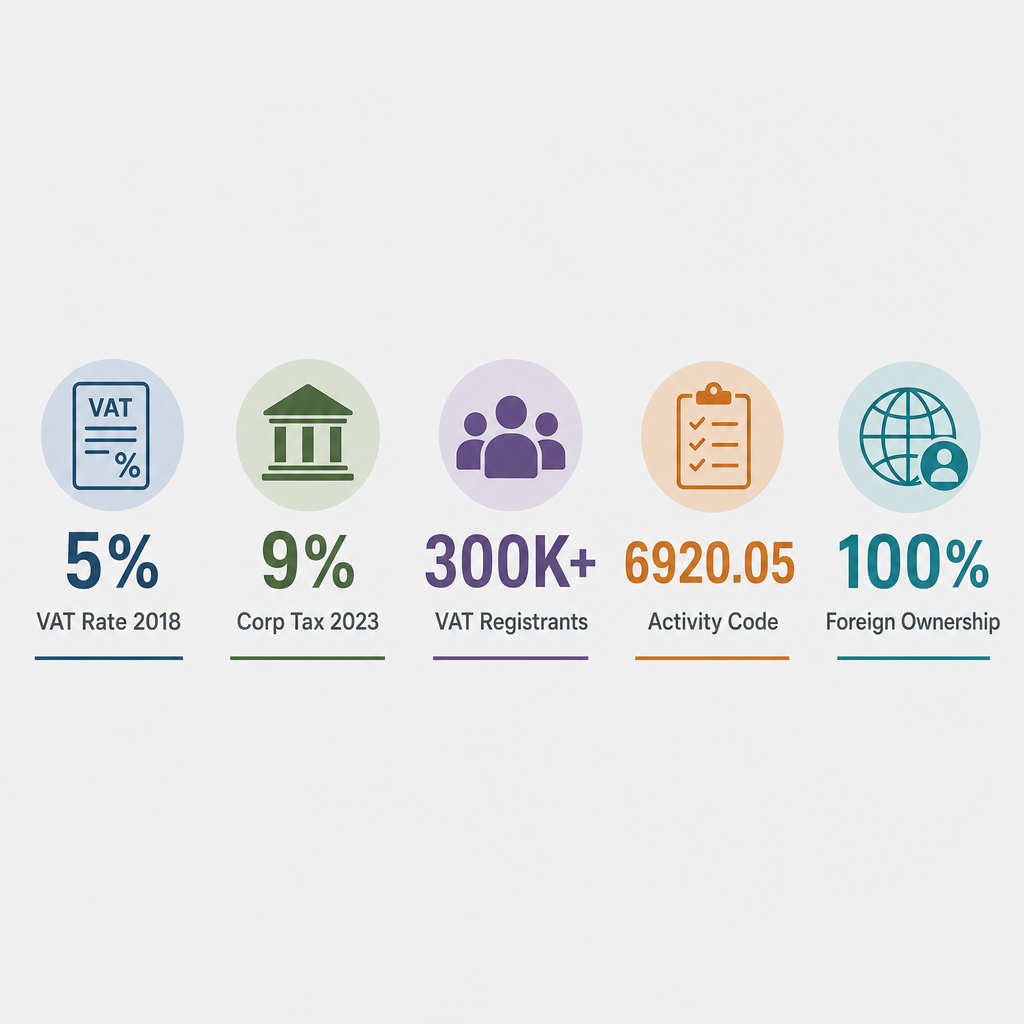
Activity code 6920.05, Advisory Activities and Representation on Behalf of Clients Before Tax Authorities, covers a defined and commercially distinct set of services. This is not general bookkeeping or financial reporting. It is formal representation and advocacy for businesses dealing directly with the Federal Tax Authority.
The scope runs to responding to FTA audit notices, filing tax objections, submitting reconsideration requests, managing voluntary disclosures and advising clients through corporate tax filing duties. Where a business receives a penalty, an assessment or an audit query, a licensed representative under this code steps in and manages the process on the client's behalf.
That distinction from general accounting is what drives the economics. Clients engaging this service are in an active compliance situation, meaning a dispute, a deadline or an enforcement action, and that produces a higher-value and more urgent engagement than routine bookkeeping ever does.
Who Your Clients Will Be
The client base clusters into three situations, and all three are stressful for the client, which is the point.
- Businesses facing active FTA audits or penalty notices
- Companies navigating their first corporate tax filings under the 2023 regime
- Entities that have found historical errors and need to manage voluntary disclosure before enforcement begins
Foreign-owned businesses are a strong segment. Many run lean back offices and outsource all regulatory engagement. SMEs and free zone companies are the same story: with no in-house tax function, external representation stops being optional the moment the FTA makes contact.
Two revenue structures suit this work. A retainer covers ongoing compliance mandates, meaning monthly or quarterly corporate tax returns, FTA correspondence management and audit readiness. Project fees suit dispute resolution, where the scope is defined and the outcome measurable, such as a penalty reconsideration or a specific objection filing.
The referral channel deserves as much attention as direct selling. Law firms, corporate service providers and business setup consultants constantly meet clients with representation needs and cannot serve them in-house. Because the trigger is usually an urgent event, those intermediaries meet clients at exactly the right moment.
Mainland or Free Zone
Meydan Free Zone issues licenses for 6920.05 under its professional and advisory categories, with 100% foreign ownership and no local partner or sponsor. For a practice whose only assets are expertise and relationships, that structure is efficient and keeps overheads low. A mainland license from the Department of Economy and Tourism is worth weighing if your client mix pushes that way. Let your clients decide it, not the price.
[blockCTACostCalculator]
Step by Step Setup Guide
- Step 1, select your activity: Confirm 6920.05 as your primary activity. Complementary activities can be added at application stage.
- Step 2, book your trade name: Choose a name that follows UAE naming conventions, with no offensive terms, no references to government entities and nothing already registered.
- Step 3, send in your setup documents: Passport copies, proof of address and a completed application form. Notarisation is not usually needed for free zone setup at Meydan.
- Step 4, take your license: Meydan Free Zone issues the trade license on approval, typically within a few business days.
- Step 5, open a corporate bank account: With the license in hand, approach UAE banks. Meydan's banking relationships can help with introductions.
- Step 6, apply for visas: Investor and employee visa applications are supported, and flexi-desk packages satisfy the physical address condition for visa eligibility.
Compliance and What You Need in Place
Tax agent status
Understand this properly before you position yourself. The FTA does not currently make all tax representatives hold formal Tax Agent accreditation. However, registered tax agents carry greater authority before the authority and can act on a broader range of matters. Registration is examination-based, and it adds real credibility to a representation practice. Whether you pursue it is a commercial decision, but be accurate with clients about where you stand.
Professional indemnity insurance
Carry it as standard. You are acting on behalf of clients in regulatory disputes, which means claims risk is a live consideration rather than a theoretical one. Treat insurance as basic risk management, not an optional cost.
Staying inside your scope
Representation before the FTA is distinct from strategic tax structuring and from the procedural follow-up work that other activity codes cover. Be clear in your engagement letters about what you are doing and what you are not, because a client under enforcement pressure will assume you cover everything unless you say otherwise.
Your own tax position
You are a UAE business too. Register with the FTA for corporate tax and assess your VAT position against turnover. A representation firm that is late with its own filings has a credibility problem it cannot argue its way out of.
Market Opportunity
The UAE's tax environment has matured quickly. VAT arrived in January 2018 at 5% and built the initial compliance infrastructure, with over 300,000 VAT-registered businesses now on the FTA's books. Corporate tax at 9% then became effective for financial years beginning on or after 1 June 2023, adding an entirely new compliance layer for tens of thousands of entities, many of which had never managed a corporate income tax obligation before.
That second layer is what created this market. The same population of businesses now faces twice the compliance surface, and the volume of situations calling for professional representation has expanded accordingly. Most SMEs and foreign-owned firms have no dedicated internal tax function, so when the FTA opens an audit, issues a penalty or requests documentation, they have to look outside.
The imbalance is the opportunity. The compliance burden has grown faster than in-house capability across the market, and the competitive field remains relatively thin for properly qualified practitioners. The UAE also ranks among the top 10 globally for ease of doing business per the World Bank, which keeps new entities forming and the client pool growing.
Conclusion
VAT, corporate tax and active FTA enforcement have created durable, recurring demand for specialist representation, and it is concentrated among exactly the businesses least able to handle it internally.
Position as a specialist rather than a generalist accounting practice that also does tax, because that is what supports the fees. Build the referral relationships with law firms and setup consultants early, decide deliberately whether to pursue tax agent registration, and carry indemnity insurance from your first engagement.
[blockCTAContact]