Table of Contents
Topic Summary
Know the Six Activity Codes Before Starting
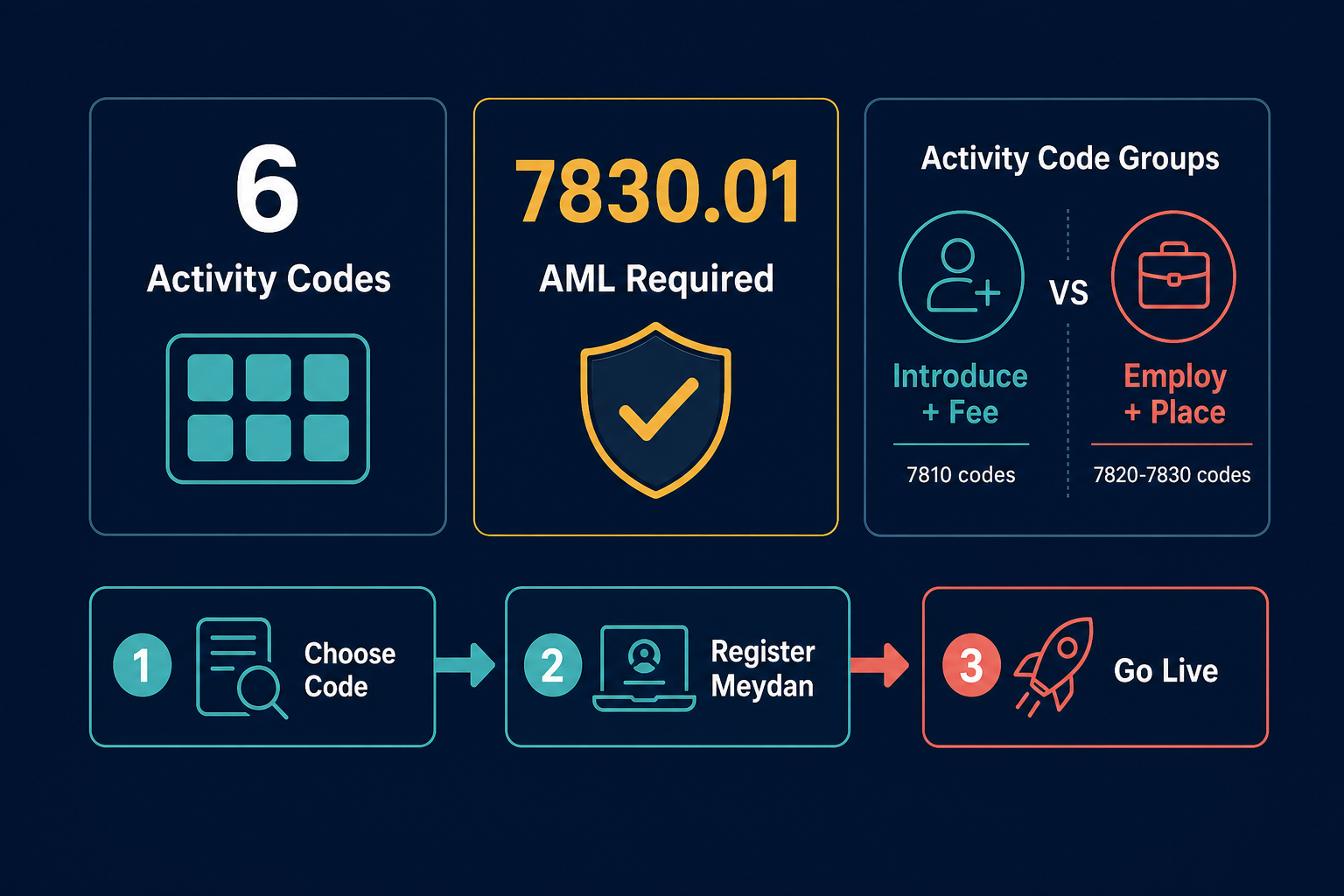
Dubai's labour supply sector has six distinct activity codes, and choosing the wrong one limits what you can legally do. Each code defines a specific relationship between you, the worker, and the client business.
Placement Agencies Don't Employ the Workers
Under codes 7810.00 and 7810.01, your role is to source, screen, and refer candidates to client companies. Once placed, those workers are the client's responsibility, not yours.
Temporary Supply Means Workers Stay on Your Books
Codes 7820.00 and 7820.01 require you to employ the workers yourself and supply them to clients for short periods. You cover seasonal peaks and absences without the client making a permanent hire.
Long-Term HR Provision Carries AML Obligations
Code 7830.01, covering long-term or permanent human resources supply, is the only one in the group that triggers anti-money laundering duties. You must build compliant processes into your business before onboarding any clients.
Choose Your Code Based on the Client Relationship
If you want to introduce talent and earn a placement fee, the 7810 codes are your fit. If you want workers on your payroll with recurring monthly revenue, the 7820 and 7830 codes deliver steadier income but carry more compliance responsibility.
Mainland vs Free Zone Depends on Your Clients
A mainland licence opens the full UAE market including government contracts, while a Meydan Free Zone licence offers 100% foreign ownership and faster setup. Let your target client base drive this decision rather than upfront cost alone.
Employer of Record Services Command Higher Value
Taking on payroll, onboarding, tax compliance, and benefits under codes 7830.00 or 7830.01 makes you an employer of record. Clients pay a premium to offload this complexity, making it one of the higher-margin models in the sector.
Labour Supply and HR Solutions Business Setup in Dubai
Labour supply means putting people into jobs. You find candidates, check they can do the work, and place them with businesses that need them. Depending on which activity code you hold, you either introduce the worker and step back, or you employ that worker yourself and hire them out.
That difference is the whole game here. Six activity codes sit under labour supply in Dubai, and they are not interchangeable. This guide explains what each one lets you do, which ones carry anti-money laundering duties, and how to get set up through Meydan Free Zone.
Key Stats at a Glance
| Activity code | What it covers | Third-party approval | AML duties |
|---|---|---|---|
| 7810.00 | Employment placement agencies | None needed | Exempt |
| 7810.01 | Personnel search, selection, referral and placement | None needed | Exempt |
| 7820.00 | Temporary employment agency activities | None needed | Exempt |
| 7820.01 | Supplying workers to clients for limited periods | None needed | Exempt |
| 7830.00 | Other human resources provision | None needed | Exempt |
| 7830.01 | Long-term or permanent provision of human resources | None needed | Must be met |
What These Licenses Cover
Employment placement agencies, 7810.00
You list vacancies from client companies and refer or place applicants into them. The people you place are not your employees. The code covers a wide spread of placement work, including executive placement, casting agencies for theatrical roles, and online placement platforms. It does not cover personal theatrical or artistic agents, which are treated as something separate.
Personnel search, selection, referral and placement, 7810.01
This is the sourcing and screening side. You search for candidates, weigh up their skills and qualifications, and refer the good ones to client companies.
Temporary employment agency activities, 7820.00
You supply workers to client businesses for short periods. The workers are employed by you, not by the client. You do not supervise them at the client's site. You are there to cover gaps and peaks so the client does not have to hire permanently.
Supplying workers for limited periods, 7820.01
The same practice viewed from the client's side: temporary staff on your books, sourced and screened to fit a specific need such as absence cover, seasonal demand, or a short project.
Other human resources provision, 7830.00
Long-term or permanent HR services. You become the employer of record and take on recruiting, hiring, onboarding, payroll, tax compliance, and benefits. You do not supervise the staff day to day. This is different from running the client's HR function outright, and it does not cover temporary cover.
Long-term or permanent provision of human resources, 7830.01
The same long-term supply, with sourcing, screening, hiring, payroll, and compliance handled by you. This is the one code in the group that carries anti-money laundering duties, so build that into your processes before you take on clients.
Who Your Clients Will Be
Your buyers are businesses that need people faster than they can hire them. That means firms with seasonal peaks, companies covering absences, employers running short projects, and organisations that would rather hand payroll and compliance to someone else than build the function in-house.
Pick your code around the relationship you actually want. If you want to introduce people and take a fee, the 7810 codes fit. If you want the workers on your own books and recurring monthly revenue, the 7820 and 7830 codes are where you belong. The second route pays more steadily, but you carry the payroll, the compliance, and the risk.
Mainland or Free Zone
This is the biggest choice you will make when setting up. Let your clients decide it, not the price.
| Factor | Mainland (DET) | Free Zone (Meydan Free Zone) |
|---|---|---|
| Client access | Open UAE market, including government bodies | Clients across the UAE under service agreements |
| Ownership | Varies by activity and structure | 100% foreign ownership |
| Office | Physical office needed | Flexi-desk options available |
| Setup speed | More steps and approvals | Faster, and possible remotely |
Free Business Setup Cost Calculator
Calculate NowHow to Set Up Through Meydan Free Zone
- Step 1, pick your activity code: Choose from the six codes above based on whether you are placing people or employing them. You can hold more than one.
- Step 2, book your trade name: Check it is available and meets UAE naming rules.
- Step 3, choose your structure: Decide your shareholding and whether you need a flexi-desk or a dedicated office.
- Step 4, send your documents: Passport copies for shareholders and directors, plus the application forms.
- Step 5, get your trade license: Issued once your application is approved.
- Step 6, apply for visas: Your visa count depends on the workspace package you select, so plan headcount first.
- Step 7, open your bank account: Do this once the license is issued.
If you want to move quickly, Fawri gives you an instant license, and the cost calculator will size the whole thing before you commit.
Compliance and What You Need in Place
Third-party approvals
None of the six codes needs approval from an outside body. That makes this an unusually clean sector to enter compared with regulated activities such as health or finance.
Anti-money laundering
Five of the six codes are exempt. Code 7830.01 is not. If you hold it, you need AML policies, records, and reporting in place. Do not assume the exemption on your other codes carries across.
Employer duties
If you employ the workers you supply, under the 7820 or 7830 codes, you are the employer of record. Payroll, contracts, and compliance sit with you, not the client. Price that in.
Scope
Keep your license scope and what you actually sell aligned. Placing candidates under a code meant for temporary supply, or the reverse, is the kind of mismatch that surfaces at the worst possible moment.
Market Opportunity
The pull here is simple. Dubai's economy runs on hired labour across construction, hospitality, logistics, and professional services, and very few of those employers want to build recruitment and payroll teams of their own.
The six codes also let you grow without starting again. Many operators begin with placement under 7810.00, learn which clients keep coming back, then add a temporary or long-term supply code once they can carry payroll. The client relationships built in the first phase transfer straight into the second.
Conclusion
Labour supply and HR solutions in Dubai is a workable business with no third-party approvals to chase and a clear set of activity codes to choose from. The decisions that matter are which code matches the service you intend to sell, and whether you are ready to carry employer duties for the people you place.
Use the cost calculator to size your setup, browse the business activities list to confirm your codes, or speak to the Meydan Free Zone team to start your application.
Ready to Launch Your Business in Dubai?
Let's Connect