

Table of Contents
Frequently Asked Questions
What does activity code 7210.01 cover in Dubai
Activity code 7210.01 covers Research and Experimental Development on Natural Science, Engineering, Technology, Medical Sciences, Biotechnology, Agricultural Sciences, and Interdisciplinary R&D. It sits within ISIC Division 72 — Scientific Research and Development.
The licence encompasses both basic research (advancing fundamental knowledge without a specific commercial application) and applied research (work directed toward a defined practical outcome). The primary commercial activity of the licensed entity must involve genuine experimental or investigative methodology — it is not a consultancy classification.
Who is the Research and Experimental Development licence designed for
The licence is designed for entities where investigative or experimental work is the primary commercial activity. It suits a range of operators across the research and science ecosystem.
Eligible business types include:
- Independent research firms and private R&D laboratories
- Biotech and life sciences startups
- University spin-outs and academic commercialisation vehicles
- Contract research organisations (CROs)
- Corporate research subsidiaries established in the UAE by international groups
If a business primarily advises clients rather than conducts research, a different activity classification would apply.
What commercial models work under the 7210.01 licence
Several revenue structures fit naturally under this licence. Grant-funded research entities — receiving government, institutional, or international funding — operate cleanly within this classification. Private R&D labs charging clients for research outputs and corporate subsidiaries conducting proprietary research for a parent group are equally well-suited.
Intellectual property development and licensing is a particularly strong model. Research conducted under this licence can generate patents, trade secrets, and proprietary methodologies that are then licensed to third parties, creating recurring revenue without requiring physical product sales.
Collaboration structures with UAE universities and government science bodies are also commercially viable, potentially opening access to funding, facilities, and talent pipelines through the UAE Ministry of Education's support for public-private research partnerships.
Can a foreign founder own 100% of a Research and Experimental Development company in Dubai
Yes. 100% foreign ownership is available for entities established in a Free Zone such as Meydan Free Zone. This makes Free Zone registration a popular choice for international founders, IP-holding structures, and entities focused on international research contracts.
On the mainland (DED), foreign ownership is also possible following the UAE Commercial Companies Law reforms introduced in 2021, which expanded sectors eligible for full foreign ownership. However, the specific ownership structure available on the mainland depends on the activity and should be confirmed with a local adviser before applying.
What is the difference between setting up in a Free Zone versus the mainland for R&D activities
The choice of jurisdiction affects ownership structure, tax position, and market access from the outset. Free Zones such as Meydan Free Zone offer 100% foreign ownership, no corporate tax on qualifying income, and faster setup timelines. They are well-suited for IP-holding structures, international research contracts, and early-stage research entities where cost efficiency matters.
Mainland (DED) registration is required if research contracts are directly with UAE federal or emirate government agencies, and it provides broader local market access. The setup process involves more touchpoints, and the ownership structure is governed by the UAE Commercial Companies Law post-2021 reforms.
What is the UAE's broader strategy around R&D investment
The UAE has set an ambitious target to grow R&D spending to 1.5% of GDP under its National Innovation Strategy. This positions Dubai — and the UAE more broadly — as a serious research and development hub competing for international science investment.
Activity code 7210.01 gives founders, research institutions, and science-led businesses a direct route into that ecosystem, with the regulatory framework designed to support both domestic and internationally oriented R&D operations.
Is Meydan Free Zone a suitable jurisdiction for a research or biotech startup
Yes. Meydan Free Zone is listed as one of the eligible jurisdictions for activity code 7210.01 and is noted for its relative cost efficiency, making it a practical entry point for early-stage research entities and biotech startups that do not yet require direct government contracting rights.
Free Zone registration at Meydan provides 100% foreign ownership, no corporate tax on qualifying income, and faster setup timelines compared to mainland registration — advantages that are particularly relevant for startups managing runway and seeking to establish an IP-holding structure in the UAE.
Can a Research and Experimental Development entity in Dubai generate revenue from intellectual property
Yes. IP development and licensing is explicitly a strong commercial model under this licence. Research conducted under activity code 7210.01 can generate patents, trade secrets, and proprietary methodologies that are subsequently licensed to third parties.
This creates recurring revenue without requiring physical product sales, making it an attractive structure for research-intensive businesses. Free Zone entities in particular are well-positioned for IP-holding structures, given the tax treatment of qualifying income and the 100% foreign ownership available in jurisdictions such as Meydan Free Zone.
Start Research & Experimental Development in Dubai
Dubai is putting real money and policy weight behind R&D, and the license that lets you operate legally in this space is more accessible than most founders expect. Whether you are running a pure science operation, building an applied research consultancy, or holding IP developed by a distributed team, there is a clear legal structure for you here.
This guide covers what a Research & Experimental Development license covers, who needs one, where to set it up, and how to get started.
Key Stats at a Glance
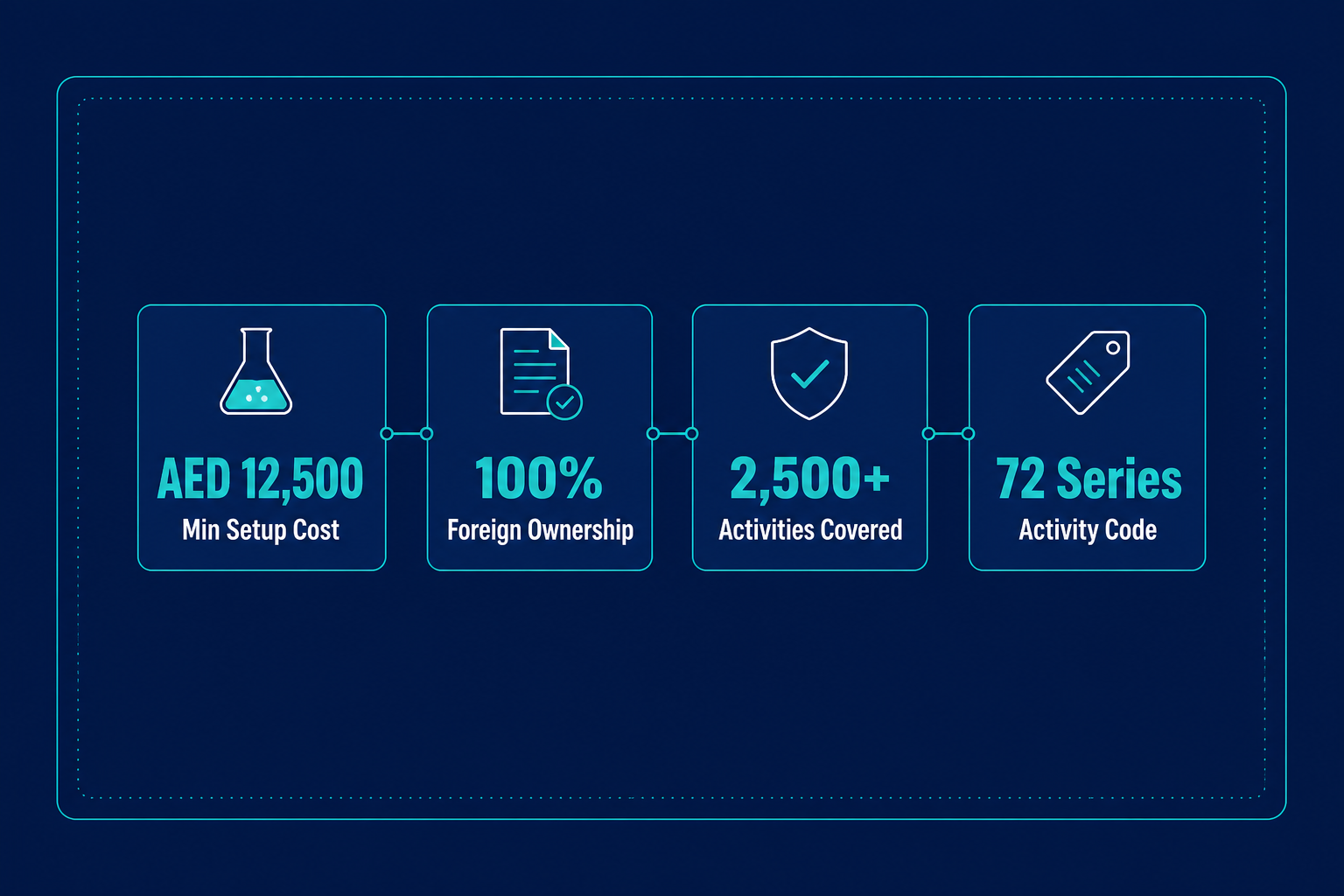
| License category | Research & Experimental Development |
|---|---|
| Typical activity code | 72 series (Scientific Research and Development) |
| Foreign ownership | 100% in free zone and on the mainland following the 2021 Commercial Companies Law reforms – Invest in Dubai |
| Setup cost at Meydan Free Zone | Starting from AED 12,500 for a trade license |
| Visa allocation | Flexible, based on office package selected |
| UAE R&D spending context | The UAE has consistently increased public and private R&D investment as part of its national innovation agenda – IMARC Group |
What This License Covers
A Research & Experimental Development license covers three broad types of work: pure research, applied research, and experimental development. Pure research means you are generating new knowledge without a specific commercial application in mind. Applied research means you are using that knowledge to solve a defined problem. Experimental development means you are turning research findings into working prototypes, systems, or processes.
In practice, this license lets you bill clients for research studies, feasibility work, technical testing, scientific analysis, and development of new methodologies across science and engineering fields. You can structure contracts around deliverables, retainers, or milestone-based project work.
What is excluded
This license does not cover manufacturing. If your work moves from development into production, you need a separate industrial or manufacturing license. Clinical trials that need health authority sign-off, such as those overseen by the Dubai Health Authority, sit outside this license too. And if you want to sell a finished commercial product, you need the right trading activity added or a separate license for that activity.
Primary versus ancillary R&D
Some companies hold an R&D activity as a secondary line alongside a technology, consulting, or manufacturing license. That works, but it limits what you can bill under the R&D code. If research is your main revenue stream, make it your primary licensed activity. The activity code needs to match what you actually invoice for, because the Federal Tax Authority (FTA) and your bank will both look at this when reviewing your business.
How the code maps to real work
The activity code tells regulators, banks, and clients what your company is licensed to do. For R&D, the relevant codes sit in the 72 series under the UAE standard industrial classification. When you apply, confirm the exact code with your chosen jurisdiction before you submit. Meydan Free Zone covers over 2,500 business activities, so the right code is almost certainly available.
Mainland vs Free Zone: Which Setup Works for You
This is the biggest choice you will make when setting up. Let your clients and your operating model decide it, not the price alone.
When Mainland Makes Sense
A mainland license from the Dubai Department of Economy and Tourism (DET) lets you work directly with UAE government bodies, semi-government entities, and public research institutes. If you are targeting government-funded research tenders, partnering with UAE universities, or bidding on national science programmes, you need a mainland presence. Government procurement here almost always needs a local registered entity, and some contracts specify a mainland license explicitly.
The trade-off is cost and structure. A mainland setup typically needs a physical office address, and depending on your headcount, Emiratisation duties apply. Check the current thresholds with the Ministry of Human Resources and Emiratisation (MOHRE) before you commit.
When Meydan Free Zone Makes Sense
If your clients are international, your research team is remote, or you are building an IP-holding structure, Meydan Free Zone is worth a close look. You get 100% foreign ownership, no currency restrictions, and a Dubai Trade License from AED 12,500. Flexi-desk options keep overheads low, which matters when your main asset is intellectual output rather than physical space.
Free zone companies cannot work directly with UAE government entities without a local agent or a separate mainland entity. But for private-sector clients, overseas universities, multinational research partners, and IP licensing arrangements, the free zone route is simple and cost-effective.
On tax and customs: importing lab kit or specialist equipment into a free zone can attract different duty treatment than mainland imports. Check the current position with Ports, Customs and Free Zone Corporation (PCFC) before you plan your equipment budget.
| Factor | Mainland (DET) | Free Zone (Meydan Free Zone) |
|---|---|---|
| Client access | Open UAE market including government | Mainly private sector and international clients |
| Foreign ownership | 100% in most activities post-2021 | 100% always |
| Office requirement | Physical office needed | Flexi-desk options available |
| Setup speed | Typically longer due to DET approvals | Faster, often within days |
| Emiratisation duties | Apply above set headcount thresholds | Not applicable in free zone |
| IP holding | Workable but more complex structuring | Clean and straightforward |
Free Business Setup Cost Calculator
Calculate NowHow to Set Up: Step-by-Step
- Step 1, choose your jurisdiction: Decide between mainland and Meydan Free Zone based on your client base. If you are not sure, use the cost calculator to compare costs before you commit.
- Step 2, book your trade name: Use the DET e-Services portal for a mainland company, or the Meydan Free Zone portal for a free zone one. Your name cannot conflict with an existing registered entity. Check your company name availability before you go further.
- Step 3, confirm your activity code: Make sure the R&D code you want is approved in your chosen jurisdiction. For Meydan Free Zone, the team can confirm this quickly.
- Step 4, submit your documents: You will need passport copies for all shareholders and directors. Some jurisdictions ask for a business plan or a no-objection certificate (NOC) if you are already on a UAE residence visa. Have these ready before you apply.
- Step 5, pay the license fee and get your establishment card: Once approved, you pay the license fee and receive your trade license and establishment card. Keep both documents; banks and government portals will ask for them.
- Step 6, apply for visas: Your visa allocation depends on the office package you choose. Meydan Free Zone's mResidency services can handle the visa process in Dubai end to end, including medical fitness tests and Emirates ID.
- Step 7, open a corporate bank account: Do this after your license is issued. The UAE banking process takes time, so start early. Meydan Free Zone's mCore package includes business banking support to help you through it.
Compliance and What You Need in Place
Getting the license is the start, not the finish. Here is what you need to keep on top of once you are operating.
Annual renewal
Your license needs renewing every year. Missing the renewal date triggers fines and can affect your visa status. Set a reminder three months before the expiry date. A compliance review can be triggered if your activity does not match your license code, so make sure your invoices and contracts reflect your licensed activities accurately.
VAT
If your taxable turnover exceeds AED 375,000 in a 12-month period, you must register for VAT. R&D services supplied to clients outside the UAE may qualify for zero-rating, but this depends on the specific nature of the service and where the benefit is received. The FTA sets the rules here, and the position is fact-specific. Get proper advice before you assume zero-rating applies. Meydan Free Zone's mAccounting team can help with VAT registration support services if you need it.
Corporate tax
The UAE introduced a 9% corporate tax for financial years starting on or after 1 June 2023. Free zone entities can access a 0% rate on qualifying income if they meet the substance and activity conditions. R&D income can qualify, but the rules are detailed. Check the current position with the FTA or use corporate tax services in Dubai to make sure you are structured correctly from day one.
IP ownership and data protection
If your research involves third-party data, make sure your contracts are clear on who owns the output. UAE data protection law applies to personal data processed in the UAE, and some research contracts with government or semi-government clients will include specific IP assignment clauses. Read these carefully before you sign.
Staff visas and Emiratisation
In a free zone, Emiratisation rules do not apply. On the mainland, once your headcount crosses the relevant threshold, you need to meet Emiratisation targets set by MOHRE. The threshold and quota change, so check the current rules before you hire. If you want to bring family members to Dubai, Meydan Free Zone's dependent visa services can handle the application process.
Bookkeeping and audit
Keep clean financial records from day one. Free zone companies are generally required to maintain accounts and, in some cases, to produce audited financial statements. Meydan Free Zone offers bookkeeping services for SMEs if you want to keep this in-house but supported.
Market Opportunity
The UAE government has made R&D investment a national priority. The country's long-term economic strategy targets a significant increase in the share of GDP coming from knowledge-based industries, and that creates real demand for licensed R&D entities, both as direct contractors and as partners to larger organisations doing technical work in the region.
Private sector demand is also growing. Multinationals setting up regional operations increasingly want a local R&D entity for tax structuring, grant eligibility, and IP management. UAE-based research companies can also access regional science funding programmes and bilateral research agreements that are not available to foreign entities without a local presence.
The talent pool is improving too. Dubai's universities and research institutes are producing more graduates in science, technology, and engineering fields each year, and the visa system now makes it easier to bring specialist researchers from overseas. If you are building a team, the infrastructure is there.
Conclusion
A Research & Experimental Development license in Dubai is a workable, well-supported structure for founders, scientists, and consultancies doing serious technical work. The setup process is simple, costs are manageable, and both mainland and free zone routes have clear use cases. The key is matching your jurisdiction to your client base from the start, getting your activity code right, and keeping your compliance in order once you are running.
Speak to the Meydan Free Zone team to confirm your activity code and get a cost estimate before you commit to a jurisdiction. You can also start a business remotely if you are not yet based in the UAE.
Ready to Launch Your Business in Dubai?
Let's ConnectReferences
- Invest in Dubai
- Federal Tax Authority (FTA)
- IMARC Group
- Dubai Health Authority (DHA)
- Ports, Customs and Free Zone Corporation (PCFC)
- Ministry of Human Resources and Emiratisation (MOHRE)